
# Age Groups Most Likely to Cheat: Full Data
Most people assume infidelity is a young person's problem — something driven by dating apps, commitment-phobia, and the general chaos of early adulthood. The data says otherwise. Research from the General Social Survey (GSS), which has tracked American sexual behavior for decades, consistently shows that infidelity rates rise with age and peak in the 60s and 70s — not the 20s. Men in their 70s report the highest infidelity rate of any demographic group at 26%. Women reach their peak in their 60s at 16%.
That's not what most people searching this topic expect to find.
A single statistic flips the dominant cultural narrative on its head: adults over 55 report higher infidelity rates than adults under 55, at approximately 20% versus 14% respectively. The group least likely to have cheated, statistically, is the group most likely to be on Tinder right now — young adults in their 20s.
This article breaks down the age groups most likely to cheat using data from two independent sources: the GSS and academic research on dating platform behavior. It explains why the patterns look the way they do, identifies four distinct life-stage windows of infidelity risk, and examines what the research actually supports versus what's commonly assumed. By the end, you'll have a clear, data-grounded picture of when and why cheating is most likely to occur at each stage of adult life.
What Does the Data Say About Cheating by Age Group?
The most consistent finding in decades of infidelity research is simple: cheating rates rise with age, and the gender gap widens over time. Both parts of that statement require unpacking.
The primary data source for age-based infidelity statistics in America is the General Social Survey, a nationally representative survey administered by NORC at the University of Chicago. The Institute for Family Studies (IFS) has analyzed GSS data on infidelity across age groups, producing the most credible age-breakdown available. Their analysis focuses on ever-married adults who report having had sex with someone other than their spouse at some point during their marriage — a lifetime measure, not a current-behavior measure.
Here is what that data shows across age groups:
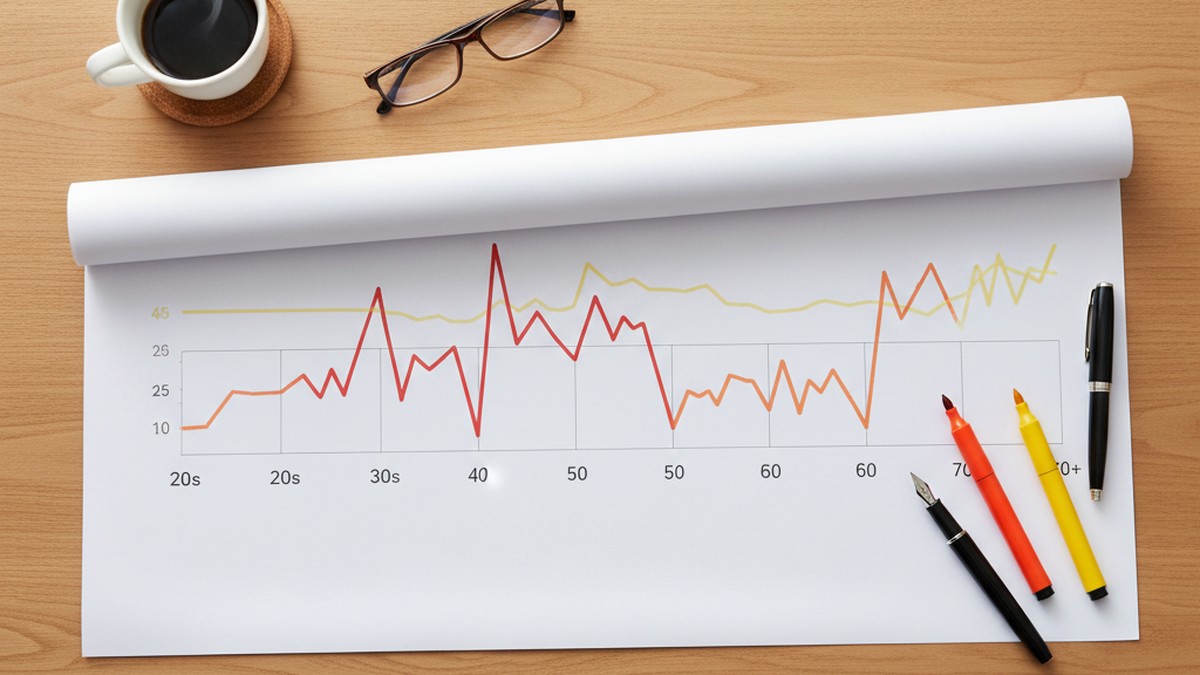
| Age Group | Men | Women |
|---|---|---|
| 18-29 | 10% | 11% |
| 30-39 | ~14% | ~13% |
| 40-49 | ~18% | ~17% |
| 50-59 | 22-28% | 15-17% |
| 60-69 | 24% | 16% |
| 70-79 | 26% | 13% |
| 80+ | 24% | 6% |
Three patterns in this table define everything that follows.
First, women aged 18-29 are the only group in the entire dataset where female infidelity rates marginally exceed male rates. Everywhere else, men's rates are higher — and the gap widens decade by decade.
Second, women's infidelity peaks in their 60s at 16%, then declines sharply. Men's rates climb through their 70s and only begin to drop in their 80s. By the time both partners are in their late 70s, men cheat at nearly twice women's rate.
Third, the numbers for older adults are substantially higher than most people expect. A 26% infidelity rate among men in their 70s means more than one in four men in that age group have had extramarital sex at some point during their marriage. That's not a small or fringe figure.
A separate dataset adds a complementary angle: 45-54-year-olds account for the highest concentration of reported infidelity cases at 21.6% of all affairs tracked. This reflects the difference between lifetime accumulated rates (which favor older groups) and active ongoing infidelity (which peaks in middle age when the largest number of married people are simultaneously in relationships and in high-risk life circumstances).
It's also worth noting what the GSS data measures and doesn't measure. The survey asks whether a respondent has had sex with someone other than their spouse while married — a definition that excludes emotional affairs, non-sexual intimate relationships, and what some researchers call "micro-cheating." If those behaviors were included, the rates at all ages would likely be higher, and the age distribution might look somewhat different. The data reported here captures sexual infidelity in marriage specifically.
The overall gender gap in lifetime infidelity is 20% for men versus 13% for women, according to the GSS. That 7 percentage point difference at the population level masks a much wider gap at specific ages — and a brief reversal among young adults that the headline figures erase entirely.
If the data here has you concerned, CheatScanX can give you a direct answer. It searches 15+ dating apps for hidden profiles.
Search dating profiles now →What Age Group Is Most Likely to Cheat?
Men in their 70s show the highest statistically documented infidelity rate of any demographic group at 26%, according to General Social Survey data analyzed by the Institute for Family Studies. Women reach their peak in their 60s at approximately 16%. When measuring current active cases rather than lifetime rates, the 45-54 age bracket accounts for the largest share of reported affairs at 21.6%, making middle age the period when the most infidelity is actively occurring across the population.
This finding consistently surprises people, and the surprise itself is informative. Cultural assumptions about cheating are shaped by visibility — and young people on dating apps are highly visible. Older adults' infidelity is less visible because it operates through different channels and social networks, and because it rarely becomes the subject of popular media coverage. The data, however, is clear: age correlates positively with infidelity, not negatively.
Ages 18-29: What Young Adults Actually Do
Young adults show the lowest infidelity rates of any age group in the survey data. Men in their 20s report a 10% lifetime infidelity rate among ever-married adults; women report 11%.
That single-percentage-point gap — with women marginally ahead — is the most counterintuitive finding in the entire dataset. It contradicts both the general expectation that men cheat more and the cultural assumption that young women are the more committed partner in early relationships.
Researchers point to several explanations. Women who marry in their 20s and later cheat in that decade may be responding to early marriages that constrained their identity before it was fully formed. They're also somewhat more likely than men in this age group to describe their affairs as emotionally motivated — driven by connection and validation rather than purely by sexual opportunity.
The presence of dating apps doesn't appear to make young adults more unfaithful than their non-app-using counterparts. The GSS data doesn't show a meaningful spike in young adult infidelity rates in the post-smartphone era compared to earlier periods. What apps provide is opportunity — but opportunity alone doesn't determine whether someone cheats. The data on dating app cheating statistics consistently shows that app usage and marital infidelity are related but not equivalent phenomena.
Why Young Adults Cheat Less Than Expected
Several structural factors suppress infidelity among 18-29-year-olds, even controlling for marriage rates.
Commitment selection is part of it. Young adults who get married are self-selected for relatively high commitment — people who are most cautious about relationships tend to delay marriage. The pool of 18-29-year-olds who are already married skews toward people who take commitment seriously.
Marriage duration also matters. Someone who is 27 and has been married for two years has had two years in which an affair could have occurred. Someone who is 67 and has been married since they were 27 has had 40 years. Some of the age-based difference in lifetime rates is simply a function of accumulated time.
Finally, millennials and younger adults show genuinely lower infidelity inclinations than baby boomers did at equivalent ages. Research by sociologist Nicholas Wolfinger found that Americans born after 1980 show lower extramarital sex rates than those born in earlier decades. The front-row view of their parents' divorces, combined with later marriage ages and different relationship expectations, appears to have produced a generation that cheats less.
What About Non-Married Young Adults?
The GSS measures ever-married adults, which creates a specific limitation when interpreting the 18-29 data. Young adults who are cohabitating, in long-term relationships without formal marriage, or in casual arrangements are not captured in these figures. Infidelity in non-marital relationships is systematically harder to measure — partly because the definition of "cheating" in those contexts is less standardized, and partly because survey respondents in non-marital relationships are harder to categorize consistently.
Some researchers argue that measuring only married adults undercounts young adult infidelity by excluding the relationship structures most common in that age group. Others argue the opposite — that married young adults represent the most comparable unit across age groups, because the commitment level is equivalent. Both arguments have merit. The GSS data should be read as representing married young adults specifically, not the entire population of 18-29-year-olds in relationships.
The 10-11% lifetime rates for 18-29-year-olds represent the floor of the age distribution among married adults. Every decade after this, rates go up. One interpretive note worth carrying forward: if young adults are the group least likely to cheat by the data, and we're also seeing more transparent conversations about relationship structures (ethical non-monogamy, explicit agreements about exclusivity) among younger cohorts, the numbers going forward may look different than any historical comparison suggests. The GSS data reflects the relationship norms of the people being measured — and those norms are shifting fastest among the youngest adults in the dataset.
Ages 30-39: The First Real Risk Window
The 30s are when infidelity rates begin a climb that doesn't stop. Both men and women see rising rates in this decade, and — critically — this is the decade when most people who will ever have a first affair have one.
Among self-identified cheaters surveyed on timing, 32% reported their first affair occurred between ages 30 and 39. That makes the 30s the most common decade for initiating infidelity, not because individual rates are highest, but because the forces that push people toward affairs converge for the first time.
The 7-to-10 Year Marriage Effect
By the time most people are in their mid-to-late 30s, their marriages are 5-12 years old. Relationship research consistently identifies a risk period around years 7-10 of a marriage, when novelty has fully worn off, communication patterns have calcified, and couples are managing the highest-stress phase of parenting and career simultaneously.
A marriage that was satisfying in its early years may have drifted during this period without either partner fully recognizing the drift. Partners stop investing in the relationship not out of malice but out of exhaustion and familiarity — and that drift creates the emotional distance that often precedes an affair.
The 9-Ender Effect in the 30s
There's a documented spike in infidelity-seeking behavior at age 29 and again, more significantly, at 39. A 2014 study in the Proceedings of the National Academy of Sciences analyzed over 8 million profiles on a dating platform for people in committed relationships and found 18% more users at 9-ending ages than would be expected from a random age distribution (Alter & Hershfield, 2014).
The research linked this to existential stress about approaching a milestone birthday — a heightened preoccupation with aging and meaningfulness that drives some people to seek validation, novelty, or the sensation of time reversal through an affair. The effect at 39 is roughly twice the magnitude of the effect at 29, consistent with the greater cultural weight of turning 40.
Career and Identity Pressure
The 30s are also, for many people, the period of highest professional ambition and stress. Long work hours, frequent travel, and expanded professional networks create both motivation and opportunity. Men and women in demanding careers in their 30s often report spending more emotionally engaged time with colleagues than with their spouses — a situation that historically precedes emotional affairs.
Career success itself can create risk. Research on infidelity motivation finds that men who experience significant career advancement in their 30s sometimes report heightened feelings of entitlement and reduced commitment — not because success corrupts character, but because it expands their social world and their sense of possibility.
What First Affairs in the 30s Typically Look Like
Affairs that begin in the 30s are more likely to start as emotional connections than as purely physical ones. They often develop gradually from workplace relationships, social friendships, or reconnections with past partners — accelerated by text-based communication that creates intimacy without the visibility of in-person meetings.
Researchers who study infidelity trajectories note that people in their 30s who eventually have affairs rarely describe a single moment of decision. They describe a slow accumulation of small steps: a friendship that became flirtatious, a conversation that felt more honest than any they were having at home, a moment of physical contact that seemed unplanned but wasn't entirely unexpected. This gradual escalation is what makes Window 2 affairs particularly hard to detect early.
The behavioral changes most associated with an emerging affair in this age group tend to be emotional rather than logistical: increased emotional distance from the partner, more time spent on the phone with privacy, changes in communication patterns at home, and a growing reluctance to engage in the kind of low-stakes daily interaction that characterizes close relationships. These are also signs consistent with high work stress, which creates genuine ambiguity in many cases.
For couples navigating the 30s, the combination of marriage maturation, career pressure, and milestone-birthday anxiety creates a risk profile that differs qualitatively from any earlier period. The signs your partner is cheating in this decade often look like emotional withdrawal or secrecy — not the dramatic behavioral changes that people expect.
If you want to know whether a specific partner is active on dating platforms during this risk window, CheatScanX scans 15+ apps and delivers a factual answer rather than a statistical estimate.
Ages 40-49: The Midlife Divergence Begins
By the 40s, a visible gender gap has emerged in the infidelity data, and both men and women are in their middle period of maximum risk.
For women, the 40s appear to be close to peak risk. Research suggests women's infidelity rates in this decade hover around 17-18%, which approaches the highest rates women show at any age — their 60s peak at 16%. Interestingly, women in their 40s who cheat are more likely than their male counterparts to describe their affairs as emotionally driven, and they're also more likely to leave their marriages after discovery.
For men, the 40s represent an intermediate phase. Rates are around 18%, consistent with women's rates in this decade, but they will continue climbing through the 50s and 60s while women's plateau and decline. The motivational profile shifts: men in their 40s who cheat are somewhat more likely to cite variety and a desire to feel sexually desirable than men in their 30s, who are more likely to cite opportunity or low commitment.
The Real Data Behind the Midlife Crisis
The midlife crisis as a popular concept has been mocked so often that people forget there's genuine developmental research behind it. Psychologist Daniel Levinson's work on the "seasons of life" identified a midlife transition beginning around age 40 that involves real psychological disruption — a questioning of earlier commitments, a sense of urgency about unlived experiences, and a revision of the life story one has been telling oneself.
Levinson's research wasn't about affairs specifically, but its implications for infidelity are direct: the emotional conditions that characterize the midlife transition are precisely the conditions that make affairs more likely.
Only about 15% of middle-aged adults experience what researchers would classify as a full midlife crisis. But a much larger proportion experience the underlying questioning — and that questioning, combined with opportunity, produces the elevated rates the data shows.
Empty Nest and Relationship Re-examination
For couples whose children are approaching or entering high school in the late 40s, the anticipation of an empty nest can surface relationship dynamics that have been deferred for years. Partners who have organized their relationship around parenting may not recognize how little direct investment they've made in the marriage itself.
A 2020 study in the Journal of Sex & Marital Therapy that identified eight primary motivations for infidelity found that the mix of motivations shifts across age groups. In the 40s, "need for variety" and "sexual desire" feature more prominently than in younger cohorts, while "anger" and "neglect" — which are more relational in nature — feature less. This motivational profile suggests that 40s infidelity is somewhat more likely to come from within the person rather than from the marriage's specific circumstances.
This doesn't make affairs in the 40s inevitable. Couples who deliberately invest in the relationship during this transition — through communication, shared experiences, and honest assessment of satisfaction — show significantly better outcomes. The risk is real but not fixed.

Ages 50-59: Why Men's Rates Spike in Middle Age
The 50s mark the clearest inflection point in the gender data. Men's infidelity rates climb sharply to 22-28% depending on the dataset, while women's rates plateau at 15-17%.
The Cohort Effect
People currently in their 50s were born roughly between 1967 and 1976. People in their 60s and 70s were born between 1947 and 1966 — the baby boomer generation that came of age during the sexual revolution and a period of dramatic shifts in relationship norms. The Institute for Family Studies has documented that the historical peak infidelity rates — 31% for men aged 50-59 in earlier cohort data — were concentrated in people born in the 1940s and 1950s.
This cohort effect has real implications: some of what appears as an age-related climb in infidelity for older adults is actually a generational signature. The boomers brought higher infidelity inclinations into marriage and carried them forward. Current 50-somethings show somewhat lower rates than boomers did at the same age, consistent with this interpretation.
Happy Marriages and Infidelity
One finding from the 50s data that contradicts popular assumptions: 56% of men who cheat in this age group describe their marriages as "happy" or "very happy" (Journal of Sex & Marital Therapy, 2020). For women who cheat, the figure is 34%.
This matters because it challenges the most common explanation for infidelity — that people cheat because they're unhappy in their marriages. For men in their 50s especially, the affair often isn't about the marriage. It's about an internal experience that a new relationship seems to promise access to: vitality, validation, the sensation of being desirable, or the feeling that personal change is still possible.
Affairs motivated by identity rather than dissatisfaction are harder to detect from the outside and harder to predict. They don't always follow the behavioral warning signs that people associate with a troubled marriage. This is why understanding the broader reasons why people cheat matters more than looking for a single trigger.
The Awareness of Mortality
Research on midlife and late-life psychology consistently identifies a shift in awareness of mortality that intensifies in the 50s. Men in particular — who often suppress emotional processing more than women through earlier adulthood — may encounter this awareness in forms they find disorienting. The impulsive behaviors sometimes associated with this awareness, including affairs, function less as calculated decisions and more as attempts to escape from an internal experience rather than from the marriage itself.
Women's relatively stable rates in the 50s may partly reflect differences in how women process and express this awareness — more often through direct relationship intervention (including ending unsatisfying relationships) than through supplementing them.
Ages 60-79: The Late-Life Data Nobody Talks About
This is where the data most sharply contradicts popular intuition, and it's the section most absent from mainstream coverage of infidelity statistics.
Men in their 60s report a 24% infidelity rate. Men in their 70s report 26% — the highest rate of any age-sex group in the GSS dataset (Institute for Family Studies, 2023). Women in their 60s reach their own peak at 16%, then decline to 13% in their 70s and 6% in their 80s.
By the time couples are in their late 70s, the gender gap in infidelity has reached 18-20 percentage points — wider than at any earlier life stage. Men in their 80s report a 24% lifetime infidelity rate while women in their 80s report 6%. This four-to-one ratio is the most extreme finding in the entire age dataset.
Why Men's Rates Stay High
Several mechanisms sustain men's elevated infidelity rates in late life.
The social opportunity structure favors older men. Women outlive men by an average of approximately 5.7 years (CDC, 2023), which means older men are surrounded by a pool of widowed and divorced older women that is structurally larger than the equivalent pool for older women. This demographic reality creates more opportunity for men in their 70s than for women in the same age group.
Health is a partial explanation for the male persistence. Men in their 60s and 70s who remain physically healthy and active are more likely to pursue affairs than those with significant health limitations. This selection effect inflates the rates somewhat — the men remaining in the survey pool at these ages are not representative of all men; they skew toward those who are healthier and more engaged with life.
Life-review psychology also plays a documented role. Research on late-life development identifies the 60s and 70s as a period of intensive reflection — examining what was lived, what was left undone, and what still feels possible. For some men, this review includes desires and experiences they suppressed earlier in life, and the sense of narrowing time creates urgency around acting on them.
Why Women's Rates Decline
Women's sharp drop from their 60s peak (16%) to their 70s rate (13%) and 80s rate (6%) reflects a different set of dynamics.
The dating market disadvantage for older women is real and structurally reinforced. Widowed or divorced women in their 70s face a significantly smaller pool of available partners than men in equivalent circumstances, which limits opportunity even among women who would be open to infidelity.
There's also evidence that women in late life are more likely to respond to relationship dissatisfaction by ending the relationship than by supplementing it. Divorce rates among older couples have risen significantly — the so-called "grey divorce" phenomenon — partly driven by older women with independent income who no longer tolerate unsatisfying marriages. This exit strategy, rather than the affair strategy, may explain why women's infidelity rates don't climb in lockstep with their overall relationship dissatisfaction in later years.
One factor that often goes unmentioned in coverage of late-life infidelity: the practical constraints that made affairs logistically difficult in earlier life stages are frequently reduced. Adult children have left home. Retirement has loosened rigid schedules. Social networks have shifted. Reduced visibility and increased schedule flexibility don't explain the motivation for affairs in older age, but they do explain why motivation translates into action more often than it might have decades earlier. The research consistently identifies opportunity as one of the strongest situational predictors of whether a motivation for infidelity becomes an actual affair.
For context on how late-life infidelity rates compare across different data sources and relationship types, the once a cheater always a cheater research review addresses recidivism patterns that are particularly relevant to understanding infidelity persistence into older age groups.

What Is the "9-Ender" Effect?
People approaching a decade birthday — specifically ages 29, 39, 49, and 59 — show measurably higher rates of infidelity-seeking behavior than people at adjacent ages. This is the "9-ender" phenomenon, documented in one of the most methodologically careful studies on age-based infidelity.
Alter and Hershfield's 2014 study, published in the Proceedings of the National Academy of Sciences, analyzed registration data from 8,077,820 men on Ashley Madison, a dating platform specifically designed for people in committed relationships. The researchers found 18% more registrations from men at 9-ending ages than would be predicted from a random age distribution.
The 18% excess isn't a marginal finding. Across the ages studied, the pattern was consistent: someone is statistically more likely to join an infidelity platform at 39 than at 37, 38, 40, or 41, and more likely at 39 than at 29, 49, or 59.
The Psychological Mechanism
The research linked this behavior to existential stress about aging — what the researchers called heightened preoccupation with meaning and life assessment. People approaching milestone birthdays are more likely to evaluate whether their current life matches their earlier expectations, and the gap between expectation and reality becomes more salient.
This evaluation can produce constructive outcomes: people who reassess their lives at 39 sometimes quit unfulfilling jobs, relocate, or make other deliberate changes that increase long-term wellbeing. But for some, the assessment produces impulsive attempts to recapture something lost — or to experience something never tried.
The effect at 39 is approximately twice the magnitude of the effect at 29, consistent with the greater cultural weight of turning 40. Turning 30 carries psychological weight; turning 40 carries more.
What This Study Does and Doesn't Prove
The 9-ender research demonstrates elevated seeking behavior on a specific platform among self-selected users. It shows that men at these ages are more likely to initiate the search for an affair — not necessarily that the affairs are completed. And the data came from a platform with clear selection bias: men who join such platforms are not representative of all married men.
The genuine conclusion is that milestone birthdays represent a real, documented period of elevated psychological vulnerability to infidelity-related decision-making. Whether that vulnerability produces an actual affair depends on a range of other factors — relationship quality, opportunity, individual values, and chance. The 9-ender effect is best understood as an inflection point rather than a trigger.
The Four Age Windows of Infidelity Risk
Understanding cheating by age requires more than a table of numbers. The data across these decades reveals four distinct life-stage windows in which infidelity risk operates differently — with different triggers, different gender dynamics, and different implications for what behavioral changes might signal risk.
Window 1: The Young Adult Baseline (Ages 18-29)
Risk is low by any measure and represents the floor of the lifetime distribution. Women's rates marginally exceed men's (11% vs. 10%), the only period in adult life where this holds. Primary risk factors in this window are opportunity (active social lives, mobile living arrangements) and the 29 "9-ender" effect. First marriages are relatively young; relationship duration is short.
Affairs in this window are more likely to be emotionally motivated and less likely to be sustained. They're also the most likely to produce relationship-ending consequences — couples in their 20s show less marital resilience to discovered infidelity than couples in their 40s and 50s, who have more invested in maintaining the relationship.
Window 2: The Midlife Initiation (Ages 30-45)
This is when most first affairs occur. The 7-10 year marriage zone falls within this window for most couples. The 39 "9-ender" effect strikes here. Career and family pressure is typically at its highest. Both genders are in similar risk territory, with rates around 13-17%, though men's rates have now overtaken women's.
Affairs in this window are the most likely to match the culturally dominant picture of infidelity — an emotional affair with a colleague or friend that develops gradually, or a more deliberate decision driven by a sense of personal stagnation.
Window 3: The Peak Divergence (Ages 46-65)
The gender gap widens to its most pronounced form outside of very late life. Men's rates continue climbing while women's plateau and begin to decline. The motivational profile shifts toward identity — men in this window are more likely to describe their affairs in terms of feeling alive, vital, or desired rather than in terms of relationship dissatisfaction.
The cohort effect (baby boomer prevalence) inflates rates somewhat for current 60-somethings. This window contains what might be called the classic midlife crisis affair that dominates popular culture — but as the data shows, it's not a crisis unique to middle age.
Detection in Window 3 is harder than in earlier windows because the behavioral signals are more easily explained by plausible alternatives: a career shift, increased stress, physical health changes, or simply the natural recalibration of a long-term relationship. Partners in this window often describe looking back and recognizing that warning signs were present for 12-18 months before they understood what they were seeing. The warning signs during this window are subtler than in younger relationships — emotional distance and increased privacy rather than dramatic behavioral departures.
Window 4: Late-Life Persistence (Ages 65+)
Men maintain high rates (24-26%) while women's rates fall sharply (16% → 13% → 6%). The longevity gap, social opportunity differences, and life-review psychology drive this divergence. Affairs in this window often involve widowed or divorced secondary partners rather than hidden parallel relationships, making them structurally different from affairs in earlier windows.
Late-life infidelity is culturally underrepresented partly because it's less likely to be discovered — long-married couples often have more established independence and privacy from each other than younger couples — and partly because it's simply less studied. The GSS data on this window is among the most surprising findings in the entire what percentage of people cheat research corpus.
Why Do Older Adults Cheat More Than Younger Adults?
The simple answer — "longer marriages give more opportunity" — is true but incomplete. Three independent mechanisms operate simultaneously, and separating them matters for understanding what the data actually shows.
The duration effect. Longer marriages accumulate more time in which an affair could have occurred. A 70-year-old who has been married since age 25 has had 45 years for an affair to happen. A 30-year-old who has been married for five years has had five years. Some of the age-based pattern simply reflects this mathematical reality.
Controlling for marriage duration doesn't eliminate the age effect, however. Older adults show higher infidelity rates even within the same marriage-length brackets, which suggests age itself operates as an independent factor beyond accumulated time.
The cohort effect. People who came of age during the sexual revolution of the 1960s — currently in their 60s and 70s — show systematically higher lifetime infidelity rates than younger cohorts showed at the same ages. IFS analysis documents that historical peak rates were 31% for men aged 50-59 in earlier generations, versus lower current rates among more recently born cohorts. If this cohort effect is real, it carries a quietly optimistic implication: the high rates currently seen among 70-year-olds may not be replicated when millennials reach that age.
The identity crisis effect. Levinson's research on adult development identifies predictable transitional periods at 40, 50, and beyond — each involving heightened life review and existential assessment. Affairs in these later windows frequently function less as escapes from bad marriages and more as attempts to access experiences or identities that feel foreclosed by the course of one's life. This is why the finding that 56% of cheating men rate their marriages as "happy" doesn't undermine the data — it clarifies it. The marriage isn't always the problem. The internal experience is.
For women, a different mechanism operates in late life: rather than supplementing an unsatisfying relationship with an affair, women in their 60s and beyond are increasingly likely to end the relationship outright. The grey divorce phenomenon reflects this — rising divorce rates among couples over 55, driven substantially by women who are financially independent and no longer willing to remain in unfulfilling marriages. This exit strategy partly explains why women's infidelity rates decline after their 60s peak even though their relationship dissatisfaction may not.
Does Marriage Length Matter More Than Age for Infidelity Risk?
Marriage length and age are often conflated in discussions of infidelity risk because they're correlated — older people have been married longer. But treating them as the same thing misses something important.
Marriage length has its own documented risk architecture. Research on relationship trajectories identifies specific duration windows that correlate with elevated infidelity risk, most consistently the 7-10 year period. This window produces what's sometimes called the "itch" — a period when novelty has fully dissipated, communication has become habitual, and couples face the question of who they are to each other beyond the early bonding period.
A 35-year-old in a 10-year marriage sits at the intersection of the Window 2 age risk and the marriage-duration risk simultaneously. A 52-year-old in a 5-year second marriage sits at the age risk without the marriage-duration risk. These two people have meaningfully different risk profiles that a purely age-based analysis would obscure.
Evidence suggests both factors are independent. Studies that control for marriage duration still find age-related increases in infidelity. Studies that control for age still find duration-related peaks. Each factor contributes something the other doesn't explain.
There's a third variable that interacts with both: relationship satisfaction. Lower relationship satisfaction, more communication problems, and unaddressed sexual dissatisfaction each independently predict infidelity. When all three factors align — advanced age, long marriage duration, and declining satisfaction — the risk profile is substantially higher than any one factor alone would suggest. Research indicates that people with lower commitment and satisfaction are more likely to respond to opportunistic situations with infidelity, while highly committed people show relative resilience even when age and duration factors are elevated.
The practical implication: if you're trying to assess whether your relationship is at a particularly vulnerable point, looking at all three factors simultaneously gives you a more accurate picture than any single number. The combination of a 7-10 year marriage, a partner approaching their late 30s or mid-50s, and declining relationship investment stacks three independent risk factors in a way that none does individually.
This is also relevant context for understanding broader cheating statistics — most of the population-level data combines these risk factors without separating them, which can make the numbers harder to interpret for any individual situation.
How to Read This Data Accurately
Population-level statistics describe patterns across large groups. They don't determine outcomes for individuals.
A 26% infidelity rate among men in their 70s doesn't mean any specific 72-year-old husband has cheated or has a 26% probability of cheating. It means that across a large representative sample of married men in that age range, 26% reported having had sex outside their marriage at some point. That's a statistical description of a group, not a prediction for any individual.
The practical value of this research is context, not prophecy. It tells you when the underlying conditions that make infidelity more likely tend to converge — and that information is most useful when combined with observation of your specific partner in your specific relationship.
Several common misreadings of this data deserve direct correction before you apply it.
"Young people on dating apps are the biggest cheaters" — this confuses visibility with prevalence. Young adults dominate dating app demographics because apps are primarily a young-adult product. Among married adults, 18-29-year-olds show the lowest infidelity rates of any group. Presence on dating apps and marital infidelity are related but distinct behaviors. The research on dating app cheating statistics makes this distinction clearly.
"People cheat because they're unhappy in their marriages" — true for many cases but significantly overstated as a universal explanation, particularly for men in their 50s and beyond. The finding that more than half of cheating men in that age group describe their marriages as happy or very happy indicates that relationship dissatisfaction is one factor among several, not the defining one. For men in midlife and later, the trigger is often internal rather than relational.
"The midlife crisis is a myth" — the caricature is a myth; the underlying developmental disruption is documented. Levinson's work, replicated across multiple research teams, shows that midlife transition is a real, predictable feature of adult development. It doesn't produce affairs in everyone who experiences it, but it creates the psychological conditions in which affairs become more likely. Approximately 15% of middle-aged adults experience a clinical-level crisis; a much larger proportion experience the underlying questioning.
"The 9-ender effect proves people have affairs at 39" — overstated. The Alter and Hershfield research shows elevated seeking behavior on one self-selected platform, not confirmed affairs. The underlying psychological mechanism — existential stress about approaching a milestone birthday — is plausible and independently supported, but the specific magnitude of the effect in the general population is likely smaller than the 18% figure from that particular dataset.
"Older couples are past the risk" — contradicted directly by the data. The finding that men in their 70s show the highest infidelity rates of any age group is among the most replicated findings in the GSS dataset. Late-life infidelity is less visible, not less prevalent.
For couples who want to actively protect their relationship during high-risk windows, the research on relationship maintenance consistently points in one direction: honest conversations about satisfaction, deliberate investment in the partnership, and willingness to address distance before it becomes entrenched. Affairs in Windows 2 and 3 rarely emerge from nowhere — they typically follow periods of drifting disconnection that went unaddressed for months or years.
If you want to move from statistical context to specific factual information about a partner's current behavior, CheatScanX scans 15+ dating platforms and returns factual results rather than probability estimates.
What This Means for Your Relationship
Several clear practical takeaways emerge from this data.
Infidelity risk is not uniformly distributed across adult life. It has a shape — rising from a relatively low floor in young adulthood, peaking in middle age for women, continuing to rise through late life for men. Understanding that shape lets you recognize when a relationship is in a period of elevated structural risk.
The 30s and 40s are the most active decades for ongoing infidelity, combining high marriage prevalence, high relationship duration risk, and the identity pressures of midlife transition. These are the decades when active investment in a relationship — not just maintenance — matters most.
The late 60s and 70s are when men's lifetime rates peak, but this is often invisible because late-life infidelity is rarely detected, rarely discussed, and rarely represented in media coverage of the topic. If you have a partner in that age range, the data suggests not dismissing behavioral changes simply because of an assumption that older couples are past this risk.
The Four Age Windows framework provides a more nuanced lens than any single statistic. Someone who knows their relationship is approaching Window 2 (their 30s, with a marriage approaching the 7-10 year mark) is in a different situation from someone in Window 4 (late 60s or beyond). The behavioral warning signs differ, the underlying triggers differ, and the interventions that matter most differ too. Grouping all of this under "cheating statistics" flattens what is genuinely a life-stage phenomenon.
The most constructive use of this research is prevention-oriented, not accusatory. Couples who use knowledge of risk windows to have direct conversations — about what's satisfying, what's missing, and what each person needs — are using the data in the way the relationship science actually supports. The research on affairs consistently shows that the partners who cheat wish they had found ways to address what was missing before they reached the point of looking outside the relationship.
Finally: patterns are patterns, not guarantees. People across all age groups remain faithful. The risk factors identified in the research create conditions that make infidelity more likely — they don't determine whether any individual will act on those conditions.
Frequently Asked Questions
Men in their 70s show the highest statistically documented infidelity rate at 26%, per General Social Survey data analyzed by the Institute for Family Studies. Women peak in their 60s at 16%. However, the 45-54 age bracket accounts for the highest concentration of active reported affairs at 21.6% of all cases, making middle age the peak period for ongoing infidelity events.
Women aged 18-29 report marginally higher infidelity rates than men in the same group (11% vs. 10%), the only age bracket where women's rates exceed men's. After age 30, men's rates climb faster and the gap never reverses. By their 70s, men cheat at roughly twice women's rate — 26% vs. 13%. The gender gap widens with every decade past young adulthood.
Three independent factors converge: marriage duration (longer marriages provide more accumulated opportunity), cohort effects (baby boomers show higher lifetime rates than younger generations did at equivalent ages), and identity-related psychological pressures that intensify during midlife. Health status and social opportunity also diverge by gender, helping explain why men's rates stay high while women's decline after the 60s.
Research suggests yes, with caveats. A 2014 PNAS study found 18% more people at 9-ending ages on an infidelity-linked dating platform than expected by chance, linked to existential stress about approaching a new decade. The effect is real but the data came from a self-selected platform, so the precise size of the effect in the general population is likely smaller.
Both are independent risk factors that interact. Marriage length has its own documented risk windows — the 7-10 year mark sees elevated rates across studies. Age adds separate pressure through identity shifts, cohort effects, and health transitions. A 45-year-old in a 20-year marriage sits at the intersection of both factors. Neither one alone determines risk.