
# Cheating Guilt Signs: How Guilty Cheaters Behave
Cheating guilt signs are the behavioral changes that surface when someone carrying the psychological weight of infidelity can no longer fully contain it. They fall into three distinct patterns: compensatory behaviors (unexpected gifts, sudden extra attention), avoidant behaviors (emotional withdrawal, manufactured arguments), and deflective behaviors (accusing you of cheating, sudden paranoia about your activities).
About 50% of cheaters report intense guilt immediately after their first encounter outside the relationship, according to 2024 infidelity research data. That psychological pressure has to go somewhere — and it almost always surfaces in observable behavior.
This guide breaks down 15 specific cheating guilt signs organized by behavioral category, explains the crucial distinction between guilt and remorse that changes what those signs actually mean, and covers the one finding most guides ignore entirely: a significant proportion of cheaters feel no guilt whatsoever.
Understanding what that means — whether you see the signs or you don't — matters more than any individual behavior on this list.
What Are Cheating Guilt Signs?
Cheating guilt signs are specific behavioral shifts caused by the psychological stress of carrying the secret of an affair. They are not random personality changes. They follow predictable patterns tied to how the cheating partner processes the conflict between what they've done and who they believe themselves to be.
Why Infidelity Triggers Guilt
Most people enter relationships with an internal moral framework that classifies cheating as wrong. When their actions violate that framework, the resulting cognitive dissonance — the gap between "I am a good person" and "I am doing something that contradicts that" — produces psychological discomfort. That discomfort is guilt.
The American Association for Marriage and Family Therapy identifies guilt as one of the primary emotional consequences of infidelity for the person who cheated. It often appears alongside shame, anxiety, and in some cases depression. Guilt and shame are related but distinct: guilt centers on a specific action ("I did something wrong"), while shame attacks the person's identity ("I am a bad person"). Both drive behavioral changes, but they produce different patterns.
Guilt produces action-seeking behavior. The cheating partner feels compelled to do something — apologize, overcompensate, hide, or blame. Shame produces withdrawal. When you observe your partner's behavior through this lens, the pattern often becomes readable.
The intensity of guilt also varies with the specifics of the affair. 68% of men report feeling guilty after an affair, according to 2024 infidelity research — but that figure means more than a third do not. This variation is shaped by the type of relationship, the cheater's moral framework, how long the affair has been ongoing, and whether the affair is purely physical or involves emotional investment.
The Guilt vs. Remorse Distinction That Changes Everything
Most guides about cheating guilt signs treat guilt and remorse as the same thing. They are not, and conflating them is the most costly interpretive error you can make.
According to licensed marriage and family therapist Dr. Margalis Fjelstad, guilt and regret "can lead a person to feel sorrow, grief, hurt, and anger — but these can be for the pain he or she feels for the self, not necessarily for the other person who was hurt by the behavior." Remorse, by contrast, stems from genuine empathy for your pain.
This distinction has direct implications for behavior. A guilty cheater's actions are self-protective: managing their own discomfort, avoiding consequences, and preserving their self-image. A remorseful cheater's actions are oriented toward you: repairing what they broke, answering your questions honestly, demonstrating real change. The behaviors can look superficially similar — both might involve gifts, apologies, and increased attention — but the motivation and durability are entirely different.
This guide returns to this distinction repeatedly, because it determines what the signs you're observing actually mean and what options are realistically available to you.
If any of this sounds familiar, there's a way to know for sure. CheatScanX checks 15+ dating platforms for hidden profiles using a name, email, or phone number.
Check for hidden profiles →How Do Guilty Cheaters Typically Behave?
Guilty cheaters typically fall into three behavioral patterns: compensatory (overcompensating with gifts and attention to manage internal discomfort), avoidant (creating emotional distance through withdrawal or conflict), and deflective (redirecting suspicion through projection and accusation). These patterns frequently overlap, and most cheaters exhibit behaviors from more than one category over time.
The Guilt Signal Matrix
Based on patterns in infidelity research and analysis of behavior reports reviewed through CheatScanX's platform, cheating guilt behaviors organize into a three-part framework we call the Guilt Signal Matrix. Understanding which category your partner's behavior falls into tells you something specific about where they are psychologically — not just whether they're cheating, but how they're processing it.
| Category | Core Mechanism | Observable Signs | What It Indicates |
|---|---|---|---|
| Compensatory | Managing guilt by becoming "extra good" | Unexpected gifts, increased affection, unusual helpfulness | Attempting to balance an internal emotional ledger |
| Avoidant | Reducing confrontation risk by withdrawing | Emotional distance, manufactured conflict, declining future plans | Minimizing the chance of discovery or emotional exposure |
| Deflective | Redirecting guilt and suspicion outward | Accusing you of cheating, sudden paranoia about your whereabouts | Psychological projection to reduce self-blame |
One pattern being more dominant than another doesn't indicate more or less guilt. It reflects the cheating partner's psychological profile and their perceived risk of discovery. Someone who believes they're at high risk of being found out tends to deflect more. Someone who genuinely likes you and feels real conflict tends to compensate more. Someone with a history of avoidant attachment tends toward withdrawal.
Understanding which category you're observing also narrows the behavioral search. If you're seeing compensatory behaviors, you know to look for the emotional unavailability that often underlies them. If you're seeing deflection, you know to examine your own suspicion levels and whether accusation is driving it.
Compensatory Signs: When Guilt Masquerades as Affection
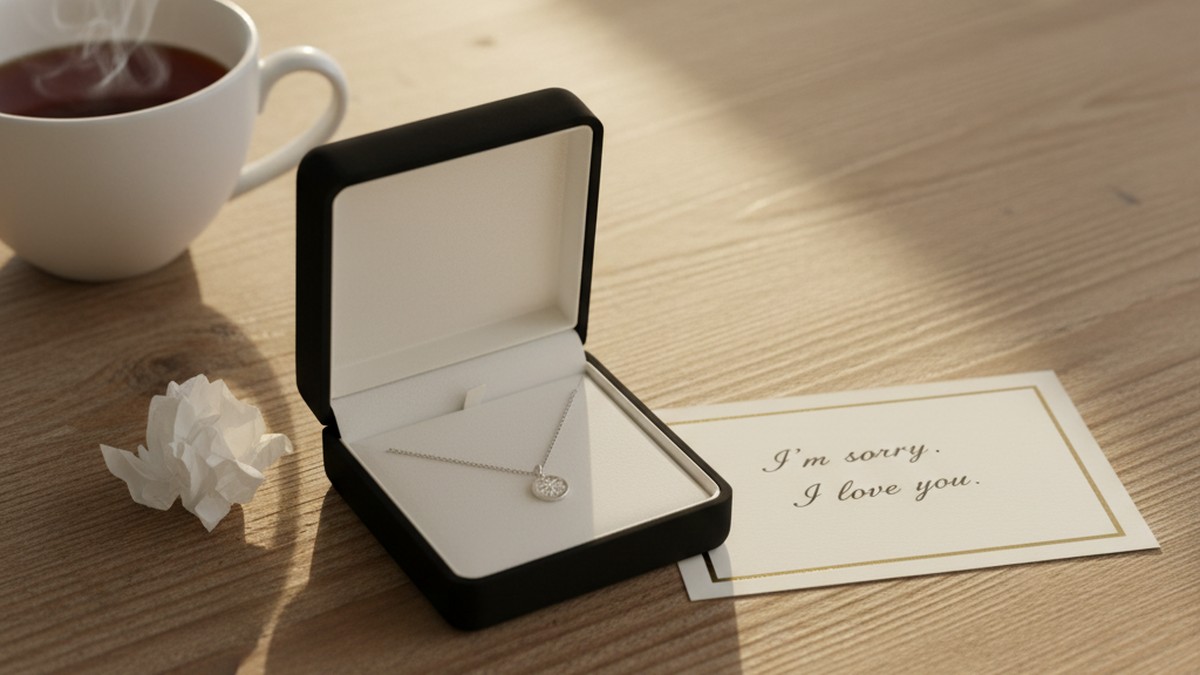
Compensatory guilt signs are the easiest to misread. They look like affection. They feel like care. In the short term, they can even temporarily improve the surface quality of a relationship. That's exactly what makes them worth understanding clearly.
Sign 1: Unexpected Gifts With No Occasion
A partner who begins bringing home flowers, jewelry, or thoughtful presents without any anniversary, birthday, or established reason is showing a classic compensatory behavior. The pattern is specific: the gift-giving appears after a period of unusual absence or behavioral change, and it often carries a slightly off-key quality — the gift is nicer than usual, or the frequency is unusual, or there's a frantic edge to the generosity.
Therapists who work with couples affected by infidelity describe this pattern consistently. One report described a partner who had never in eight years of marriage given spontaneous gifts who suddenly, within three months, had given an expensive present, booked a surprise weekend trip, and began bringing home flowers regularly. The behavioral shift was so pronounced that it felt wrong before any other evidence appeared.
Gifts function as a psychological offset. The cheating partner is trying to balance an internal emotional ledger: "If I do something this generous, maybe what I'm doing is less terrible than it feels." This isn't always calculated manipulation. In most cases, it's an anxiety response — an attempt to reduce the cognitive dissonance between action and self-image.
Sign 2: Sudden Increases in Affection and Attention
Beyond material gifts, a newly attentive partner who was previously emotionally reserved represents another compensatory signal. This includes more verbal compliments, more physical touch initiated without prompting, more frequent check-ins during the day, and increased expressed appreciation for things you've been doing all along.
The key diagnostic marker is contrast. If your partner has always been openly affectionate, a continued pattern of affection means nothing. If they have never been particularly demonstrative, a sudden shift warrants attention — especially when it coincides with other behavioral changes described in this article.
80% of cheaters report significant guilt within six months of their infidelity, according to 2024 infidelity research. That guilt needs an outlet, and for many people that outlet is increased affection toward the person they've wronged. Partners who sense something is off often describe this attention as performative, strained, or slightly desperate — present but hollow, like going through relational motions.
Sign 3: Oversolicitous Helpfulness at Home
The third compensatory pattern is behavioral rather than material: the cheating partner suddenly becomes unusually helpful, eager to assist with tasks they've historically avoided, and attentive to household responsibilities they previously ignored. They offer to do the laundry unprompted, pick up groceries, handle the home repair that's been pending for months, and take on childcare tasks that were previously always yours.
This mirrors the same internal dynamic as gifts and affection, with one important difference: domestic helpfulness is easier to sustain and less conspicuous. It can be maintained over weeks rather than requiring a specific occasion. It also allows the cheating partner to feel actively "good" in ways that are concrete and measurable — a form of behavioral penance.
How to Distinguish Genuine Affection From Guilt-Driven Compensation
The critical question isn't whether the behavior is happening — it's whether it's consistent with who your partner has been across the whole relationship. Genuine shifts in affection are typically gradual, contextually motivated (a relationship conversation, a difficult period you worked through together), and accompanied by emotional availability.
Guilt-driven compensation tends to be sudden, disproportionate to any recent positive event, and coexisting with emotional distance. The partner brings gifts but doesn't hold your gaze. They're physically present but mentally elsewhere. If you can observe the affection and simultaneously notice emotional unavailability or avoidance, the combination is more informative than either signal alone.
The transition into the next behavioral category — avoidance — often happens in cycles. Compensatory behavior rises when guilt is acute, drops as the cheating partner manages their discomfort, then rises again after the next incident. Watching for this cyclical pattern across several weeks is more revealing than any single behavioral snapshot.
Avoidant Signs: Withdrawal, Distance, and Emotional Disappearing
Avoidant guilt behaviors are driven by the need to reduce the risk of exposure and to manage the cognitive dissonance of maintaining intimacy with someone while concealing something significant from them. These behaviors are often more painful to experience than compensatory ones, because they feel like rejection.
Sign 4: Emotional Withdrawal That Doesn't Match Their External Mood
The first avoidant sign is a specific type of emotional disappearance: your partner is physically present but psychologically absent. Conversations feel clipped or perfunctory. They don't engage with things you share. Eye contact decreases. The texture of ordinary daily interaction — the small exchanges, the shared observations, the easy intimacy — diminishes without a clear external cause.
This is distinct from a general life stressor. When someone is under work pressure or dealing with a family difficulty, they typically remain emotionally available when you engage them directly, even if preoccupied. Guilt-driven withdrawal behaves differently: the partner avoids genuine connection because intimacy increases the psychological cost of the secret, and because looking at you closely while carrying this knowledge is difficult.
What's commonly seen in practice is a partner who seems fine around others — present, social, functional — but becomes unavailable or slightly guarded specifically in moments of genuine closeness with you. The context-specificity of the withdrawal is itself informative.
Sign 5: Manufactured Arguments and Deliberate Conflict
Among the more counterintuitive avoidant signs is the sudden emergence of conflict where little previously existed. The cheating partner begins finding fault with small things, snapping at questions that would previously have been unremarkable, escalating minor disagreements, or withdrawing into silence after ordinary interactions.
There are two psychological drivers for this pattern. First, conflict creates emotional justification for the affair: if the cheating partner can frame the primary relationship as troubled or unsatisfying, the infidelity feels more defensible. Second, fighting creates managed distance — emotional withdrawal achieved through conflict is easier to maintain and explain than withdrawal alone.
The pattern to watch is both the frequency of new arguments and their content. If new conflict concentrates on topics related to time, availability, emotional disconnection, or criticism of your behavior in areas where no criticism existed before, that pattern is more diagnostic than general irritability from a life stressor.
Sign 6: Refusing to Make Future Plans
A partner who has historically been comfortable discussing the future — vacations, major decisions, long-term goals — who now deflects, stalls, or expresses vague resistance to these conversations is showing a specific avoidant sign. If an affair is serious or has created genuine uncertainty about the primary relationship, commitment-related conversations become psychologically threatening.
This sign is worth noting within the broader pattern of infidelity warning signs because it's one of the few that reflects the cheating partner's internal state rather than their management of external perception. They aren't performing anything here — they're genuinely uncertain, and that uncertainty leaks through in reluctance to commit.
Sign 7: Self-Criticism, Low Mood, and Inward Withdrawal
Not all avoidant signs involve pulling away from you. Some involve pulling inward. A partner who becomes noticeably low-energy, quietly self-critical without apparent reason, less interested in activities they previously enjoyed, or persistently sad may be processing the emotional weight of what they're doing.
Guilt in its most direct form looks like sadness and self-reproach. Some cheating partners — particularly those who are genuinely conflicted about their behavior — experience a form of low-grade depression. This isn't always easy to distinguish from ordinary life difficulties, but the combination of low mood with other behavioral changes in this list makes it more notable.
If you're already acting on a gut feeling that something is wrong, this self-critical pattern sometimes emerges in the weeks after an affair begins, before any other behavioral changes become visible.
Why Guilty Cheaters Create Emotional Distance
The core function of avoidant behaviors is to reduce the cognitive load of the secret. Being genuinely emotionally close to someone while concealing something significant from them is psychologically taxing. Distance reduces that load. It also provides partial cover: if you notice something is wrong and ask about it, "I've just been stressed lately" is a more defensible answer when emotional withdrawal has already been established as a recent baseline.
Deflective Signs: When the Cheater Becomes the Accuser
Deflective guilt behaviors are psychologically distinct from compensatory and avoidant ones because they require action directed outward. Rather than trying to be better or disappear, the cheating partner turns attention — and suspicion — toward you.
Sign 8: Accusing You of Cheating Without Cause
Projection is a well-documented psychological defense mechanism: attributing to another person what you are experiencing yourself. In the context of infidelity, this frequently manifests as a cheating partner suddenly accusing you of cheating.
These accusations often have no basis in your actual behavior. They may emerge mid-conversation without apparent trigger, or they may begin as questions that feel interrogating rather than curious: "Where were you exactly?" "Who were you texting?" "Why did you take so long to get home?" A partner who has never expressed jealousy about your friendships suddenly scrutinizing them is exhibiting a specific and recognizable pattern.
47.7% of cheaters confess their affair due to guilt, according to 2024 infidelity research data — but before they confess, many redirect. Accusatory projection serves a specific internal function: it moves the emotional spotlight away from the cheating partner and onto you, resets the relational dynamic with them in the questioning role, and creates psychological justification ("If they could do it too, then what I'm doing is less singular").
Sign 9: Sudden Paranoia About Your Activities
Closely related to accusatory projection, this sign involves an escalation in tracking your whereabouts and activities without any change in your behavior that would warrant it. Your partner asks where you've been with unusual specificity. They want to know the details of plans they've never previously questioned. They check your location more, or ask follow-up questions about ordinary events.
The distinction between jealousy and guilt-driven tracking matters here. Jealousy-driven tracking is usually consistent with a partner's historical personality. Guilt-driven tracking is a behavioral change that arrives without a precipitating event on your side — you haven't done anything different, but suddenly your activities are under scrutiny.
The Psychology Behind Projection in Infidelity
Projection functions as an anxiety-reduction mechanism. By actively suspecting you, the cheating partner creates a mental frame in which they are the concerned party rather than the one causing harm. It also produces a secondary effect: if they can identify any ambiguity in your behavior, they can use it retroactively to justify the affair.
This pattern is worth distinguishing from ordinary relationship insecurity. Longstanding jealousy or anxiety about fidelity, consistent with how the partner has always behaved, is not a guilt signal. It's a relationship pattern. The diagnostic marker for deflective guilt is change — behavior that is new, that arrived without a corresponding change on your part, and that intensified during the same period where other behavioral shifts appeared.
Digital and Phone Behavior Changes
Phone and device behavior is among the most commonly cited and diagnostically reliable categories of guilt signs, because digital communication is often the primary channel through which an affair exists. The behavioral change pattern is specific: a partner who has historically been casual with their phone becomes protective of it — not from new privacy principles, but because specific content requires active concealment.
Sign 10: Sudden Phone Secrecy
The most frequently reported digital guilt sign is a change in phone behavior that involves concealment. Specific markers: the phone face-down on surfaces when it was previously left face-up; taking the phone to the bathroom when it was previously left on the counter; moving away to take calls that were previously answered in shared spaces; angling the screen when typing in your presence.
The word "sudden" is doing significant work here. Someone who has always been private about their phone is not showing a guilt signal — that's an established pattern. The diagnostic marker is change. A partner who has been casual about their device for years who becomes newly protective of it during a period of behavioral changes is showing something specific.
What's commonly observed is not necessarily explicit content visible in moments of carelessness. It's the anxiety around the device itself. A partner with nothing to conceal doesn't think about their phone when it's on a table. A partner managing an active communication channel thinks about it constantly — and that hypervigilance shows.
Sign 11: Deleted Messages, Calls, and History
Beyond physical phone guarding, active deletion of communication records is a more deliberate guilt sign. You may notice that a partner who never cleared message threads now has a nearly empty inbox. Call logs that previously accumulated regularly now reset. Browser history clears consistently.
This sign exists in the context of understanding apps cheaters use to hide affairs: some cheating partners use apps specifically designed to auto-delete messages or communicate through secondary channels less likely to be examined. But many simply delete from their primary device — which leaves behavioral traces even when the content itself is gone. The absence of expected content is itself evidence of management.
Sign 12: New Password Protection and Account Changes
A partner who sets new passwords on previously accessible accounts, removes your access to shared devices or accounts, or creates new accounts on platforms you weren't previously connected to is showing a deliberate and premeditated behavioral change.
This differs from passive phone-guarding because it requires active planning. The partner has thought about what information could be accessed, identified the risk, and taken steps to close it. This is the more advanced form of the concealment that characterizes avoidant guilt behavior. It suggests the affair has been ongoing long enough for the cheating partner to have thought carefully about information management.
The Difference Between Privacy and Secrecy
Not all phone privacy is a guilt sign. Some people maintain consistent digital boundaries as a personal practice, independent of relationship behavior. The relevant question is always: what changed, and when?
A partner who has always had a phone password and has never offered to share their messages has a privacy preference — not a guilt signal. A partner who changed their password during a period of behavioral changes, or whose digital privacy is distinctly new, is showing something different. Pattern recognition over time, not a single behavioral moment, produces the most reliable read.

Physical and Social Signs of Cheating Guilt
Physical appearance changes and social behavior shifts represent a distinct category of observable guilt signs that are often overlooked in favor of more direct behavioral analysis. They can be among the most revealing because they involve the cheating partner's management of their public identity — the self they present to the world and to themselves.
Sign 13: Sudden Appearance Overhaul
A partner who begins paying noticeably more attention to their appearance — new clothes, new fitness investment, significant grooming changes — may be doing so for someone outside the relationship. The diagnostic question is directionality: is this change oriented toward you and your shared life, or is it independent, slightly guarded, and externally directed?
If your partner gets a haircut and seems excited to show you, that's different from coming home having changed their entire style with no mention of it. If they've started going to the gym and include you in the goal, that's different from new workout gear you discovered by accident.
Appearance changes associated with infidelity guilt tend to be slightly secretive in execution. The person doesn't hide them exactly, but they don't celebrate them at home either. They happen in a space that feels slightly removed from the primary relationship.
Sign 14: Social Media Overcorrection
Some cheating partners respond to guilt by posting dramatically more couple content than their established pattern — sudden public declarations of affection, couple photos where there were none before, effusive comments about your relationship on platforms where they previously said nothing. This represents a form of identity management: asserting a public self-image that contradicts what's happening privately.
This sign requires historical context. A partner who has always been openly expressive on social media continuing that pattern is unremarkable. A partner whose previous pattern contained zero relationship content who suddenly begins posting weekly couple content during a period of other behavioral changes is showing something specific.
The psychological function is related to compensatory behavior: the public declaration offsets the private betrayal. "Look how good this relationship is" serves the same internal role as the unexpected gift.
Sign 15: Avoiding Mutual Friends Who Might Know
A cheating partner who knows that mutual friends, colleagues, or family members have information about their affair may begin subtly avoiding situations where those people are present. They decline invitations to events where those individuals will be, become cool toward friendships that were previously warm, or express vague negative opinions about people who were previously uncomplicated parts of their social life.
The psychological mechanism is straightforward: proximity to someone who holds damaging information creates anxiety, and that anxiety produces avoidance. If you notice your partner suddenly finding reasons to skip events they would previously have attended without question — particularly when specific people are present — that specificity is informative.
How Do You Tell Cheating Guilt From Remorse?
Guilt is self-focused: the cheating partner feels bad about the consequences for themselves — being caught, losing the relationship, damaging their self-image. Remorse is other-focused: the cheating partner feels genuine pain for what they've done to you. According to therapist Dr. Margalis Fjelstad, only remorse indicates a real possibility of genuine repair.
Understanding which emotional state is driving your partner's behavior is the most important analytical step you can take after identifying guilt signs. The behaviors can look nearly identical in the short term. The distinction determines everything about what those behaviors predict for your future.
Two Distinct Emotional States
Guilt-driven behavior is calibrated to the cheating partner's comfort, not yours. The partner wants the situation to improve — specifically, they want their internal discomfort to reduce. Whether your pain improves is secondary to whether their anxiety reduces.
Remorse-driven behavior is calibrated toward repair. The partner feels genuine distress at what they've done to you and is motivated to fix the harm rather than simply manage their own emotional state. Dr. Fjelstad's distinction is precise: "Guilt and regret can lead a person to feel sorrow, grief, hurt, and anger — but these can be for the pain he or she feels for the self, not necessarily for the other person who was hurt by the behavior."
A 2020 study in the Journal of Sex & Marital Therapy identified eight primary motivations for infidelity: anger, low self-esteem, lack of love, low commitment, need for variety, neglect, sexual desire, and situational opportunity. The guilt response correlates most strongly with motivations involving emotional complexity — genuine conflict between love and other desires. Partners whose affairs were primarily opportunity- or variety-driven are more likely to experience minimal remorse.
Guilt-Driven Behavior: What to Look For
| Guilt Behavior | Observable Signs | What It's Actually Doing |
|---|---|---|
| Overcompensating with gifts | Sudden presents, unexpected romantic gestures | Reducing internal discomfort; balancing an emotional ledger |
| Avoiding deep conversation | Shutting down when conversation turns serious | Protecting themselves from emotional exposure |
| Defensiveness to simple questions | Anger, dismissal, subject-changing | Preventing information from surfacing |
| Moving past discovery quickly | Wants conflict resolved fast, dislikes extended processing | Minimizing consequences rather than repairing damage |
| Blame-shifting | "You drove me to this"; focusing on your relationship problems | Reducing personal culpability |
| Partial confessions | Admitting less than the full truth | Controlling the narrative while appearing honest |
A person operating primarily from guilt will likely repeat the cheating. They've managed their discomfort through behavior, rationalization, or partial disclosure — but the underlying dynamic hasn't changed. Their motivation remains self-protective.
Remorse-Driven Behavior: What to Look For
| Remorse Behavior | Observable Signs | What It Signals |
|---|---|---|
| Full accountability | Acknowledging the complete truth without minimizing | Prioritizing your understanding over their protection |
| Tolerating difficult questions | Answering honestly, including painful answers, without shutting down | Genuine commitment to transparency |
| Seeking professional help | Initiating couples or individual therapy | Recognizing the problem requires structural work |
| Patience with your process | Allowing you to be angry, uncertain, or grieving without pressure | Accepting the full consequence of their actions |
| No pressure to "get over it" | Not setting timelines for your recovery | Respecting the scale of what they've done |
| Behavioral transparency | Sharing access, being accountable for time, answering location questions honestly | Building trust through consistent action, not promises |
The practical test is this: whose comfort does their behavior primarily serve? If their actions reduce your anxiety and pain, even when that's difficult for them, the motivation is closer to remorse. If their actions reduce their own discomfort while leaving your questions unanswered or your pain unacknowledged, the motivation is guilt.
What This Means for Your Relationship
Research from a 2012 American Association for Marriage and Family Therapy survey found that 74% of couples who underwent therapy after infidelity successfully recovered — but the condition for that outcome is genuine engagement from both partners, which requires the cheating partner to be operating from remorse, not guilt management.
Guilt alone, without genuine remorse, dramatically reduces the probability of meaningful recovery. Understanding which emotional state is driving your partner's behavior tells you what kind of process is realistically possible and what your own realistic expectations should be.
Do All Cheaters Show Guilt Signs?
Not all cheaters show guilt signs. This is the finding most guides on this topic avoid, because it complicates the clean narrative of observable remorse — but it's critical information for anyone trying to interpret what they're observing.
A 2023 peer-reviewed study published in the Archives of Sexual Behavior, led by researcher Dylan Selterman at Johns Hopkins University, examined infidelity among people actively pursuing affairs and found that many participants reported high relationship satisfaction and no significant remorse. Selterman noted directly that "in popular media, television shows and movies and books, people who have affairs have this intense moral guilt, and we don't see that in this sample of participants."
The implication is direct and uncomfortable: a partner who is cheating may show no unusual behavior whatsoever.
Who Doesn't Feel Guilt, and Why
The absence of guilt doesn't indicate the absence of an affair. It indicates something specific about the cheating partner's psychological profile and their motivation for the affair.
The guilt response correlates most strongly with people whose infidelity involved genuine emotional conflict — real love for their partner alongside other desires. People motivated primarily by desire for variety, situational opportunity, or low baseline commitment tend to experience substantially lower levels of guilt. Their internal moral framework may not classify what they're doing as a significant violation, particularly if they perceive their primary relationship as satisfactory on its own terms.
The General Social Survey finds that approximately 20% of married men and 13% of married women report having had sex outside their marriage — a figure that has remained relatively stable over decades. Not all of those people are walking through the behavioral changes described in this article. Many are continuing their lives without visible disruption to their primary relationship.
This profile doesn't show compensatory, avoidant, or deflective behaviors — not because they're concealing them, but because the guilt that drives those behaviors is genuinely absent.
Why Absence of Guilt Signs Doesn't Clear a Partner
If you are looking for guilt signs and not finding them, that is not reassuring. The Selterman data reinforces a point worth stating plainly: the presence of guilt signs indicates a cheating partner who is psychologically conflicted. The absence of guilt signs is neutral. It tells you nothing about whether an affair is or isn't happening.
Partners without guilt signs but with suspected cheating behavior tend to show different indicators: unexplained time gaps, logistical inconsistencies, discovery of specific evidence. If you're trying to understand what's happening without relying on behavioral inference, the guide on how to catch a cheater covers methods that don't depend on reading emotional cues.
The Profile Most Associated With Low-Guilt Cheating
Based on infidelity research, the behavioral profile associated with low or absent guilt includes:
- A history of boundary violations across multiple relationships
- Affairs motivated primarily by desire for variety rather than emotional dissatisfaction
- Relationship contexts characterized by low emotional investment in the primary partnership
- Use of platforms specifically designed for discreet affairs (the design itself reduces moral friction)
- Compartmentalization as an established psychological coping mechanism
This is a descriptive pattern drawn from research data, not a moral characterization. It matters because it shapes what kind of evidence is actually useful for understanding your situation — and whether behavioral guilt signs are the right place to look.
The Stages of Guilt After Cheating
Guilt after infidelity is not static. It evolves through recognizable phases, and the behavioral signs you observe are shaped by which phase the cheating partner is currently in. Understanding the stage helps interpret what you're seeing more accurately.
The Five Stages
Research on emotional processing after infidelity identifies a pattern broadly analogous to the stages of grief. Not everyone progresses through all five in sequence, and some people plateau or cycle between stages.
Denial. In the early stage, the cheating partner minimizes the significance of what happened. Internal framing reduces the weight of the affair: "It was just once," "Nothing real happened," "It doesn't affect how I feel about my partner." Behavioral signs at this stage are typically minimal. The partner may appear entirely normal because they have not yet fully registered — or admitted to themselves — the weight of what they've done. This is the stage most consistent with no visible guilt signs.
Anger. As the psychological reality sets in, some cheating partners externalize their emotional state. They become irritable, defensive, and conflict-seeking. They argue without apparent reason, snap at minor things, or express vague dissatisfaction with the relationship. This stage maps directly onto the manufactured conflict in Sign 5 and the deflective behaviors in Signs 8 and 9. The anger is often self-directed internally but expressed outward.
Bargaining. In this stage, the cheating partner attempts to manage the situation and reduce consequences. They make implicit or explicit promises: "I won't do it again," "If I can just be a better partner, this will resolve itself." Compensatory behaviors — gifts, increased attention, helpfulness — are most pronounced during this stage. The partner is trying to buy their way out of the psychological debt they've created.
Depression. Some cheating partners experience a period of genuine low mood as the weight of the secret becomes increasingly difficult to carry. Behavioral signs include the low-energy, self-critical patterns described in Sign 7. This stage often produces the most authentic-seeming guilt signals because the emotional state is real, not performed.
Acceptance. In the final stage, the cheating partner takes genuine responsibility. They confess, or they internally commit to real change. The behavioral marker is a shift from self-management toward other-directed behavior — the transition from guilt to remorse described earlier.
How the Stage Shapes What You're Observing
If you're seeing predominantly compensatory behaviors — gifts, attention, unusual helpfulness — you're most likely observing the bargaining stage. If you're seeing emotional withdrawal, low mood, and conflict-seeking, the denial or anger stages are more probable. If you're seeing transparent, accountable behavior combined with emotional directness, you may be seeing acceptance.
This framing doesn't tell you whether an affair happened. It tells you where the cheating partner is in their internal processing — which shapes what kind of response they're capable of giving you if you choose to address what you're observing.
It also matters for your own approach. A partner in denial will deflect and minimize. A partner in bargaining will over-promise. A partner in acceptance can engage honestly. Meeting someone where they are in this process, rather than where you need them to be, is the most effective starting point for any conversation.

Common Mistakes People Make When They Spot Guilt Signs
Recognizing guilt signs accurately is only useful if you respond in a way that gets you reliable information. Several common responses to suspected guilt signs actively reduce the chances of understanding what's actually happening.
Confronting Immediately Based on Behavioral Signs Alone
The most common mistake is treating behavioral guilt signs as proof and confronting a partner directly based on observation alone. This approach has a predictable outcome: a partner who is guilty but hasn't decided to confess will deny, deflect, and adjust their behavior to conceal the signs more effectively. You will have disclosed your awareness without gaining any concrete information.
Guilt signs are evidence of psychological distress. They are not evidence of the specific action causing that distress. Your partner could be showing compensatory behavior because of an affair, or because of a financial problem they haven't disclosed, or because they've been offered a job relocation and haven't told you, or because they're managing a personal health concern. The behavioral cluster you're observing is informative about internal state — it's not conclusive about cause.
Use guilt signs to direct your attention, not to draw conclusions.
Letting Overcompensation Reset Your Suspicion
A specific mistake related to compensatory behaviors: the gifts, attention, and increased affection feel good. They're intended to feel good. For many people, receiving them temporarily relieves the anxiety that prompted the observation in the first place.
This is the precise psychological function of overcompensation — whether the cheating partner is calculating it deliberately or not. If you notice compensatory behaviors, note them. Do not allow them to function as reassurance. A partner who is simultaneously more affectionate and less emotionally available has not resolved the problem; they've applied a surface-level offset to it.
The pattern that matters is the combination: warmth on the surface, absence underneath. That coexistence is more diagnostic than either signal alone.
Misreading Life Stress as Guilt
The behavioral signs in this article — phone guarding, emotional withdrawal, conflict-seeking, appearance changes — can all appear in a person dealing with significant life stress unrelated to infidelity. Job loss, financial pressure, health concerns, family crises, and depression can produce behavior that superficially resembles a cheating guilt pattern.
This is not a reason to dismiss what you're observing. It is a reason to look for the full cluster of behavioral changes rather than a single signal. A person under work pressure typically shows work-focused preoccupation without the specific phone-secrecy behaviors, deflective accusation, or social avoidance patterns that tend to accompany infidelity guilt.
Two or three isolated changes can have alternative explanations. Five to six behavioral changes across multiple categories in the same timeframe is a more coherent signal.
Treating One Behavioral Category as More Definitive Than Another
Not all cheating partners show compensatory behaviors. Not all show deflective ones. The dominant category reflects the individual's psychological profile and their perception of risk — not the severity of the affair or the intensity of the guilt.
A partner who never brings gifts or becomes suddenly attentive is not "less guilty." They may be more avoidant by personality, more confident in their concealment, or simply less prone to compensation as an anxiety response. Interpret the pattern that's actually present rather than looking for the pattern you expect.
What Should You Do When You Spot Cheating Guilt Signs?
When you spot cheating guilt signs, document specific behavioral changes with dates and context before taking any action. Avoid confronting based on guilt signs alone — they indicate psychological distress but not its cause. Look for corroborating information, such as whether your partner is active on dating platforms, before drawing conclusions or initiating a conversation.
Document What You Observe
Before taking any action, write down what you've observed, when it happened, and in what context. This is not about building a legal case or preparing an accusation. It's about creating an accurate record that will be useful for several purposes: understanding the pattern more clearly when reviewed across weeks, providing accurate information if you speak with a therapist, and avoiding the distortion that anxiety naturally introduces into memory.
Document specifics, not impressions. "She was defensive when I asked where she'd been Tuesday evening and changed the subject without answering" is useful. "She's been acting weird" is not. A specific behavioral record reviewed across two or three weeks often reveals a pattern that's either clearer or less alarming than moment-to-moment anxiety suggests.
Look for Corroborating Information
Behavioral guilt signs warrant attention. They warrant more research. They don't warrant confrontation on their own.
If you're observing a consistent cluster of changes and need to understand what's behind them, the most direct route is to identify whether your partner is active on dating platforms. This produces concrete, specific information that either confirms or eliminates the most common explanation for the behavioral cluster you're observing. Guilt signs combined with confirmed dating app activity is a different situation than guilt signs with no corroborating evidence.
If the signs you're seeing are consistent enough that you need a clear answer before anything else, CheatScanX checks 15+ dating platforms for hidden profiles — it's designed to answer this specific question without confrontation, accusation, or reliance on behavioral inference alone.
The Conversation Framework
If you decide to address what you're observing, be clear about your objective before the conversation starts. Understanding what's happening and resolving what's happening are different goals that require different approaches and different readiness from both sides.
A conversation aimed at understanding starts from specific observations rather than accusations. "I've noticed you've seemed more distant and have been more defensive about ordinary questions over the past few weeks" creates room for honest response. "I think you're cheating" immediately produces a defensive or confessional dynamic — and if you don't have corroborating information, it gives the cheating partner a clear warning without producing anything useful.
For a detailed approach to this conversation after you have the information you need, the guide on how to confront a cheater covers preparation and approach in full.
What the Signs Tell You — and What They Don't
Cheating guilt signs cluster into three distinct categories: compensatory behaviors that attempt to offset the harm being done, avoidant behaviors that reduce the psychological load of the secret, and deflective behaviors that redirect suspicion outward. Each reflects a different internal state and produces a different observable signature.
The guilt vs. remorse distinction is the most important concept to carry out of this article. Guilt is self-protective; remorse is other-directed. Identifying which emotional state is driving your partner's behavior tells you more about your actual situation than any individual behavioral sign.
The research makes clear that many cheaters show no guilt signs at all — which means their absence is not reassurance, and their presence is not proof. What guilt signs are is informative. They indicate that something psychologically significant is happening with your partner, that it warrants attention, and that corroborating concrete information will give you a far clearer picture of what you're dealing with than behavioral inference alone.
The most direct path to clarity is not watching and waiting. It's understanding what you're seeing, taking it seriously, and seeking the specific kind of information that can confirm or eliminate the explanation you're most concerned about.
Frequently Asked Questions
Not always. Around 50% of cheaters report intense guilt immediately after their first encounter, but a significant portion feel none at all. A 2023 study in Archives of Sexual Behavior found many affair participants reported high satisfaction with no remorse. Guilt likelihood correlates with personal values, the relationship's emotional quality, and the type of affair.
A guilty cheater typically shows one or more of three patterns: overcompensation (unexpected gifts, increased affection, unusual helpfulness), avoidance (emotional withdrawal, manufactured arguments, declining to discuss the future), or deflection (accusing their partner of cheating, sudden paranoia about their partner's activities). Most guilty cheaters cycle through multiple patterns over time.
Yes. Several behaviors associated with cheating guilt — withdrawal, defensiveness, phone secrecy, and mood changes — can also reflect other stressors: job problems, financial pressure, family difficulties, or personal mental health challenges. Guilt signs are worth noting, but they are not proof of cheating and require corroborating information before conclusions are drawn.
Cheating guilt varies widely in duration. Some cheaters experience acute guilt in the days immediately after the affair, then rationalize it away within weeks. Others carry it for months or years. Research from Johns Hopkins University suggests many cheaters manage guilt through compartmentalization, never fully experiencing long-term remorse.
Guilt is self-focused: the cheater feels bad about consequences for themselves — being caught, losing the relationship, damaging their self-image. Remorse is other-focused: they feel genuine empathy for the pain they've caused you. According to therapist Dr. Margalis Fjelstad, only remorse — not guilt — indicates a real chance at meaningful repair.