
# Cheating Recovery: How to Heal After Infidelity
Recovery from cheating is possible — and for most people, the most acute pain begins to ease within six months, with meaningful stability returning within one to three years. Whether you choose to stay in the relationship or leave, healing follows a recognizable progression that research has mapped with increasing clarity. The path is not linear, and it is not fast, but it is real.
What makes infidelity different from other relationship wounds is the specific type of trauma it creates. Researchers now classify betrayal by a romantic partner as a distinct form of interpersonal trauma. A 2019 PubMed study of young adults found that 45.2% of those who experienced partner infidelity showed symptoms consistent with clinically significant PTSD — not general sadness, but intrusive thoughts, hypervigilance, and emotional shutdown. That's not weakness. That's a measurable neurological response to a perceived safety threat from someone you trusted completely.
This guide covers the five-stage recovery process, the four paths forward, which treatments the research actually supports, and the question most guides sidestep entirely: what changes depending on whether you stay or leave.
What Is Cheating Recovery, Really?
Cheating recovery is the process of addressing betrayal trauma — a distinct psychological response to discovering that a trusted partner violated the boundaries of your relationship. Genuine recovery means processing the trauma, rebuilding a stable sense of self, and reaching a point where the betrayal no longer disrupts your daily functioning or future relationships.
This definition matters because the path to healing after infidelity is fundamentally different from healing after a normal breakup. When a partner cheats, the harm is not just emotional loss — it is a rupture in your sense of reality. You believed something to be true about your relationship, your partner, and yourself. That belief was invalidated simultaneously. Therapists call this "assumptive world disruption," and it requires different work to repair than ordinary grief.
The confusion between heartbreak and betrayal trauma explains why so many people feel like they're healing "wrong." You might expect to feel sad. Instead, you feel like you're unraveling — replaying events obsessively, doubting your own perceptions, alternating between rage and numbness. That pattern is not dysfunction. It's the predictable signature of betrayal trauma operating exactly as it's designed to.
Three markers define genuine recovery versus simply surviving:
- Integration: The betrayal becomes part of your history without dominating your present
- Trust restoration: Either in the relationship (if staying) or in your own judgment about future relationships (if leaving)
- Identity stability: A clear sense of who you are, separate from what happened to you
Almost every cheating recovery resource defines recovery only as saving the relationship. That framework misses roughly half the people reading it. Recovery is just as real — and just as achievable — when you leave. Understanding that distinction changes everything about how you approach what comes next.
Understanding what recovery actually is gives you a more accurate map of the terrain ahead. That starts with the most common question people ask when they're in it.
If any of this sounds familiar, there's a way to know for sure. CheatScanX checks 15+ dating platforms for hidden profiles using a name, email, or phone number.
Check for hidden profiles →How Long Does Cheating Recovery Take?
Most people feel meaningful stability 12 to 18 months after discovery, with full integration typically taking two to five years. Recovery time varies significantly based on four factors: whether you entered therapy, how complete the disclosure was, whether the cheating partner ended contact with the affair partner immediately, and the type of accountability shown. Those four variables matter more than any other factor — including how long the affair lasted.
Research from Here Counseling, synthesizing multiple clinical studies, found that people in couples therapy typically reach emotional stability within 2-3 years. Without therapy, the same process averages 3-5 years, with significantly higher rates of stalling. A 2012 American Association for Marriage and Family Therapy (AAMFT) survey reported that 74% of couples who entered therapy after infidelity recovered their relationship. Without therapy, success rates dropped to approximately 20%.
The four variables that most directly affect recovery speed:
| Variable | Accelerates Recovery | Extends Recovery |
|---|---|---|
| Therapy | Couples and/or individual therapy within 3 months | No professional support, or quitting after a few sessions |
| Disclosure | Complete, honest account given in one conversation | Trickle disclosure — details revealed over weeks or months |
| Contact with affair partner | Ended immediately, no exceptions | Ongoing contact under any framing |
| Accountability | Cheating partner takes full, undefended responsibility | Minimizing, blame-shifting, or framing it as a response to your behavior |
One factor that published recovery timelines consistently underestimate: the timeline for those who leave. Most research assumes you're staying in the relationship. People who leave often experience an initial relief period (weeks 1-4), followed by a second grief wave (months 2-6) that can feel worse than the first. This is not regression. It is grief for the relationship itself arriving on a delay, once the adrenaline of the immediate crisis fades.
What recovery does not mean:
- Forgetting that the infidelity happened
- Returning to exactly who you were before
- Never experiencing another painful thought about it
What it does mean: those thoughts arrive less frequently, with less intensity, and without hijacking your ability to function or connect.
Knowing the timeline is useful, but understanding the terrain of that timeline — the specific emotional territory you'll move through — is what makes the difference between getting stuck and moving through.
The 5 Stages of Cheating Recovery
The five stages of cheating recovery parallel grief, but with specific features that set them apart from standard bereavement. These stages are not linear — most people cycle back through earlier stages, particularly Stage 2 and Stage 3, multiple times before reaching integration. Knowing this in advance significantly reduces the sense that you're moving backward.
Stage 1: Shock and Crisis (Weeks 1-4)
Discovery hits the nervous system like a physical blow. Many people describe the first 24-72 hours as dissociative — functioning on autopilot while the mind struggles to integrate information it can't yet process. Sleep collapses. Appetite disappears. Some people can't stop crying. Others feel nothing at all and then feel alarmed by their own numbness.
This is not the time for permanent decisions. Research is consistent on this: major choices made within the first four weeks after discovery have significantly lower satisfaction outcomes than decisions made after 3-6 months of processing. In Stage 1, the task is not to decide anything about the relationship. The task is to stabilize.
Practical steps in Stage 1: find one safe person to talk to, schedule an appointment with a therapist within the next seven days, and resist the urge to do repeated evidence-gathering. Looking through their phone, email, and social media repeatedly beyond establishing what happened extends the shock period and delays actual processing.
Stage 2: Rage and Reality (Months 1-3)
The numbness of Stage 1 typically gives way to intense, destabilizing anger. This is appropriate. The anger that emerges after betrayal is not just grief-anger — it includes specific rage about deception, about having your reality manipulated, and about choices that affected you without your knowledge or consent.
A 2024 Frontiers in Psychology study on betrayal anger found that 39% of betrayed partners reported that their helping professionals did not specifically address their anger, which significantly prolonged recovery. If your therapist skips past your anger toward reconciliation frameworks too quickly, that is a signal worth acting on.
Some people in this stage experience intrusive thoughts — vivid, unwanted mental images of the affair. These are a recognized PTSD symptom. Between 30% and 60% of betrayed partners develop clinically significant PTSD symptoms, according to a synthesis of multiple peer-reviewed studies. If intrusive thoughts are disrupting sleep or work, they are a clinical concern that responds well to EMDR therapy — covered in the treatment section below.
Stage 3: The Bargaining Pit (Months 3-6)
This is the hardest stage to describe and the most dangerous to misread. It's characterized by obsessive what-if thinking: "What if I had been more attentive?" "What if I'd caught this earlier?" Many betrayed partners internalize blame here — and research consistently identifies self-blame as the single biggest predictor of extended recovery timelines.
Self-blame feels logical in Stage 3, but it is functionally inaccurate. Responsibility for infidelity belongs entirely to the person who made the choice to cheat. That intellectual fact doesn't resolve the emotional experience through argument alone. It resolves through specific therapeutic work — cognitive processing therapy (CPT) is particularly effective for the self-blame that characterizes this stage.
One non-obvious feature of Stage 3: it often looks, from the outside, like the person is doing better. The acute crisis energy of Stage 2 has faded. They're back at work, seeing friends, appearing functional. Inside, bargaining and self-blame are often at their most intense. Watch for this pattern in yourself.
Stage 4: Reconstruction (Months 6-18)
The emotional intensity of earlier stages begins to give way to the work of deliberate rebuilding. If you've stayed in the relationship, this stage involves actively restoring trust through specific, consistent behaviors — not hoping time alone will do the work. If you've left, this stage involves building a new identity and framework for what relationships can look like.
The key shift of Stage 4: choices are made based on who you want to become, not purely as reactions to what happened. Many people describe this as the first time since discovery that they feel a genuine sense of agency.
Stage 5: Integration (18+ Months)
Integration does not mean the betrayal stops being part of your story. It means it becomes one chapter in a longer narrative rather than the lens through which you see everything else. Most people reach Stage 5 between 18 months and 3 years, with or without the relationship. Those who have done consistent therapeutic work tend to reach it closer to 18 months. Those who avoided processing tend to oscillate between Stages 2 and 3 for years.
The marker of genuine integration: you can talk about the experience without your nervous system flooding. The memory still carries emotional weight, but not the same sensory urgency as the original discovery.
The stages give you a map of the emotional terrain. They don't tell you which road you're actually on. For that, you need to understand which of the four possible paths your situation calls for.

The Four-Path Recovery Model
Most cheating recovery resources assume a single path: the relationship continues, trust rebuilds, and the couple emerges stronger. Research on actual outcomes after infidelity suggests that model applies to roughly one in four possible trajectories.
The Four-Path Recovery Model identifies four distinct paths forward, based on patterns in clinical outcomes research, and what each path requires for genuine healing.
Path 1: Stay and Rebuild (approximately 35% of cases)
Both partners commit to full reconstruction: complete disclosure, immediate end to affair partner contact, couples therapy, and individual therapy for both. This path has the highest long-term satisfaction rate among couples who choose to stay. The 2012 AAMFT data found 74% recovery rates for couples who pursued structured repair. The critical element is that both partners are not just staying in the relationship — they are actively building a different relationship together.
Path 1 requires: full accountability from the cheating partner without defensiveness, willingness from the betrayed partner to tolerate the discomfort of repair work, and both partners treating the betrayal as a shared challenge rather than a single person's wound to manage alone.
Path 2: Stay and Coexist (approximately 20% of cases)
The relationship continues in form but not in substance. Neither partner has done the full work of repair — the topic has been handled through avoidance, or minimal work was done and then abandoned when the acute crisis passed. Outwardly, the couple appears to have "gotten through it." Internally, the betrayed partner typically carries unresolved trauma, and the relationship operates without genuine intimacy.
This path receives less attention in recovery literature than it deserves, because it is common and often goes unrecognized by both partners. People on Path 2 frequently report feeling like they "should be over it by now," not understanding that the avoidance is precisely what's preventing healing. Path 2 is accessible from Path 1 — but it requires the courage to reopen conversations that have been sealed by apparent peace.
Path 3: Leave and Heal (approximately 30% of cases)
The relationship ends, and the betrayed partner pursues deliberate individual recovery. This path is underserved by most recovery resources, which focus almost exclusively on couples. Leaving does not automatically produce healing — it produces a different kind of work. The grief that follows separation after infidelity is distinctive because it combines betrayal trauma with conventional relationship loss, both arriving simultaneously.
People on Path 3 who do individual therapy reach stable emotional functioning within 1-2 years in most cases. Those who skip therapeutic support often reach functional stability but carry unprocessed betrayal patterns into future relationships, where the trauma resurfaces in ways that seem unrelated to the original infidelity.
Path 4: Leave and Recycle Trauma (approximately 15% of cases)
The relationship ends, but the trauma is not processed. The person moves into new relationships quickly, seeking validation or attempting to overwrite the betrayal with new positive experiences. In clinical research on attachment and betrayal, this pattern is associated with hypervigilance in new relationships, difficulty tolerating intimacy, and a cycle of suspicion followed by self-protective withdrawal.
This path is not a character flaw — it's an understandable response to profound pain without adequate support. Recognition is the entry point to change. People who identify themselves in Path 4 respond well to individual therapy specifically focused on attachment and betrayal processing before entering the next relationship.
If any of this sounds familiar and you're still trying to confirm what actually happened, CheatScanX can scan 15+ dating platforms to give you a clear answer — so you can make decisions based on facts rather than uncertainty.
Understanding your path matters because the work required is genuinely different depending on where you are. The factors that move each path toward better outcomes are not fixed — they respond directly to specific behaviors on both sides of the betrayal.
What Accelerates Healing — and What Kills It
Recovery from infidelity is not passive. Certain behaviors reliably accelerate it. Certain behaviors reliably stall or prevent it entirely. This distinction is not based on general relationship advice — it's derived from patterns in clinical research on betrayal trauma outcomes.
Accelerators:
Entering therapy within 3 months of discovery
Earlier intervention produces faster recovery with higher satisfaction outcomes. Couples who began therapy within the first three months showed approximately 40% faster resolution of acute PTSD symptoms compared to those who waited more than six months, according to clinical patterns cited in the Journal of Marital and Family Therapy (2023). Individual therapy for the betrayed partner — separate from couples work — produces significantly better outcomes than couples therapy alone.
Single, complete disclosure
"Trickle disclosure" — in which the cheating partner reveals affair details piece by piece over days or weeks — is one of the most documented predictors of extended recovery. Each new revelation re-triggers the discovery trauma from the beginning. A complete, single disclosure, while intensely painful in the immediate term, consistently produces faster long-term healing because the betrayed partner can begin processing one defined event rather than an ongoing series of shocks.
Immediate and maintained no-contact with the affair partner
Not eventual no-contact. Immediate, unambiguous no-contact with no exceptions. Ongoing communication between the cheating partner and the affair partner — described as "just handling the ending" or "we work together" — keeps the betrayed partner's nervous system in a continuous state of threat detection. Recovery cannot meaningfully begin while the threat is still perceived as active.
Transparent behavioral accountability from the cheating partner
Trust is rebuilt through evidence, not declarations. Research by Dr. Shirley Glass and other betrayal trauma specialists identifies consistent behavioral transparency — voluntarily sharing location and communication as a standard practice, not under coercion — as the single strongest trust-restoration mechanism available to the cheating partner. It is not surveillance. It is the behavioral recalibration of trust.
Killers:
Trickle disclosure or incomplete disclosure
Each new revelation after an apparently complete disclosure functions as a fresh discovery. Many betrayed partners report that finding out additional details months later felt more devastating than the original discovery — because it added a second layer of deception to the first.
Continued contact with the affair partner
Any form — work requirements, claimed genuine friendship, or gradual wind-down. Each instance of continued contact extends the acute trauma phase because it maintains an active perception of ongoing threat.
Framing the betrayed partner's symptoms as punishment
"You're still not over it?" is among the most destructive statements a cheating partner can make during recovery. PTSD symptoms do not resolve on a timeline determined by the person who caused them. When the cheating partner interprets ongoing symptoms as manipulative or theatrical, it invalidates the betrayed partner's experience and research consistently shows it extends recovery significantly.
Repeated evidence-gathering after initial discovery
Looking through their phone, email, and social media repeatedly beyond establishing the factual parameters of what happened creates a compulsive hypervigilance loop. Each search provides the sensation of control without the substance. It reinforces threat perception rather than resolving it, and typically delays the start of genuine processing.
Major permanent decisions in the first 30 days
This applies in both directions. Decisions made within 30 days of a major betrayal — whether to leave or to stay — have significantly higher rates of regret and reversal than decisions made after a period of stabilization. Most therapists consider 60-90 days as the earliest point at which trauma-influenced emotional states have settled enough to support decisions you'll be able to rely on.
What Are the Symptoms of Betrayal Trauma?
Betrayal trauma symptoms include intrusive thoughts about the affair, hypervigilance (constant scanning for new evidence of threat), emotional numbness, panic responses to triggers, sleep disruption, difficulty concentrating, and persistent self-blame. Between 30% and 60% of betrayed partners develop clinically significant PTSD symptoms, according to multiple peer-reviewed studies.
Betrayal trauma is a distinct category of psychological injury in which the person responsible for your safety and well-being is also the source of harm. In a romantic relationship, this creates a specific neurological conflict: the person your brain registered as "safe" becomes the source of threat, and your threat-detection system responds accordingly — sometimes for months after the relationship has ended or the cheating has stopped.
Between 30% and 60% of people who experience partner infidelity develop clinically significant PTSD symptoms, according to a synthesis of multiple peer-reviewed studies. A 2019 PubMed study specifically on unmarried young adults found 45.2% met criteria for probable infidelity-related PTSD. These are not metaphorical figures — they reflect measurable changes in nervous system function.
Common symptoms of betrayal trauma:
- Intrusive thoughts and images: Unwanted, vivid mental scenarios of the affair appearing without invitation, often at entirely unrelated moments
- Hypervigilance: Constant scanning for evidence of new threat — monitoring their location, phone, communication patterns, and emotional state
- Emotional numbness: Feeling disconnected from yourself or unable to access emotions that should logically be present
- Panic responses to triggers: A song, a location, a phrase, or even a time of day activating a full physiological response as if the discovery just happened
- Sleep disruption: Difficulty falling or staying asleep, or recurring nightmares connected to the betrayal
- Cognitive flooding: Difficulty concentrating on work, conversations, or daily tasks because the mind returns compulsively to betrayal-related content
- Self-blame loops: Persistent, unshakeable thoughts that you caused, missed, or could have prevented the infidelity
These symptoms require clinical recognition separate from general emotional distress because they respond better to trauma-specific treatment than to general support or time alone. A therapist who treats betrayal trauma symptoms as a "trust issue to work through" rather than a clinical trauma response tends to produce slower outcomes.
A point worth naming explicitly: hypervigilance after infidelity is often misread by both the betrayed partner and their therapists as simply anxiety or insecurity. That framing understates the clinical reality. Hypervigilance after betrayal trauma is a protective nervous system response to a real threat event. It requires specific deactivation work — not just reassurance that the cheating has stopped.
If four or more of the symptoms above are regularly present and disrupting your functioning, this is a clinical-level response. Waiting for it to resolve on its own produces measurably worse outcomes than early intervention in virtually every study that has examined the question.
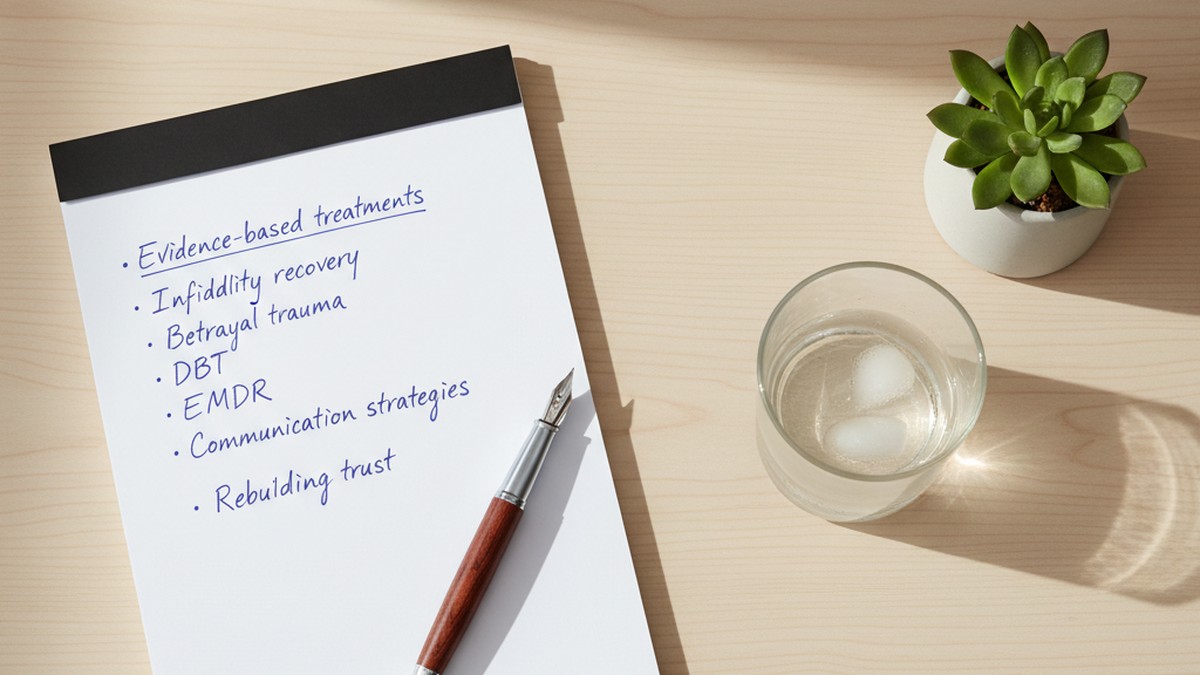
Which Treatments Actually Work for Cheating Recovery?
Four treatments have the strongest research support for betrayal trauma: EMDR for intrusive thoughts and triggers, Emotionally Focused Therapy for couples rebuilding attachment, Cognitive Processing Therapy for self-blame, and the Gottman Atone-Attune-Attach model for structured couples repair. Your primary symptoms and whether you're staying in the relationship determine which to start with.
Not all therapy approaches produce equal outcomes for betrayal trauma. Some therapists are trained specifically in affair recovery. Many are not. The specific model matters significantly — more than session frequency or therapist rapport alone.
EMDR (Eye Movement Desensitization and Reprocessing)
EMDR is backed by more than 30 randomized controlled trials as a first-line treatment for PTSD, according to a 2024 state-of-science review in the Journal of Traumatic Stress. A 2024 meta-analysis found EMDR equally effective as other gold-standard trauma therapies including Cognitive Processing Therapy and Prolonged Exposure across multiple RCTs.
A 2022 Frontiers in Psychology study on EMDR specifically for intimate partner betrayal found significant reduction in trauma symptoms within 8-12 sessions. EMDR is most effective for intrusive thoughts and trigger responses — the symptoms that cause normal afternoons to suddenly collapse into crisis. If those are your primary complaints, EMDR should be the first approach you discuss with a therapist.
Emotionally Focused Therapy (EFT) — for couples
EFT, developed by Dr. Sue Johnson, is the most research-supported approach specifically for couples recovering from betrayal. It targets attachment injuries — the specific moments of disconnection that created vulnerability in the relationship — and rebuilds secure emotional bonding. A meta-analysis of EFT outcomes found 70-73% of couples moved from relationship distress to recovery (International Journal of Couple Therapy, 2019). EFT is particularly effective because it addresses the underlying attachment dynamics that make trust repair more complex than simply addressing the act of cheating.
Cognitive Processing Therapy (CPT) — primarily individual
CPT targets the stuck points in thinking that characterize Stage 3 recovery — specifically self-blame and cognitive distortions that develop around the question of why this happened. CPT helps the betrayed partner challenge inaccurate beliefs directly, without requiring premature forgiveness or forced optimism. Research on CPT for PTSD consistently shows significant symptom reduction within 12 sessions.
The Gottman Atone-Attune-Attach Model — for couples
Dr. John Gottman's specific model for affair recovery sequences repair into three phases: Atone (the cheating partner takes full, non-defensive responsibility), Attune (both partners rebuild emotional attunement and understand what created relationship vulnerability), and Attach (physical and emotional intimacy is deliberately re-established). Couples who completed all three phases in the Gottman framework showed significantly higher relationship satisfaction outcomes than those who attempted reconciliation without structure.
What all four approaches share: they prioritize processing the specific trauma before pushing toward reconciliation or moving forward. Generic couples therapy not focused on betrayal trauma often produces worse outcomes than no therapy, because it pressures forward movement before the betrayed partner has processed the injury — compounding distress rather than resolving it.
For the emotional affair vs. physical affair distinction, treatment approach may differ slightly — EFT is often more effective for emotional affairs because of its focus on attachment patterns, while EMDR is equally effective across types.
Healing When You're Staying in the Relationship
Choosing to stay in a relationship after infidelity is not the same as deciding to save it. Staying and rebuilding require active, deliberate work from both partners — not a shared decision to not leave, followed by the expectation that time handles the rest.
Research consistently identifies three non-negotiables for the cheating partner:
Full, undefended accountability
This means acknowledging the specific harm caused without qualifying statements ("but you should understand that..."), comparative minimization ("it wasn't that serious"), or invoking the betrayed partner's behavior as a contributing cause. Research by Dr. Janis Abrahms Spring on forgiveness and accountability found that the betrayed partner's healing correlated more directly with the depth and consistency of the cheating partner's non-defensive acknowledgment than with any other single factor.
Behavioral transparency, not just promises
Sincere declarations of change move the needle only minimally in the research. Trust is rebuilt through evidence. Behavioral transparency — proactively sharing location and communication as a consistent, voluntary practice — reduces hypervigilance in the betrayed partner measurably over 3-6 months. When the cheating partner volunteers this behavior without being asked, it functions as ongoing behavioral evidence rather than compliance under pressure. That distinction is neurologically meaningful to the betrayed partner's threat system.
Patience with the non-linear timeline
The cheating partner typically moves through the acute crisis phase faster than the betrayed partner, partly because they did not experience the same rupture in their sense of reality. This asymmetry creates a predictable and dangerous dynamic: the cheating partner feels ready to move forward while the betrayed partner is still in Stage 2 or 3. Research on this dynamic is unambiguous. Pressure on the betrayed partner to heal faster consistently produces worse outcomes. The cheating partner's job is not to determine when healing should be complete — it is to remain consistent regardless of timeline.
For the betrayed partner staying in the relationship: the hardest part is rarely the anger. It is the recurring loss of trust, which returns unexpectedly even after apparent stability. Triggers — a specific phrase, a location, an anniversary — can reactivate acute responses years into recovery. This is not regression. It is the nature of trauma processing. Expecting a clean linear progression creates unnecessary self-doubt when the inevitable setbacks arrive.
Rebuilding genuine intimacy follows trust restoration — not the other way around. Attempting to restore physical or emotional closeness before trust is rebuilt typically produces avoidance responses rather than connection. The sequence matters, and it cannot be shortened by will alone.
Healing When You're Leaving the Relationship
Leaving after infidelity does not automatically produce healing. It produces a different kind of work — and that distinction matters because many people leave expecting immediate relief, then feel confused and pathologized when the acute pain not only continues but intensifies.
Weeks 1-4: Relief and Disorientation
The decision to leave brings real relief — particularly if the relationship involved an extended period of uncertainty before confirmation. If you found yourself struggling with whether your gut feeling they're cheating was accurate, having clarity resolves the cognitive dissonance even while the emotional pain remains. This relief coexists with immediate practical and identity disorientation. Who are you outside this relationship? What does your daily life look like now? The cognitive demands of these questions, combined with the betrayal trauma preceding the decision, create a distinctive exhaustion that many people mistake for depression.
Months 2-6: The Second Wave
The acute crisis adrenaline fades, and grief for the relationship itself — distinct from the betrayal anger — arrives. This is the phase in which many people feel paradoxically worse than they did immediately after discovery. This is normal, not regression. It represents the grief the crisis response suppressed: grief for the version of the relationship you thought you had, for the future you imagined, and sometimes for the version of yourself that existed before you knew.
Research on infidelity separation outcomes consistently shows this second wave is the phase most likely to lead to premature re-partnering — or to carrying unprocessed betrayal patterns into new relationships, where the trauma resurfaces as hypervigilance, difficulty with intimacy, or repeated testing of new partners' loyalty.
Key tasks for healing after leaving:
Work with an individual therapist who has specific experience in betrayal trauma, not just general grief counseling — the interventions are genuinely different. Establish a physical routine: research on PTSD recovery consistently finds that regular aerobic exercise significantly reduces intrusive thoughts and hypervigilance through documented neurological pathways. Separate the betrayal from your self-worth. You were cheated on because a specific person made specific choices, not because of qualities about you that will inevitably produce the same outcome in future relationships.
Resist the urge to maintain connection through anger. Sustained intense focus on the cheating partner — even negative focus — delays the identity separation that healing requires. The goal is not to not care about what happened. It is to care about what happens next more than you care about relitigating what already did.
Should You Forgive a Cheater to Heal?
Forgiveness is the single strongest predictor of relationship stability after infidelity, but the research definition of forgiveness means releasing the need for retribution — not unconditional trust or a required emotional state. Some people achieve full recovery through acceptance without traditional forgiveness, particularly when the cheating partner showed no genuine accountability.
Almost every cheating recovery resource presents forgiveness as the required destination of healing. The research tells a more complicated story — one that actually offers more people a usable path than the conventional framework does.
The conventional wisdom: you cannot heal until you forgive, and forgiving means returning to a full relationship with the cheating partner. Both of those claims deserve scrutiny.
The forgiveness data is real, but it's being applied too narrowly
Research from the University of Tennessee (2023) found that forgiveness is the single strongest predictor of relationship stability after infidelity, with 80% of partners who genuinely forgave remaining married after five years. That finding is real and significant. But the research definition of "forgiveness" in that context is not the conventional one. It meant:
- Releasing the active need for retribution
- Releasing the betrayal as the primary organizing principle of your identity
- Choosing not to punish the relationship for the infidelity indefinitely
It did not mean unconditional trust, minimizing what happened, requiring continued relationship, or achieving a state of feeling no pain about the betrayal.
What research on grief and trauma actually shows
A significant body of clinical research on trauma recovery shows that some people who are explicitly unable to forgive in the conventional sense still achieve full recovery — restored functioning, healthy new relationships, and integration without ongoing distress. The mechanism is acceptance without forgiveness: acknowledging that the betrayal happened, acknowledging it was real harm, and moving forward without requiring the specific emotional resolution that traditional forgiveness implies.
This is not a lesser form of healing. For people whose cheating partners showed no genuine accountability, it is often a more structurally stable foundation. Healing that requires a specific emotional resolution toward someone who may have shown no remorse creates dependency on a response that may never come.
In practice, based on patterns observed through our work at CheatScanX with people navigating the early discovery phase: people who hold the most rigid expectations of traditional forgiveness — that it must be full, that it must feel like peace — tend to experience the longest recovery periods. People who frame the goal as finding their own stable ground tend to reach integration faster, regardless of whether the conventional forgiveness resolution arrives.
The piece that almost no guide discusses: self-forgiveness
Many betrayed partners carry a secondary layer of self-blame distinct from the betrayal itself — blame for not seeing the signs, for trusting someone who broke that trust, for staying too long after their signs your partner is cheating were visible. Self-forgiveness is not about concluding you made no mistakes. It is about releasing the punishing narrative that what happened reflects something fundamentally broken about your judgment or worth.
Psychologist Dr. Kristin Neff's research on self-compassion found that self-directed kindness — not self-criticism — was the most reliable predictor of emotional recovery after interpersonal trauma. People who processed the experience with self-compassion recovered measurably faster than those who used the betrayal as evidence of their own inadequacy.
True cheating recovery does not require you to feel a particular way about the person who cheated. It requires you to reach a stable, self-aware relationship with the experience — one where it informs rather than defines you.
How to Stop Ruminating After Being Cheated On
Rumination — compulsively replaying betrayal events, conversations, and what-if scenarios — is not a personality trait or a character flaw. It is a specific neurological loop that betrayal trauma activates, and it responds to specific, evidence-based interventions.
Research distinguishes between productive processing (examining the experience to extract understanding) and maladaptive rumination (replaying without resolution, which increases distress rather than reducing it). The goal is not to stop thinking about what happened. It is to shift from the second type of thinking to the first.
Scheduled processing time ("worry windows")
Developed originally for generalized anxiety disorder and adapted for trauma rumination, this technique works as follows: set a specific 20-minute window each day — write, think, or talk about the betrayal deliberately and completely during that time. Outside that window, practice naming and deferring: "I notice this thought — I'll return to it at 7pm." Research on worry window protocols shows 40-60% reduction in total daily rumination time within three weeks of consistent practice. The counterintuitive element that makes it effective: giving the rumination a legitimate time slot removes the suppression resistance that makes intrusive thoughts worse.
Bilateral rhythmic physical activity
Walking, swimming, cycling — activities with alternating left-right physical engagement — have documented neurological effects on intrusive thought patterns. This is not metaphorical. Bilateral stimulation is the core mechanism of EMDR therapy, and research from the Royal College of Psychiatrists has identified regular aerobic exercise as having effect comparable to SSRI medication for mild-to-moderate PTSD symptoms. If intrusive thoughts are constant and you have not started any physical routine since discovery, this is the most accessible evidence-based intervention available.
Structured expressive writing
Unstructured journaling about the betrayal can increase rumination by reinforcing the emotional state it documents. Structured expressive writing, in which you write specifically about what you have learned, what has changed, and what you want your life to look like, produces measurably better outcomes. The frame matters: "what happened and how wrong it was" increases distress; "what I understand now that I didn't before" promotes integration (Pennebaker, 2024 research review, Journal of Traumatic Stress).
The 90-second physiological rule
Neuroscientist Dr. Jill Bolte Taylor's research on emotional neurochemistry found that the physiological cascade of an emotion peaks and dissipates within approximately 90 seconds if not actively re-engaged. When a trigger activates acute distress, the practice of non-engagement for 90 seconds — not fighting the thought, not following it, simply allowing the neurochemical wave to pass — interrupts the escalation loop. This technique does not eliminate the emotional response. It prevents it from spiraling into a 20-minute crisis.
What consistently does not work: direct thought suppression. Attempting to not think about what happened reliably increases the frequency of the thoughts, through the mechanism described by Wegner's "white bear" research on thought suppression. The target is redirection and scheduling, not suppression.
Is Your Recovery Stalling? Signs and What to Do
Recovery stalls when the same conversation keeps happening without movement, when you're outwardly functional but emotionally flat, when hypervigilance hasn't decreased after 12+ months of consistent behavior by the cheating partner, or when persistent physical symptoms remain unexplained. Each of these patterns has a specific therapeutic response.
Recovery from betrayal trauma has a recognizable forward momentum. When that momentum stalls, there are specific indicators that distinguish a temporary plateau from genuine blockage — and specific responses that address each.
The same conversation is happening indefinitely
If you and your partner are having the same conversation about the infidelity with the same intensity and no forward movement, this is a therapeutic stall. In couples work, this typically indicates that conversation is processing at the level of events and feelings but not reaching the underlying attachment injury. EFT therapy is specifically designed for this stall pattern.
Functional recovery without internal recovery
You've returned to your job, your social life, your routine. But you're operating in a kind of emotional flatness — not distressed, but not genuinely present. This pattern, sometimes called emotional numbing or structural dissociation, is a recognized trauma response that can persist for years without announcing itself as a crisis. It is clinically significant because it prevents genuine presence in the current relationship (if staying) and genuine availability in future ones (if leaving).
Hypervigilance has become structural
Checking a partner's location and communication has shifted from an acute post-discovery response to a permanent, normalized feature of the relationship after 12+ months of consistent trustworthy behavior. When monitoring behavior hasn't decreased at all in the context of genuine accountability from the cheating partner, the monitoring has become a structural feature that requires specific therapeutic attention — not as a moral judgment, but because structural hypervigilance prevents the very trust restoration it's trying to protect.
If you're still in the early phase of figuring out what happened, learning whether your suspicions are warranted is a reasonable first step before choosing a recovery path.
Persistent physical symptoms
Chronic sleep disruption, jaw clenching, shoulder and neck tension, recurring gastrointestinal issues that have no explained medical cause often indicate unprocessed trauma being held somatically. These symptoms respond better to somatic therapies and EMDR than to talk therapy alone.
What to do when recovery stalls
First, assess whether you're in therapy. If not, that is the step most reliably associated with breaking stalls. If you are in therapy, assess whether your therapist has specific training in betrayal trauma or affair recovery — generalist therapists without specific training in this area produce significantly worse outcomes. Simply switching to a therapist with specialized training can restart progress that has been stalled for months.
If you're already with a trained specialist and still stalling, assess whether all four accelerators are fully in place: complete disclosure, no contact, full accountability, and behavioral transparency. Even one missing element can prevent progress across all the others.
Moving Forward After Infidelity
Recovery from infidelity does not return you to who you were before. It develops something that can be genuinely better — a self that has been tested at the level of trust, survived the test, and arrived with more clarity about what you need, what you're capable of, and who you want in your life.
That is not a consolation prize. Clinical research on post-traumatic growth documents measurable improvements in perspective, relationships, and self-understanding emerging from processed major trauma. Tedeschi and Calhoun's foundational research, updated in 2024, shows measurable positive change in 50-60% of people who process betrayal trauma with professional support. Not everyone experiences post-traumatic growth, and nothing obligates you to reframe a real harm as a gift. But the research is worth knowing: the people who invest in recovery don't just survive. Many arrive at something genuinely more clarified than what they had.
The forward-looking indicators that signal genuine integration:
- You can discuss what happened without your nervous system flooding
- Relationship decisions come from your current values, not from fear generated by the past betrayal
- The question of whether a new person will cheat is a reasonable background consideration, not a consuming foreground preoccupation
- You trust your own perceptions again — including the things you noticed before discovery that you talked yourself out of
- The story of what happened feels like your story, not a story that happened to you
For those who have recently discovered something that confirms your suspicions, or are still in the early chaos of discovery: all five of these outcomes are accessible to you. Not this week, not this month, but within the timeframes research consistently documents. The work is real, and it works.
Cheating recovery is not a destination you reach and then maintain effortlessly. It is a state you build through consistent attention and occasionally repair when new triggers arrive. That level of engagement with your own psychological well-being is not a burden. It is the foundation of any relationship — with a partner or with yourself — worth maintaining.
If you're still in the early stages and need to confirm what you're dealing with before choosing your path forward, CheatScanX can scan 15+ dating platforms in minutes — giving you facts to work from instead of uncertainty.
Frequently Asked Questions
Most people reach meaningful stabilization within 12-18 months, with full integration typically taking 2-5 years. Recovery is fastest with couples and individual therapy entered early, complete disclosure, and immediate no-contact with the affair partner. Without therapy, the same process averages 3-5 years with significantly higher rates of stalling.
Yes — a 2012 AAMFT survey found that 74% of couples who entered therapy after infidelity recovered their relationship. Without therapy, success rates drop to approximately 20%. The key factors are the cheating partner's full accountability, complete disclosure, immediate no-contact with the affair partner, and both partners committing to consistent structured work over 1-3 years.
Cheating recovery typically moves through five stages: Shock and Crisis (weeks 1-4), Rage and Reality (months 1-3), the Bargaining Pit and self-blame (months 3-6), Reconstruction (months 6-18), and Integration (18+ months). These stages are not linear — most people cycle back through earlier stages, particularly during months 3-6.
Intrusive thoughts are a PTSD symptom that respond to specific techniques: scheduled processing windows (20 minutes daily, deferred outside that time), bilateral rhythmic exercise like walking or swimming, EMDR therapy for severe symptoms, and structured expressive writing focused on what you've learned. Direct suppression consistently worsens intrusive thought frequency.
There is no universal answer, but research identifies the predictors of successful recovery if you stay: the cheating partner took full non-defensive accountability, ended affair contact immediately, disclosed completely, and both entered couples therapy. Most therapists recommend waiting 60-90 days after discovery before making permanent decisions, as choices made in acute trauma have higher reversal rates.