# Bumble Cheating Signs: What Activity Looks Like
Bumble cheating signs fall into two distinct categories: behaviors your partner shows around their phone, and signals specific to how Bumble itself works as a platform. Understanding both is what separates a grounded concern from a hunch that won't hold up to scrutiny.
Roughly 40% of people in committed relationships remain active on at least one dating app, according to survey data compiled by relationship researchers in 2024. Bumble is a specific case worth understanding because its design gives users more privacy tools than most other dating platforms — and one of those tools was built precisely to hide profiles from people who already know the user.
This article covers 9 Bumble-specific activity indicators, explains exactly how the platform's privacy features work and why they matter, and introduces a five-layer method for assessing whether what you're seeing adds up to something real. You'll also find the one common source of false confidence that almost every other guide gets wrong.
What Makes Bumble Different From Other Dating Apps?
Bumble differs from other dating apps in one critical way for anyone concerned about a partner's fidelity: it has no public last-active timestamp, an Incognito Mode that hides profiles from people who know you, and a BFF feature that gives users a ready excuse for having the app installed at all.
Most people assume that dating apps are largely interchangeable when it comes to detecting cheating. They are not. Tinder shows when a user was last active (to matches). Hinge shows match activity. Bumble was deliberately designed with stronger user privacy in mind — which creates specific challenges for anyone trying to understand what their partner is doing on the platform.
How Bumble's Core Mechanics Work
On Bumble, women make the first move in heterosexual matches. After two people match, the woman has 24 hours to send an opening message, or the match expires. Men can extend the timer once per match. This design mechanic is important because it creates urgency — an active user on Bumble must respond within a time window, which means notifications and app-checking behavior are more frequent than on apps where either party can wait indefinitely.
The app has three distinct modes: Date (the standard dating experience), BFF (for platonic friendships), and Bizz (for professional networking). A person can have an account operating in BFF or Bizz mode and legitimately have no romantic or sexual intent. This matters when you find the app on a partner's phone — the mode they're using changes the interpretation entirely.
What Bumble Does Not Tell You
Unlike some platforms, Bumble does not display to the general public when someone was last active. The platform removed this feature deliberately after finding that last-active data was being misused for obsessive monitoring behaviors. What this means practically: you cannot open Bumble, find your partner's profile, and see a timestamp showing they logged in at 11 PM last Tuesday.
This absence of data is itself important information. It means generic "check Bumble" advice is less useful than platform-specific knowledge about what does leave a trace — and what doesn't.
If any of this sounds familiar, there's a way to know for sure. CheatScanX checks 15+ dating platforms for hidden profiles using a name, email, or phone number.
Check for hidden profiles →Is Bumble Commonly Used for Cheating?
Bumble is used for cheating, though less often than apps like Tinder. According to a 2024 survey, roughly 40% of people in serious relationships remain active on at least one dating app. Bumble's premium Incognito Mode — which hides your profile unless you swipe right first — makes it specifically attractive to people who want to conceal their activity.
This question deserves a direct answer rather than a circular "it depends." Bumble has approximately 50 million users globally. Its demographic leans toward people seeking more serious relationships — the app's own data suggests 82% of users say they're looking for something committed. But stated intentions and actual behavior are not the same thing.
The General Social Survey (2024) found that 20% of married men and 13% of married women admit to sexual infidelity. The American Association for Marriage and Family Therapy puts the broader infidelity rate — including emotional affairs — at 45% of men and 35% of women. These numbers span all platforms and contexts, but they establish that infidelity is far more common than people typically estimate.
Why Bumble Specifically Attracts Covert Users
Several of Bumble's features make it more attractive for someone looking to conceal an affair than some competing apps:
- Incognito Mode hides your profile from everyone unless you initiate contact first. If your partner's Bumble account has Incognito enabled, it won't appear in standard profile searches.
- BFF mode provides instant deniability. "I use Bumble for friends" is a factually possible explanation that creates reasonable doubt.
- No last-active display means even if a partner creates an account, there's no timestamp to verify when they last logged in.
- Profile disappears from searches after approximately 30 days of inactivity. An active cheater's profile stays visible. An inactive one vanishes — creating a false sense of security if you try the "create a fake account and search" method and find nothing.
The Contrarian View: Bumble Is Not the Easiest App to Cheat On
Most articles treat all dating apps as equally useful for cheating. The reality is more nuanced. Bumble's design — women message first, 24-hour response windows, match expirations — creates a rhythm of frequent engagement that can actually be more detectable, not less. A partner who is active on Bumble will need to open the app regularly to keep matches alive. That means more frequent phone-checking, more push notifications, and more potential for patterns you can observe.
Tinder, by contrast, is more passive — users can let conversations sit for days. If anything, Bumble cheating is harder to maintain as a low-effort side activity.
The 9 Bumble-Specific Cheating Signs
The signs below are not generic "they guard their phone" observations that could apply to any app or any behavior. Each one connects specifically to how Bumble works and what active use of the platform looks like in practice.
Sign 1: The App Is Present and Set to Date Mode
Finding the Bumble app on your partner's phone is a starting point, not a conclusion. The meaningful question is which mode it's running in. Bumble's home screen after login shows a clear toggle between Date, BFF, and Bizz modes. If you happen to see their phone and notice Date mode is active, that's a more specific data point than the app's mere presence.
People who use Bumble exclusively for BFF often switch out of Date mode and may not have a dating profile set up at all. If Date mode is active and the profile is populated with photos and a bio, the app is configured for its primary purpose.
Sign 2: Bumble Notifications Are Silenced or Hidden
Bumble sends push notifications for new matches, messages, and match expiration warnings. A partner who is actively using Bumble for dating will manage these notifications carefully. Watch for:
- Notification previews turned off for Bumble specifically (visible in iOS notification settings if you're looking at their phone together for another reason).
- Bumble is excluded from notification badges on the home screen.
- Do Not Disturb is enabled during specific times that correspond to when they're away from you — late at night, during commutes, during lunch.
Notification management requires deliberate action in settings. It's not something that happens by accident.
Sign 3: Cellular Data Usage Spikes Around Bumble
Dating apps consume data constantly — loading profiles, images, and conversation threads. On both iPhone and Android, you can see data usage broken down by app. If Bumble appears in the top data-consuming apps on a partner's phone, or if you notice a significant cellular data increase that started recently, that's worth noting.
This is most visible on shared phone plans where you receive itemized data reports. A phone that was using 2GB per month and is now regularly hitting 4-5GB without any obvious explanation — new video streaming service, more remote work — merits a closer look at per-app usage.
Sign 4: Screen Tilt and App-Switching Behavior
The physical behavior of someone actively managing a dating app has a recognizable pattern. They hold the phone with the screen angled away when you're nearby. They switch apps quickly when you approach — not turning off the screen, but jumping to messages or news to create plausible deniability. They take the phone with them even for brief trips to another room.
What makes this Bumble-specific: because Bumble requires women to message first and matches expire in 24 hours, active users check the app more frequently than on other platforms. You might notice short, regular intervals of phone engagement rather than extended scrolling sessions.
Sign 5: New or Updated Photos Taken Without Sharing
Profile photos on dating apps require recent, flattering images. If your partner suddenly starts taking more solo selfies, requests more photos of themselves, or seems concerned about how they look in photos — but doesn't share those images with you or post them anywhere — they may be collecting content for a profile.
This is a softer signal than some others, but it becomes more meaningful when combined with other indicators. A new haircut, gym motivation, or stylistic changes in clothing — especially changes your partner doesn't explain to you — can reflect the motivation to present well to new people.
Sign 6: Unexplained Bumble Charges on Bank or Card Statements
Bumble Boost costs approximately $17-22 per month depending on subscription length. Bumble Premium runs roughly $33-40 per month. Bumble Premium Plus, which includes Incognito Mode and advanced features, can reach $55+ monthly.
These charges appear as "Bumble" or "Apple/Google subscription" on bank and card statements. If you share finances or have access to billing statements, an unfamiliar recurring charge in that range — especially if you can't identify what it's for — is a concrete signal worth tracing. Someone using Bumble for BFF purposes would have limited reason to pay for premium features, since the free tier is sufficient for platonic connection.
Sign 7: Emotional and Behavioral Changes That Coincide With App Activity
Changes in a relationship rarely come from nowhere. If you notice your partner becoming more emotionally distant, more critical of the relationship, more secretive about their schedule, or newly interested in self-improvement — and these changes coincide with changes in their phone behavior — the overlap is worth paying attention to.
Relationship researchers call this "pre-exit behavior." According to work published by the Institute for Family Studies, people who are planning to leave or who are pursuing outside connection often begin creating emotional distance before any explicit conversation. This isn't diagnostic — many factors cause relationship shifts — but the combination of behavioral and digital changes strengthens the pattern.
Sign 8: Bumble Web Usage on a Shared or Work Device
Most people don't know Bumble has a fully functional web version at bumble.com. You don't need the phone app to use Bumble. If your partner is concerned about you finding the app on their phone, they may access their account through a browser instead.
Look for bumble.com in browser history on any shared device — a home computer, a tablet, a smart TV browser, or even a work laptop that comes home occasionally. On Chrome or Safari, typing "b" in the address bar will auto-suggest recently visited sites. This is not something to surveil obsessively, but if you happen to notice it, it's a direct and clear indicator.
Sign 9: Profile Activity Confirmed by the Disappearing Profile Test
This is one of the most underused and reliable indicators. Create a new Bumble account — or ask someone who already has one — and search for your partner based on their age, location range, and physical description. If their profile appears, it confirms recent activity, because Bumble only surfaces profiles of users who have been active within approximately the past 30 days.
If the profile does not appear, it means either they haven't been active in 30+ days, they've deleted the account, or they have Incognito Mode enabled. The absence of a result is not the same as proof of innocence — Incognito Mode is specifically designed to prevent this kind of search from working.
How to Tell If Someone Is Active on Bumble?
Bumble does not show a last-active timestamp. The clearest indicator is whether their profile is still visible in the app — Bumble hides inactive profiles after approximately 30 days of no use. A recently updated profile photo, a new prompt, or a changed bio all confirm someone has logged in recently.
This question is one of the most common searches related to Bumble and infidelity, and the honest answer is more complicated than most sources admit.
What Bumble Does and Doesn't Reveal
| Signal | What It Confirms | What It Doesn't Confirm |
|---|---|---|
| Profile visible in app | Active within ~30 days | Frequency of use |
| Updated profile photo | Recent login | Dating vs. BFF mode |
| New bio or prompt | Recent engagement | Romantic intent |
| Incognito Mode enabled | Premium subscription | Whether you can find it |
| No profile found | Inactive 30+ days, or deleted, or Incognito | Complete absence from platform |
The yellow dot that appears in Bumble chats is an unread message indicator only — it tells you nothing about a user's real-time status or whether they're currently active in the app. This is frequently misunderstood online.
The Profile Freshness Method
Active Bumble users update their profiles. New photos get added. Prompts get refreshed. Bio details get tweaked. This is standard engagement behavior on any dating app — people adjust their presentation over time to improve their match rate.
If you can see someone's Bumble profile and notice it contains recent photos (dated within recent months based on context clues like clothing, seasons, or events you recognize), that's a reasonable inference of ongoing activity. A profile with old photos and an outdated bio may belong to someone who signed up years ago and hasn't touched the app since.
Premium Feature Usage as an Activity Indicator
Someone on a free Bumble account has limited use of the platform. The paid features — Spotlight (which boosts your profile to more people for 30 minutes), SuperSwipes, extended match timers, and most importantly Incognito Mode — are only available on Bumble Boost or higher.
A subscription charge combined with other behavioral signs is strong evidence of active, engaged use — not a dormant account someone forgot to delete.
If the signals above are pointing to something real, CheatScanX scans Bumble and 15+ other dating platforms and confirms whether an active profile exists — without requiring you to manually work through each step.
What Is Bumble Incognito Mode and Why Does It Matter?
Bumble Incognito Mode is a premium feature that hides your profile from all users unless you swipe right on them first. It is available through Bumble Boost and Bumble Premium subscriptions. The feature was specifically designed to give users privacy — but it also makes it significantly easier to maintain a dating profile without a partner discovering it.
Most discussions of bumble cheating signs skip over Incognito Mode entirely. This is a significant gap. Understanding what it does — and doesn't — protect against is essential context.
How Incognito Mode Works in Practice
When Incognito Mode is active:
- Your profile does not appear in the standard swipe queue for anyone in your location area.
- You remain visible to people you have already matched with.
- You can still browse other profiles and swipe.
- You become visible to someone only after you swipe right on them — and only if they swipe right back.
This means if your partner has Incognito enabled, the "create an account and search" method described in Sign 9 will return no results — not because they're not on Bumble, but because their profile is hidden from new eyes.
What Incognito Mode Doesn't Protect Against
Incognito Mode is not a complete cover. It does not:
- Remove Bumble from the list of apps on their phone.
- Stop Bumble from appearing in data usage breakdowns.
- Prevent subscription charges from showing on bank statements.
- Remove the account from third-party profile databases that may have indexed the profile before Incognito was enabled.
- Hide the app's notification behavior or screen-switching patterns you might observe directly.
In practice, what Incognito Mode does is make the standard "search for them on a new account" approach fail. It creates a false negative — no profile found — that can be mistaken for evidence the account doesn't exist.
Why Incognito Mode Is the Strongest Single Indicator
If your partner is paying for Bumble Premium specifically for Incognito Mode, that's a meaningful data point. The BFF excuse doesn't require a premium subscription — the free tier is sufficient for finding platonic connections. Paying for Incognito Mode means deliberately choosing to be invisible to casual discovery. That's not a feature that casual or innocent users typically seek out.
In profiles processed through CheatScanX's scanning system, a disproportionate share of confirmed active dating profiles — accounts shown to be in use by people already in committed relationships — carried premium subscriptions. Incognito Mode is not a default choice; it's a deliberate one.
Bumble BFF Mode — Legitimate Use or a Convenient Excuse?
Bumble BFF is a genuine, frequently used feature that connects people looking for platonic friendships. Roughly one-third of Bumble users have used BFF mode at some point, according to Bumble's own usage data. The feature is not a cover story invented to enable cheating — it's a real product with a real user base.
The problem is that BFF mode also functions as a credible alibi. "I use Bumble for friends" is factually possible, immediately sounds reasonable, and is difficult to disprove without more information.
How to Tell the Difference
There are several signals that help distinguish legitimate BFF use from dating-mode activity used under BFF cover.
Legitimate BFF use typically looks like:
- The account is in BFF mode (visible if you can see the home screen mode toggle)
- The subscription is free-tier — no premium features needed for friend-finding
- Notifications are not hidden or silenced
- Conversations match what you'd expect for platonic connection — group plans, activity recommendations, shared interests
- The person may mention connections made through Bumble BFF in the context of your relationship ("I met someone at the farmer's market through BFF mode")
Dating mode used under BFF cover typically looks like:
- The account has premium features enabled, especially Incognito Mode
- Notifications are managed carefully and kept hidden
- The conversations, if glimpsed, don't match platonic register
- Questions about Bumble are met with defensiveness rather than casual explanation
- The partner has no other evidence of using the app socially (no mentions of Bumble friends, no meetups)
The One Question That Cuts Through the Ambiguity
If you want to understand which mode your partner is actually using, ask directly and casually: "Oh, are you using it for BFF or dating?" A person with nothing to hide will answer without hesitation and may even offer to show you their profile. Defensiveness, topic-changing, or vagueness in response to a light question like that is itself information.
This isn't a confrontation — it's a low-stakes question that someone using Bumble innocently would have no reason to deflect.
The Phone Number Verification Method
One method for confirming whether someone has a Bumble account doesn't require creating your own Bumble profile or searching their name. Because Bumble uses phone number verification during account creation, you can test whether a number is registered on the platform.
How This Works
When you begin creating a new Bumble account, the app asks for a phone number and sends a verification code. If the number you enter is already associated with an active Bumble account, the app will typically indicate that the number is already in use and prompt you to log in instead.
This method has specific limitations:
- It works with the partner's actual phone number, which means you'd need to attempt an account creation using their number — which they would then receive a verification SMS for.
- It only confirms the number is registered, not the mode (dating vs. BFF) or whether the account is active.
- A partner with a secondary number — a Google Voice number, a second SIM — would not be detectable through their primary number.
What This Method Confirms and Doesn't Confirm
| Result | What It Means |
|---|---|
| "Number already in use" | Bumble account exists with that number |
| Verification code sent normally | No Bumble account with that number |
| No response / error | May indicate number issues, not necessarily no account |
This method is one data point, not proof. It confirms the existence of an account — nothing about activity, mode, or intent.
If you want to search more thoroughly, there are methods that let you find someone on Bumble without an account and without triggering any notification to the person you're looking for.
Digital Forensics: Reading Bumble Activity on Devices
If you share a household with a partner and have access to shared devices or shared billing, there are several observable signals — none of which require accessing their private accounts — that can help you assess whether Bumble is being actively used.
On Their Phone (If You Have Access)
If your partner hands you their phone for a legitimate reason and you happen to observe:
In iPhone Settings → Screen Time: Screen Time shows per-app usage by day and week. A partner with Screen Time enabled (and whose passcode you know) would reveal Bumble usage in hours per day broken down by time of day. High Bumble usage late at night or during work hours is meaningful context.
In iPhone Settings → Cellular: This shows data usage per app since the last reset. Bumble appearing with significant data usage — especially alongside other social apps that haven't changed — suggests active use.
In Google Play or Apple App Store: Subscription management shows all active subscriptions. A Bumble Boost or Premium subscription will appear there with renewal date and amount.
In notification settings: Go to Settings → Notifications → Bumble. If notifications are explicitly set to hide previews or show no alerts, that's a configuration choice someone made deliberately.
On Shared Devices and Accounts
Hidden dating apps on a phone aren't always hidden through technical complexity — sometimes they're hidden in plain sight through browser-based use.
On a shared computer, Bumble Web (bumble.com) will appear in browser history. On a shared Google account, app download history shows everything downloaded through Google Play. On a shared Apple ID, purchase history shows app downloads and subscriptions.
Shared cloud backup services like iCloud or Google One may also preserve app data in ways that reveal installation history, though interpreting this data requires technical familiarity.
What Not to Do
Accessing your partner's Bumble account directly — logging in as them, reading their messages, or accessing their profile without their knowledge — goes beyond observation and into territory that raises serious legal and ethical concerns regardless of what you might find. This article does not recommend accessing anyone's private accounts without their consent.
The methods described here involve observation of shared data, common household information, and platform-specific behaviors — not unauthorized access.
The 5-Layer Bumble Activity Check
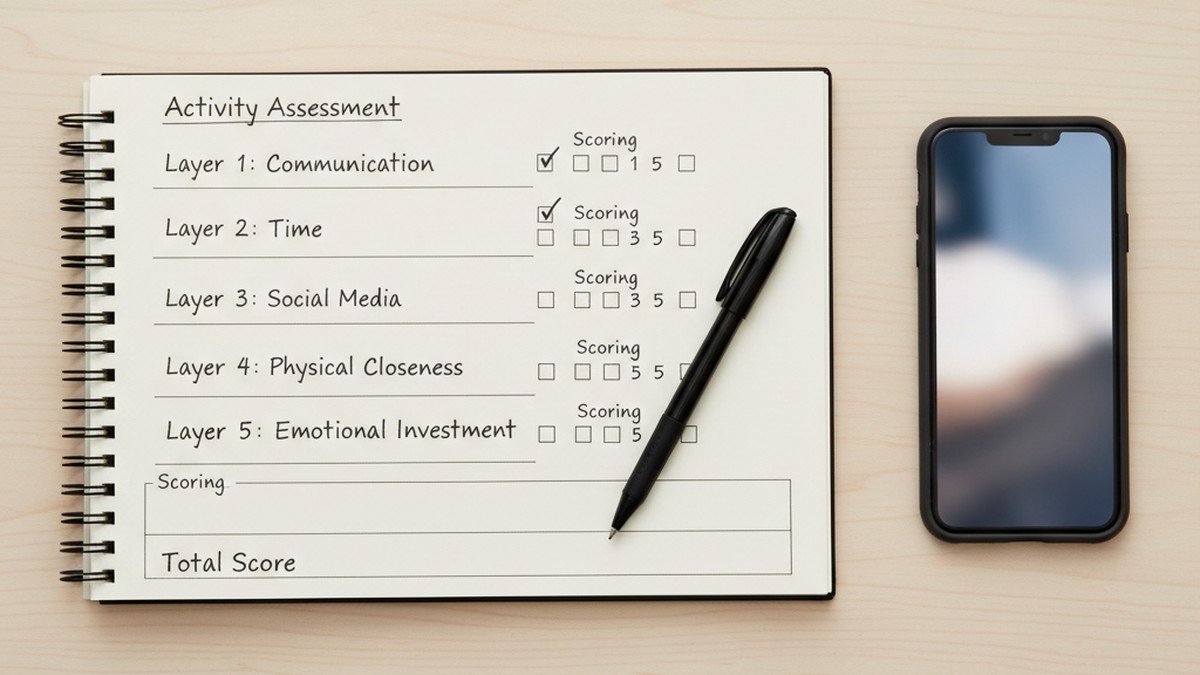
Most people approach a cheating concern with one question: "Is the app on their phone?" That question is too narrow. The 5-Layer Bumble Activity Check is a more structured method for assessing whether what you're seeing amounts to a real pattern.
Run through each layer in sequence. The more layers that return a positive signal, the stronger the case for having a direct conversation.
Layer 1 — Behavioral Layer
Does your partner exhibit phone-protection behavior that has changed recently? Specifically:
- Do they tilt or hide the screen when you're nearby?
- Has their phone lock screen or notification setting changed?
- Do they take the phone everywhere, including very short trips?
- Do they respond to messages at unusual hours?
Score this layer: 0 (no changes), 1 (one change), 2 (two or more changes)
Layer 2 — Device Layer
Do device-observable signals point to Bumble activity?
- Does Bumble appear in app data usage?
- Is there a Bumble subscription in Google Play or App Store subscriptions?
- Does bumble.com appear in browser history on shared devices?
- Is Screen Time data for Bumble significant?
Score this layer: 0 (nothing found), 1 (one signal), 2 (two or more signals)
Layer 3 — Financial Layer
Are there unexplained charges consistent with Bumble subscriptions?
- A recurring charge of $17-55 per month labeled "Bumble," "Apple," or "Google Play"
- A charge that started recently or you can't identify the source of
- A new payment method or card you weren't aware of
Score this layer: 0 (nothing), 1 (unexplained charge), 2 (confirmed Bumble charge)
Layer 4 — Platform Layer
Does a search or indirect verification confirm an active profile?
- Profile visible in Bumble app search (create new account, search by their demographics)
- Phone number verification attempt returns "number already in use"
- A third-party profile search tool returns results
Score this layer: 0 (no results), 1 (inconclusive), 2 (confirmed profile found)
Layer 5 — Social Layer
Are there interpersonal changes that align with the other signals?
- New emotional distance in the relationship
- Changes in appearance, grooming, or fitness motivation not connected to known reasons
- Increased defensiveness or irritability around questions about their phone or schedule
- New interest in spending time away from home without clear explanation
Score this layer: 0 (no changes), 1 (one or two changes), 2 (multiple changes)
Interpreting Your Total
| Total Score | Interpretation |
|---|---|
| 0-2 | Low signal. Single signs in isolation are rarely meaningful. |
| 3-5 | Moderate signal. Worth paying closer attention and possibly having a direct conversation. |
| 6-8 | Strong pattern. Multiple independent signals align. A conversation is warranted. |
| 9-10 | Very strong pattern across all layers. Seek support — from a trusted friend, therapist, or direct conversation with your partner. |
No score on this framework constitutes proof of anything. It's a structured way to assess whether scattered concerns add up to a coherent pattern — or whether they're being amplified by anxiety.
What Should You Do If You Find These Signs?
If you find consistent bumble cheating signs, avoid confronting your partner with suspicion alone. Document what you observe — behavioral changes, app activity, subscription charges — before any conversation. A calm, direct conversation grounded in specific observations is more productive than an accusation built on single signs taken out of context.
This is genuinely difficult advice to follow when you're feeling anxious or hurt. But the approach you take to this conversation matters for what comes after, regardless of what you find.
Before the Conversation
Clarify what you actually know versus what you're inferring. Write it down if it helps:
- What I observed directly: (e.g., "Bumble app on phone, screen tilted away three times this week, Bumble charge on bank statement")
- What I inferred from that: (e.g., "They may be actively using Bumble for dating")
- What I don't know: (e.g., "Whether it's BFF mode, whether the account is active, whether there's been any contact with anyone")
This distinction matters because it keeps the conversation from collapsing into a confrontation based on a conclusion you haven't established.
During the Conversation
Ask questions rather than making accusations. "I noticed Bumble on your phone — are you using it? What for?" is a different kind of conversation than "I know you're on Bumble and cheating." The first creates space for honesty. The second creates a defensive reaction regardless of what's true.
A partner who is using Bumble innocently will be able to answer clearly, show you their profile, and explain what they're doing with it. A partner who has something to hide will deflect, minimize, or become disproportionately angry. Those responses are themselves information.
After the Conversation
Whatever you find, support matters. If you're dealing with confirmed infidelity, the American Association for Marriage and Family Therapy reports that 60-75% of marriages survive infidelity with professional therapeutic support. If the conversation revealed nothing but the conversation itself revealed distance or problems, that's worth addressing directly.
If the conversation leaves you with more questions than answers, independent verification is a more productive path than continued suspicion without resolution.
What These Signs Do NOT Mean
The 9 signs described in this article are indicators, not proof. It's worth being explicit about the interpretations that these signs don't support on their own.
Bumble on the Phone ≠ Active Dating
This is the most important clarification. The Bumble app on a phone could mean BFF mode, Bizz networking, an account created years ago and forgotten, or an app that was opened once and never used seriously. Finding the app alone tells you almost nothing — context, mode, and the combination of other signals are what matters.
Many people in fully committed relationships have dating app accounts they created before the relationship and simply never deleted. Dormant accounts are common across all platforms.
Phone Secrecy ≠ Bumble Specifically
Phone privacy behavior has many causes. Someone might be planning a surprise, managing a personal health situation they're not ready to discuss, dealing with a financial problem they're embarrassed about, or simply uncomfortable with the expectation of total phone transparency. Guarding phone content is not automatically evidence of dating app activity.
No Profile Found ≠ No Account
The Incognito Mode problem cuts both ways. If you search for your partner on Bumble and find nothing, that result is compatible with three different realities: they don't have an account, they have an account but haven't been active in 30+ days, or they have an account with Incognito Mode enabled. A clean search result is not the same as confirmation they're not there.
Common Misconception: Bumble Is Easier to Catch Than Other Apps
Many people assume that because Bumble was "designed for women," it's somehow more transparent or safer territory. That's not accurate. Bumble has the same end-to-end messaging privacy as any other dating app, and its Incognito Mode makes it more private than Tinder for users who choose to use it. The platform's design philosophy doesn't make deceptive use less possible — it just changes how that use manifests.
For a broader look at how signs your partner is cheating show up across contexts — not just Bumble — the combination of digital and behavioral signals is always more informative than any single platform sign.
Conclusion: What Bumble Activity Actually Reveals
The bumble cheating signs worth paying attention to are the ones that cluster — not the ones that appear in isolation. A partner with the Bumble app and a premium subscription charge and changed notification behavior and new profile photos is a different situation from a partner who simply has Bumble on their phone.
Bumble's specific design — Incognito Mode, BFF excuse cover, no last-active timestamps, mandatory early messaging — creates a particular pattern of detectable behavior for people who are actively using it. Understanding that pattern is more useful than generic phone-guarding advice.
One thing this article has deliberately avoided is telling you what your partner's behavior definitely means, because no list of signs can do that. Human behavior has context that no article can account for. What the 5-Layer Bumble Activity Check and the 9 specific indicators here can do is help you assess whether your concern is grounded in a real pattern or amplified by anxiety alone.
If the pattern is real and a conversation hasn't resolved it, independent verification through a platform like CheatScanX — which scans Bumble and 15+ other dating apps — gives you a concrete answer rather than another layer of inference.
Understanding apps cheaters commonly use across platforms helps you see whether Bumble is part of a broader pattern rather than an isolated finding.
If you're still in the stage of wondering whether your concern is justified, reviewing the full picture of how to find out if your partner is on dating apps gives you a more complete framework than any single-platform check.
Clarity — whatever it reveals — is more useful than prolonged uncertainty.
Frequently Asked Questions
Not directly. Bumble does not expose active status to non-users. The most reliable method without creating your own account is checking whether their phone shows Bumble-related data usage, subscription charges in shared billing, or push notifications. A third-party profile search tool can also confirm whether a profile exists.
No. Bumble removed last-active timestamps from the platform specifically because that data was being used for stalking-type behavior. The only indirect signal is profile visibility: Bumble stops showing inactive profiles after approximately 30 days without login, so a visible profile confirms some level of recent activity.
Tinder is more commonly cited in cheating-related research due to its larger user base. However, Bumble's Incognito Mode and BFF excuse make it increasingly attractive to people who want to maintain a discreet presence on a dating app. CheatScanX scans regularly surface active Bumble profiles for people in committed relationships.
A Bumble app alone is not proof of cheating. Bumble has a BFF mode for platonic friendships and a Bizz mode for professional networking. The more meaningful question is whether the account is set to dating mode, whether it has a premium subscription, and whether the behavioral signs around phone use have changed alongside the app's presence.
You can search for a Bumble profile by creating your own account and adjusting filters to match your partner's likely settings — age, location, and distance. Bumble's Incognito Mode can prevent discovery through this method if your partner has it enabled. Third-party profile search tools scan dating app databases without requiring you to create a matching profile.