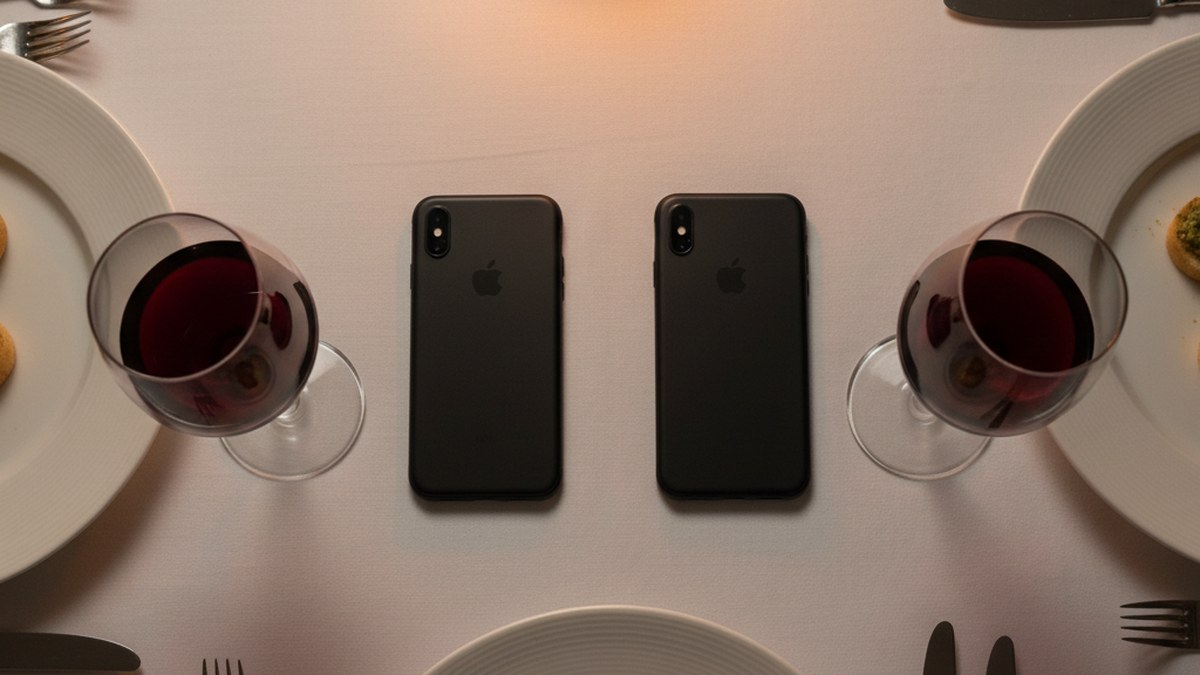
The phones are face-down again.
It is a Thursday evening at a restaurant in Chicago, and at every occupied table the scene repeats with minor variations: two people, two devices, screens pressed against white linen. Nobody agreed on this arrangement. Nobody needed to. The face-down phone has become the default posture of American intimacy — a gesture so routine that most couples no longer notice it, and so loaded that the ones who do notice cannot stop thinking about what it means.
What it means, according to a growing body of research, is that modern love operates under a tension that no previous generation of lovers has had to manage. The same technology that brought these couples together — 39% of heterosexual couples now meet online, per Stanford's HCMST data — is also the technology most likely to pull them apart. Eleven percent of married adults under 40 are active on dating apps right now, according to a 2024 Institute for Family Studies/YouGov survey. Not separated. Not in open relationships. Married. Swiping.
This is the fidelity paradox. Technology has made finding love faster, more efficient, and more democratic than at any point in human history. It has also made betrayal ambient — woven into the same devices we use to say goodnight, the same platforms we use to say I love you.
What follows is a data-driven examination of that contradiction. Not a moral argument, but a map: of how we meet, how we stray, what it costs, and where it might be heading.
Part 1: The Default Mode Shift
There was a moment, sometime between 2013 and 2019, when the question flipped. It used to be unusual to meet a partner online. Now it is unusual not to. The transition happened so gradually that most people missed the crossover, but the data captures it precisely.
Stanford sociologist Michael Rosenfeld has tracked how American couples meet since 2009 through the How Couples Meet and Stay Together (HCMST) study. His most recent data shows that 39% of heterosexual couples met online, making the internet the single most common pathway to partnership — ahead of friends, work, bars, school, and every other channel combined (Stanford HCMST, 2017-2023).
Among younger adults, the shift is more pronounced. Pew Research reports that 53% of Americans aged 18 to 29 have used a dating app, and that 30% of all U.S. adults have tried one at least once (Pew Research, 2023). The Knot's 2025 survey of newlyweds found that 27% met their spouse through a dating app — a figure that has roughly doubled since 2019.
The speed at which these relationships progress tells its own story. Communication researcher Liesel Sharabi's 2024 study, published in Communication Monographs, found that couples who met online reached marriage in an average of 37.1 months, compared to 44.1 months for offline couples. That is a seven-month acceleration — roughly the time it takes to go from meeting someone's parents to moving in together.
But acceleration and efficiency are not the same as success. Sharabi's research also found that online couples had lower progression rates from first date to exclusive relationship — 85% versus 89% for offline couples — and reported modestly lower satisfaction scores (3.82 out of 5 compared to 4.05 for offline couples). Pew's data shows that only 10% of all partnered adults actually met on a dating app, even though 30% have tried one. The gap between trial and success is enormous.
The Speed-Depth Tradeoff
| Metric | Online Couples | Offline Couples | Source |
|---|---|---|---|
| Average months to marriage | 37.1 | 44.1 | Sharabi, Communication Monographs, 2024 |
| First date to exclusive relationship | 85% | 89% | Sharabi, 2024 |
| Relationship satisfaction (out of 5) | 3.82 | 4.05 | Sharabi, 2024 |
| Divorce rate | 5.96% | 7.67% | Telematics and Informatics, 2025 |
| Love intensity rating | Lower | Higher | University of Stirling, 2025 |
The table above captures something important: online couples marry faster and divorce less often, but they also report feeling less in love. This is not a paradox so much as a selection effect. People who meet online tend to be more intentional about finding a partner, more willing to screen for compatibility, and more likely to treat relationship formation as a structured process rather than an accident. That structure produces stability. Whether it produces passion is another question entirely.
There is one unambiguously positive outcome of the online dating revolution. Nineteen percent of new marriages in the United States are interracial, a figure that researchers have directly linked to the growth of online dating (Pew Research). When algorithms replace social circles as the primary matchmaking mechanism, the pool of potential partners expands far beyond the demographic boundaries of geography, workplace, and family.
Part 2: The Fidelity Paradox
Here is where the story turns.
The couple at the Chicago restaurant met on Hinge three years ago. They moved in after fourteen months. They talk about marriage. By every visible metric, they are a success story of the system that brought them together. But there is a detail that does not appear in any survey, that would never show up in a study on how couples meet: he still has Bumble on his phone. He has not opened it in weeks, he would say if asked. He is not looking for anyone. He just never got around to deleting it. Whether that is true or not, and what it means if it is, occupies the exact fault line this article is about.
The same infrastructure that helps 39% of couples find each other also provides a permanent, frictionless channel for infidelity. A married person in 2006 who wanted to pursue an affair had to find a willing partner, arrange secret meetings, and manage an elaborate logistics of deception. A married person in 2026 needs only a phone, a few minutes, and one of the dozens of apps cheaters use to maintain a separate life that exists entirely within a screen.
The numbers are stark. The Institute for Family Studies and YouGov found in 2024 that 11% of married adults under 40 are active on dating apps. The gender split is dramatic: 18% of married men versus 6% of married women. These are not people in open marriages or polyamorous arrangements. These are people whose partners, in all likelihood, do not know.
The General Social Survey's most recent data (2022) puts baseline infidelity rates at 20% for married men and 13% for married women. But UK data suggests the trajectory is sharply upward: the Sunday Times reported in 2024 that infidelity in Britain surged from 20% to 36% between 2015 and 2024, a period that tracks almost exactly with smartphone saturation and dating app proliferation.
The New Vocabulary of Betrayal
What makes the fidelity paradox so difficult to navigate is that technology has created categories of infidelity that did not exist a generation ago — behaviors that fall into a gray zone between loyalty and betrayal, each with its own pattern and its own damage.
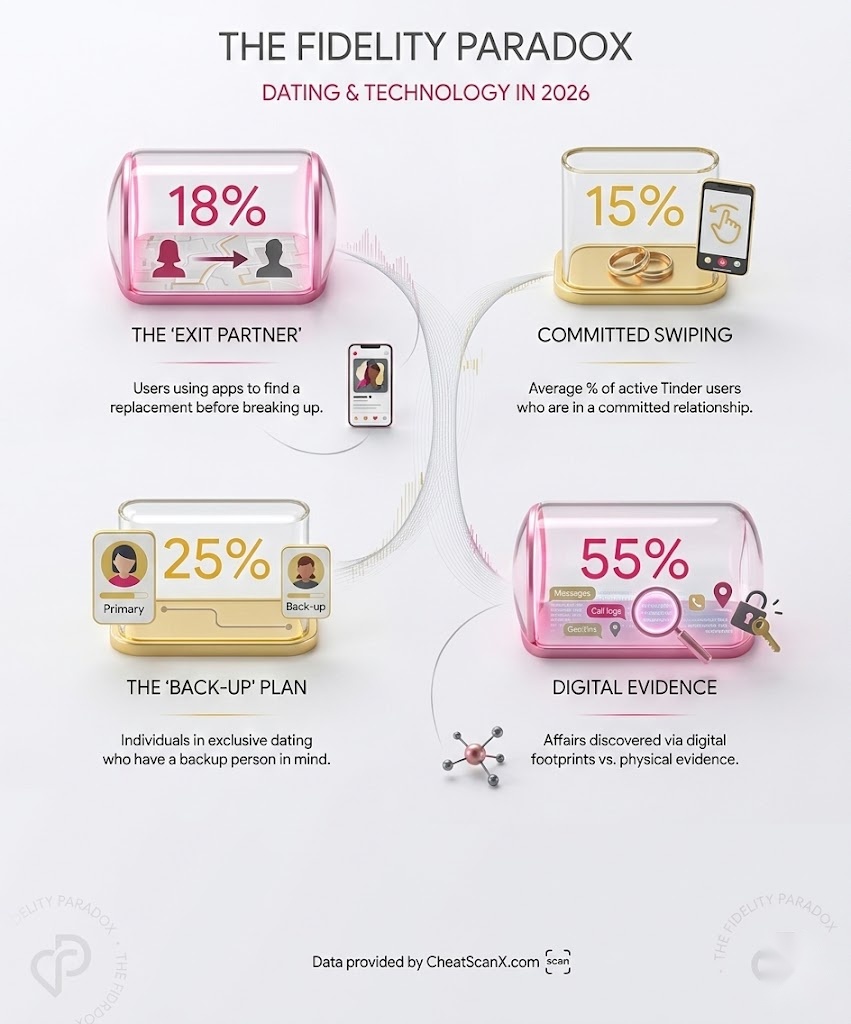
Committed Swiping. The act of maintaining an active dating profile while in a committed relationship. Not necessarily meeting anyone. Not necessarily messaging. Just... keeping the option open. Research published in Computers in Human Behavior (2020) found that 80% to 90% of people in relationships view their partner's dating app activity as a betrayal. Yet a significant minority of committed adults continue to do it, often rationalizing it as harmless browsing. Our research into dating app cheating statistics finds this is one of the most commonly reported forms of digital infidelity.
The Exit Partner. Someone maintained as a contingency — a relationship insurance policy. If the current relationship fails, there is someone already warmed up and waiting. The concept is related to what Psychology Today documented in 2019: 20% of women in committed relationships maintain what researchers called a "backup partner." The behavior is not limited to women. It is simply studied more frequently in that population.
The Backup Plan. Distinct from an exit partner, this describes the practice of keeping secret messaging apps and channels open for potential future use, even if no specific person is on the other end. It is less about a person than about preserving optionality.
Digital Evidence. The trail that technology leaves behind. When 55% of infidelity discoveries now involve some form of digital evidence — a notification, a screenshot, a hidden dating app on a phone — the phone itself has become the primary site of both the crime and its detection. Many who suspect something is wrong describe recognizing signs of emotional cheating through texting before any physical evidence appears.
How Affairs Start Now
The mechanics of infidelity have shifted from opportunity to architecture. Lazo App's 2025 research found that 38% of affairs now begin through social media, and that 42% start as what both parties describe as "harmless messaging" — a like, a reply, a DM that gradually escalates. Among adults under 35, 46% say that digital secrecy increases the temptation to cheat (Lazo App, 2025).
The gender gap in how cheating is defined adds another layer of complexity. Multiple surveys from 2024 and 2025 found that 85% of women consider sexting to be cheating, compared to 74% of men. This 11-point gap means that in many heterosexual relationships, the two partners are operating under fundamentally different definitions of fidelity.
| Behavior | % Considering It Cheating (Women) | % Considering It Cheating (Men) | Gap |
|---|---|---|---|
| Physical intimacy with someone else | 97% | 95% | 2 pts |
| Sexting / explicit messages | 85% | 74% | 11 pts |
| Active dating app profile | 83% | 71% | 12 pts |
| Emotional intimacy with someone else | 78% | 59% | 19 pts |
| Following / DMing attractive strangers | 45% | 28% | 17 pts |
Sources: Multiple surveys, 2024-2025. Figures represent approximate consensus across studies. Computers in Human Behavior, 2020; Lazo App, 2025.
The widest gap is emotional. Nearly four in five women consider deep emotional intimacy with someone outside the relationship to be infidelity. Fewer than three in five men agree. This disconnect is not academic. It plays out in millions of relationships where one partner believes they are being faithful and the other believes they are being betrayed.
For anyone who recognizes these patterns, the question of whether to investigate is deeply personal. Some find clarity through direct conversation. Others find themselves wondering if they are paranoid or if something is genuinely wrong. The research suggests that suspicion, when persistent and specific, is right more often than it is wrong.
Part 3: The Burnout Economy
If technology has made infidelity frictionless, it has also made the search for love exhausting.
Forbes Health and OnePoll surveyed dating app users in 2025 and found that 78% report burnout. The gender breakdown is revealing: 80% of women and 74% of men describe themselves as burned out on dating apps. Users spend an average of 50 minutes per day swiping, evaluating, and messaging — roughly the same time as a daily commute — and 41% have deleted a dating app at least once in the past year, only to re-download it later.
The delete-and-return cycle is so common that it has its own industry metric. AppsFlyer reported in 2025 that 69% of dating apps are deleted within the first month of installation. The apps are designed to be addictive, but the experience they deliver is often miserable enough to override the addiction — temporarily.
The Market Is Correcting
The burnout epidemic is reshaping the dating app industry in real time. Tinder, the platform that defined the swipe era, has lost 1.2 million paid subscribers since early 2024 (Match Group earnings, 2025). Bumble's paying user base is down 16%. Fewer than 15% of premium subscribers across the industry renew their plans.
Yet Hinge — the app that markets itself as "designed to be deleted" — saw revenue increase 27% over the same period. The divergence tells a story. Users are not abandoning dating apps entirely. They are migrating from volume-based platforms (swipe on everyone, match with many, connect with few) to intention-based platforms (fewer but more curated interactions). The market is punishing breadth and rewarding depth.
| Platform | Trend (2024-2025) | Direction | Source |
|---|---|---|---|
| Tinder | Lost 1.2M paid users | Down | Match Group Earnings, 2025 |
| Bumble | Paying users down 16% | Down | Bumble Earnings, 2025 |
| Hinge | Revenue up 27% | Up | Match Group Earnings, 2025 |
| Industry-wide premium renewal | Below 15% | Down | Industry data, 2025 |
| App deletion within 30 days | 69% | Stable/High | AppsFlyer, 2025 |
The Financial Toll
The burnout carries a financial cost that few users calculate. BMO and Ipsos reported in early 2026 that the average American spends $2,323 per year on dating, with the average date costing $189. That annual figure includes app subscriptions, dinners, drinks, transportation, grooming, and clothing — a cumulative investment that, for many users, produces months of swiping and a handful of mediocre evenings.
For context: $2,323 per year is more than the average American spends on electricity. The dating economy has become a significant line item in personal budgets, and the returns — measured in successful relationships per dollar spent — are declining as burnout rises and app engagement drops.
Part 4: The Political Bedroom
If burnout represents the emotional cost of modern dating, the political divide represents its ideological one. Dating has always involved compatibility filtering — shared values, mutual attraction, aligned life goals. But the filters have become explicitly partisan in ways that would have seemed absurd twenty years ago.
An NPR/PBS/Marist poll from May 2025 found that 60% of Americans aged 18 to 29 want a partner who shares their political views. Among Gen Z women specifically, 46% say they would never date someone from the other side of the political aisle. This is not a preference. It is a wall.
The dating apps have noticed. Hinge introduced political affiliation badges. Bumble lets users filter by political leaning. Smaller platforms like "The Right Stuff" and "Loveflutter" have launched around explicitly partisan identities. The result is a dating landscape that increasingly mirrors the media landscape: siloed, self-reinforcing, and hostile to cross-pollination.
The implications extend beyond individual relationships. When romantic partnerships form almost exclusively within political tribes, the last remaining bridge between ideological camps — the dinner table, the shared bed, the in-laws from the other side — weakens further. Political scientists have long argued that cross-cutting social ties moderate polarization. Dating apps, by design, are eliminating those ties before they can form.
AI as Matchmaker
Layered on top of the political filter is a technological one. The Match Group and Kinsey Institute's annual Singles in America survey reported in June 2025 that AI usage in dating has increased 333% year over year. Twenty-six percent of singles now use AI in some capacity — to write messages, to select photos, to evaluate matches. Among Gen Z, the figure approaches 50%.
Perhaps more telling: 44% of users say they want AI to filter their matches for them. Nearly half of the dating population is willing to outsource their first impression to an algorithm. The implications are significant. If AI selects who you see, and political filters determine who the AI considers, the pool of potential partners narrows dramatically before a single human judgment is made.
| AI in Dating | Statistic | Source |
|---|---|---|
| Year-over-year growth in AI usage | 333% | Match/Kinsey Institute, 2025 |
| Singles who use AI for dating | 26% | Match/Kinsey Institute, 2025 |
| Gen Z singles using AI for dating | ~50% | Match/Kinsey Institute, 2025 |
| Users who want AI to filter matches | 44% | Match/Kinsey Institute, 2025 |
| Belief in love at first sight | 60% (up from 34% in 2014) | Match/Kinsey Institute, 2025 |
There is a deep irony in the last row of that table. At the exact moment when dating is becoming more algorithmic, more filtered, and more mediated by technology, belief in love at first sight has nearly doubled. Sixty percent of singles now believe in it, up from 34% in 2014. The generation most reliant on technology to find love is also the generation most likely to believe that love should feel like magic.
Part 5: The Stability Question
So the central question: do relationships formed in this new landscape actually last?
The answer depends on what you mean by "last."
A cross-national study published in Telematics and Informatics in 2025 found that couples who met online had a divorce rate of 5.96%, compared to 7.67% for couples who met offline. On paper, online relationships are more durable. They survive at higher rates.
But survival is not the same as thriving. Researchers at the University of Stirling published findings in August 2025 showing that couples who met online reported lower love intensity and lower relationship satisfaction than those who met through traditional channels. Sharabi's 2024 data supports this: online couples rated their satisfaction at 3.82 out of 5, versus 4.05 for offline couples. The difference is statistically significant and emotionally meaningful.
What emerges is a picture of relationships that are stable but somewhat muted — partnerships built on rational compatibility rather than irrational chemistry. They work. They last. But they may not produce the depth of feeling that older modes of meeting — the chance encounter, the slow burn of workplace proximity, the introduction through a trusted friend — once did.
There is a possible explanation for this pattern that goes beyond selection effects. When you meet someone through a friend, through a shared activity, through the organic friction of daily life, the context itself provides a foundation of meaning. You share a world before you share a bed. When you meet someone through an app, the context is the app itself — a transactional space designed to facilitate evaluation. The relationship begins in a marketplace and must work to transcend its origins. Many do. But the marketplace leaves a residue.
The implications for fidelity are direct. If a relationship feels more like a rational arrangement than an emotional inevitability, the cost of disrupting it feels lower. The phone face-down on the table carries less weight when the relationship itself began as a decision rather than a discovery. This may help explain why online couples divorce less often (the rational decision to stay is easier to maintain) but report less intensity (the emotional foundation was never as deep).
The Diversity Dividend
One area where online dating has produced unambiguously positive outcomes is in the diversification of partnerships. Pew Research has documented that 19% of new marriages in the United States are interracial, and researchers have directly linked this increase to the rise of online dating. When algorithms replace social networks as the primary matchmaking tool, the result is a broader, more diverse set of potential matches. People connect across racial, socioeconomic, and geographic lines that their offline lives would never have crossed.
This is worth pausing on. Whatever its flaws, online dating has done something that decades of social policy struggled to achieve: it has made American marriage meaningfully more diverse.
The Homogamy Trade-Off
The flip side is that online dating has also made it easier to filter for sameness. Political filters, religious preferences, education requirements, income thresholds — each narrowing parameter reduces the pool and increases homogamy (the tendency to pair with someone similar to yourself). The same technology that breaks down racial barriers can reinforce ideological ones.
The net effect depends on which filters people use. For race, the effect has been liberating. For politics, it may be calcifying. For education and income, the data is mixed. The platform design matters: apps that emphasize profiles (Hinge, The League) tend to encourage homogamy, while apps that emphasize proximity and spontaneity (Tinder, Bumble) tend to produce more diverse matches.

Part 6: The Generation Paradox
No group embodies the contradictions of modern dating more fully than Gen Z.
Consider the data points side by side. Sixty-eight percent of Gen Z adults say they would consider non-monogamy in a relationship. They are twice as likely as older generations to be in open relationships (Hims, 2025). Non-monogamy is not just tolerated in this cohort; it is mainstream.
And yet: 81% have fantasized about monogamy. Forty-four percent fantasize about it often (Feeld/Kinsey Institute, 2025). The generation that is most open to alternative relationship structures is also the generation most likely to daydream about the traditional one.
This is not hypocrisy. It is the natural result of growing up in a dating landscape where optionality is the default. When every relationship exists alongside the awareness that there are thousands of other potential partners a swipe away, monogamy becomes aspirational rather than assumed. It is something you choose deliberately, not something you fall into by default.
The Ghosting Epidemic
The cost of all this optionality is a crisis of follow-through. The Thriving Center of Psychology reports that 84% of Gen Z adults have been ghosted — cut off without explanation by someone they were dating. Forty-four percent have ghosted someone they dated for more than a month. The ease of finding new connections has made it trivially easy to abandon existing ones.
Ghosting is not just rude. Research consistently links it to anxiety, depression, and erosion of self-worth in the person ghosted. It is also corrosive to the ghoster, who learns that relationships can be terminated without consequence, a lesson that does not serve them well when they eventually attempt to build something lasting. Those who have experienced this pattern often describe the gut feeling that something is wrong — a persistent unease that develops after repeated exposure to sudden disconnection.
The ghosting epidemic connects directly to the fidelity paradox. A generation trained by dating apps to treat people as disposable does not suddenly develop deep loyalty when a relationship becomes serious. The muscle of commitment — the ability to stay present when staying is hard, to choose repair over replacement — atrophies when it is never exercised. And the same phone that makes ghosting a stranger effortless also makes maintaining a secret connection with someone outside the relationship feel equally frictionless.
Clear-Coding: The Counter-Movement
Perhaps because of all this, Gen Z is also the generation pushing hardest for transparency. Tinder's December 2025 report named "Clear-Coding" as the top dating trend for 2026 — the practice of stating your relationship intentions explicitly and upfront. No ambiguity about whether you want something casual or serious. No strategic vagueness about your emotional availability.
Sixty-four percent of Gen Z say that emotional honesty is what dating needs most (Tinder, 2025). This is a generation that has been burned by the consequences of ambiguity — by partners who still have dating apps and claim it means nothing, by relationships that refuse to define themselves, by connections that evaporate without explanation. Their response is not to retreat from dating but to demand clarity within it.
The Cost of Being Young and Dating
The financial burden falls hardest on the generation least able to afford it. At $2,323 per year in average dating costs and $189 per date (BMO/Ipsos, 2026), dating represents a substantial portion of a young person's discretionary spending. For a 24-year-old earning the median Gen Z salary, those dating costs represent roughly 5% of their take-home pay — spent on an activity that produces burnout in 78% of participants.
Part 7: The Verdict
What does all of this add up to?
Not a crisis. Not a golden age. Something more complicated: a fundamental restructuring of how human beings pursue and maintain intimate relationships, one that is still in its early stages and producing contradictory outcomes at every turn.
The data tells us that technology has made partnership more accessible and more diverse. It has accelerated the path to commitment and reduced certain barriers — racial, geographic, socioeconomic — that once constrained who could love whom. These are genuine gains, and they should not be minimized.
The data also tells us that the same technology has introduced a persistent, ambient threat to fidelity. When an alternative is always one unlock away, commitment requires a different kind of discipline than it did in previous generations. The signs a partner is cheating have shifted from lipstick on a collar to a notification at 11 PM, from a receipt in a pocket to a hidden dating profile. The infidelity has not necessarily increased in total volume — the GSS shows relatively stable rates over decades — but it has changed in character, moving from discrete events to continuous possibility.
The burnout is real. The political polarization of dating is real. The financial toll is real. And the generational contradictions — wanting both freedom and commitment, both transparency and mystery, both algorithmic efficiency and romantic magic — are not going to resolve themselves anytime soon.
But there is one consistent signal cutting through the noise: a demand for honesty.
Across every demographic, every platform, and every data set reviewed for this article, the strongest finding is that people want to know where they stand. They want partners who say what they mean. They want relationships where the phone can stay face-up on the table.
Clear-coding is not just a trend. It is a survival strategy for a generation navigating a dating landscape that has become opaque by design. When apps profit from ambiguity, when algorithms optimize for engagement rather than connection, and when the line between browsing and betrayal has been blurred to the point of invisibility, radical transparency is the only reliable countermeasure.
The fidelity paradox will not be resolved by better technology. It will be resolved — to the extent it can be — by people who choose clarity over convenience, who treat commitment as a verb rather than a status, and who recognize that the most important swipe is the one they do not make.
Back in Chicago, the couple finishes dinner. He picks up his phone. She watches, briefly, then picks up hers. Neither of them is doing anything wrong. Both of them are aware that wrongdoing has never been easier. That awareness — the ambient hum of possibility that technology has introduced into every committed relationship — is the fidelity paradox reduced to its smallest unit: two people, two phones, and the daily choice to keep choosing each other.
If the data here has you concerned, CheatScanX can give you a direct answer. It searches 15+ dating apps for hidden profiles.
Search dating profiles nowMethodology and Sources
This article draws on peer-reviewed research, large-scale surveys, industry earnings reports, and nationally representative polling data. All statistics are cited inline with source names and years. Where multiple sources report similar findings, we have used the most recent and most methodologically rigorous figure available. Approximate figures are noted as such. No single data point should be interpreted in isolation — the value of this analysis lies in the convergence of multiple independent data sets pointing toward the same conclusions.
Key research reviewed: Stanford HCMST (2017-2023), Pew Research Center (2023), General Social Survey (2022), IFS/YouGov (2024), Forbes Health/OnePoll (2025), AppsFlyer (2025), Match Group/Bumble earnings reports (2025), Sharabi in Communication Monographs (2024), Telematics and Informatics (2025), University of Stirling (2025), NPR/PBS/Marist (2025), Match/Kinsey Institute (2025), Hims (2025), Feeld/Kinsey Institute (2025), Thriving Center of Psychology (2023-2025), Tinder Year in Swipe (2025), BMO/Ipsos (2026), Lazo App (2025), Computers in Human Behavior (2020).
For those looking to explore specific aspects of the data in more depth, our research team has published detailed analyses on cheating statistics, what percentage of people cheat, Tinder cheating statistics, and long-distance cheating signs. Those investigating specific concerns can learn how to catch a cheater, explore the best ways to catch a cheating spouse, or learn how to find hidden social media accounts.
If you suspect a partner is active on dating platforms, practical guidance is available for those who want to find out if a partner is on dating apps or check if a partner is on dating sites. And if confirmation arrives, we have written about how to confront a cheater in a way that centers your well-being over their excuses.
Frequently Asked Questions
The fidelity paradox describes a contradiction at the center of modern romance: technology has made finding committed partners easier and faster than ever, yet it has simultaneously created new categories of betrayal. Couples who meet online reach marriage about seven months sooner, but they also report lower relationship satisfaction than offline couples, and 11% of married adults under 40 remain active on dating apps.
UK data shows infidelity surged from 20% to 36% between 2015 and 2024, a period that tracks closely with smartphone saturation. Research finds 38% of affairs now begin through social media, 42% start as harmless messaging, and 46% of adults under 35 say digital secrecy increases cheating temptation. The shift is from physical acts to digital behaviors that erode trust gradually.
Forbes Health and OnePoll found that 78% of dating app users report burnout, with women at 80% and men at 74%. Supporting data shows 69% of dating apps are deleted within the first month, users spend an average of 50 minutes per day swiping, and fewer than 15% of premium subscribers renew. Tinder alone lost 1.2 million paid users since early 2024.
A cross-national study in Telematics and Informatics found online couples divorce at 5.96% versus 7.67% for offline couples. However, University of Stirling research shows online couples report lower love intensity and relationship satisfaction. The data suggests online-formed relationships last longer on paper but may feel less fulfilling in practice.
Gen Z holds seemingly contradictory desires. Sixty-eight percent would consider non-monogamy, yet 81% have fantasized about monogamy and 44% do so frequently. They prioritize emotional honesty, with 64% naming it as what dating needs most. Tinder named Clear-Coding, the practice of stating intentions upfront, as the top dating trend for 2026.