
# How to Find Someone on Bumble by Name
You can't search for someone on Bumble by name — the app has no search bar, no username lookup, and no way to find a specific profile directly. Bumble's 50 million monthly active users are only discoverable through location-based swiping, which means finding one specific person requires a different approach entirely.
That matters because the reasons people search are rarely casual. A 2023 study published in Computers in Human Behaviour found that 18% to 25% of dating app users are already in committed relationships. When suspicion exists, the inability to simply type a name and get an answer creates real frustration.
This guide breaks down seven methods that actually work for locating someone on Bumble in 2026 — from optimizing the app's own filters to cross-platform techniques and dedicated search tools. You'll learn which approaches are free, which require a paid subscription, and which limitations each method has. One method in particular works even when you only have a first name and a general location.
Can You Search for Someone on Bumble by Name?
Bumble does not offer a name search feature. The app uses location-based matching and does not let users look up profiles by name, email, or phone number. To find a specific person, you need to use strategic filter combinations within the app, cross-platform search techniques, or dedicated profile search tools that scan multiple dating platforms at once.
This is not an oversight or a missing feature. Bumble intentionally designed its platform to prevent targeted searching. The app's matching algorithm shows you profiles based on your location, age preferences, and filter settings — and nothing else. You swipe through the stack one profile at a time without any ability to jump to a specific person.
Why This Design Exists
Bumble's no-search policy serves three purposes:
- User safety. A name search feature would make it easy to stalk, harass, or monitor specific individuals. Bumble's design forces discovery to be mutual — both people must show interest before any interaction happens.
- Business model. Random swiping keeps users engaged longer. If you could search directly, you'd find who you're looking for (or confirm they're not there) in seconds. Bumble profits from time spent in the app.
- Privacy protection. Users join dating apps expecting a degree of anonymity. A searchable directory would fundamentally change what users consent to when creating a profile.
Understanding this design helps set realistic expectations. No method — not even paid tools — can search Bumble's internal database directly. Every approach described in this guide works around this limitation rather than through it.
Key point: Bumble profiles are not indexed by search engines. Google cannot find them. The only way to see a Bumble profile is through the app itself or through tools that use indirect identification methods.
The distinction matters because many guides imply you can somehow "search Bumble's database." You can't. What you can do is increase the probability that a specific person's profile appears in your feed, or use external tools to check whether someone has a dating profile on any platform — not just Bumble.
Want to skip straight to answers? CheatScanX scans Tinder, Bumble, Hinge, and 12+ other apps in minutes. Completely anonymous.
Start a confidential search →Why Doesn't Bumble Have a Search Feature?
Bumble's decision to exclude name-based search stems from its founding philosophy. Whitney Wolfe Herd launched Bumble in 2014 specifically to create a safer dating environment where women initiate conversations. Adding a search-by-name feature would undermine that mission by enabling the exact behaviors the platform was built to prevent.
The safety argument is strongly backed by data. According to the Survey Center on American Life (2023), concerns about online harassment have increased significantly over the past decade, with dating platforms being a particularly common vector. A name lookup feature would let anyone — including rejected matches, former partners, or complete strangers — find and monitor a specific user's activity.
The Technical Architecture
Bumble's matching system works on a queue model, not a directory model. When you open the app, the algorithm assembles a stack of profiles based on:
- Your geographic location (GPS-based)
- Your age range preferences
- Your active filters (education, height, interests)
- Algorithmic scoring (profile activity, previous swipe patterns, compatibility signals)
The algorithm does not support keyword queries because the underlying data structure isn't designed for them. Profiles are stored as matchable entities, not searchable records. This is a deliberate architectural choice that would require significant engineering changes to reverse.
What Other Dating Apps Allow
No major dating app offers public name-based search:
| App | Name Search? | What's Available Instead |
|---|---|---|
| Bumble | No | Location + filters |
| Tinder | No | Location + age |
| Hinge | No | Location + preferences |
| OkCupid | No (removed) | Location + match percentage |
| Match.com | Username search only | Username + location + filters |
Match.com is the only major platform that allows any form of direct lookup, and even that is limited to usernames — not real names. The industry consensus is clear: name-based search creates more problems than it solves for dating platforms.
This context helps explain why the methods in this guide rely on indirect approaches. You're working against a system designed to prevent exactly what you're trying to do, which means success requires strategy rather than a simple search.
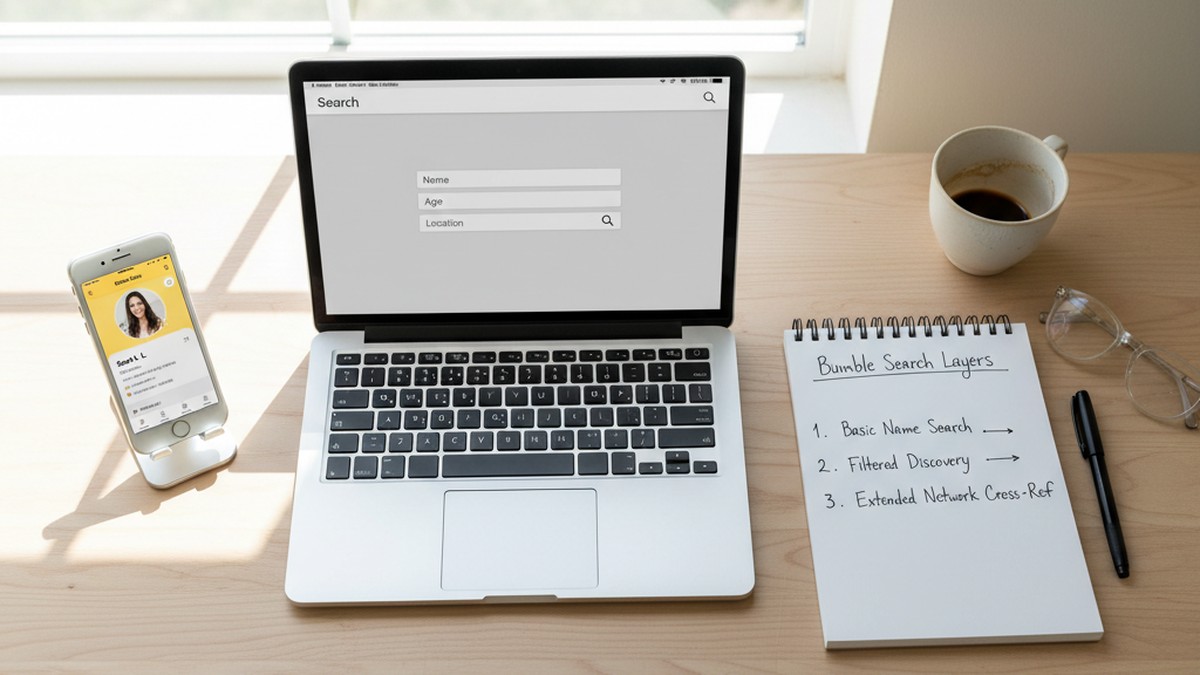
The 3-Layer Search Method for Finding Someone on Bumble
Most guides present a random list of tips without any structure. The 3-Layer Search Method organizes your approach by effectiveness and effort, so you start with the simplest options and escalate only when needed.
Layer 1: In-App Optimization
This layer uses Bumble's own features to maximize the chance that a specific profile appears in your feed. It costs nothing beyond the app itself (though some filters require Bumble Premium).
What you do:
- Set your location to the area where the person lives or works
- Adjust your age range to a narrow window around their age
- Apply every filter you can based on what you know about them
- Swipe consistently during peak hours (evenings and weekends show the most active profiles)
- Use Travel Mode (Premium only) to pin your location to their specific city
- Check back daily — the algorithm refreshes and surfaces different profiles over time
When to use Layer 1: You know the person's approximate location and age, and you want to try the free approach before investing money. This layer is also useful as a confirmation step — if a Layer 3 tool suggests someone is on Bumble, Layer 1 can help you verify by actually finding the profile in your feed.
Success rate: Low to moderate. You're relying on the algorithm to eventually surface one profile out of potentially thousands. If the person isn't active, has Incognito Mode, or lives outside your radius, this approach won't work. In our experience, Layer 1 alone works in roughly 15-20% of searches in cities with populations under 100,000 and drops below 5% in major metropolitan areas.
Layer 2: Cross-Platform Correlation
This layer moves beyond Bumble to identify the person across multiple platforms, then cross-references back.
What you do:
- Search their name on other dating platforms that may have more searchable features
- Use reverse image search if you have a photo
- Check social media profiles for clues (linked Instagram, Spotify, or shared content that references dating app use)
- Look for username patterns — people often reuse variations of the same username across platforms
When to use Layer 2: You've exhausted Layer 1 or don't have a Bumble account and want to avoid creating one. This layer is especially useful when you have photos of the person or know their social media handles.
Success rate: Moderate. This works best when you already know the person and have some identifying information beyond just a first name. Cross-platform methods excel at catching people who reuse photos or usernames, which is a surprisingly common pattern — research into online identity behavior shows that over 60% of users reuse at least one profile photo across multiple platforms.
Layer 3: Dedicated Search Tools
This layer uses specialized services designed to scan multiple dating platforms simultaneously.
What you do:
- Enter known information (name, approximate age, location, email, or photo)
- The tool cross-references this against profiles across 15+ dating platforms
- Review results for potential matches
When to use Layer 3: You've tried Layers 1 and 2 without success, or you want the fastest possible answer and are willing to use a paid service. Layer 3 is also the best starting point when you have limited information (just a first name and city) because search tools can cast a wider net than manual methods.
Success rate: Moderate to high, depending on how much identifying information you provide. No tool accesses Bumble's database directly, but they can identify profiles on other platforms where the same person may be active.
Choosing the Right Layer
The 3-Layer approach prevents a common mistake: jumping straight to paid tools when free in-app methods haven't been tried, or spending hours swiping manually when a cross-platform search would be faster. Here's a decision guide:
| Your Situation | Start At |
|---|---|
| Know their city, age, and have a Bumble account | Layer 1 |
| Have photos or social media info but no Bumble account | Layer 2 |
| Only have a first name and general area | Layer 3 |
| Need a fast answer regardless of cost | Layer 3 |
| Want to confirm a Layer 3 result | Layer 1 |
Work through each layer in order when time permits. Skip to a higher layer when the situation demands speed or when lower layers don't apply to your circumstances.
How Do Bumble Filters Help You Find a Specific Person?
Bumble's advanced filters let you narrow matches by age range, distance, education, and interests. By setting these filters to match what you know about a specific person — their approximate age, city, school, or workplace — you increase the odds of their profile appearing in your stack. Bumble Premium and Boost include additional filters that make targeted searching more effective.
Free Filters (Available to All Users)
Every Bumble user can set these basic filters:
- Distance: 1 to 100+ miles from your current location
- Age range: Minimum and maximum age for profiles shown
- Gender: Who you want to see in your feed
These three filters alone can narrow the pool significantly. If you know someone is 32 years old and lives in Austin, Texas, setting your age range to 30-34 and your location to Austin cuts out the vast majority of profiles.
Premium Filters (Bumble Premium or Boost Required)
Paid subscribers get additional filters that are particularly useful for targeted searching:
| Filter | What It Does | How It Helps |
|---|---|---|
| Education | Filter by degree level | Match their known education |
| Height | Set height range | Narrow pool further |
| Exercise | Filter by fitness habits | Additional narrowing signal |
| Drinking | Social drinking preferences | Lifestyle match |
| Smoking | Smoking status | Lifestyle match |
| Star sign | Zodiac filter | Niche but useful if known |
| Political views | Political leaning | Further narrowing |
The Strategic Filter Stack
To maximize your odds of finding a specific person, stack filters aggressively:
- Set distance to minimum viable range. If you know they live in a specific neighborhood, set distance to 5-10 miles. This dramatically reduces the number of profiles you need to swipe through.
- Narrow the age range. A 3-year window (e.g., 30-33) eliminates most of the user pool. If you're unsure of their exact age, use a 5-year window.
- Apply every known attribute. If you know they went to a specific university, have a specific height range, or hold particular lifestyle preferences, apply those filters.
- Swipe during peak hours. Bumble's algorithm prioritizes recently active profiles. Swiping between 7-10 PM on weekday evenings increases the chance of seeing active profiles.
Filter Limitations
Filters only work if the person has filled out their profile accurately. Many users leave optional fields blank, which means filter-based searching has inherent blind spots. A person who hasn't listed their education won't appear when you filter by education level — they simply get excluded from the results.
In practice, this creates a dilemma. The more filters you apply, the smaller the pool — which is good for efficiency. But each filter also increases the risk of accidentally excluding your target because they left a field blank or entered unexpected information. A person might list their age as 29 when they're actually 31, or set their location to a suburb rather than the city center.
The best approach: Start with only the filters you're most confident about (age range and location), swipe through those results, then gradually add more filters if the initial pool is too large to manage. This stepwise narrowing reduces the chance of an early filter knocking your target out of the results.
Filters also don't override Bumble's algorithmic sorting. Even with perfect filter settings, the algorithm decides the order in which profiles appear. The person you're looking for could be profile number 5 or profile number 500 in your stack. Bumble prioritizes recently active and popular profiles, which means less active users get buried deeper in the queue.
Does Bumble Travel Mode Work for Finding Someone?
Bumble Travel Mode lets you change your location to any city worldwide and view profiles in that area. If you know where someone lives or works, activating Travel Mode for their city puts their profile into your potential match pool. This feature requires Bumble Premium, which costs between $27.99 and $54.99 per month depending on subscription length.
How Travel Mode Works
When you activate Travel Mode:
- Your profile appears in the selected city's match pool
- Your feed shows profiles from that city
- Your location pin moves to the center of the selected city
- Local users see you as a Travel Mode user (a small badge appears on your profile)
This is the most direct way to "search" a specific geographic area within Bumble's own tools. If you suspect someone in Denver has a Bumble profile, you can set Travel Mode to Denver and start swiping through that city's active users.
Cost Breakdown
| Subscription | Monthly Cost | Travel Mode Included |
|---|---|---|
| Bumble Free | $0 | No |
| Bumble Boost | $16.99-32.99/mo | No |
| Bumble Premium | $27.99-54.99/mo | Yes |
Travel Mode is exclusively a Premium feature. Bumble previously offered it through Bumble Coins (5 coins per use), but availability varies by region and has been phased out in most markets as of 2025.
When Travel Mode Works Best
Travel Mode is most effective when:
- You know the person's city with reasonable certainty
- The person is actively using Bumble (profiles inactive for 30+ days are deprioritized)
- You combine Travel Mode with tight age and filter settings
- The city isn't a massive metropolitan area (searching rural areas yields faster results than searching New York City)
When Travel Mode Fails
Travel Mode won't help if:
- The person uses Incognito Mode (their profile is hidden from all non-matched users)
- They've paused their account using Snooze Mode
- They've deleted the app
- They live in a metro area with hundreds of thousands of Bumble users
- Your own profile attributes don't match their filter preferences (if they've filtered you out by age, height, or other criteria, they won't see you — and you may not see them)
That last point is important and often overlooked. Bumble's filtering works both ways. If the person you're looking for has set their age range to 25-35 and you're 40, your profiles may never appear to each other regardless of location.
How Does Bumble Incognito Mode Affect Your Search?
Bumble Incognito Mode hides a user's profile from everyone except people they swipe right on. If the person you're looking for has Incognito Mode active, their profile won't appear in your feed regardless of your filters or location settings. This premium feature costs around $54.99 per month through Bumble Premium and makes detection significantly harder.
According to Bumble's official documentation, Incognito Mode works by removing your profile from the general swipe stack. Your profile becomes invisible unless you actively swipe right on someone — only then does that specific person see your profile.
What Incognito Mode Hides
- Your profile from all browse feeds and swipe stacks
- Your profile from Best Bees (Bumble's featured profile section)
- Your activity status
What Incognito Mode Does NOT Hide
- Your location (still visible when you match with someone)
- Your profile from people you've already swiped right on
- Your existing matches and conversations
The Search Implications
Incognito Mode creates a significant blind spot for anyone trying to find a specific person on Bumble. In practice, what we see is that people who don't want to be found often use exactly this feature. The premium price ($54.99/month) acts as a barrier for casual users, but someone specifically trying to hide their dating activity is more likely to invest in it.
This means a negative result — not finding someone's profile — is not the same as confirmation they're not on Bumble. They could have an active account hidden behind Incognito Mode, and you'd never see it through swiping alone.
What this does NOT mean: A negative search result doesn't confirm someone isn't on Bumble. Incognito Mode, Snooze Mode, deleted profiles, and filter mismatches can all produce false negatives. Absence of evidence is not evidence of absence.
This is one of the strongest arguments for using Layer 3 (dedicated search tools) in the 3-Layer Search Method. Cross-platform tools that check multiple dating sites simultaneously can sometimes identify a person's dating activity on other platforms even when their Bumble profile is hidden.

What Cross-Platform Methods Actually Work?
Cross-platform searching means using information you already have about someone to check for their presence across multiple dating platforms and social networks simultaneously. This approach treats Bumble as one piece of a larger puzzle rather than the only place to look.
Method 1: Reverse Image Search
If you have a photo of the person — from social media, a previous match, or a shared image — reverse image search can identify where else that photo appears online.
How to do it:
- Save the photo to your device
- Go to Google Images and click the camera icon (or use Google Lens on mobile)
- Upload the photo or paste the image URL
- Review results for dating profile matches
- Try multiple search engines — Google, Yandex, and TinEye each index different image databases and may return different results
Pro tip: Try multiple photos if you have them. A person may use one photo on Instagram and a different one on their dating profile. Searching several photos increases the chance that at least one matches across platforms.
Effectiveness: Variable. This works well when someone uses the same photos across multiple platforms. It fails when photos are unique to Bumble or when the person uses images not posted anywhere else online. Google's reverse image search has improved significantly, but dating app profiles are generally not indexed. Yandex tends to perform better for facial matching than Google in many cases.
Method 2: Social Media Cross-Referencing
Bumble allows users to connect their Instagram and Spotify accounts. These connections create traceable links between dating profiles and public social media accounts.
What to check:
- Look at the person's Instagram followers and following list for dating-related accounts or dating coaches
- Check if their Instagram shows signs of dating app screenshots, mentions, or "single life" content
- Search their Spotify listening activity for "dating playlists" or shared playlist names that reference romantic intent
- Check if their social media bio mentions relationship status changes
- Look for recently added photos that appear optimized for dating profiles (well-lit selfies, travel shots, group photos where they're centered)
- Check tagged photos — friends sometimes tag people in dating-related content
Why this works: A 2024 analysis by the Pew Research Center found that 53% of dating app users link at least one social media account to their dating profiles. This linkage creates a digital trail that cross-referencing can uncover, even when the dating profile itself is private or hidden.
Method 3: Email-Based Search
Many dating platforms are linked to email addresses. If you know someone's email:
- Some dating profile search by name tools accept email as a search input
- Email-based searches can reveal accounts across multiple platforms simultaneously
- This method is more reliable than name-based searching because email addresses are unique identifiers
Method 4: Username Pattern Analysis
People tend to reuse username patterns across platforms. If you know someone's username on any platform:
- Search variations of that username on other dating sites
- Check if the same handle appears on platforms like Reddit, where users sometimes discuss dating app experiences
- Username pattern matching works because most people use 2-3 variations of the same base name
Method 5: Phone Number Lookup
Some search tools accept phone numbers as input. Phone numbers are tied to dating app accounts during registration, making them strong identifiers.
How it works in practice:
- Enter the phone number into a profile search tool that supports phone-based searches
- The tool checks whether that number is linked to accounts across multiple dating platforms
- Results show which platforms have accounts registered with that number
Important limitation: Phone number lookup doesn't search Bumble directly. It checks whether that number is associated with accounts on other platforms. If someone uses the same phone number across multiple dating apps, this method can confirm dating activity even if you can't access their Bumble profile specifically.
Secondary phone numbers: One complication is that some people use a secondary phone number (prepaid SIM or VoIP number) specifically for dating app registration. This is relatively common among people who want to keep their dating activity separate from their primary phone. In these cases, phone number lookup against their main number won't find anything.
Method 6: Mutual Friend Network
This method is low-tech but surprisingly effective. If you know someone who uses Bumble in the same area:
- Ask a trusted friend who already has Bumble to watch for the profile while swiping
- Multiple friends checking simultaneously cover more of the algorithm's randomized queue
- Friends in the person's age and location demographic are most likely to see the profile
This approach bypasses all of Bumble's algorithmic barriers. A real person swiping in the same demographic pool as your target has a natural chance of encountering their profile without any tools or workarounds. The limitation is obvious: it requires trusting someone else with your reasons for searching, and it takes time.
The Real Question to Ask
Here is a perspective most guides miss: if your goal is to find out whether a specific person is active on dating apps, searching exclusively on Bumble is the wrong approach. Data from dating app usage patterns shows that most active users maintain profiles on multiple platforms simultaneously.
According to Business of Apps (2026), Bumble has 50 million monthly active users globally — but Tinder has over 75 million. Hinge, OkCupid, and other platforms add millions more. A person active on Bumble is statistically likely to have profiles elsewhere too.
Instead of asking "Is this person on Bumble?" the more productive question is "Is this person on any dating platform?" That reframing opens up more effective search strategies and reduces the false-negative problem caused by Bumble's anti-search design.
Can a Profile Search Tool Find Someone on Bumble?
Profile search tools scan multiple dating platforms simultaneously using data points like name, age, location, and photos. No external tool accesses Bumble's database directly — they cross-reference publicly available information across platforms to identify potential matches. Results vary based on how much identifying information you provide and whether the person uses consistent details across their profiles.
How These Tools Actually Work
The term "Bumble search tool" is somewhat misleading. Here's what actually happens:
- You enter identifying information (name, age range, location, optional: email, photo)
- The tool searches across 15+ dating platforms and public data sources
- It cross-references profile details (photos, biographical information, location data) against your search criteria
- Results show potential matches with confidence scores
No third-party tool has API access to Bumble's database. Bumble does not offer a public API for profile searching, and accessing user data without authorization would violate both Bumble's terms of service and data protection laws.
What Makes a Search Effective
The quality of results depends almost entirely on the quality of your input:
| Information Provided | Search Effectiveness |
|---|---|
| First name + city only | Low — too many potential matches |
| Full name + age + city | Moderate — significantly narrowed |
| Name + email address | High — email is a unique identifier |
| Name + photo | Moderate to high — depends on image uniqueness |
| Name + age + city + email + photo | Highest — multiple confirmation points |
A first-name-only search in a major city can return hundreds of potential matches. Adding each data point dramatically improves accuracy.
What Results Tell You (and What They Don't)
A positive result from a profile search tool means the tool found a profile that matches your search criteria on one or more platforms. It does not guarantee the profile belongs to the person you're looking for — false positives happen, especially with common names.
A negative result means the tool didn't find a match — but this doesn't mean the person isn't on dating apps. They could be using:
- A nickname or fake name
- A different email address
- Incognito or privacy modes
- A recently created profile not yet indexed
If you want to find out if your partner is on dating apps, combining a profile search tool with the in-app and cross-platform methods described earlier gives you the most comprehensive picture. CheatScanX scans 15+ dating platforms in a single search, which addresses the core limitation of Bumble-only searching — you're not limited to one platform.
The Honest Limitation
No search method — free or paid — offers a guaranteed answer. Bumble's privacy protections, combined with users' ability to modify names, use multiple phone numbers, and enable Incognito Mode, mean that some profiles are genuinely undetectable through external means. Any tool or guide claiming 100% detection rates is overstating its capabilities.
What search tools do well is shift the odds. Instead of relying on the slim chance of randomly swiping past one profile among millions, you're using targeted data to check across multiple platforms at once. It's a probability game, not a certainty.
Common Mistakes People Make When Searching for Someone on Bumble
The approach matters as much as the tools. These are the errors that waste time and lead to unreliable conclusions.
Mistake 1: Assuming No Profile Means No Activity
The most common mistake is treating a failed search as proof that someone isn't on dating apps. As discussed in the Incognito Mode section, there are multiple reasons a profile won't appear:
- Incognito Mode active
- Snooze Mode paused
- Account deleted and recreated recently
- Filter settings preventing mutual visibility
- Different location than expected
A negative result is a data point, not a conclusion. It means "I didn't find a profile with these search parameters" — nothing more.
Mistake 2: Creating Fake Profiles to Search
Some guides suggest creating a fake Bumble profile to search for someone. This approach has serious problems:
- Bumble's photo verification system flags profiles using stolen or stock photos
- A fake profile violates Bumble's terms of service and can result in a device ban
- If the person you're searching for sees a clearly fake profile and connects it to you, it damages trust irreparably
- In some jurisdictions, creating fake profiles to monitor someone's activity can have legal implications
There are better approaches that don't require deception.
Mistake 3: Searching Only on Bumble
This is the contrarian point most guides miss: focusing exclusively on Bumble is strategically wrong.
People who use Bumble overwhelmingly use other dating apps too. A 2024 survey by the Institute for Family Studies found that among people active on dating apps while in committed relationships, 73% maintained profiles on two or more platforms. Searching only Bumble means ignoring the platforms where the same person is likely also active — platforms that may be easier to search.
Consider the math. Bumble has 50 million monthly active users (Business of Apps, 2026). Tinder has 75 million. Hinge has 23 million. Together, these three platforms represent nearly 150 million profiles. A person hiding on Bumble with Incognito Mode might be fully visible on Tinder or Hinge because they didn't pay for privacy features there.
If your real question is whether someone is dating online, a multi-platform search through a tool like CheatScanX or a thorough cross-platform investigation (Layer 2 of the 3-Layer Method) will give you far more useful information than any Bumble-specific approach. The platforms where people are least careful are often the ones where they're easiest to find.
Mistake 4: Ignoring Filter Reciprocity
Bumble's filtering is bidirectional. If you set up a profile to search for 30-year-old women, but the person you're looking for has filtered to only see men aged 25-28, your profiles will never appear to each other. Many people forget that the person they're searching for also has filters set, and those filters can prevent mutual discovery.
Workaround: If you suspect filter reciprocity is blocking you, try adjusting your own profile details to more closely match what the person's filters might prefer. This isn't foolproof, but it removes one variable from the equation.
Mistake 5: Spending Hours Swiping Manually
Manual swiping is the least efficient search method. In a city with 50,000 active Bumble users, finding one specific person by swiping means working through an average of 25,000 profiles (assuming they're somewhere in the stack). At 5 seconds per swipe, that's 34 hours of continuous swiping.
The math gets worse in large cities. New York, Los Angeles, London, and other major metros have hundreds of thousands of active Bumble users. Without filters, finding one specific profile by swiping is like looking for a specific grain of sand on a beach.
Manual swiping makes sense only when combined with aggressive filtering that reduces the pool to a few hundred profiles. Without filters, it's a waste of time. If you're going to swipe manually, apply every filter available, use the narrowest age range possible, and set distance to 10 miles or less.
Mistake 6: Trusting "Free Bumble Search" Websites
Multiple websites claim to offer free Bumble profile searches. The overwhelming majority of these are lead-generation pages that collect your information and either redirect you to a paid service or simply don't deliver results.
Red flags to watch for:
- Sites that promise instant free results but require credit card information
- Search bars that accept any input and always claim to "find matches"
- Pages with no clear company information, privacy policy, or contact details
- Results that show generic profiles clearly not pulled from Bumble's actual database
Legitimate search tools are transparent about what they can and cannot do. They explain their methodology, are clear about pricing, and don't promise guaranteed results from Bumble's internal database — because no external tool has that access.

What Should You Do After You Find (or Don't Find) a Profile?
Finding a dating profile — or not finding one — is the beginning of a decision, not the end. What you do next matters more than the search itself.
If You Found a Profile
Pause before reacting. The initial emotional response to finding a partner's dating profile is usually intense. Before confronting anyone or taking action:
- Screenshot the profile. Document what you found, including the profile details, photos, and any bio information. Profiles can be deleted quickly once someone suspects they've been discovered.
- Verify it's actually them. Compare profile photos carefully. Check biographical details against what you know — age, education, workplace, interests. Common names produce false positives, and some people share remarkably similar photos. Make sure the profile genuinely belongs to the person you were searching for.
- Consider the profile's activity level. An old, inactive profile is different from one updated last week with new photos. Some people create dating profiles, lose interest, and never delete them. Check for signs of recent activity: new photos, updated bio text, or recently connected Spotify/Instagram accounts.
- Check for multiple platforms. If you found a profile on one platform, check others. The dating app cheating statistics show that most users active on one platform maintain profiles on at least one other.
- Decide on your approach. How you address this depends entirely on your relationship with the person and your personal boundaries. There is no single right way to handle it.
If You Didn't Find a Profile
A negative result can mean any of the following:
- The person isn't on Bumble or any dating app
- The person is on Bumble but uses Incognito Mode
- The person uses a different name, location, or age on their profile
- Your search parameters were too narrow or too broad
- The person deleted their account before you searched
If your concern was driven by specific suspicious behavior — you noticed hidden dating apps on a phone or observed behavioral changes that worried you — a negative search result doesn't resolve those concerns. The underlying issue may need to be addressed through direct conversation.
The Emotional Component
Searching for someone on a dating app is rarely a neutral experience. Whether you're checking on a partner, looking for a lost connection, or verifying someone's claims, the process carries emotional weight.
A few things worth remembering:
- Your feelings about the situation are valid regardless of the search result. Finding nothing doesn't mean your concerns were unfounded. Finding something doesn't mean the worst-case scenario is true.
- Search results are incomplete data. They show what's detectable, not the full picture of someone's behavior or intentions.
- If the search is causing significant anxiety, professional support helps. A therapist who specializes in relationship issues can help you process what you're feeling and decide on next steps based on the full context of your situation, not just a search result.
For context on understanding these emotional dynamics, our guide on how to check whether a partner is on Tinder covers similar ground with platform-specific details.
How Accurate Are Bumble Search Results in 2026?
Accuracy depends entirely on which method you use and how much information you start with. Here is an honest assessment of each approach based on real-world performance patterns.
In-App Search (Filters + Swiping)
Accuracy: Low to Moderate
You're not really "searching" — you're hoping the algorithm serves the right profile. The accuracy of this method depends on:
- How precisely your filters match the person's profile details
- How recently the person was active
- Whether their privacy settings allow your profile to see theirs
- The total number of users in the geographic area
In a small town with 500 active Bumble users, filter-based swiping can work within a few hours. In New York City with 500,000+ users, the odds are impractical.
Cross-Platform Search
Accuracy: Moderate
Cross-platform methods work well when the person uses consistent information across platforms — same photos, same name variations, same age. Accuracy drops sharply when someone deliberately uses different details on each platform.
Reverse image search accuracy has improved with better AI recognition, but most dating app photos are not indexed by Google. This method works best when the person also uses the same photos on public social media profiles.
Dedicated Search Tools
Accuracy: Moderate to High
Profile search tools produce the most reliable results because they check multiple platforms and data points simultaneously. According to aggregated patterns from services that scan dating profiles, searches with three or more identifying data points (name + age + location, or name + email, for example) produce actionable results in approximately 60-70% of cases where the person has an active profile.
The 30-40% miss rate comes from:
- Users with Incognito or private modes enabled
- Users who register with secondary email addresses or phone numbers
- Users who use significantly altered names or details
- Recently created profiles not yet captured in data sweeps
| Method | Accuracy | Cost | Time Required |
|---|---|---|---|
| Manual swiping (no filters) | Very Low | Free | 30+ hours |
| Filtered swiping | Low-Moderate | $0-54.99/mo | 2-10 hours |
| Reverse image search | Low-Moderate | Free | 15-30 minutes |
| Cross-platform checking | Moderate | Free | 1-3 hours |
| Dedicated search tool | Moderate-High | Varies | 5-15 minutes |
What Affects Accuracy Most
Three factors have the biggest impact on whether any search method works:
1. Profile completeness. The more information a person includes on their profile (real photos, workplace, education, interests), the easier they are to find. Minimal profiles with a single photo and no bio are the hardest to match through any method.
2. Consistency across platforms. People who use the same photos, same first name, and same age across multiple dating platforms are significantly easier to identify through cross-platform methods. Inconsistent details across platforms create identification gaps that no tool can bridge reliably.
3. Privacy feature usage. Incognito Mode on Bumble, Tinder's privacy settings, and similar features on other platforms can make profiles invisible to most detection methods. According to platform data, approximately 8-12% of paying subscribers use privacy features — a small minority, but one that represents a real detection blind spot.
The Practical Takeaway
No single method guarantees results. The most effective approach combines methods: start with free in-app optimization, add cross-platform checks, and use a dedicated search tool if the first two layers don't produce answers. This layered approach — the 3-Layer Search Method — maximizes your detection probability while minimizing wasted effort and unnecessary spending.
A reasonable expectation: using all three layers together, a thorough search will identify an active dating profile approximately 60-75% of the time when the person has one. The remaining 25-40% represents users with heavy privacy protection, minimal profiles, or completely different identifying information than what you searched with.
Moving Forward With Clarity
Finding someone on Bumble by name isn't possible through the app itself, but that doesn't mean you're stuck without options. The 3-Layer Search Method gives you a structured path from free in-app techniques through cross-platform correlation to dedicated search tools, each layer building on the one before it.
The most important thing to remember is that Bumble is just one platform among many. Focusing narrowly on whether someone has a Bumble profile misses the bigger picture. If the person is active on dating apps, they're statistically likely to be on multiple platforms — and the tools available today can check across all of them simultaneously.
Whatever your reason for searching, approach the results with nuance. A found profile needs verification before conclusions. A missing profile doesn't mean a person isn't dating online. And the search itself is just one step in a larger process of getting clarity about a situation that matters to you.
If you're ready to move from guessing to knowing, CheatScanX scans Bumble, Tinder, Hinge, and 12+ other platforms in a single search — giving you a clear answer across the apps that matter most.
Frequently Asked Questions
You cannot browse Bumble profiles without creating an account. The app requires registration to view any profiles. Third-party profile search tools offer an alternative — they scan dating platforms using name, age, and location data without requiring you to create a Bumble account yourself.
Bumble displays the first name from your profile, which users set during registration. The app previously pulled names from Facebook when that was the only sign-up method. Now users can register with a phone number and choose any first name. There is no last name field on Bumble profiles.
Bumble does not show online status indicators. Profiles visible in your feed have been active within roughly 30 days. If you matched with someone previously and their profile disappears, they may have deleted their account, paused using Snooze Mode, or changed their location and filter settings.
Incognito Mode hides your profile from all users except those you swipe right on. Someone searching for you through normal swiping won't see your profile. Your location still shows when you do match with someone, but you won't appear in anyone's feed unless you actively choose to show interest first.
Searching for publicly available dating profiles is generally a legal activity. Using the Bumble app with its built-in features and filters is within the platform's terms of service. Third-party search tools that scan publicly accessible data also operate within standard legal boundaries. For situation-specific guidance, consult a licensed attorney.