
# Found Partner's Dating Profile? What to Do Next
You found your partner's dating profile, and your stomach just dropped. Before you screenshot everything and fire off a confrontation text, stop. What you do in the next 24 hours matters more than the discovery itself. A 2023 YouGov survey{:target="_blank"} found that nearly two-thirds of Tinder users were already in a committed relationship — meaning the profile you found could range from a forgotten account to active cheating.
That range is exactly why your reaction needs to be measured. Roughly 39.5% of dating app users are in committed relationships, according to research from the Pew Research Center{:target="_blank"}. Some never deactivated old profiles. Others log in for a dopamine hit. And yes, some are actively pursuing other people.
This article gives you an actionable 7-step response framework, a severity assessment tool, and conversation scripts for when you're ready to talk. You'll also learn three mistakes almost everyone makes after this discovery — one feels like the obvious move but nearly guarantees a bad outcome.
What Does It Mean When You Find Your Partner's Dating Profile?
Finding your partner's dating profile means their account exists on a dating platform, but it doesn't automatically confirm cheating. Profiles can remain visible months or years after someone stops using an app. The critical distinction is whether the profile is dormant, passively maintained, or actively used for conversations and meetups.
Dating apps handle inactive accounts differently. Tinder keeps profiles visible indefinitely unless a user manually deletes the account. Bumble pauses profiles after extended inactivity but doesn't remove them. Hinge shows a "last active" indicator that can reveal recent usage. Understanding these platform mechanics helps you assess what you're actually looking at.
What the Profile Itself Can Tell You
Before drawing conclusions, examine the evidence objectively:
- Photos: Are they recent? If the photos are from before your relationship started, the profile may predate your commitment.
- Bio content: Does it reference current life details, or does it read like a time capsule from months or years ago?
- Location data: Some apps update location automatically when the app opens. A current location suggests recent activity.
- Last active status: Platforms like Hinge and Bumble display this. "Active today" means something very different from "Active 6 months ago."
A profile's existence alone tells you very little. The activity level tells you everything. In practice, what we commonly see is a wide gap between "has a profile" and "is using a profile." Treating both the same leads to conversations built on wrong assumptions.
The Emotional Reality
Your brain is flooding with cortisol and adrenaline right now. That's a normal threat response. Psychologist Dr. Shirley Glass, whose research on infidelity remains foundational, noted that discovering a partner's potential betrayal activates the same neurological pathways as physical danger. Your body is responding to a perceived threat to your attachment bond.
This physiological reaction is precisely why acting immediately is risky. Your prefrontal cortex — the part responsible for rational decision-making — is temporarily offline. Decisions made in this state tend to escalate conflict rather than resolve it.
The emotional timeline after discovery typically follows a predictable arc. The initial shock and adrenaline hit lasts 15-45 minutes. Anxiety and rumination follow for several hours. Only after 12-24 hours does most people's nervous system calm enough for complex emotional processing. Knowing this timeline helps you give yourself permission to wait — not because the situation isn't urgent, but because your biology needs time to restore your capacity for clear thinking.
If any of this sounds familiar, there's a way to know for sure. CheatScanX checks 15+ dating platforms for hidden profiles using a name, email, or phone number.
Check for hidden profiles →Why Do People in Relationships Keep Dating Profiles?
People in committed relationships keep dating profiles for several reasons, and the motivation behind the profile matters far more than the profile itself. Research shows 39.5% of dating app users are already in committed relationships, yet their reasons vary dramatically in severity.
Here are the five most common reasons:
- They forgot to deactivate. This is more common than most people assume. When a relationship becomes official, deleting dating apps from a phone feels like closure. But removing the app doesn't delete the account. Many people genuinely don't realize their profile remains live and visible to other users.
- Validation seeking. Matches trigger a dopamine release. A 2023 study on dating app motivations found that a significant subset of partnered users logged in specifically for the confidence boost of being "liked" — with no intention of responding to messages or meeting anyone. This behavior sits in a grey area that many couples haven't explicitly discussed.
- Entertainment and boredom. Some people swipe the way others scroll social media — out of habit and boredom. The gamification of dating apps (swiping mechanics, match notifications) creates the same engagement loops as Instagram or TikTok.
- Keeping options open. This is more concerning. Some individuals maintain active profiles as a form of insurance — especially if they feel uncertain about the current relationship. This often reflects underlying relationship dissatisfaction that hasn't been voiced.
- Actively seeking connections. The most serious scenario. Active messaging, ongoing conversations, and arranging meetups through dating apps represent a clear boundary violation in virtually any committed relationship.
Understanding which category your partner falls into requires information you don't have yet — which is why the conversation matters more than the discovery.
How Common Is Each Reason?
Data from platform usage studies and relationship research suggests the distribution is uneven. The majority of partnered users fall into categories 1-3 (forgot, validation, entertainment). Active pursuit of other relationships (categories 4-5) represents a smaller but significant minority.
In practice, what we see from scan data is that most flagged profiles show characteristics of categories 1 or 2: outdated photos, no recent messages, and minimal activity. This doesn't erase your concern — even a dormant profile raises questions about why it was never deleted. But it does change the appropriate response.
If you want to understand the broader psychology behind these behaviors, our breakdown of why people cheat covers the research on relationship dissatisfaction and opportunity factors.
The Profile Discovery Assessment: 4 Levels of Severity
Not all dating profile discoveries are equal. To help you evaluate what you've actually found — and respond proportionally — use the Profile Discovery Assessment. This four-level framework separates genuine emergencies from situations that deserve a calm conversation.
| Level | Name | What It Looks Like | Typical Meaning | Response |
|---|---|---|---|---|
| 1 | Dormant | Old photos, outdated bio, no recent activity indicators | Forgot to delete after becoming exclusive | Calm conversation about account cleanup |
| 2 | Passive | Account exists, occasional logins, no messages sent | Validation seeking or habitual swiping | Direct discussion about boundaries |
| 3 | Active Engagement | Recent activity, updated profile, messages exchanged | Emotional or digital infidelity in progress | Serious conversation about relationship commitment |
| 4 | Physical Meetings | Evidence of meetups arranged through the app | Active cheating | Professional support recommended |
Level 1: Dormant Profile
The profile exists, but there's no evidence of recent use. Photos are old. The bio references a previous life stage. The app may not even be on their phone anymore.
What this typically means: Your partner created an account before your relationship and never completed the deletion process. Most dating apps make deactivation easy but permanent deletion harder — requiring multiple steps, email confirmations, or waiting periods.
Red flag to watch for: If they claim the profile is dormant but it shows recent photos or updated location data, the account isn't dormant. Trust the data over the explanation.
Level 2: Passive Activity
The account shows some recent activity — occasional logins, maybe updated photos — but no evidence of outbound messages or active engagement with other users.
What this typically means: Your partner may be logging in for the dopamine hit of checking matches without any intention of pursuing someone. A study published on dating app behaviors noted that many partnered users treat apps as a form of passive entertainment. This doesn't make it acceptable — that depends on your relationship boundaries — but it's meaningfully different from Level 3.
Red flag to watch for: If the profile has been updated during your relationship (new photos, changed bio, adjusted preferences), that represents intentional effort, not passive habit.
Level 3: Active Engagement
Clear evidence of current use: messages sent or received, active conversations, recently updated profile designed to attract matches.
What this typically means: Your partner is engaging with other people on a dating platform while in a relationship with you. Whether this involves flirtatious messages, emotional conversations, or explicit content, this level represents a deliberate choice to invest attention outside the relationship.
This falls into what relationship psychologists classify as micro-cheating signs, though many couples would consider active app messaging a more significant violation. Australian psychologist Dr. Melanie Schilling defines micro-cheating as "a series of seemingly small actions that indicate a person is emotionally or physically focused on someone outside their relationship."
Level 4: Physical Meetings
The app has been used to arrange in-person meetings with other people. This may involve evidence of specific dates, location-sharing, or direct references to meeting up in message threads.
What this typically means: This is active infidelity carried out through a dating app. At this level, the situation is no longer about a profile — it's about actions taken in the physical world. Professional counseling is strongly recommended before attempting to address this alone.
Key takeaway: The difference between Level 1 and Level 4 is enormous. Responding to a dormant profile the same way you'd respond to active cheating damages relationships that could have been fine with a simple conversation.
Should You Confront Your Partner About Their Dating Profile?
Immediate confrontation while emotionally flooded usually backfires. Research from the Gottman Institute shows that conversations beginning with harsh criticism have a 96% chance of ending badly. A more effective approach is to wait 24-48 hours, gather your thoughts, and start a calm, direct conversation focused on understanding rather than accusing.
This is the contrarian take that most guides won't give you: the "confront them immediately" advice that feels so right is actually one of the worst things you can do.
Here's why. When you discover a dating profile, your amygdala triggers a fight-or-flight response. In this state, your communication defaults to accusation, ultimatums, and emotional intensity. Your partner, caught off-guard, defaults to defensiveness, denial, or counter-attack. The result is a conversation that generates heat but no clarity.
What Happens During Emotional Flooding
Dr. John Gottman's research at the University of Washington identified a physiological state called "diffuse physiological arousal" (DPA) — what most people call being "emotionally flooded." During DPA:
- Heart rate exceeds 100 BPM
- Stress hormones spike
- The ability to process complex information drops sharply
- Empathy becomes nearly impossible
- People default to rehearsed defensive scripts rather than genuine listening
When both partners are in this state simultaneously, productive conversation is physiologically impossible. Your body isn't built for nuanced relationship discussion while running on threat-response chemicals.
An empirical study cited in Gottman's research demonstrated this directly. Researchers interrupted couples mid-conflict and had them read magazines for 30 minutes. When they resumed the conversation, their heart rates were significantly lower and their interactions became more positive and productive. The same conversation produced a completely different outcome simply because the participants' nervous systems had time to reset.
The 24-Hour Rule
Instead of confronting immediately, practice what therapists call the "24-hour rule":
- Document what you found. Screenshots are factual. Memory distorts under stress. Capture the evidence calmly and completely.
- Process your initial emotional reaction privately. Call a trusted friend. Journal. Go for a walk. Let the cortisol dissipate.
- Separate facts from interpretations. "I found a profile with recent photos" is a fact. "They're definitely cheating" is an interpretation.
- Plan your questions. Write down what you actually need to know, not what you want to accuse them of.
This waiting period isn't about suppressing your feelings or letting your partner off the hook. It's about ensuring that when you do have the conversation, you're operating from your rational brain rather than your threat-response system.
A common misconception about waiting is that it means being passive. Waiting 24 hours is an active, strategic choice. You're choosing to have the conversation when it can actually produce useful information.
How Do You Talk to Your Partner About Finding Their Dating Profile?
Start with a factual statement about what you found, not an accusation. Use phrasing like "I came across a profile that appears to be yours on [app name]" followed by "I'd like to understand what this means for us." Ask specific questions about the account's activity level, timeline, and purpose. Listen to their full response before reacting.
The way you open this conversation largely determines how it ends. Relationship researcher Dr. John Gottman found that the first three minutes of a difficult conversation predict the outcome with 96% accuracy. Starting with blame ("I can't believe you're on Tinder") almost guarantees a defensive reaction. Starting with observation ("I found something and I want to understand it") opens space for honest dialogue.
The Conversation Framework
Use this three-part structure:
Part 1: State what you found (facts only)
- "I came across a dating profile on [app name] that appears to be yours."
- "The profile shows [specific detail — recent photos, active status, etc.]."
- "I want to talk about this honestly."
Avoid: "How could you do this to me?" or "I knew you were cheating." These statements assume conclusions before gathering information.
Part 2: Ask specific, open-ended questions
- "Can you tell me about this profile?"
- "When was the last time you used this app?"
- "Have you been in contact with anyone through it?"
- "What does this account mean to you?"
These questions invite explanation rather than demand confession. They also give you information you can verify later.
Part 3: Share your feelings without ultimatums
- "Finding this profile made me feel [specific emotion]."
- "I need to understand where we stand."
- "This is important to me because our agreement was [specific boundary]."
Save any decisions about the relationship for a separate conversation. Trying to diagnose the problem, process your emotions, and decide the relationship's future in a single sitting overwhelms both of you.
What Not to Say
| Avoid This | Why It Backfires | Say This Instead |
|---|---|---|
| "You're a cheater" | Labels trigger defensive identity protection | "I found a profile and I need to understand it" |
| "I went through your phone" | Shifts focus to your behavior | "I came across this and want to be honest about it" |
| "We're done" | Ultimatums before information closes doors prematurely | "I need some answers before I know how to feel" |
| "Everyone told me you were shady" | Involving others escalates shame and defensiveness | "This is between us right now" |
If you want more detailed guidance on handling the full confrontation, our article on how to confront a cheater effectively walks through the complete process.

What Their Response Tells You
Your partner's reaction when you raise the topic reveals more than the profile itself. Pay attention to the pattern of their response, not just the words.
Green Flags (Encouraging Responses)
- Immediate transparency. They don't minimize, deflect, or get angry. They acknowledge the profile and offer a clear explanation.
- They take responsibility. Whether the profile is dormant or active, they recognize how finding it affected you.
- Willingness to show you the account. Offering to open the app together and show message history demonstrates confidence in their explanation.
- They take action. Deleting the account in front of you — not just the app, but the actual account — shows commitment.
Red Flags (Concerning Responses)
- Deflection. "Why were you snooping?" turns the conversation back on you. While how you found the profile is a valid topic, using it to avoid answering is a manipulation tactic.
- Minimizing. "It's not a big deal" or "Everyone has old profiles" dismisses your legitimate concern.
- Anger disproportionate to the situation. Explosive anger often signals that the person knows they've been caught and is using aggression to shut down the conversation.
- Vague explanations. "I don't know why it's there" or "I never use it" without any specifics are non-answers.
- Blaming you. "If you weren't so insecure, this wouldn't be an issue" shifts responsibility to you.
- Refusing to show the account. If they won't let you see the profile or message history, they're protecting information they don't want you to have.
The Trickle Truth Pattern
Watch for "trickle truth" — a pattern where someone reveals information in small increments, each admission slightly larger than the last. First it's "I don't know why it's there." Then "I logged in once." Then "I may have swiped a few times." Then "I talked to someone but it was nothing."
Trickle truth is common because the person is gauging your reaction to each piece of information before deciding how much more to reveal. It's a form of damage control rather than genuine honesty. If you notice this pattern, name it directly: "I need the full truth now, not in pieces."
Comparing Honest vs. Dishonest Responses
The table below helps you distinguish between responses that indicate genuine accountability and responses that signal continued deception.
| Honest Response Pattern | Dishonest Response Pattern |
|---|---|
| Provides specific details voluntarily | Gives vague answers and waits for follow-up questions |
| Accepts responsibility for the impact on you | Focuses on their own feelings about being "caught" |
| Offers access to the profile/messages unprompted | Makes excuses for why they can't show you |
| Acknowledges your pain without qualifying it | Tells you you're overreacting or being dramatic |
| Takes immediate action (deleting profile) | Promises to "deal with it later" |
| Stays calm and engaged in the conversation | Shuts down, storms out, or escalates to yelling |
No single response tells the whole story. But patterns across multiple indicators paint a reliable picture. If your partner hits most of the items in the left column, you're dealing with someone who made a mistake and is willing to own it. If their responses cluster on the right, the profile is a symptom of deeper issues.
If you've been sensing something was off before this discovery, trust that instinct. Our article on gut feeling about cheating explains why intuition about infidelity tends to be remarkably accurate.
Can a Relationship Survive After Finding a Dating Profile?
Relationships can recover from a dating profile discovery, but outcomes depend on the severity level and both partners' responses. Research from the American Association for Marriage and Family Therapy (AAMFT) found that 74% of couples who sought professional help after trust violations successfully rebuilt their relationships. Without professional intervention, that number drops to approximately 15.6%.
Those numbers tell an important story: recovery is possible, but it rarely happens on its own.
Factors That Predict Recovery
Research on relationship repair after trust violations identifies several consistent predictors:
Strong predictors of recovery:
- The offending partner takes full responsibility without excuses
- Both partners agree to transparent communication going forward
- The couple seeks professional counseling within the first 30 days
- The offending partner makes concrete, verifiable behavior changes (not just promises)
- There was no physical infidelity — only a digital boundary violation
Strong predictors of failure:
- The offending partner minimizes the violation or blames the discoverer
- The pattern has happened before (a person who has cheated is three times more likely to cheat again{:target="_blank"}, according to a 2017 study published in the Journal of Family Psychology)
- The relationship had significant pre-existing issues that the profile discovery exposed
- One or both partners refuse professional help
- The offending partner maintains contact with people met through the app
The Recovery Timeline
Rebuilding trust after this kind of discovery isn't a one-conversation process. Therapists who specialize in infidelity recovery typically describe three phases:
- Crisis phase (weeks 1-8): Emotional processing, full disclosure, establishing new boundaries. This is the most volatile period.
- Understanding phase (months 2-6): Exploring why the behavior happened, addressing underlying relationship issues, building new communication patterns.
- Rebuilding phase (months 6-18): Gradually restoring trust through consistent behavior, reducing monitoring and vigilance, developing a shared narrative about what happened.
The total timeline varies, but most couples report meaningful progress after 6-12 months of active work. If you're feeling overwhelmed by this timeline, that's normal. Healing doesn't follow a predictable schedule, and setbacks are part of the process.
What Type of Professional Help Works Best
Not all therapy approaches are equally effective for trust repair. Research points to specific modalities with stronger track records:
- Gottman Method Couples Therapy: Uses a three-phase approach (Atone, Attune, Attach) specifically designed for betrayal recovery. The offending partner takes full responsibility in phase one before the couple works on rebuilding emotional connection.
- Emotionally Focused Therapy (EFT): Developed by Dr. Sue Johnson, EFT focuses on identifying and reshaping the attachment patterns that underlie relationship distress. Studies show EFT produces lasting improvements in 70-75% of couples.
- Individual therapy for the discoverer: Processing betrayal trauma individually before or alongside couples work ensures you have dedicated space for your own healing without needing to manage your partner's feelings simultaneously.
When selecting a therapist, look for someone who specializes specifically in infidelity recovery — not just general couples therapy. The skills required are different, and a therapist without betrayal-specific training may inadvertently minimize the impact or rush the process.
One important caveat: therapy only works when both partners participate genuinely. If your partner attends sessions but refuses to engage honestly, or uses therapy as a performance rather than a process, professional help alone won't fix things.
What this does NOT mean: Recovery statistics don't mean you should stay in a relationship that's causing you harm. The 74% success rate applies to couples where both partners are genuinely committed to repair. If your partner isn't willing to do the work, those numbers don't apply to your situation.

7 Steps to Take Right Now
If you've just found your partner's dating profile, this sequence gives you a structured response that protects both your emotional well-being and your options going forward.
Step 1: Document What You Found
Take screenshots of the profile including photos, bio text, activity indicators, and the date you found it. Store these somewhere your partner can't access — email them to yourself or save to a cloud account. This isn't about building a case for court. It's about preserving facts that your stressed brain might distort or forget later.
Be thorough in what you capture. Screenshots should include:
- The profile name and any identifying details
- All photos visible on the profile
- The full bio or "about me" text
- Any visible activity indicators (last active, distance, etc.)
- The platform name and date you found it
- If visible, any match count or connection indicators
Write a brief note to yourself recording how you found the profile, what time it was, and your immediate observations. Memories of stressful discoveries become unreliable within hours. Written notes preserve accuracy.
Step 2: Assess the Severity Level
Use the Profile Discovery Assessment from earlier in this article. Determine whether you're dealing with a Level 1 (dormant), Level 2 (passive), Level 3 (active engagement), or Level 4 (physical meetings) situation. Your response should match the severity. A dormant profile warrants a different conversation than evidence of active messaging.
This assessment step is crucial because it prevents a common error: treating every profile discovery as proof of active cheating. In scans processed through our platform, the majority of flagged profiles show no recent messaging activity. Many are genuinely abandoned accounts from before the current relationship. Skipping the severity assessment leads to disproportionate reactions that damage relationships unnecessarily.
Step 3: Regulate Your Nervous System
Before doing anything else, bring your body out of fight-or-flight mode. Your physiological state right now is working against clear thinking.
Effective regulation techniques:
- Box breathing: Inhale for 4 counts, hold for 4, exhale for 4, hold for 4. Repeat 10 times.
- Cold water on wrists and face: Triggers the mammalian dive reflex, which slows heart rate.
- Physical movement: A 20-minute walk reduces cortisol levels measurably.
- Grounding exercise: Name 5 things you can see, 4 you can hear, 3 you can touch, 2 you can smell, 1 you can taste.
Step 4: Identify Your Non-Negotiables
Before the conversation, clarify what you need — not want, need — to move forward. Write these down. Common non-negotiables include:
- Complete honesty about the profile's history
- Immediate deletion of the account (not just the app)
- Willingness to attend couples counseling
- Full transparency with devices for a defined period
- A clear explanation of what happened
Knowing your non-negotiables prevents you from accepting vague reassurances in the heat of the moment.
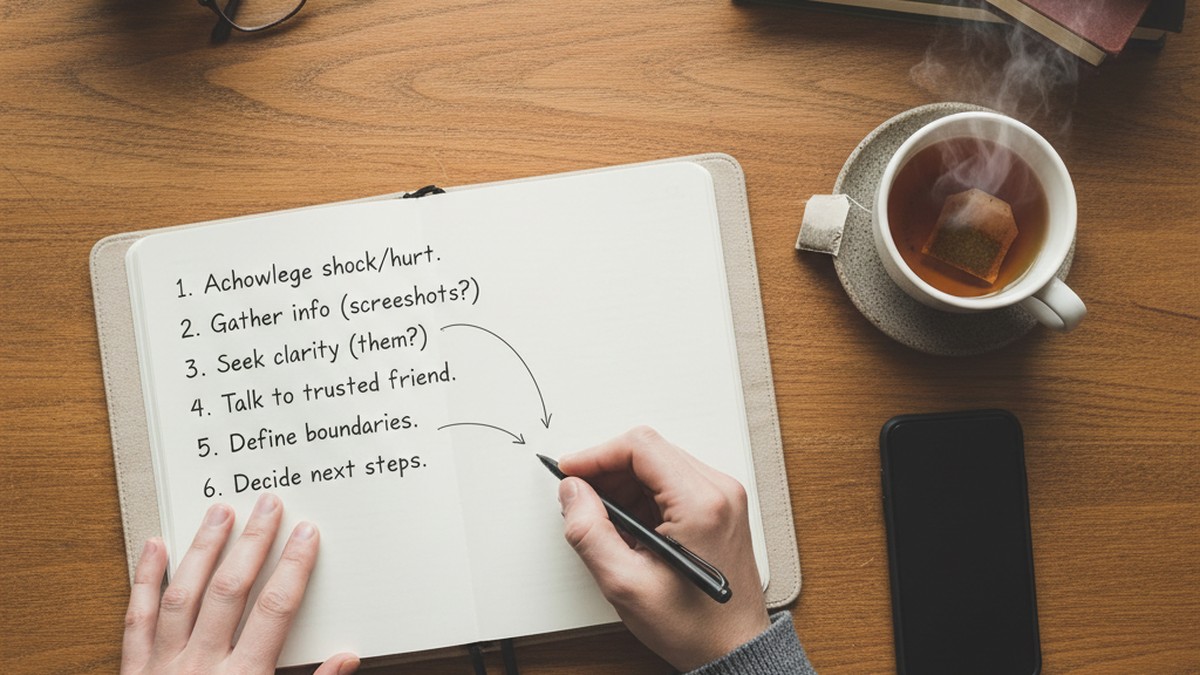
How Should You Follow Through After Preparing?
Once you've documented the evidence, assessed severity, regulated your emotions, and clarified your non-negotiables, you're ready for action. These final three steps move from preparation into direct engagement with your partner and the situation.
Step 5: Have the Conversation
Use the conversation framework outlined earlier. Choose a private, neutral setting. Ensure you have enough time — don't start this discussion 20 minutes before someone has to leave.
Timing matters more than most people realize. Avoid starting this conversation:
- Late at night when both of you are tired
- Right before work or another obligation
- In a public place where either partner feels constrained
- Immediately after another stressful event
- Via text, phone call, or video chat for serious relationships
The best setting is a private location where both of you feel physically safe and have no time pressure. Weekend mornings often work well.
If the initial conversation goes well enough to continue the relationship, set a follow-up conversation for 48-72 hours later. First conversations reveal initial reactions. Follow-up conversations reveal considered positions.
Step 6: Verify Their Claims
If your partner claims the profile is dormant or unused, that claim is verifiable. Several methods exist to check whether a dating profile shows recent activity. Our guide on how to find out if your partner is on dating apps covers the specific tools and techniques available.
Verification isn't about being paranoid. It's about closing the gap between what was said and what is true. Specific things you can verify include:
- Profile activity timestamps: Many apps show when a user was last active. Ask your partner to show you this information directly on the app.
- Message history: If they claim no messages were sent, they should be willing to show the inbox.
- Account creation date: Some platforms display when the account was first created, which confirms or contradicts claims about timeline.
- Profile search tools: Services like CheatScanX can scan multiple platforms simultaneously to provide a comprehensive picture of your partner's dating app presence.
Trust but verify is a reasonable position after a trust violation. Blind trust after evidence of potential deception isn't healthy — it's avoidance.
Step 7: Decide Your Next Steps
Based on the conversation, the verification results, and your non-negotiables, you have three paths:
- Continue with active repair. The explanation was credible, your partner is taking accountability, and you're both willing to work on rebuilding trust. Set specific milestones: profile deletion verified, check-in conversations scheduled, boundaries explicitly agreed upon.
- Seek professional help. The situation is too complex for you to process alone. A couples therapist provides neutral ground and structured tools. This is especially important if the discovery is Level 3 or above on the severity assessment, or if prior trust issues exist.
- End the relationship. The response you received, the evidence you found, or the pattern of behavior makes continuation untenable. Ending a relationship after a trust violation isn't failure — it's a legitimate decision that sometimes represents the healthiest option.
None of these paths is wrong. The right choice depends on your specific situation, your values, and what you need from a partner. Give yourself time to make this decision. A choice made after two weeks of reflection tends to be more durable than one made in the first 48 hours.
If you're looking for more warning signs beyond the dating profile itself, understanding the broader pattern of behavior helps you make a more informed decision about which path to take.
What Are the Most Common Mistakes After Finding a Dating Profile?
Three mistakes consistently make this situation worse. Nearly everyone is tempted by at least one of them, and they all feel justified in the moment.
Mistake 1: Creating a Fake Profile to Catfish Your Partner
This is the most tempting and most counterproductive response. The logic seems sound — make a profile, match with your partner, and catch them red-handed. In reality, this approach has serious problems.
You're using deception to address a trust issue. If your partner discovers the catfish attempt, the conversation shifts from their behavior to yours. You've now given them a legitimate grievance that muddies the original issue.
Beyond the relationship dynamics, catfishing can have consequences you don't anticipate. Some individuals have faced legal complications from creating fake profiles, and most dating app terms of service prohibit impersonation.
If you need confirmation that your partner is active on dating apps, profile search tools provide answers without the ethical and practical problems of catfishing.
Mistake 2: Telling Everyone Before Talking to Your Partner
The urge to call your best friend, your sister, and your mother is powerful. You want validation that your feelings are justified. The problem: once other people know, the situation becomes much harder to resolve privately.
If the profile turns out to be dormant and the conversation goes well, you've still created a narrative among your social circle that your partner was "caught." Those people will carry suspicion and judgment long after you and your partner have resolved things.
There's also a strategic problem. If your partner learns from someone else that you found the profile — before you've had the conversation — they have time to prepare a story, delete evidence, or go on the offensive. You lose the advantage of an honest, unscripted reaction.
The exception: if you feel unsafe, tell someone immediately. Personal safety always comes first. But for most situations, telling one trusted person for emotional support is sufficient. Save the broader announcements until you know what you're actually dealing with.
The Social Media Trap
A specific version of this mistake deserves its own mention: posting about the discovery on social media. Whether it's a vague subtweet ("when you find out who someone really is...") or a direct callout, social media broadcasts create permanent public records of a private crisis. They generate attention and drama rather than resolution. Even if you delete the post later, screenshots exist forever.
Mistake 3: Ignoring It and Hoping It Goes Away
On the opposite end, some people see the profile, feel the emotional wave, and then suppress it entirely. They tell themselves it doesn't matter, or that bringing it up would cause unnecessary conflict.
Unaddressed discoveries don't disappear. They create an undercurrent of resentment and suspicion that erodes the relationship slowly. Every time your partner picks up their phone, the unspoken question resurfaces. Research on relationship anxiety shows that unresolved suspicion intensifies when concerns go unaddressed. Avoidance doesn't prevent conflict — it delays and amplifies it.
A Fourth Mistake Worth Mentioning
Going through their entire phone. The discovery of a dating profile doesn't grant blanket permission to search through every app, email, and text message on your partner's device. If you escalate from finding a dating profile to conducting a full digital investigation without their knowledge, you've crossed a boundary that will be used against you in the inevitable conversation.
Address what you found. If the conversation reveals deeper issues, expand the discussion from there.
There's a meaningful difference between transparency and surveillance. After a trust violation, your partner might agree to temporary transparency measures — shared passwords, open phone access, location sharing — as a rebuilding tool. That's negotiated transparency with consent. Secretly going through their entire digital life without their knowledge is surveillance. One builds trust. The other erodes it further, even if it feels justified in the moment.
If you feel the need for comprehensive digital investigation, that instinct itself is information. It suggests the trust damage runs deep enough that professional guidance would serve you better than solo detective work.
Is Having a Dating Profile the Same as Cheating?
Whether having a dating profile constitutes cheating depends entirely on the boundaries your relationship has established. There is no universal answer, because relationships define fidelity differently.
The Boundary Spectrum
Relationship boundaries around dating apps exist on a spectrum:
- Some couples consider any dating app presence a violation — even a dormant profile that predates the relationship.
- Some couples distinguish between having a profile and using a profile. The profile's existence isn't the issue; active engagement is.
- Some couples have never explicitly discussed dating app boundaries, which creates a grey area neither partner has clearly defined.
If you and your partner never had an explicit conversation about dating app use after becoming exclusive, you're both operating on assumptions. Your assumption might be that exclusivity automatically means deleting all dating profiles. Their assumption might be that exclusivity means not meeting other people but keeping an old profile isn't meaningful.
Neither assumption is unreasonable. The problem isn't the difference in expectations — it's that the expectations were never aligned through direct conversation.
What Relationship Experts Say
Dr. Tammy Nelson, a certified sex therapist and author specializing in infidelity, describes a concept called the "new monogamy" — the idea that modern couples need to negotiate specific agreements about digital behavior rather than relying on assumed rules. A profile that one partner considers meaningless may feel like a profound betrayal to the other.
The question isn't really "Is this cheating?" The more productive question is: "Does this violate the agreement we have, and if we don't have a clear agreement, we need one."
This distinction is central to understanding the broader question of where digital behavior crosses the line, and it's an issue more couples face than most realize.
Digital Boundaries Worth Setting
If your relationship survives this discovery, use it as a starting point for explicitly defining digital boundaries:
- Are dating app profiles acceptable if inactive?
- Is following or DMing attractive strangers on social media acceptable?
- What level of digital interaction with an ex is comfortable?
- How do both partners feel about privacy vs. transparency on devices?
- What counts as a boundary violation vs. harmless behavior?
- How should concerns about digital behavior be raised in the future?
These conversations feel awkward. They're also the ones that prevent future crises. Research consistently shows that couples who explicitly discuss boundaries experience fewer trust violations than those who rely on implied agreements.
A Helpful Comparison
The table below illustrates how different couples might categorize the same behaviors differently. Neither column is "correct" — the point is that these categories need to be agreed upon, not assumed.
| Behavior | Couple A (Strict Boundaries) | Couple B (Flexible Boundaries) |
|---|---|---|
| Dormant dating profile from before relationship | Violation — should have been deleted | Not an issue — it's inactive |
| Swiping on apps with no messaging | Cheating — intent to browse others | Problematic but not cheating |
| Liking attractive strangers' posts on Instagram | A concern worth discussing | Normal social media behavior |
| Having private conversations with an ex | Serious boundary violation | Fine if content is platonic |
Understanding where you and your partner fall on this spectrum prevents future misunderstandings. If this profile discovery teaches you anything, it's that assumed boundaries create vulnerability. Stated boundaries create security.
For a deeper look at the grey area between harmless habits and genuine boundary violations, understanding the full spectrum of digital behaviors that cross lines is essential to setting expectations.
How Do You Protect Yourself Emotionally After This Discovery?
The emotional aftermath of finding your partner's dating profile can be intense. Even if the situation resolves well, the discovery itself often triggers anxiety, hypervigilance, and intrusive thoughts that persist for weeks or months.
Normalize Your Emotional Response
Whatever you're feeling — anger, sadness, confusion, numbness, relief that your suspicions were confirmed — is a valid response. There's no correct way to feel about this.
Common emotional responses include:
- Obsessive checking: An urge to repeatedly verify your partner's phone, apps, and online activity.
- Retroactive anxiety: Replaying past events and reinterpreting them through a lens of suspicion.
- Self-blame: Wondering if something you did or didn't do caused your partner to seek attention elsewhere.
- Emotional numbness: Shutting down emotionally as a protective mechanism.
All of these are normal trauma responses. They don't mean you're overreacting, and they don't mean the relationship is doomed.
The Difference Between Caution and Hypervigilance
After a trust disruption, some increased awareness about your partner's behavior is natural and even healthy. The line between reasonable caution and unhealthy hypervigilance matters, though.
Reasonable caution looks like:
- Paying attention to whether your partner follows through on promises (deleting the profile, attending counseling)
- Noticing if their phone habits change after the conversation
- Having periodic check-in conversations about how you're both feeling
Hypervigilance looks like:
- Checking their phone every time they leave the room
- Monitoring their location constantly through shared apps
- Interrogating them about every text notification
- Losing sleep over hypothetical scenarios
If you find yourself in the hypervigilance category, that's a signal that individual therapy could help. The anxiety is controlling you rather than informing you. The goal is awareness with equilibrium, not surveillance with exhaustion.
Practical Self-Care Steps
- Maintain your routines. Sleep, eat regular meals, exercise. Your body needs stability while processing emotional disruption.
- Limit digital surveillance. Constant checking reinforces anxiety rather than relieving it. Set specific times to check if needed, rather than doing it compulsively.
- Talk to a professional. Individual therapy provides a space to process your feelings without burdening friends or escalating the situation with your partner. Many therapists offer sessions focused specifically on relationship anxiety and trust repair.
- Journal your thoughts. Writing helps externalize ruminating thoughts. Record facts, feelings, and questions separately. This prevents the three categories from blending into a single overwhelming narrative.
When to Seek Professional Help
Consider individual or couples therapy if:
- Intrusive thoughts about the discovery interfere with daily functioning for more than two weeks
- You're engaging in compulsive checking behavior that you can't control
- The anxiety is affecting your sleep, appetite, or work performance
- You and your partner are stuck in repetitive arguments about the same issue
- You're experiencing symptoms of depression (withdrawal, hopelessness, loss of interest in activities)
If the discovery has triggered broader feelings of anxiety about your relationship, professional support helps you distinguish between reasonable caution and anxiety-driven hypervigilance.
Moving Forward: Your Next Steps
Finding your partner's dating profile is a disruption, not necessarily a conclusion. What it means for your relationship depends on what you find when you look closer, what you hear when you ask questions, and what your partner does next.
The Profile Discovery Assessment gives you a framework for evaluating severity objectively. The 24-hour rule protects you from making decisions your rational brain wouldn't endorse. And the conversation framework gives you tools to have the most important talk of your relationship with clarity instead of chaos.
Remember the core numbers: 39.5% of dating app users are already in committed relationships, meaning profile discoveries are far more common than most people realize. Recovery rates reach 74% when couples actively pursue professional support. And the single strongest predictor of a good outcome isn't the severity of the discovery — it's the quality of the response that follows.
If you're still unsure whether your partner's profile tells the whole story, CheatScanX scans 15+ dating platforms to check for hidden or active profiles. Getting clear answers beats living with uncertainty.
Whatever path you choose — repair, professional help, or moving on — choose it from a position of informed calm, not reactive panic. You deserve to make this decision with your full intelligence, not just your first emotion.
Frequently Asked Questions
Whether a dating profile counts as cheating depends on the boundaries you and your partner have agreed on. A dormant profile that was never deactivated is different from actively swiping and messaging. The key factor is intent and activity level. If your partner is engaging with others on the platform, most relationship experts consider that a boundary violation, even without physical contact.
Common reasons include forgetting to delete the account, using the app for entertainment or ego validation, keeping options open due to relationship uncertainty, or actively seeking connections outside the relationship. A 2023 study found that nearly 40% of dating app users were already in committed relationships, with many citing boredom or curiosity rather than intent to cheat.
Relationship experts strongly advise against creating fake profiles to catfish your partner. This approach uses deception to address a trust issue, which only deepens the dishonesty cycle. If you suspect your partner is active on dating apps, a direct conversation or a profile search tool like CheatScanX provides clearer answers without the ethical complications of entrapment.
Several indicators reveal profile activity. Recently updated photos, a changed bio, new location data, or a recent 'last active' timestamp all suggest current use. Dormant profiles typically show outdated photos, old bio text, and no recent activity markers. Some platforms display when a user was last online, which provides the clearest evidence of recent engagement.
Trust recovery is possible but requires genuine effort from both partners. Research shows couples who pursue professional counseling after trust violations have a 74% success rate. The process typically takes one to two years and requires full transparency, consistent behavior change, and ongoing honest communication about boundaries and expectations.