# How to Tell If Someone Has Tinder Gold
Tinder does not show whether someone has a Gold subscription. No badge, icon, or label appears on their profile. But premium features leave behavioral traces that free accounts simply cannot produce, and those traces are visible if you know where to look.
This matters more than you'd expect. With 9.8 million paying Tinder subscribers out of 75 million monthly active users globally (DemandSage, 2026), roughly 1 in 8 people on the app are paying for enhanced features. Some of those features — like changing your location or seeing who liked you before swiping — create patterns that differ from standard free-tier behavior.
This article breaks down the 5 behavioral signals that indicate someone has Tinder Gold, explains what each premium feature actually does, and separates real indicators from common myths. You'll also learn why subscription status alone tells you far less than most people assume — and what actually matters if you're trying to understand someone's activity on the platform.
Does Tinder Display Gold Status on Someone's Profile?
Tinder does not display Gold status on anyone's profile. The app keeps all subscription information private, meaning there is no badge, icon, or label that reveals whether someone pays for Tinder Gold. Other users see the same profile regardless of subscription tier.
This design choice is intentional. Tinder's business model depends on keeping the playing field feeling level. If Gold subscribers had visible markers, it could create a two-class system where free users feel disadvantaged and premium users feel self-conscious about spending money. Neither outcome encourages the swiping behavior that drives Tinder's revenue.
What you actually see on a profile
Every Tinder profile displays the same elements regardless of subscription:
- Name and age (unless age is manually hidden)
- Photos (up to 9)
- Bio text (up to 500 characters)
- Distance from you
- Job title and company (if added)
- School (if added)
- Anthem song, Instagram feed, and Spotify artists (if connected)
None of these fields indicate whether someone pays for Gold, Plus, or Platinum. The one exception involves hidden profile details, which we'll cover in the detection framework below.
The privacy design behind subscription hiding
Tinder's official subscription page describes feature benefits without ever mentioning visibility to other users. The company confirmed in support documentation that "subscription type is not displayed on your profile." This applies to all tiers: Plus, Gold, and Platinum.
The privacy approach means direct detection is impossible. But indirect detection through feature-use patterns is a different story entirely. Premium features produce observable side effects, and those side effects become your detection signals.
Want to skip straight to answers? CheatScanX scans Tinder, Bumble, Hinge, and 12+ other apps in minutes. Completely anonymous.
Start a confidential search →What Features Come with Tinder Gold in 2026?
Tinder Gold is the mid-tier subscription sitting between Tinder Plus ($24.99/month) and Tinder Platinum ($49.99/month). Gold costs $39.99/month as of early 2026, though prices vary by age, location, and platform.
Understanding what each feature does is essential for recognizing which behaviors point to a paid subscription. Some features are invisible to other users. Others create unmistakable patterns.
Pricing varies based on several factors. Users under 28 typically pay less than those over 28 — a practice Tinder has maintained despite legal challenges. Location also affects pricing, with users in higher-income countries paying more. Purchasing through a web browser rather than the iOS or Android app can save 10-40% because Tinder avoids app store commission fees.
Feature comparison across tiers
| Feature | Free | Plus ($24.99) | Gold ($39.99) | Platinum ($49.99) |
|---|---|---|---|---|
| Daily swipe limit | ~100 swipes | Unlimited | Unlimited | Unlimited |
| See who liked you | No | No | Yes | Yes |
| Super Likes per week | 1 | 5 | 5 | 5 |
| Monthly Boost | No | No | 1 free | 1 free |
| Passport (location change) | No | Yes | Yes | Yes |
| Rewind last swipe | No | Yes | Yes | Yes |
| Hide age/distance | No | Yes | Yes | Yes |
| Top Picks | Limited | Limited | Full access | Full access |
| Priority Likes | No | No | No | Yes |
| Message before matching | No | No | No | Yes |
| Ad-free experience | No | Yes | Yes | Yes |
Features that leave visible traces
Three Gold features produce patterns another person can potentially notice:
- Passport — Changes your swiping location to any city. Creates distance and location mismatches.
- Hidden age/distance — Removes age or distance from your profile. A missing age field stands out.
- Super Likes — The blue star notification is visible to the recipient. Frequent Super Likes suggest a premium tier with more allotment.
The remaining Gold features — Likes You, Rewind, Boost, Top Picks, ad removal — operate entirely behind the scenes. Nobody on the other end can tell you used them.
The Likes You feature explained
The Likes You grid is Gold's signature feature and the primary reason most users upgrade. When someone swipes right on you, their profile appears in a grid accessible through the gold heart icon. Free users see blurred thumbnails — enough to know someone liked them, but not enough to identify who. Gold removes the blur entirely.
This feature changes how matching works. Instead of swiping through stacks hoping for mutual interest, Gold users can browse people who've already expressed interest and decide whether to match. In practice, this means Gold users match more selectively and more quickly. They spend less time swiping through uninterested profiles and more time engaging with confirmed mutual interest.
For detection purposes, the Likes You feature is entirely invisible to the person who swiped right on you. They don't know you saw them in your grid. They don't know whether you matched from the grid or from the regular card stack. The feature operates in a one-way privacy model.
What Does the Gold Heart Mean on Tinder?
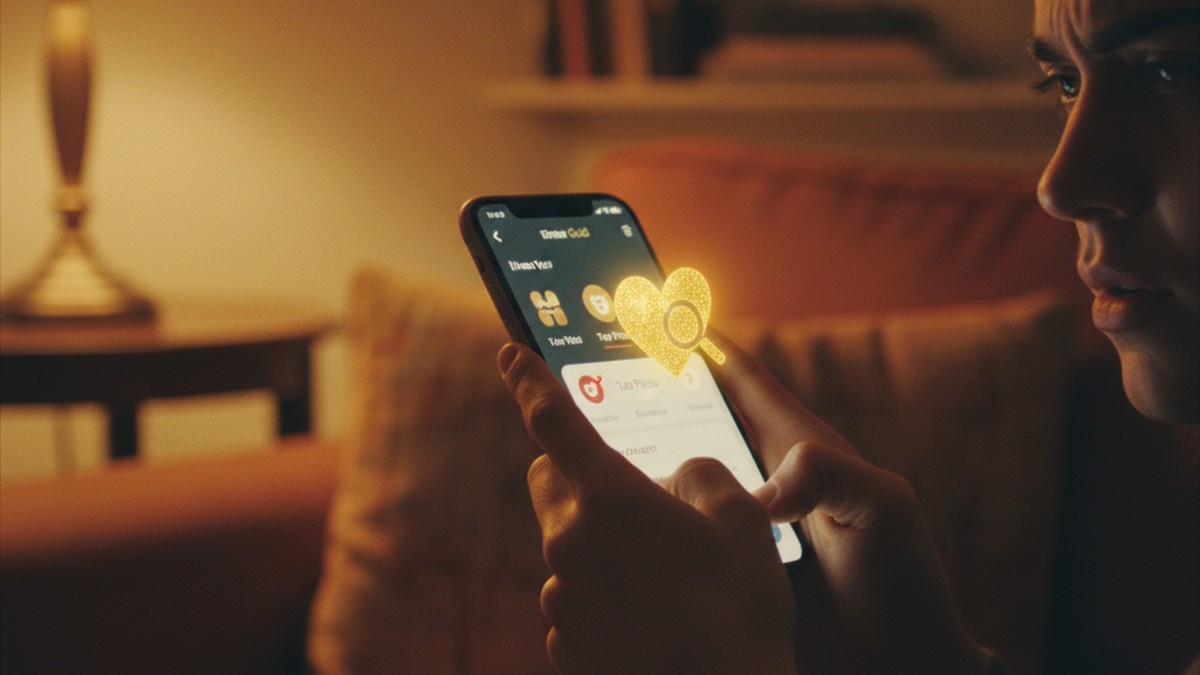
The gold heart on Tinder appears in your own Likes You grid when another user has already swiped right on you. It is not a marker of their subscription status. You only see gold hearts if you have Tinder Gold yourself, making it your feature indicator rather than theirs.
This is one of the most commonly misunderstood symbols on the platform. The gold heart icon sits at the top of the Tinder interface, next to the flame icon. Tapping it reveals a grid of blurred profile photos — these are people who already liked you. With Gold, the blur disappears, and you can browse them freely.
What the gold heart does not tell you
The gold heart does not reveal:
- Whether the person who liked you has Gold, Plus, Platinum, or a free account
- How long ago they swiped right on you
- Whether they use any premium features
- Their activity level on the platform
A common misconception suggests that seeing a gold border around someone's photo means they have Gold. This is incorrect. The gold border appears on profiles in your Likes You grid and simply means that person liked you first. It reflects the feature you paid for, not their subscription.
Other Tinder symbols to know
| Symbol | Meaning | Indicates premium? |
|---|---|---|
| Gold heart | Someone liked you (Likes You feature) | Shows YOUR Gold status |
| Blue star | Someone Super Liked you | Possible — premium users get more Super Likes |
| Purple lightning | Profile is Boosted | Yes — Boosts are a premium/purchased feature |
| Gold diamond | Top Pick profile | Shows YOUR Gold/Platinum status |
The blue star is the only symbol that appears on someone else's action toward you that might hint at premium status. Free users get just 1 Super Like per week. If someone Super Likes you multiple times across different weeks, they might be paying. But even that is inconclusive — Super Likes can be purchased individually without a subscription.
How to Spot Tinder Gold: The 5-Signal Detection Framework
Since Tinder hides subscription status by design, direct confirmation is impossible from within the app. But premium features produce behavioral side effects. The 5-Signal Detection Framework organizes these side effects into a systematic checklist.
No single signal confirms Gold. Two or more signals together significantly raise the probability. Think of each signal as evidence that adds weight, not proof that delivers a verdict.
Signal 1: Location anomalies
Tinder Passport allows Plus, Gold, and Platinum subscribers to set their swiping location to any city in the world. This creates detectable anomalies.
What to look for:
- Their profile says they're 2 miles away, but their bio mentions living in another state or country
- Their location jumps between distant cities within the same day or week
- They match with you in your city but later mention they've never visited your area
- Their photos show landmarks or settings from a different region than their listed location
Passport is one of the clearest premium indicators because free users cannot change their location at all. If someone appears to be local but isn't, a paid subscription is the most likely explanation.
Real-world scenario: You match with someone who says they're 3 miles away. Their photos show a beach lifestyle, and their bio references a coastal city. But you live in Denver. When you ask them about the area, they don't know local landmarks or neighborhoods. This pattern strongly suggests Passport use — they set their location to your city to expand their options, but their actual life is hundreds or thousands of miles away.
In scans processed through our platform, profiles using Passport often show a distinctive pattern: their listed distance fluctuates between "less than 1 mile" and 50+ miles within the same 24-hour period, depending on whether they've toggled Passport on or off. This kind of oscillation is physically impossible without a location-changing feature.
Signal 2: Hidden profile details
All premium tiers (Plus, Gold, and Platinum) allow users to hide their age and distance from their profile. Free users cannot do this.
What to look for:
- No age displayed next to their name
- No distance shown on their profile card
- Both age and distance missing simultaneously
A missing age is the most reliable single indicator of a paid account. Free Tinder accounts always display age by default, and there is no way to remove it without a subscription. If you see a profile with no age listed, that person is paying for at least Tinder Plus.
One caveat: some users set their age intentionally incorrect rather than hiding it. This is a free-tier workaround, though it's against Tinder's terms of service and can result in account suspension.
Why people hide their age: The reasons vary. Some users are older and worry about age-based left swipes. Others want to keep personal details private in general. A few are in relationships and remove identifying details to reduce the chance of being recognized. The feature itself is neutral — the reason behind using it depends entirely on the person.
How to verify: If you see a profile without an age and wonder whether they're hiding it or simply didn't enter one, consider that Tinder requires an age during registration. Every profile has an age in the system. If it's not displaying, the user actively chose to hide it, which requires a paid subscription.
Signal 3: Super Like frequency
Free users receive 1 Super Like per week. Plus, Gold, and Platinum subscribers receive 5 per week.
What to look for:
- Someone Super Likes you more than once within a short period (they re-created their account, or they have premium)
- In conversation, they mention Super Liking several profiles in the same week
- You notice the blue star notification on their swipe repeatedly
This signal is weaker than the first two because Super Likes can be purchased individually as add-ons. A single Super Like proves nothing. A pattern of frequent Super Likes across multiple interactions suggests a premium allotment.
The cost context: Individual Super Likes cost approximately $3-5 each when purchased without a subscription. A free user would need to pay $15-25 per week to match the 5 weekly Super Likes included with any premium tier. Most casual users won't spend that much on individual purchases when a subscription bundles them with other features. Frequent Super Likes therefore correlate with subscriptions, even though the individual purchase option prevents certainty.
Signal 4: Match timing patterns
Gold users can see who liked them before deciding to swipe. This creates a distinctive matching pattern.
What to look for:
- You swipe right, and a match appears almost instantly (within minutes)
- The match occurs at an unusual hour when active swiping seems unlikely
- They consistently match quickly after you swipe, rather than days or weeks later
When a Gold user opens their Likes You grid, they see everyone who already swiped right on them. They can then match instantly by tapping. This produces faster match times compared to the random card-stack swiping that free users rely on.
Free users match only through coincidence — both people happen to swipe right independently. Gold users can match deliberately. The timing difference is subtle but statistically real over multiple interactions.
A practical example: You swipe right on someone at 2:00 AM. Within 3 minutes, you have a match — even though they were last active at 11:00 PM. How? If they have Gold, they opened their Likes You grid earlier that evening, saw your profile among their pending likes, and swiped right before going to bed. The match triggered when their earlier right-swipe met yours. On the free tier, this timing pattern would require them to be actively swiping through stacks at 2:00 AM and happen to reach your profile in the same few minutes.
One match with unusual timing proves nothing. But if every match with a particular person happens within minutes of your swipe — especially at odd hours — the Likes You feature offers the simplest explanation.
Signal 5: Profile polish indicators
This signal is the weakest individually but adds context when combined with others. Premium users tend to invest more in their profiles because they're already investing money.
What to look for:
- All 9 photo slots filled (premium users tend to maximize their profiles)
- Professional-quality photos or clear variety in photo types
- Spotify, Instagram, and anthem all connected
- Bio that reads as carefully written rather than hastily filled
Research from Business of Apps (2026) shows that Tinder's revenue per paying user reached $16.68 in 2024, suggesting subscribers are invested enough in their dating outcomes to spend consistently. This investment mindset often extends to profile optimization.
This signal alone means nothing. Plenty of free users have polished profiles. But when combined with hidden age, location anomalies, or rapid matching, it adds a small amount of supporting evidence.
Using the framework together
| Signal | Strength | What it confirms |
|---|---|---|
| Location anomaly | Strong | At least Plus (Passport) |
| Hidden age/distance | Strong | At least Plus |
| Super Like frequency | Moderate | Possible premium (could be purchased) |
| Match timing | Moderate | Possible Gold/Platinum (Likes You) |
| Profile polish | Weak | Suggestive only |
Two strong signals together make a confident assessment. One strong signal plus one or two moderate signals suggests premium usage. Weak signals alone are unreliable without supporting evidence.
Can Someone Tell If You Use Tinder Passport?
Tinder does not announce Passport usage directly. But location mismatches create obvious clues. If someone's profile says they are 2 miles away yet mentions living in another city, or if their location jumps between distant cities within hours, Passport is the likely explanation.
Passport works by changing the GPS coordinates that Tinder uses to place your profile. When you set your location to Paris from New York, your profile appears in Parisian users' card stacks as if you were physically there. Tinder shows a distance to other users based on this virtual location.
How location data reveals Passport use
The revealing detail is consistency — or lack of it. Real physical location changes follow logical travel patterns. You move between cities over hours or days. Passport changes are instant and can produce impossible travel patterns.
Red flags:
- A profile appears in your city, then appears in a city 3,000 miles away the same day
- Their distance reads "less than 1 mile" but conversation reveals they live elsewhere
- They appear "recently active" in your area but have no local context in photos, bio, or conversation
Free users' locations update only through real GPS movement. Any location that doesn't match real-world logistics points directly to Passport — and Passport requires at least Tinder Plus.
The Passport exception
Tinder occasionally grants temporary free Passport access during promotions or global events (they did this during COVID-19 lockdowns in 2020). These events are rare and widely publicized. Outside of promotional periods, Passport is exclusively a paid feature.
Passport and relationship concerns
Passport raises unique concerns for people in committed relationships. The feature lets someone appear to be swiping locally in a different city — which means a partner traveling for work could be actively swiping in their travel destination without any trace visible to someone at home.
Data from our platform suggests that Passport-related searches spike during business travel seasons and holidays. The concern isn't theoretical. A partner who has Tinder Gold and travels regularly has the ability to maintain separate dating activities in multiple cities simultaneously.
That said, Passport has entirely legitimate uses too. Single people planning a move often scout dating options in their future city. Travelers use it to meet locals. Long-distance couples have used it to appear closer to each other. The feature itself is a tool — context determines whether its use is concerning.
If you're interested in checking whether someone specific is active on Tinder beyond just their subscription tier, you can check if your partner is on Tinder using methods that don't rely on guessing their subscription status.

How Does Tinder's Algorithm Treat Paid Subscribers?
Paid Tinder subscribers receive measurable algorithmic advantages. Premium users get an estimated 3 to 5 times more profile views than free users. Platinum subscribers also receive Priority Likes, which push their profiles toward the front of other users' card stacks.
Tinder's algorithm assigns each user a desirability score based on multiple factors: how often people swipe right on you, how selective you are, your profile completeness, and your activity frequency. The algorithm prioritizes showing profiles to users who are most likely to swipe right on them.
How premium features interact with the algorithm
Boosts: Gold subscribers receive 1 free Boost per month. A Boost places your profile at the top of local stacks for 30 minutes, dramatically increasing visibility. During a Boost, profile views can spike by 10x or more. Other users see Boosted profiles with a purple lightning icon, which is a clear indicator of premium spending.
Priority Likes (Platinum only): Platinum users' profiles appear earlier in other users' stacks. This is invisible to the recipient — they don't know the profile jumped ahead. But it means Platinum users accumulate matches faster than both free and Gold users.
Activity bonus: All premium users tend to log in more frequently because they've invested money. Tinder's algorithm rewards consistent activity with more visibility. This creates a compounding effect: paid users swipe more, get seen more, match more, and appear more active.
What this means for detection
The algorithmic advantage is invisible to other users. You cannot tell from your side of the screen whether someone's profile was Boosted, Prioritized, or organically placed. But the downstream effects — faster matching, higher apparent popularity, and frequent appearance in your stack — can serve as context clues when combined with other signals from the detection framework.
One pattern worth noting: if the same profile appears in your stack repeatedly over a short period (after you've swiped left), that person may be using a Boost. Free users who get left-swiped typically don't reappear for weeks or months.
The Elo score connection
Tinder's internal ranking system — historically called an Elo score, now described as a more complex desirability metric — determines how often your profile gets shown. Several factors feed this score:
- Right-swipe ratio you receive: Profiles that get more right swipes rank higher
- Selectivity: Being overly non-selective (swiping right on everyone) can lower your ranking
- Profile completeness: Fully filled profiles with verified photos score better
- Messaging behavior: Users who actually message their matches rank higher than those who collect matches without engaging
Premium subscribers tend to perform better on several of these metrics because they're more invested in outcomes. The unlimited swipes that come with paid tiers also remove the artificial ceiling that free users face (~100 swipes per day), increasing engagement volume and keeping profiles actively circulating.
Tinder generated $1.96 billion in revenue in 2024 (Business of Apps, 2026), with the vast majority coming from subscriptions. The company has clear financial incentive to make premium accounts feel rewarded — which means algorithmic advantages for paying users, even if Tinder doesn't explicitly advertise them beyond stated features.
Why Do People Search for Someone's Tinder Subscription?
The search query "how to tell if someone has Tinder Gold" reveals more about the searcher's concerns than about Tinder's features. People don't typically wonder about a stranger's subscription tier. They search this because someone they care about might be on the app — and the subscription level feels like it reveals intent.
The real motivations behind this search
Based on analysis of related search patterns, three distinct groups search for this information:
Group 1: Partners with suspicions. This is the largest group. They've noticed signs — a notification, a charge on a bank statement, a friend's sighting — and want to understand what a Gold subscription means about their partner's activity level. For this group, the subscription isn't the real question. The real question is: "Is my partner actively looking for someone else?"
A 2023 study published in Current Psychology (Springer, 2023) found that perceived success on dating apps is directly associated with higher perceived availability of alternative partners, which in turn predicts attention to alternatives outside a current relationship. In other words, someone who pays for dating app features may be more invested in the outcomes those features provide — but that's a correlation, not a confirmation of infidelity.
Group 2: Matches who are curious. Some people search this after matching with someone who seems unusually responsive or well-matched. They wonder if the other person saw them in a Likes You grid and matched intentionally, rather than through normal swiping.
Group 3: Potential subscribers. A smaller group is considering buying Gold themselves and wants to know whether others can see the purchase. They're weighing the privacy implications before committing. For these users, the answer is straightforward: no one on Tinder can see your subscription. The only visibility risk is through billing statements.
Group 4: People who've been caught. A smaller subset searches this query from the opposite direction. They've been confronted by a partner about their Tinder activity and want to understand what evidence is visible. If this describes your situation, the critical detail is that Tinder itself reveals nothing about your subscription to other users — but bank statements, app store receipts, and notification previews frequently do.
Understanding which group you fall into helps frame what information is actually useful. If you're in Group 1, subscription status alone won't give you the answer you're looking for. Your real concern is activity, intent, and honesty — and those require different evidence than a subscription badge.
If suspicion is driving your search, our breakdown of Tinder cheating statistics provides data-backed context for how often Tinder usage overlaps with committed relationships.
Does Paying for Tinder Gold Actually Indicate Cheating?
Paying for Tinder Gold does not indicate cheating on its own. Roughly 13 percent of Tinder's 75 million users pay for a subscription (DemandSage, 2026). Many subscribers are single people seeking better matches. A paid subscription becomes concerning only when combined with secretive behavior and relationship context.
This is the single most important reframing in this entire article. The assumption that "paying for Tinder = greater intent to cheat" sounds logical but collapses under data.
Why the assumption fails
Consider the numbers. Tinder has 9.8 million paying subscribers globally. Research estimates suggest approximately 42% of Tinder users are either married or in a committed relationship. But that 42% figure includes free users — people who downloaded the app out of curiosity, boredom, or social pressure and never paid a cent.
The paying subscriber base skews differently. People who pay $40/month for Gold are statistically more likely to be:
- Single and actively seeking a relationship
- Frustrated with free-tier limitations and investing in better results
- Located in competitive dating markets where visibility matters
- Repeat subscribers who've found the features genuinely useful
The overlap between "paying subscribers" and "people cheating on partners" exists, but it's a subset of a subset. Treating every Gold subscription as evidence of infidelity would produce far more false positives than true ones.
The demographics of Tinder's paying users
Tinder's paying subscriber base of 9.8 million users skews toward specific demographics. According to DemandSage's 2026 analysis, 61.2% of all Tinder users fall within the 18-34 age group, with 75% of users identifying as male. The income bracket of $60,000-$100,000 represents 52% of the user base — people with disposable income for a $40/month subscription.
These demographics overlap heavily with single, working professionals who use Tinder as their primary dating tool. The subscriber who pays for Gold because they want to see who liked them and save time swiping is far more common than the subscriber who pays for Gold to conceal an affair. Both exist. One vastly outnumbers the other.
When a subscription IS concerning
Context determines whether a subscription matters. A Gold subscription becomes a legitimate concern when:
- Your partner told you they deleted Tinder, but a charge appears on their bank statement
- They hide their phone when notifications arrive and you recognize the Tinder notification sound
- They travel frequently and Passport would enable swiping in other cities without detection
- Their behavior has changed alongside the timing of the subscription charge
The subscription itself is neutral. The combination of subscription plus secretive behavior plus relationship context is what creates a meaningful signal.
What actually indicates active usage
Subscription status tells you someone is paying. It doesn't tell you they're active. Many people forget to cancel auto-renewing subscriptions — Tinder's declining subscriber count (from 10.8 million in 2022 to 9.8 million in 2026) partially reflects users who finally cancelled subscriptions they weren't using.
Active usage produces different indicators: notification sounds, recently updated photos, new matches appearing in conversation, changes to bio text, and app usage that coincides with being away from a partner. These behavioral signals matter far more than subscription tier.
If you're weighing the evidence and want a factual starting point, our guide on apps cheaters commonly use explains which platforms are most associated with hidden activity and why.

What Other Signs Suggest Someone Is Actively Using Tinder?
Beyond subscription tier, several observable behaviors indicate someone is actively using Tinder — regardless of whether they're paying for Gold.
Profile update patterns
Tinder profiles that change frequently signal active engagement. Specific changes to watch for:
- New photos: If someone's Tinder photos match recent social media posts or selfies, they're updating their profile
- Bio edits: A bio that references current events, recent trips, or seasonal interests suggests recent editing
- Connected accounts: Recently linked Spotify or Instagram accounts indicate active profile maintenance
Activity indicators visible to others
Tinder shows limited activity data to other users:
- Recently Active badge: A green dot or "recently active" label appears on profiles of users who've opened the app within the last 24 hours (visible to all users)
- New to Tinder badge: Appears on profiles less than 72 hours old. If your partner supposedly deleted Tinder months ago but shows this badge, they created a new account
- Distance changes: If someone's distance from you fluctuates, they're opening the app in different locations
Notification behaviors
Phone notifications are among the strongest real-world indicators:
- Tinder notifications display a flame icon and typically preview match names
- Notification sounds differ from other app alerts on most devices
- Someone who quickly clears notifications or keeps their phone face-down when Tinder alerts arrive is managing their visibility
Notification management is particularly telling. Tinder sends push notifications for new matches, messages received, Super Likes, and promotional reminders. A person who has turned off all Tinder notifications has made a deliberate choice to prevent the app from revealing itself. On iPhone, you can check notification settings in Settings > Notifications > Tinder. On Android, the path is Settings > Apps > Tinder > Notifications.
Screen time data
Both iOS and Android track app usage time. While accessing someone else's phone raises ethical and legal concerns, screen time data on a shared device can sometimes reveal app usage patterns.
- iPhone: Screen Time reports show daily app usage broken down by category. Dating apps appear under "Social" or "Entertainment."
- Android: Digital Wellbeing shows similar usage breakdowns.
A person spending 20-30 minutes daily on Tinder is actively swiping and messaging. Someone spending 2-3 minutes per week may have the app installed but isn't engaging with it meaningfully. Usage duration provides better insight into activity level than simply knowing the app is installed.
The bank statement trail
Tinder subscriptions appear on bank and credit card statements. The charges typically show as:
- "TINDER" or "TINDER.COM"
- "APPLE.COM/BILL" or "GOOGLE*TINDER" (if purchased through app stores)
- Recurring monthly amounts matching tier pricing ($24.99, $39.99, or $49.99)
App store receipts sent to shared email addresses are another common discovery method. Apple's Family Sharing and Google Play Family Library can reveal app purchases to family members sharing the same plan.
Social media cross-references
Sometimes the clearest indicator of active Tinder use comes from cross-referencing photos. If someone updates their Tinder profile with recent photos, those same photos often appear on their Instagram, Facebook, or other social media. A newly posted selfie that also appears as a Tinder profile photo (reported by a friend who spotted the profile) provides strong circumstantial evidence of recent activity.
Photo metadata can also be revealing. A Tinder profile photo showing a haircut, outfit, or setting from this week confirms the profile was updated recently — not left dormant from months or years ago.
The reverse also applies. If a friend sends you a screenshot of someone's Tinder profile and the photos match their current appearance on social media, the profile is likely active. Old photos from years ago suggest a dormant or abandoned account.
For a broader understanding of behavioral patterns associated with hidden dating app use, our analysis of how to find out if your boyfriend is on Tinder covers both digital and behavioral detection methods.
Common Myths About Tinder Premium Subscriptions
Misinformation about what Tinder Gold can and cannot do leads people to incorrect conclusions. Here are the most persistent myths, corrected with verified information.
Myth 1: Gold users get a special badge or border
Reality: No visual indicator of subscription status appears on any Tinder profile. The gold elements you see in the app (gold heart, gold diamond) are features of YOUR subscription, visible only to you. Other users never see these indicators on your profile.
Myth 2: Tinder prioritizes Gold profiles in the algorithm
Reality: Gold does not include algorithmic priority. That feature — called Priority Likes — is exclusive to Tinder Platinum. Gold's main advantages are the Likes You grid (seeing who liked you) and one monthly Boost. Outside of active Boosts, Gold profiles appear in stacks based on the same algorithmic factors as free profiles.
Myth 3: You can tell someone has Gold if they match with you instantly
Reality: Instant matches happen for multiple reasons. The other person may have swiped right on you days ago, and when you swipe right back, the match appears immediately. This happens to free users too. Gold simply lets users browse who liked them, but the match timing from your perspective is the same.
Myth 4: Gold users can see more information about you
Reality: Gold does not reveal additional profile information about other users. Gold users see the same profiles, with the same information, as free users. The subscription adds features about your own incoming likes and preferences — it doesn't give you more data about others.
Myth 5: Hiding your age means you definitely have Gold
Reality: Hiding age requires at least Tinder Plus, not necessarily Gold. The age-hiding feature is available on all paid tiers. Someone with a hidden age has a paid subscription of some kind, but you cannot determine which tier from this single data point.
| Myth | Reality | Confirmed by |
|---|---|---|
| Gold users have a visible badge | No visual indicator exists | Tinder support documentation |
| Gold gets algorithmic priority | Priority Likes are Platinum-only | Tinder feature comparison page |
| Instant matches prove Gold | Timing depends on mutual swiping | Standard matching mechanics |
| Gold reveals extra profile data | Same information across all tiers | Tinder feature documentation |
| Hidden age = definitely Gold | Could be Plus or Platinum | Feature available on all paid tiers |
Why these myths persist
Misinformation about Tinder Gold spreads because the app's opacity invites speculation. When Tinder doesn't explain how its systems work, users fill the gaps with assumptions. Forums, social media posts, and outdated blog articles repeat incorrect claims until they feel like established facts.
The myths also persist because people want clear answers. "If I see X, it means Y" is satisfying even when it's wrong. The reality — that detection requires multiple indirect signals weighed together — is less shareable than a confident but incorrect one-liner.
Understanding which claims are false protects you from both unnecessary worry (your match doesn't have a secret badge you're missing) and false confidence (hidden age alone doesn't prove Gold specifically). Accurate knowledge leads to better decisions.
What Should You Do If You Suspect a Hidden Tinder Profile?
If your concern extends beyond subscription status to whether someone is on Tinder at all, the approach shifts from feature detection to profile verification.
Start with a direct conversation
Before pursuing any verification method, consider whether a direct conversation is possible. Relationship research consistently shows that direct communication, while uncomfortable, produces better outcomes than covert investigation in the majority of cases.
Frame the conversation around your feelings rather than accusations:
- "I noticed a charge that looked like a dating app. Can we talk about that?"
- "I've been feeling uneasy about some things and want to be honest with you about it."
- "I need clarity about where we stand with dating apps."
When direct conversation isn't enough
In some situations — where a partner has already denied using dating apps despite evidence, or where trust has been broken before — direct conversation alone may not resolve the uncertainty. In these cases, verification provides factual clarity.
Methods for verifying Tinder activity include:
- Creating your own Tinder account and adjusting age, distance, and preference settings to match the suspected profile's demographics. Swipe through profiles in their area.
- Checking app store purchase history on shared accounts (Apple Family Sharing, Google Play Family Library).
- Reviewing bank and credit card statements for subscription charges.
- Using a dating profile search service that scans multiple platforms simultaneously.
If you want to verify whether someone has an active dating profile without creating your own account, CheatScanX scans Tinder and 15+ other dating platforms using basic identifying information. This approach provides verification without the guesswork of manual searching.
Evaluating the evidence objectively
Before taking action, assess what you actually know versus what you're assuming. This distinction matters.
What counts as evidence:
- A Tinder subscription charge on a shared bank statement
- A friend or acquaintance who saw their active profile
- Tinder notifications appearing on their phone
- Their own admission of having the app installed
What does not count as evidence:
- A general feeling that something is wrong (valid as a prompt to investigate, but not evidence itself)
- Seeing them use their phone frequently (could be any app)
- A change in their sexual behavior (many explanations exist beyond infidelity)
- Someone with a similar name or photo appearing on Tinder (mistaken identity happens)
Keeping these categories separate prevents both false accusations and false reassurance. If you have actual evidence, you're in a position to have a productive conversation. If you have suspicions without evidence, gathering facts first protects both you and the relationship.
What not to do
Some actions cross ethical and legal lines, regardless of the situation:
- Do not access someone else's phone without their consent
- Do not attempt to log into their accounts
- Do not install monitoring software on their devices
- Do not create fake profiles to catfish or entrap them
These methods may violate privacy laws in many jurisdictions. Consult a legal professional if you're unsure about the boundaries in your specific situation.
The emotional reality
Searching for whether someone has Tinder Gold often happens during a difficult emotional period. Anxiety about a partner's fidelity can consume significant mental energy and affect daily functioning.
Regardless of what you find, consider these steps for your own wellbeing:
- Talk to someone you trust — a friend, family member, or therapist — before making major decisions based on what you discover
- Write down the facts you've gathered separately from your interpretations. Review both with fresh eyes the next day.
- Set a boundary for investigation time. Spending hours searching for evidence can become its own harmful pattern. Decide in advance how much time you'll dedicate to this, and honor that limit.
The goal isn't just to find out whether someone has Tinder Gold. The goal is to reach a place of clarity — about the relationship, about your boundaries, and about what you need going forward.
Moving Forward with Clarity
Tinder Gold leaves no visible badge on anyone's profile. The app deliberately hides subscription information to maintain user privacy. But behavioral traces — location anomalies from Passport, hidden profile details, Super Like patterns, match timing, and profile completeness — create a detection framework that can indicate premium usage with reasonable confidence.
The more important insight is that subscription status alone answers the wrong question. Knowing someone pays $39.99/month for Tinder Gold tells you they spent money on a dating app. It doesn't tell you why, how actively they use it, or what their intentions are. Behavioral context — secrecy, activity patterns, and relationship dynamics — provides far more meaningful information than a payment tier ever could.
If you're reading this because you're concerned about a partner's activity on dating platforms, focus on the combination of evidence rather than any single data point. A Gold subscription plus secretive phone behavior plus emotional distance tells a different story than a Gold subscription plus transparency plus honest conversation.
The path forward depends on your specific situation. For some, a direct conversation resolves everything. For others, factual verification through profile search tools provides the clarity needed to make informed decisions. Either way, approaching the situation with both evidence and empathy leads to better outcomes than assumptions alone. The answers are rarely as simple as a subscription badge would make them — but they're available to anyone willing to look at the full picture rather than a single detail.
Frequently Asked Questions
No. Tinder keeps subscription information completely private. There is no badge, icon, or visual indicator on someone's profile that reveals whether they have Tinder Gold, Plus, or Platinum. You can only infer premium usage through indirect behavioral signals like Passport location changes or frequent Super Likes.
Tinder Gold lets you see who liked you, gives unlimited swipes, 5 weekly Super Likes, one monthly Boost, and Passport. Tinder Platinum adds Priority Likes that put your profile ahead of free users, plus the ability to message someone before matching. Platinum costs about $10 more per month than Gold.
Tinder Gold includes one free Boost per month, which places your profile near the top of local stacks for 30 minutes. Outside of active Boosts, Gold does not provide the same priority visibility that Platinum offers. Gold's main advantage is seeing who already liked you, not increased exposure.
No. Tinder does not notify any user, regardless of subscription tier, when someone swipes left. Gold users can see who swiped right on them through the Likes You feature, but left swipes remain completely anonymous across all subscription levels.
Tinder Gold does not appear on your profile or in any way visible to other users on the platform. The subscription charge appears on bank or app store statements, which is the most common way partners discover a Tinder subscription. Using family sharing on Apple or Google accounts can also reveal app purchases.