
You found this article because something feels off. Maybe he's guarding his phone like it holds state secrets. Maybe he's suddenly working late three nights a week. Or maybe you saw a Tinder notification flash across his screen before he swiped it away. Whatever brought you here, your suspicion about your husband cheating on Tinder signs deserves a straight answer.
Here it is: 30% of Tinder users are married, according to 2025 data from DatingZest. That is not a fringe number. That is nearly one in three profiles belonging to someone who already made a vow. And 85% of women who suspect their partner of infidelity turn out to be right (Stillinger Investigations, 2024).
This guide breaks down 12 specific signs that your husband is using Tinder, the Tinder-specific technical red flags most articles miss, the phone behavior patterns that give cheaters away, and what to do once you have the evidence.
If you want a definitive answer right now, CheatScanX scans Tinder and 15+ other dating apps using just a name, email, or phone number. Results come back in minutes, not days.
Why Married Men Use Tinder in the First Place
Before you look at the signs, it helps to understand the scale of this problem and why it happens. You are not dealing with a rare situation. You are dealing with a pattern that affects millions of marriages.
The Numbers Are Worse Than You Think
A study published in Computers in Human Behavior found that 18% to 25% of Tinder users worldwide are in a committed relationship. Among American users, that number jumped to 42%. Only 54% of people on Tinder are actually single. The rest are married, dating someone, or recently separated.
The data backs up these signs. See Tinder cheating statistics for the numbers.
The General Social Survey puts it another way: 20% of married men admit to cheating. And that figure only counts men who were willing to confess on a survey. The real number is almost certainly higher.
For a complete breakdown of these figures, see our full dating app cheating statistics analysis.
The Typical Excuses (And the Real Reasons)
When confronted, married men on Tinder almost always reach for one of three explanations:
- "I was just curious." Curiosity does not require creating a profile, uploading photos, and writing a bio. Browsing Reddit satisfies curiosity. Making a Tinder account satisfies something else.
- "A friend set it up as a joke." Friends do not know your best photos, your height, or that you prefer women aged 25-34 within a 15-mile radius.
- "It's an old account I forgot about." Tinder profiles become inactive after a period of non-use and stop appearing in search results. If someone found his profile, it is active.
Psychotherapist Esther Perel, who has spent decades studying infidelity, frames it this way: the constitutive element of an affair is secrecy. The structure of infidelity is built around hiding. That applies whether the affair is physical or still in the swiping stage. If he is hiding Tinder from you, the secrecy itself is the betrayal.
The real motivations, according to research and clinical data, tend to fall into four categories: seeking validation, escaping emotional disconnection in the marriage, boredom and novelty-seeking, or a pattern of serial infidelity. South Denver Therapy reports that 67% of men who cheat do so more than once, and people who have cheated before are 3x more likely to cheat again.
If any of this sounds familiar, there's a way to know for sure. CheatScanX checks 15+ dating platforms for hidden profiles using a name, email, or phone number.
Check for hidden profiles ->12 Signs Your Husband Is Cheating on Tinder
These signs range from behavioral shifts to direct digital evidence. No single sign is proof on its own. But when three or more cluster together, the pattern becomes hard to ignore.
1. His Phone Never Leaves His Side
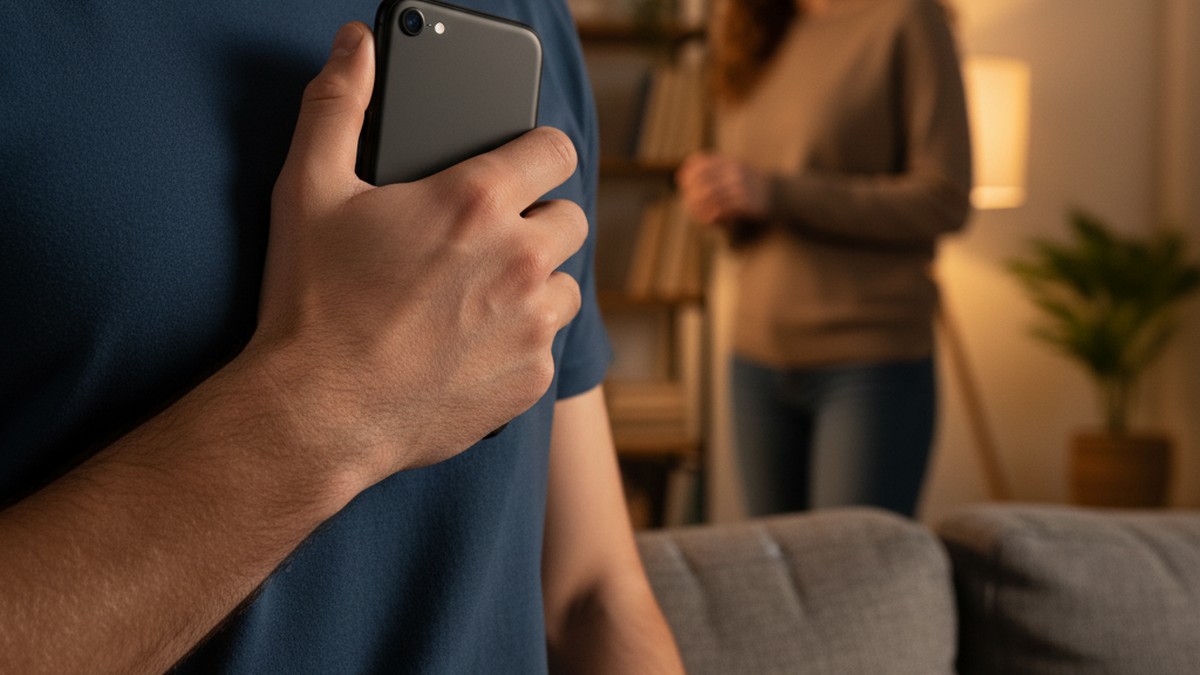
The most universal sign. A man who used to leave his phone on the kitchen counter now takes it to the bathroom, carries it to the garage, and sleeps with it under his pillow. This is protective behavior — he is guarding access to something he does not want you to see.
Pay attention to whether this is new. If he has always been attached to his phone, it means less. If this behavior started in the last few weeks or months, it is significant.
We cover this behavior in depth in our guide to signs your husband is cheating on his phone.
2. He Changed His Lock Screen or Password
Suddenly switching from a four-digit PIN to Face ID, or from no lock to a complex password, signals that something on the phone needs protection. The change itself is the red flag — not the existence of a password.
Watch for the secondary behavior: does he angle his screen away from you when typing the code? Does he get tense when you pick up his phone to check the time?
3. New Notifications You Don't Recognize
Tinder sends push notifications for new matches, messages, and "super likes." On both iPhone and Android, these show up as a flame icon with a brief text preview. If you see notifications from an app with a flame icon — or if he has turned off notification previews entirely — that warrants attention.
Some men rename their Tinder notifications or disable them. If you notice he has turned off all notification previews across every app (not just one), that is a blanket approach to hiding something specific.
4. Increased Screen Time, Especially Late at Night
Check the Screen Time feature on iPhone (Settings > Screen Time) or Digital Wellbeing on Android (Settings > Digital Wellbeing). Look for spikes in usage during hours when he should be sleeping or when you are not around. Late-night phone sessions between 10 PM and 2 AM are a particularly common pattern among cheating partners.
You do not need to see the specific apps listed. A sudden jump from two hours of daily screen time to four hours — without a corresponding new work demand or hobby — tells you something is consuming his attention.
5. He Groomed His Social Media or Photos
Tinder profiles need photos. If your husband recently updated his profile pictures on Instagram or Facebook, took new selfies (something he never does), or asked someone to photograph him at events, he may be building a dating profile.
Look for photos that seem designed to present a single lifestyle: no wedding ring visible, no family photos, solo shots in appealing locations.
6. Unexplained Charges or App Store Activity
Check your shared credit card or bank statements for charges to Tinder, Inc. or Match Group (Tinder's parent company). Tinder Plus costs $9.99 to $19.99 per month. Tinder Gold runs $14.99 to $29.99. Tinder Platinum is $19.99 to $39.99.
Also check the App Store (iPhone) or Google Play (Android) purchase history. A Tinder subscription will appear there unless he used a separate payment method.
7. He's More Distant Emotionally
Emotional withdrawal is one of the earliest and most consistent indicators of infidelity. He stops sharing details about his day. Conversations become transactional. He seems mentally elsewhere even when he's physically present.
Research from the American Association for Marriage and Family Therapy (AAMFT) found that 45% of men who cheat report feeling emotionally disconnected from their partner — both as a cause and an effect of the affair. The disconnection feeds the cheating, and the cheating deepens the disconnection.
If you've noticed emotional distance and are questioning your own judgment, our article on gut feeling he's cheating walks through how to distinguish intuition from anxiety.
8. His Schedule Has New Gaps
New "work events," sudden gym sessions, errands that take twice as long, or weeknight commitments that appeared out of nowhere — all of these create time windows. Tinder affairs need time to progress from matching to messaging to meeting.
Track whether these new schedule items are verifiable. A real work dinner has a restaurant name, colleagues who were there, and a credit card charge. A fabricated one has vague details and resistance to follow-up questions.
9. He Gets Defensive When You Ask Simple Questions
"Where were you?" should not trigger anger. "Who was that texting you?" should not lead to a fight. Disproportionate defensiveness — where the emotional response far outweighs the weight of the question — is a classic guilt response.
This is different from introversion or valuing privacy. A man who has always been private about his phone is not suddenly guilty. A man who was previously open and is now hostile to basic questions has shifted his behavior, and that shift has a cause.
10. He Accuses You of Cheating
Projection is a well-documented psychological pattern. A partner who is cheating may accuse you of the same behavior, either to deflect suspicion, to rationalize their own actions ("she's probably doing it too"), or to create a fight that justifies emotional distance.
If your husband has recently started asking who you are texting, checking your phone, or accusing you of being unfaithful — with no basis — take that as a data point, not a compliment.
11. Your Sex Life Changed Abruptly
This can go in either direction. Some men withdraw from physical intimacy because their needs are being met elsewhere. Others become more attentive — sometimes out of guilt, sometimes because the excitement of a new connection increases their overall drive.
The signal is not the direction of the change. The signal is that something shifted without explanation.
12. A Friend or Acquaintance Mentioned Seeing Him Online
Sometimes the sign comes from outside. A friend swipes across his profile. A coworker mentions seeing him on Tinder. A mutual acquaintance sends you a screenshot. People are often reluctant to share this information, so if someone tells you, they likely deliberated about it and decided you needed to know.
Take the report seriously. Ask for screenshots. Ask when they saw it and what information was on the profile. These details matter.
Related: phone habits of a cheating husband explained
Tinder-Specific Red Flags Most People Miss
General cheating signs appear in every article. These are the technical indicators specific to how Tinder works — details that most guides skip because the writers haven't studied the platform.
The Location Update Tell
Tinder updates a user's location only when they actively open and use the app. If someone found your husband's profile and it shows his current city — not a city he visited months ago — that means he opened Tinder recently.
Tinder also shows distance from the person searching. If a friend creates a profile in your area and finds your husband at "less than 1 mile away," he was using Tinder in that location within the past few days.
The Activity Status Indicators
Tinder displays two activity markers:
- Green dot: The user was active within the last 24 hours.
- "Online Now" or "Recently Active": The user was active within the last 2 hours.
There is a catch. Tinder Plus and Tinder Gold subscribers can pay to hide their activity status. So a missing green dot does not prove he is inactive. But a visible green dot does prove he has been swiping recently.
The "New to Tinder" Badge
Tinder assigns a badge to recently created accounts. If your husband's profile shows this badge, the account was created within the last few weeks — not years ago. This directly contradicts the "old account I forgot about" excuse.
The Photo Recency Test
Look at the photos on his Tinder profile. Do they show his current hairstyle, weight, and facial hair? Are they taken at locations you recognize from recent trips or events? Current photos mean current effort. Nobody updates a dormant profile.
Smart Photos and Bio Details
Tinder's Smart Photos feature rotates a user's best-performing photo to the front position. If his profile has this enabled, it means the algorithm has been actively testing which photos get the most right-swipes — a process that only happens on active accounts with ongoing swipe activity.
Also check the bio. References to current interests, recent events, or up-to-date information confirm active maintenance.
For a full walkthrough of how to find his profile without creating your own account, read our guide on how to search Tinder without an account.

Phone Behavior Changes That Point to Tinder
Your husband's phone is the primary tool for Tinder cheating. These specific phone behaviors indicate active dating app use, not just general secrecy.
App Hiding Techniques
Cheaters rarely leave Tinder sitting on their home screen. The most common hiding methods include:
- Folders: Burying Tinder inside a folder labeled "Utilities" or "Finance" on the second or third page.
- App Library (iPhone): Removing Tinder from the home screen while keeping it installed. It only appears in the App Library or through search.
- Vault apps: Installing apps that look like calculators or note-taking tools but contain hidden compartments. Entering a secret code opens the real content — including other hidden apps, photos, and messages. If you see two calculator apps on his phone, that is a significant red flag.
- Second Space (Android): Some Android phones support a parallel workspace with separate apps and accounts. He could have Tinder installed in a second workspace you never see.
We maintain a full catalog of hidden dating apps on a phone and the common disguises they use.
Data Usage Spikes
Tinder uses data. Swiping through profiles loads photos and location data. You can check data usage per app in your phone's settings:
- iPhone: Settings > Cellular > scroll to Tinder
- Android: Settings > Network & Internet > Data Usage > App Data Usage
If Tinder appears in the data usage list, the app is installed and has been used during the current billing cycle. Even if he deleted the app, some phones retain data usage logs for a period.
The Notification Sound Test
Tinder's default notification sound uses the phone's system notification tone. But the notification preview — the text that flashes on the lock screen — reveals the source. Phrases like "You have a new match" or "Someone liked you" are Tinder-specific.
If your husband has turned off lock screen previews for all apps, or if he keeps his phone on permanent silent mode (when that was not his previous habit), he may be preventing Tinder alerts from being seen or heard.
Battery Drain Patterns
Location-based apps like Tinder drain battery faster than typical apps because they constantly ping GPS. If his phone is dying faster than usual, check the battery usage breakdown. On iPhone, go to Settings > Battery. On Android, go to Settings > Battery > Battery Usage. Look for dating apps in the list, or for unusually high consumption by apps you don't recognize.
For a broader look at what apps to check, read about apps cheaters use and the technical footprints they leave behind.
The Excuses He Will Use (And Why They Don't Hold Up)
If you find evidence of a Tinder account, expect one of these explanations. Here is why each one fails under basic scrutiny.
"I Was Just Curious — I Never Met Anyone"
This is the most common excuse. Research from Computers in Human Behavior found that Tinder users in relationships often claim curiosity as their motivation. But the study also found that these same users were more likely to score higher on dark personality traits, including Machiavellianism and psychopathy, than single users.
The "just curious" defense also fails a simple logic test. Curiosity requires observation, not participation. You can learn about Tinder from articles, videos, or friends. Creating a profile, uploading your best photos, writing a bio, and swiping on real people is participation.
If he never met anyone, the profile still represents intent. He built the tool. He loaded the weapon. Whether he pulled the trigger is a separate question from whether the behavior itself crosses a line.
"My Friend Made It as a Joke"
Ask for the friend's name. Ask when it happened. Then look at the profile details. Does it contain accurate personal information? Are the photos recent? Is the bio written in his voice? If yes, his friend did not make that profile. He did.
"It's an Old Account I Forgot About"
Tinder profiles become inactive and stop showing up in other users' feeds when the account owner has not used the app for an extended period. If someone found his profile through normal swiping, the account has recent activity. If the profile shows his current appearance and location, it has been recently updated.
You can verify this yourself. Use a tool like CheatScanX to check if your partner is on Tinder and see whether the profile is actively appearing in search results.
"I Only Used It for the Ego Boost"
This excuse at least contains a grain of honesty. Many men on dating apps do seek external validation. But seeking validation from potential sexual and romantic partners outside your marriage is itself a breach of trust. The fact that it felt good to match with strangers does not make the behavior acceptable — it makes it a problem.
"Everyone Does It"
No. Not everyone does. The 30% married-user figure on Tinder means 70% of users are not married. And the vast majority of married people are not on Tinder. The normalization of the behavior is an attempt to lower the bar for his own conduct.
How to Confirm Your Husband Is on Tinder
Suspicion is painful, but uncertainty is worse. Here are the reliable methods to get a definitive answer, ordered from least to most invasive.
Ready to confirm? See how to find if someone is on Tinder for step-by-step methods.
Confirmed the Tinder signs? Our tech-based guide to catching a cheating husband covers the next moves.
Method 1: Use a Profile Search Tool
The fastest and most discreet option. Services like CheatScanX scan Tinder and 15+ other dating platforms by searching for a name, email address, or phone number. You do not need a Tinder account. You do not need access to his phone. The scan runs in minutes and tells you whether an active profile exists.
This is the method we recommend starting with because it provides a clear yes-or-no answer without confrontation, snooping, or creating a fake account. For a comparison of different search tools, see our roundup of best cheater finder apps.
Method 2: Ask a Trusted Friend to Search
If a friend is already on Tinder, ask them to adjust their search settings to match your husband's demographics (age range and distance) and swipe through profiles. This method is free but has drawbacks: it requires a friend willing to help, it only works if your husband's profile appears in their queue, and Tinder's algorithm may not surface his profile quickly.
Method 3: Check App Store Purchase History
On a shared Apple ID or Google Family account, you can see app downloads across linked devices. Go to the App Store > tap your profile icon > Purchased > tap "Not on This Phone" (iPhone) or Google Play > Library (Android). If Tinder appears in the download history, it was installed at some point.
Keep in mind: downloading does not prove current use. But combined with other signs, it adds to the picture.
Method 4: Reverse Image Search
Take a photo of your husband — one he might use on a dating profile — and run it through Google Reverse Image Search or TinEye. If the image appears on a Tinder profile or other dating site, you have your answer.
This method has limitations. Tinder profile photos are not always indexed by search engines. But it is worth trying as one component of a broader search.
Method 5: The Password Reset Test
Enter your husband's phone number or email address on Tinder's password reset page. If an account exists, Tinder will send a reset link. The downside: the reset notification goes to his phone or email, which means he will know someone attempted a reset. Use this method only if you are prepared for that conversation.
For a detailed walkthrough of all these techniques, read our article on how to catch a cheater.

Emotional Signs That Accompany Tinder Cheating
Digital cheating leaves emotional footprints as clearly as it leaves digital ones. These behavioral shifts often appear before you find any physical evidence.
Guilt-Driven Generosity
Unexpected gifts, unusually kind behavior, or sudden interest in doing things he normally avoids (cooking dinner, planning a date night) can be guilt compensation. This is not always cheating — sometimes people just have good days. But when new generosity coincides with other signs on this list, it forms a pattern.
Emotional Volatility
Cheaters often cycle between guilt and irritability. One evening he is warm and attentive. The next, he picks a fight over nothing. The inconsistency itself is the signal. He is managing two emotional realities — the marriage and the affair — and the strain creates mood swings.
Withdrawal from Shared Activities
He stops suggesting weekend plans. He is less interested in activities you used to enjoy together. He may spend more time alone in a separate room. This is not always about Tinder specifically, but when combined with phone secrecy and schedule changes, it points to a divided attention.
Comparison and Criticism
Some men in affairs begin subtly criticizing their partner — appearance, interests, habits — as a way to justify their behavior. If your husband has started making unflattering comparisons or expressing dissatisfaction with things he previously accepted, ask yourself what changed and when.
Emotional Flatness
Not all cheaters become volatile. Some go flat. They stop engaging emotionally altogether. Conversations become shorter. Eye contact decreases. They seem physically present but mentally checked out. This flatness can feel worse than fighting because it signals someone who has already partially left the relationship.
If you are unsure whether what you are feeling is intuition or anxiety, take our is my partner cheating quiz to organize your observations into a structured assessment. And if the doubt itself is consuming you, read am I paranoid or is he cheating — we explain the difference between anxiety-driven suspicion and pattern-based concern.
What to Do After You Find His Tinder Profile
Discovery is the hard part. What comes next determines whether the situation gets resolved or gets worse. Here is a step-by-step approach.
Step 1: Document Everything
Before you say a word, take screenshots. Capture the profile, the photos, the bio text, the "recently active" status, and the location. If you used a search tool, save the results. If a friend found the profile, ask them to screenshot it immediately.
Digital evidence disappears fast. Once he suspects you know, the profile will be deleted within hours. Get your documentation first.
Step 2: Process Your Emotions Before Acting
The urge to confront immediately is strong. Resist it if you can. Give yourself 24 to 48 hours to move past the initial shock. Talk to a trusted friend, a family member, or a therapist. Write down what you want to say.
Confrontations driven by raw emotion tend to devolve into arguments. Confrontations driven by calm preparation tend to produce answers.
Step 3: Decide What You Need From the Conversation
Before you confront him, know your own position. Are you looking for an explanation that might preserve the marriage? Are you looking for confirmation before you leave? Are you willing to try counseling? Your goal shapes how you approach the conversation.
Step 4: Present the Evidence Directly
Do not hint. Do not ask leading questions hoping he will confess. Show him the screenshots. State what you found. Then stop talking and let him respond.
His initial response will tell you a great deal. Does he take responsibility? Does he deflect and blame you? Does he minimize ("it's not a big deal")? Does he gaslight ("that's not mine" when it clearly is)? The quality of his response is as important as the content.
Step 5: Seek Professional Support
Whether you decide to work on the marriage or end it, professional guidance helps. The AAMFT reports that 60% to 75% of marriages survive infidelity when both partners engage in couples therapy. Without therapy, only 15.6% recover.
A therapist provides a neutral space for both partners to speak honestly. They also help you distinguish between a partner who made a mistake and genuinely wants to repair the relationship, versus a partner who will repeat the behavior.
For a complete guide to the conversation and what comes after, read what to do if your partner is on a dating app.
Common Mistakes to Avoid When You Suspect Tinder Cheating
Suspicion creates urgency, and urgency leads to errors. These are the most common mistakes we see — and how to avoid them.
Creating a Fake Tinder Profile to Catch Him
This seems clever but rarely works well. Tinder's algorithm controls who sees whom, so there is no guarantee your fake profile will appear in his feed (or his in yours). You also risk him discovering the fake account, which shifts the dynamic from his betrayal to your deception.
Profile search tools like CheatScanX give you the same answer without the complications. You can catch a cheater online without creating a fake identity.
Snooping Through His Phone Without a Plan
If you check his phone, know exactly what you are looking for and have a plan for what to do with what you find. Aimless snooping often leads to discovering something upsetting with no context, no screenshots saved, and no emotional preparation.
If you are going to look, look with purpose. And document what you find.
Confronting Him in Public or in Front of Others
The conversation about Tinder should happen in private. Public confrontations escalate, humiliate, and rarely produce honest answers. Choose a time when children, family members, or friends are not present.
Ignoring the Evidence Because You're Not Ready
Finding his Tinder profile and then pretending you didn't see it does not make the problem disappear. It makes the problem invisible to him, which means he has no incentive to stop. If you are not ready to confront the situation, that is valid — but set a timeline for yourself. Do not let "not ready" become "never."
Telling Everyone Before Telling Him
Sharing the discovery with friends, family, or on social media before confronting your husband can feel cathartic but often backfires. It removes his chance to respond privately, escalates the situation into public drama, and can complicate legal proceedings if divorce becomes relevant.
Tell one or two trusted people for emotional support. Save the broader conversation for after you have spoken with him.
Blaming Yourself
His Tinder account is not your fault. Marriages have problems — all of them do — but the decision to create a dating profile is a choice he made, not a consequence of something you did or did not do. Do not accept the framing that you "drove him to it."
Can Your Marriage Survive Tinder Cheating?
The honest answer: it depends. Not on whether he cheated, but on what happens after.
What the Research Says About Recovery
The data offers cautious optimism for couples who commit to the work:
- 60-75% of marriages survive infidelity when both partners engage in professional therapy (AAMFT, 2025).
- 15.6% survive without professional help — a dramatic difference that underscores the value of therapy.
- 74% of couples who undergo structured therapy through AAMFT-affiliated therapists report successful recovery.
These numbers apply to all forms of infidelity, not just Tinder-based cheating. But the principles are the same.
Factors That Predict Recovery
Based on analysis of clinical data and our platform's trends, marriages most likely to recover share these characteristics:
- Full disclosure. The cheating partner reveals the complete truth — not a trickle of confessions over weeks. Partial honesty destroys rebuilding.
- Genuine remorse. Not guilt (which is self-focused) but remorse (which is partner-focused). Does he understand how his actions affected you?
- Accountability without deflection. He does not blame you, the marriage, work stress, or alcohol. He owns the choice.
- Willingness to do the work. Therapy, transparency, rebuilding trust through consistent behavior over months and years.
- This was the first offense. Remember that statistic: people who cheat are 3x more likely to cheat again. A first-time offense with genuine remorse has a different prognosis than a third discovery.
Factors That Predict Failure
Marriages are less likely to survive when:
- The cheating partner minimizes the behavior ("it was just an app").
- There is a pattern of repeated infidelity.
- The cheating partner refuses therapy.
- The betrayed partner is expected to "just get over it."
- There is no change in the behavior that enabled the cheating (phone secrecy, unaccounted time, separate digital lives).
The Timeline Is Long
Trust rebuilding after infidelity takes 1 to 3 years in most clinical models. That is not a setback — it is the normal pace. If someone tells you to "move on" after a few weeks, they do not understand the process.
The goal is not to forget what happened. The goal is to reach a point where what happened does not define every interaction. That takes time, consistency, and professional guidance.
Where to Go From Here
You came to this article because something did not feel right. You now have 12 specific signs to evaluate, the technical details of how Tinder reveals secret use, and a framework for what to do with whatever you find.
If you are still in the suspicion phase and need a definitive answer, CheatScanX runs a discreet scan across Tinder and 15+ other dating apps. Enter a name, email, or phone number. Get results in minutes. No account creation required, no fake profiles, no confrontation until you are ready.
Whatever you decide to do next, make the decision based on evidence, not just emotion. You deserve clarity.
Frequently Asked Questions
You cannot search Tinder directly without an account because the app has no public search feature. Third-party profile search tools like CheatScanX can scan Tinder and 15+ other dating apps using just a name, email, or phone number — no Tinder login required.
Tinder shows a green dot for users active within 24 hours and 'Online Now' for those active in the last 2 hours. But users can pay for Tinder Plus or Gold to hide their activity status entirely, so a missing green dot does not mean your husband is inactive.
Most relationship therapists consider maintaining an active dating profile while married a form of emotional infidelity, regardless of whether physical meetings occurred. Creating a profile, swiping, and messaging other people violates the trust boundary in most marriages.
Roughly 30% of Tinder users globally are married, according to 2025 data from DatingZest. In the United States specifically, that figure climbs higher — a Computers in Human Behavior study found 42% of American Tinder users were in a committed relationship.
Yes, but not immediately. First, document the evidence with screenshots and timestamps. Gather your thoughts and decide what outcome you want. Then choose a calm, private moment to present what you found and ask direct questions. Avoid accusations — let the evidence speak.