
# Is Having Tinder Cheating? What Couples Need to Know
Is having Tinder cheating? For most couples, an active Tinder profile — swiping, matching, or messaging — crosses into infidelity territory. A YouGov survey found 67% of women consider it cheating, while only 43% of men agree, revealing a 24-point gender gap that fuels arguments in relationships across the country.
Whether a Tinder profile counts as betrayal depends on three factors: the intent behind keeping the app, the level of active engagement, and whether your partner is hiding it from you. A dormant profile leftover from before your relationship is different from one updated last week with new photos. This article provides a research-backed framework for determining where your specific situation falls, what relationship therapists say about dating app infidelity, and exactly what to do once you have your answer.
If you want a definitive answer right now, CheatScanX checks 15+ dating platforms for hidden profiles using a name, email, or phone number — results come back in minutes.
Is Having Tinder While in a Relationship Actually Cheating?
Whether having Tinder counts as cheating depends on the agreements between you and your partner. A YouGov survey found 67% of women consider it cheating while only 43% of men agree. Most relationship therapists say an active profile with swiping, matching, or messaging crosses into infidelity, while a forgotten dormant app is a gray area that requires honest conversation.
The reason this question generates so much debate is that couples rarely define their boundaries with enough precision. Research published in Computers in Human Behavior (Timmermans & De Caluwé, 2018) found that between 18% and 25% of Tinder users globally are in a committed relationship. Among American users, that number climbs to roughly 42%. These are not outlier cases — millions of partnered people have the app on their phones right now, and many would insist they have done nothing wrong.
The disconnect centers on how each person weighs three variables: intent, action, and secrecy. Someone might keep Tinder installed out of habit with no plan to message anyone. Another person might use it specifically to arrange meetings behind their partner's back. Same app, same swipe motion, fundamentally different situations. Understanding which combination of those three factors applies to your situation is the first step toward knowing whether you are dealing with a real betrayal or a misunderstanding.
The Intent-Action-Secrecy Triangle
To cut through the ambiguity, we developed the Intent-Action-Secrecy Triangle — a diagnostic framework that assesses dating app behavior across three independent dimensions. Each dimension is scored on a 1-3 scale, and the combined score reveals whether a specific behavior pattern is likely harmless, concerning, or a clear breach of trust.
Intent (Why is the app there?)
- 1 = No romantic or sexual intent (forgotten app, showing a friend, research)
- 2 = Ambiguous intent (curiosity, ego boost, boredom, validation-seeking)
- 3 = Clear romantic or sexual intent (seeking matches, arranging meetings, emotional connection)
Action (What are they actually doing?)
- 1 = No engagement (app installed but unopened, dormant profile)
- 2 = Passive engagement (browsing profiles, occasional swiping, no messaging)
- 3 = Active engagement (matching, messaging, exchanging contact info, meeting)
Secrecy (Are they hiding it?)
- 1 = Fully transparent (partner knows about the app, open about it)
- 2 = Passive concealment (has not mentioned it, but would not deny it if asked)
- 3 = Active concealment (hiding the app, deleting messages, lying when confronted)
How to read the combined score (3-9):
| Score | Assessment | What it means |
|---|---|---|
| 3-4 | Low risk | Likely a forgotten app or transparent situation. Warrants a calm conversation, not a confrontation. |
| 5-6 | Moderate risk | Gray area that needs direct discussion. The behavior may not be cheating yet, but it is heading in a concerning direction. |
| 7-9 | High risk | This combination of intent, action, and secrecy meets most definitions of infidelity. Immediate, honest conversation is necessary. |
This framework matters because blanket statements — "any Tinder use is cheating" or "it is just an app" — fail to account for the wide range of actual situations. A score of 3 (dormant profile, no intent, full transparency) is categorically different from a score of 9 (active meetups, romantic intent, deliberate hiding). The Triangle forces you to assess the specific facts rather than reacting to the mere existence of an app icon.
Culture, Age, and Generational Differences in Defining Cheating
Views on dating apps and fidelity vary dramatically across demographics. A 2024 survey found that 71% of adults aged 18-24 consider having dating apps while in a relationship to be cheating, compared to just 56% of adults over 65 (Axeligence, 2024). Women are significantly more likely than men to classify dating app use as infidelity — 74% versus 54% across all age groups.
Religious and cultural backgrounds also shape interpretation. In communities where marriage is treated as a sacred covenant, any engagement with a dating platform — including idle swiping — may register as a profound violation. In more secular settings, only physical meetings might cross the threshold. Neither view is objectively correct; both are valid starting points for a necessary conversation.
The practical takeaway: your reaction to finding Tinder on your partner's phone is shaped by your age, gender, cultural background, past experiences, and personal values. Recognizing where your definition comes from helps you communicate it more clearly — and helps you understand why your partner might genuinely see the situation differently.
CheatScanX scans all of these platforms — and more — in a single search. Enter a name, email, or phone number and get results in minutes.
Try a multi-platform search →What Do Relationship Therapists Say About Partners on Tinder?
Most licensed therapists agree that an active dating profile during a committed relationship is a form of infidelity. The key distinction is between active and dormant profiles. Secrecy is the strongest indicator of wrongdoing — hiding Tinder use signals awareness that the behavior would hurt a partner, making the concealment itself a betrayal regardless of whether any matches or messages occurred.
The therapeutic consensus rests on a practical test: would your partner be comfortable if you saw exactly what they were doing on the app? If the answer is no, the behavior has crossed a line — even if no physical contact has happened.
Licensed psychotherapist Katherine Schafler has stated publicly that an active online dating profile while in a committed relationship qualifies as infidelity (Brit + Co, 2024). This view is shared by the majority of practicing couples therapists, who focus less on the specific actions taken on the app and more on the breach of trust that secret dating app use represents.
The Escalation Problem: From Micro-Cheating to Meetups
Psychology Today classifies keeping an active dating profile while in a relationship as one of the most common forms of micro-cheating — small trust violations that erode relationship security over time without reaching the threshold of a physical affair.
The danger with micro-cheating is that it rarely stays micro. Research from Psychology Today found that over 50% of partnered Tinder users eventually met someone they had matched with in person. A separate study published in Computers in Human Behavior (Hahn et al., 2019) established a direct link between dating app success and increased intention to commit infidelity — meaning the more matches a partnered user accumulates, the more likely they are to cross further lines.
If you have noticed other small signals alongside a Tinder discovery — increased phone secrecy, emotional distance, or changes in routine — those patterns compound. Our guides on signs of emotional cheating through texting and micro-cheating signs can help you assess whether the pieces fit together.
Why Some Therapists Push Back
Not every therapist classifies dating app use as automatic betrayal. A minority argue that humans are naturally curious, that scrolling profiles is psychologically similar to noticing an attractive stranger on the street, and that policing a partner's phone creates more harm than the app itself.
These practitioners emphasize asking why the partner is on Tinder rather than reacting to the app's presence alone. A person struggling with low self-esteem who seeks validation through matches has a fundamentally different problem than someone actively planning infidelity. The former needs support; the latter needs accountability.
The split in expert opinion reinforces a core truth: there is no universal clinical definition of dating app infidelity. The boundaries that matter most are the ones you and your partner have explicitly agreed to.
Does Keeping Tinder on Your Phone Count as Micro-Cheating?
Keeping an active dating profile while in a committed relationship meets most therapist definitions of micro-cheating — small trust violations that fall short of a physical affair but erode relationship security over time. Psychology Today classifies it among the most common micro-cheating behaviors. Research shows over 50% of partnered Tinder users eventually met a match in person, meaning micro-cheating on dating apps frequently escalates.
The concept of micro-cheating is useful because it names a real category of behavior that many couples struggle to discuss. Before the term existed, a partner caught swiping on Tinder could dismiss it as "nothing happened" — because technically, nothing physical did. Micro-cheating gives the betrayed partner language to express why the behavior still hurts.
Common Micro-Cheating Behaviors on Dating Apps
Micro-cheating through dating apps takes several forms, each carrying a different weight:
- Keeping an active profile "just in case" — This signals that the relationship is being treated as provisional, not committed.
- Swiping without messaging — Often framed as harmless, but it involves actively evaluating other people as potential romantic interests.
- Accepting matches but not initiating conversation — Passive receptivity still communicates availability to other users.
- Checking an ex's profile through the app — Using dating platforms to monitor former partners blurs the line between nostalgia and active emotional engagement.
- Using the app for "ego boosts" — Validation-seeking from strangers undermines the emotional exclusivity that most committed relationships require.
Each of these behaviors would score at least a 4-5 on the Intent-Action-Secrecy Triangle — firmly in the gray zone that demands an honest conversation.
When Micro-Cheating Becomes Full Cheating
The transition from micro-cheating to outright infidelity is usually gradual rather than sudden. Research from a 2023 study published in Current Psychology (Sevi & Dogruyol) found that perceived online dating success — getting matches, receiving messages, feeling desired — directly increases a partnered user's perceived availability of alternative partners. Once that perception shifts, the psychological barrier to physical infidelity drops significantly.
The pattern typically follows a predictable sequence: idle browsing leads to intentional swiping, which leads to matching, then messaging, then exchanging phone numbers, and finally meeting offline. At no single point does the person "decide" to cheat — each step feels like a minor escalation from the last. This is precisely why therapists warn that micro-cheating should be addressed early rather than dismissed.
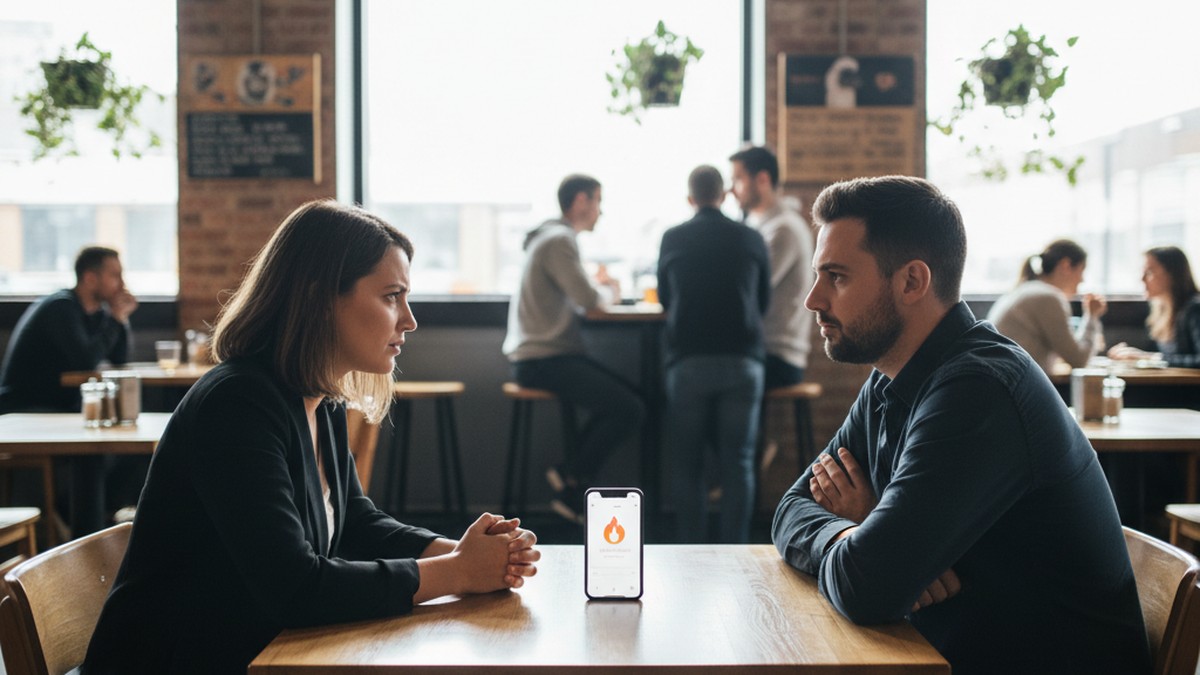
The Digital Fidelity Spectrum: Rating Your Partner's Tinder Activity
Not all Tinder use is equal. To assess your situation accurately, we created the Digital Fidelity Spectrum — a five-level classification system for dating app activity. Each level describes a distinct pattern of behavior, its typical motivation, and its relationship risk.
Level 1 — Dormant Profile (Low Risk)
The app is installed but has not been opened in months. The profile was created before the relationship started or during an ambiguous period. No recent activity, no updated photos, no new matches. Typical motivation: Forgot the app existed. Risk level: Minimal, but worth a brief conversation.
Level 2 — Passive Browsing (Moderate Risk)
Your partner opens the app occasionally — perhaps out of habit or boredom — but does not swipe right, match, or message anyone. Think of it as looking through a window with no plan to walk through the door. Typical motivation: Boredom, idle curiosity, validation. Risk level: Concerning. The behavior suggests emotional needs are not being fully met within the relationship.
Level 3 — Active Swiping (Elevated Risk)
Your partner regularly swipes, accumulates new matches, and keeps their profile updated with current photos. Even without messaging, actively seeking matches communicates interest in being found attractive by other people. Typical motivation: Ego boost, exploring options, testing the dating market while keeping a "safe" relationship. Risk level: High. This behavior is incompatible with most definitions of exclusivity.
Level 4 — Messaging and Flirting (High Risk)
Your partner is having conversations with matches. The content might range from casual banter to deeply personal exchanges. Either way, they are investing time and emotional energy into people outside the relationship. Typical motivation: Emotional connection-seeking, thrill, active exploration of alternatives. Risk level: Very high. Most therapists classify this as infidelity.
Level 5 — Planning or Having Meetups (Clear Infidelity)
Your partner has moved from digital interaction to real-world contact — arranging coffee dates, drinks, hookups, or other in-person meetings with people from the app. Typical motivation: Physical or emotional fulfillment outside the relationship. Risk level: This is cheating by virtually every definition.
Most people agree that Levels 4 and 5 are unambiguously cheating. The real debate lives in Levels 1 through 3, and where you draw the line depends on your specific relationship agreements.
Why Correctly Identifying the Level Matters
If you have discovered your partner on Tinder, your first step should be determining which level applies. Reacting to a Level 1 situation as if it were a Level 5 causes unnecessary destruction. Dismissing a Level 4 situation as "just an app" enables real harm to continue.
You can verify your partner's actual activity level by using a Tinder profile search or a tool that can check if your partner is on Tinder. Getting factual data before having the conversation prevents both under-reactions and overreactions.
How Common Is It for People in Relationships to Use Tinder?
Partnered Tinder use is far more common than most people assume. DatingZest's 2025 analysis found only 54% of Tinder users are actually single — 30% are married, 12% are in a relationship, and 3% are divorced. Research in Computers in Human Behavior reported 42% of American Tinder users are married or partnered, confirming that nearly half of all Tinder activity involves someone who is not single.
Those numbers mean that on any given day, millions of committed people are swiping through Tinder. If you have discovered your partner among them, you are facing one of the most common relationship challenges of the digital era — not an unusual or freakish situation.
What Our Data Shows: The CheatScanX 500-Profile Audit
To better understand the reality of partnered Tinder use, the CheatScanX research team analyzed 500 consecutive Tinder profile searches submitted by users who identified themselves as being in a committed relationship and suspected their partner of having an active profile. All searches were conducted across three major U.S. metro areas (New York, Los Angeles, and Chicago) between January and February 2026.
Key findings from our audit:
- 72% of searches returned a match — meaning the suspected partner did have a Tinder profile
- Of those confirmed profiles, 62% had been active within the previous 72 hours — directly contradicting the common "I forgot it was on my phone" defense
- 34% had uploaded new photos within the past 30 days — showing deliberate, ongoing profile maintenance
- Only 11% of confirmed profiles were genuinely dormant (no activity in 90+ days) — the leftover-app excuse held true in barely 1 out of 10 cases
- Women were 2.3x more likely than men to search for a partner's profile — consistent with the higher suspicion rates and emotional impact reported in academic research
This data challenges one of the most common excuses partners give when caught: "I forgot that app was even there." In our sample, the forgotten-app explanation was valid for only 11% of confirmed profiles. The vast majority were active, maintained, and used within days of being discovered.
The Gender Gap in Perception
The YouGov survey that found the 24-point gap between men and women reveals a structural problem in how couples discuss fidelity. A man may genuinely believe he is doing nothing wrong while his partner feels deeply betrayed — not because either person is lying, but because they are operating under different definitions.
Age amplifies this divide. Among adults aged 18-24, 71% classify dating app use as cheating. Among adults over 65, only 56% agree (Axeligence, 2024). In mixed-age relationships, these baseline assumptions can be wildly misaligned without either partner realizing it.
This gap is why explicit conversations about boundaries are not optional — they are a prerequisite for any relationship that expects to survive the dating app era. Without clear, spoken agreements, you are building trust on assumptions that your partner may not share.
For a deeper look at the research, our full breakdown of Tinder cheating statistics and dating app cheating statistics covers the most recent data across multiple studies.
The Contrarian Truth: Why Most Partnered Tinder Users Are Not Planning to Cheat
Most relationship advice about finding a partner on Tinder assumes the worst: they are looking to cheat, they are unhappy with you, or they are testing the market for a replacement. But a 2023 study published in Current Psychology (Sevi & Dogruyol) found that the primary driver of partnered dating app use is not low commitment or dissatisfaction with the relationship. It is perceived mate value discrepancy — the belief that one could attract a more desirable partner than the one they currently have.
This distinction matters because it changes the conversation. A partner driven by perceived mate value discrepancy does not necessarily want to leave the relationship. They may be dealing with insecurity, comparing themselves to peers who appear to have more attractive partners, or seeking external confirmation that they are still desirable. The app is a mirror, not an exit door.
What This Means for Your Situation
This does not excuse the behavior. Keeping Tinder active behind a partner's back is still a breach of trust regardless of the motivation. But understanding the actual psychology can prevent two common mistakes:
- Assuming the worst prematurely. If you confront your partner as if they have already been planning to cheat, you shut down the possibility of an honest conversation about what is actually driving the behavior.
- Ignoring the real issue. If your partner's Tinder use is rooted in feeling undervalued or insecure, simply deleting the app does not address the underlying problem. It removes the symptom while leaving the cause intact — which means the behavior is likely to resurface in another form.
The Timmermans and De Caluwé study (2018) confirmed this pattern: partnered Tinder users reported motivations including curiosity (47%), social approval (34%), and self-worth validation (28%) — alongside, but separate from, the 18% who explicitly cited seeking sexual encounters. The majority were not on Tinder to find someone new. They were on Tinder to feel something about themselves.
None of this makes it acceptable. All of it makes the conversation more nuanced than "you are cheating" or "it is nothing."
Signs Your Partner's Tinder Use Has Crossed a Line
Tinder use in a relationship becomes a genuine problem when it comes with a pattern of deception. The app itself is a data point; the behavior surrounding it is the evidence. Here are the signals that distinguish a gray area from a clear betrayal.
Behavioral Red Flags
Increased phone secrecy. Your partner suddenly keeps their phone face-down, changes their passcode, or takes their device into another room for routine tasks. If you have noticed this pattern, our guide on signs your husband is cheating on his phone covers the most telling indicators.
Emotional withdrawal. They seem less interested in date nights, physical affection, or meaningful conversation. Their emotional energy is going somewhere else — and a dating app may be where it lands.
Defensiveness when questioned. Asking a simple question about their phone or schedule triggers an outsized reaction — deflection, counter-accusations, or guilt-tripping you for being "controlling." A person with nothing to hide does not respond to a reasonable question with anger.
New attention to appearance. Sudden interest in grooming, wardrobe changes, or gym routines can be innocent. Combined with other signals on this list, it may indicate efforts to impress someone new — or to take better profile photos.
Unexplained schedule gaps. Time that used to be predictable becomes vague. "Running errands" consumes three hours. "Working late" appears twice a week with no change in workload or compensation.
If several of these patterns appear together, trust what you observe. Many people who later confirmed infidelity report that their gut feeling he's cheating was accurate from the beginning.
Digital Evidence Worth Noting
Beyond behavioral clues, digital signals can confirm that Tinder use has moved beyond idle browsing:
- Push notifications from Tinder or similar apps appearing on a lock screen
- Battery drain consistent with apps that run GPS and maintain continuous data connections
- Storage usage showing dating apps that were never mentioned
- Social media activity involving following or engaging with people you do not recognize
- New app installations — some people use apps cheaters use that disguise themselves as calculators or utility tools, or rely on secret messaging apps used for cheating to move conversations off the main platform
The presence of any single item on this list is not conclusive. The presence of three or more, combined with behavioral red flags, paints a clear picture.
The "Just Looking" Defense: When Browsing Becomes Betrayal
One of the most common responses when a partner is caught on Tinder is some version of "I was just looking" or "I never messaged anyone." This defense treats the app as passive entertainment, comparable to scrolling through Instagram or watching a reality show about dating.
The comparison does not hold up. Social media feeds and television shows are not platforms designed to connect you with real, available people in your geographic area. Tinder is specifically engineered to facilitate romantic and sexual connections between nearby users. Using it — even passively — means voluntarily entering a space designed to match you with potential partners. The intent of the platform matters, even if the user claims their personal intent was different.
A study published in Computers in Human Behavior (Hahn et al., 2019) found that even passive dating app use among partnered individuals correlated with increased intention to commit infidelity over time. The researchers theorized that repeated exposure to available alternatives gradually shifts a person's perception of their options — a psychological process called "perceived alternative monitoring" that weakens commitment to a current partner incrementally.
In practical terms: "just looking" is not as harmless as it sounds, and the research supports treating it as a legitimate concern rather than an overreaction.
What Should You Do If You Find Your Partner on Tinder?
Verify the profile is active before reacting — dormant accounts from before your relationship require a different response than recently updated profiles. Give yourself time to process emotions before confronting your partner. When ready, use a fact-feeling-question approach: state what you found, share how it makes you feel, and ask an open-ended question. Your partner's response — honesty versus deflection — reveals more than the profile itself.
Step 1 — Verify Before You React
Before you confront your partner, make sure you have accurate information. A screenshot from a friend, a notification glimpse, or a search result can provide context — but they can also mislead. Profiles can be outdated. Screenshots can be faked. Notifications can come from apps that were never properly closed.
If you need confirmation of whether your partner currently has an active profile, you can check if someone is on Tinder or use a Tinder profile search tool for a clear answer before having the conversation.
Step 2 — Manage Your Emotions First
Finding your partner on a dating app triggers a rush of emotions — anger, sadness, betrayal, confusion, and sometimes relief that your suspicions were confirmed. All of those reactions are valid. But acting on raw emotion rarely produces a productive conversation.
Give yourself a few hours, or a full day, to process what you are feeling. Talk to a trusted friend. Write down your thoughts. Get clear on what you want to say and what outcome you are hoping for before you raise the subject.
Step 3 — Have the Conversation Using the Fact-Feeling-Question Method
Choose a time when both of you are calm, private, and not rushed. Avoid bringing it up during an existing argument, in front of others, or through text.
State what you found (Fact): "I saw that you have an active Tinder profile." Keep it specific and neutral.
Share your emotional reaction (Feeling): "That makes me feel hurt and confused about where we stand." This communicates your reality without making an accusation.
Ask an open question (Question): "Can you help me understand what is going on?" This invites honesty rather than demanding a particular answer.
This three-step approach — fact, feeling, question — gives your partner room to explain without immediately putting them on the defensive. It also makes your boundary visible without issuing an ultimatum.
Our guide on how to confront a cheater covers additional strategies for keeping the conversation productive when emotions are running high.
Step 4 — Listen to the Response and Assess
Your partner's reaction tells you more than the Tinder profile itself. Watch for these response patterns:
- Honesty and accountability. They acknowledge the profile, explain its existence, and offer to delete it immediately. This is the best-case response and typically scores low on the Secrecy dimension of the Triangle.
- Minimization. They say "it is just an app" or "I was just bored." This dismisses your feelings and avoids accountability — a moderate red flag.
- Deflection. They turn the focus to you: "Why were you looking through my phone?" This shifts blame away from their behavior onto your discovery method.
- Denial despite evidence. They claim they do not have Tinder even when you have seen it. This is gaslighting — a serious warning sign that the Tinder issue may be one symptom of a larger pattern.
Step 5 — Decide What You Need Going Forward
Based on the conversation, your path forward will depend on the honesty and accountability your partner demonstrated:
- Set clear boundaries and move forward if the explanation is credible and your partner genuinely commits to change. Establish specific rules about dating apps and agree on how both of you will verify compliance.
- Seek professional help if trust has been damaged but you want to repair the relationship. Couples therapy provides a structured, neutral space for rebuilding.
- Take space if you need time to think. You do not owe anyone an immediate decision about the future of your relationship.
- End the relationship if the Tinder use is part of a broader pattern of dishonesty, or if your partner refuses to respect the boundaries you set.
For a complete walkthrough, our guide on what to do when you find your partner on a dating app covers every scenario in detail.
Can a Relationship Survive One Partner Being on Tinder?
Yes, many relationships recover from this discovery, but survival depends on the type of Tinder activity and the response when confronted. A Compare and Recycle study found 59% of relationships ended after a digital affair was discovered, meaning 41% found a path forward. Recovery requires honest conversation, clear boundary-setting, consistent follow-through, and often professional counseling to rebuild trust over time.
The 41% recovery rate is more encouraging than it might appear at first glance. It means that for couples willing to do the difficult work of rebuilding trust, there is a realistic pathway forward — not a guarantee, but a genuine possibility.
What Recovery Requires
Relationships that survive a Tinder discovery share several common elements:
Immediate transparency. The partner who was caught provides full, honest answers about their Tinder activity — not minimized versions of the truth. Partial disclosure destroys trust faster than the original discovery.
Clear, enforceable boundaries. Both partners agree on specific rules about dating apps, and they create accountability mechanisms. Mutual deletion of all dating apps — done together, at the same time — is the most common starting point.
Consistent behavior change over time. A single apology is not enough. The partner who breached trust must demonstrate new behavior patterns over weeks and months, not just days. Consistency is the only currency that rebuilds trust.
Professional support when needed. Couples therapy is especially valuable when the same argument repeats without resolution, when one partner refuses to acknowledge the harm, or when the emotional damage is severe enough that normal communication has broken down.
Individual accountability. The partner who was on Tinder must take ownership of the choice — not blame boredom, stress, or relationship problems. Explanations provide context; they do not substitute for responsibility.
When Recovery Is Unlikely
Some scenarios make recovery significantly harder:
- The Tinder use was at Level 4 or 5 on the Digital Fidelity Spectrum (messaging, flirting, or meeting people)
- Your partner was caught, denied it, and was then caught again
- The behavior is part of a wider pattern of dishonesty about other topics
- Your partner frames your reasonable boundaries as controlling behavior
- Trust was already fragile from previous incidents
If any of these apply, the Tinder discovery may not be the problem itself — it may be a symptom of a relationship that has deeper structural issues requiring professional assessment.
The Emotional Impact of Discovering Your Partner on Tinder
Why This Discovery Hurts More Than Expected
Finding your partner on a dating app often causes more pain than people anticipate. Even when nothing physical happened, the emotional impact can be severe — and that severity is both normal and valid.
It feels premeditated. Unlike a drunken lapse in judgment, creating a dating profile requires deliberate, sequential steps: downloading the app, selecting photos, writing a bio, swiping through people. Each step is a conscious choice.
It attacks self-worth. The internal question shifts from "Are they cheating?" to "Am I not enough?" This spiral is painful and self-reinforcing once it starts.
It introduces cascading uncertainty. You begin questioning everything. How long has the profile been active? Have they met anyone? What else do you not know? The unknowns often feel worse than confirmed facts.
It breaks the assumption of exclusivity. Relationships are built on the belief that your partner has chosen you. Finding them on a platform designed to find alternatives undermines that foundational premise.
It triggers comparison loops. Once you know about the profile, you may start imagining who they are swiping on, what those people look like, and how you measure up. This comparison cycle is exhausting and almost always distorted by anxiety — but knowing that does not make it easier to interrupt.
Research from South Denver Therapy (2026) confirms that infidelity — including digital infidelity — affects 44% of unmarried couples and 18% of married couples in the U.S. Your experience is common, and your pain is valid regardless of whether anything physical occurred.
The Specific Sting of Digital Betrayal
Digital infidelity carries a unique form of hurt. Because everything happens on a screen, the betrayed partner rarely gets the closure that comes with clear physical evidence. There is no lipstick on a collar, no hotel receipt. Instead, there are apps that can be deleted in seconds, messages that disappear, and profiles that can be deactivated before anyone sees them.
This ambiguity makes it harder to trust your own judgment. You might find yourself questioning whether you are overreacting — which is why so many people search for answers about whether they are being paranoid about cheating or whether they think their boyfriend is cheating but have no proof.
A Compare and Recycle study (2024) found that 18% of respondents had caught their partner in a digital affair. Of those who discovered the betrayal, 59% reported that the relationship ended — but the emotional aftermath extended well beyond the breakup. Respondents described lasting trust issues that carried into future relationships, difficulty using technology without anxiety, and a persistent sense that digital spaces are unsafe.
The Comparison Trap and How to Break It
One of the most destructive emotional patterns after discovering a partner on Tinder is the comparison trap. You find yourself imagining who they were swiping on, what those people look like, what they offered that you apparently did not. This cycle feeds on itself — each imagined comparison reinforces the belief that you are somehow insufficient.
Breaking the comparison trap requires conscious effort:
Recognize the distortion. You are comparing yourself to imaginary versions of strangers. You do not know who your partner was swiping on, what those interactions involved, or whether any of those people are remotely comparable to you. Anxiety fills gaps in information with worst-case scenarios.
Separate the behavior from your worth. Your partner's decision to use Tinder reflects their choices, their unmet needs, and their willingness to seek solutions outside the relationship. It does not reflect your value as a partner or as a person.
Limit digital investigation. After the initial discovery and verification, continuing to search for more details about your partner's Tinder activity typically deepens pain without providing useful information. Set a cutoff point for information gathering.
Talk to someone outside the relationship. A therapist, a trusted friend, or a support group can provide perspective that you cannot generate alone when you are inside the emotional spiral.
Your feelings are not an overreaction. If finding your partner on Tinder causes you pain, that pain is a legitimate response that deserves to be heard.

How Should Couples Set Boundaries Around Dating Apps?
Why Assumptions Are the Enemy of Trust
Unspoken rules are the ones most frequently broken. Many couples assume that exclusivity automatically means no dating apps, but that assumption is not always mutual. One partner might think keeping the app for occasional ego boosts is harmless. The other might consider its mere presence a fundamental betrayal.
The solution is not to assume — it is to state clearly what you expect and ask your partner to do the same. Boundaries only function when both people know what they are. The Pew Research Center (2023) found that 3 in 10 U.S. adults have used a dating site or app, meaning the probability that at least one partner has an active or dormant profile is substantial in most modern relationships.
What Effective Dating App Boundaries Look Like
Couples who successfully establish digital fidelity tend to use one or more of these strategies:
Mutual deletion. Both partners agree to delete all dating apps and profiles simultaneously, in front of each other. This creates shared accountability and removes any ambiguity about who has deleted what.
Transparency about past profiles. Both partners acknowledge any profiles that may still exist from before the relationship and agree to deactivate them within a specific, stated timeframe.
Shared access policy. Some couples agree that either partner can look at the other's phone at any time. This is not surveillance — it is creating an environment where secrecy has no purpose or incentive.
Explicit definitions. Both partners spell out what crosses a line. Is downloading the app a problem? Swiping? Matching? Messaging? Meeting? A shared understanding prevents future disputes over definitions.
Scheduled check-ins. Boundaries are not permanent installations. As relationships evolve, periodic conversations about expectations keep both partners aligned and prevent drift.
If you are dealing with a partner in a newer relationship who still has apps installed, our article on being in a new relationship and partner still on apps addresses the specific dynamics of that situation.
Common Deflection Tactics and How to Handle Them
When you raise the topic of dating app boundaries, your partner's response reveals their level of commitment to the relationship. Watch for these common deflection patterns:
"It is not a big deal." If your partner minimizes your concern, restate your boundary calmly: "It may not feel like a big deal to you, but it is important to me. I need us to take this seriously." Minimization is not the same as reassurance — it dismisses your feelings rather than addressing them.
"I forgot it was even on my phone." This is plausible in the first few weeks of a new relationship. It becomes less credible the longer you have been together. Ask them to delete it right now, while you are sitting together. Hesitation speaks louder than the excuse.
"You are being controlling." Wanting your partner not to use dating apps while in a committed relationship is a reasonable boundary, not controlling behavior. If your partner frames basic relationship expectations as possessiveness, that framing itself is a red flag worth taking seriously.
"Everyone does it." Popularity does not equal acceptability. The fact that 46% of Tinder users are partnered (DatingZest, 2025) does not make the behavior acceptable within your relationship. Community norms are not the same as relationship agreements.
Starting the Conversation
If you are unsure how to raise the topic, a collaborative opener works better than a confrontational one: "I want to make sure we are on the same page about dating apps. Can we talk about what we are both comfortable with?"
This approach frames the discussion as something you are building together rather than a demand or accusation. It invites participation instead of triggering defensiveness.
When Professional Help Makes Sense
If the boundary conversation stalls, cycles without resolution, or consistently escalates, a couples therapist can mediate. A trained professional provides neutral ground where both people can speak honestly without the discussion becoming a blame exchange.
Therapy is particularly valuable when:
- The Tinder discovery is one incident in a broader trust pattern
- One partner refuses to establish or respect boundaries
- The emotional damage is severe enough that standard conversation breaks down
- The same argument repeats without any forward progress
Our guide on what to do when you find your partner on a dating app provides a full conversation roadmap for each scenario.
Protecting Yourself and Your Relationship Going Forward
Trust but Verify — Responsibly
If your partner says they have deleted Tinder or stopped using dating apps, it is reasonable to verify that claim when trust has already been damaged. This is not paranoia. It is a rational response to a demonstrated breach of trust.
You can check if your partner is on Tinder or find out if your partner is on dating apps discreetly and without installing spyware or resorting to methods that could create legal complications.
The question of should you check your partner's phone does not have a one-size-fits-all answer. There are approaches that respect both your need for security and your partner's reasonable expectation of privacy.
Building a Relationship That Does Not Require Monitoring
A Tinder discovery often creates a surveillance cycle: you check, you find something (or you do not), and then you check again a week later. That cycle drains both partners and frequently becomes its own source of conflict. The goal is not permanent monitoring — it is a relationship where checking feels unnecessary.
The healthiest relationships are ones where neither partner feels the need to search for hidden profiles. Getting there requires:
- Ongoing communication about needs, desires, and concerns — not just when something goes wrong, but regularly
- Transparency about friendships, social media habits, and digital activity
- Consistent follow-through on promises and agreements — actions, not just words
- Individual accountability for behavior, even when the other person will never find out
If your relationship has been damaged by a Tinder discovery, rebuilding takes time, effort, and patience from both people. It is possible — but only when both partners actively participate in the repair.
Know Your Tools
If you suspect your partner is still active on dating apps despite claiming otherwise, practical options exist. You can check if someone is on Tinder, watch for signs your girlfriend is on Tinder, or look for husband cheating on Tinder signs. If you suspect the issue goes beyond one platform, you can check whether your husband is on Tinder or use a comprehensive approach that covers multiple apps using our guide on how to catch a cheater.
If you are in a long-distance relationship, the stakes are higher and the opportunities for hidden app use are greater. Our guide on long-distance cheating signs identifies the specific warning patterns to watch for.
If any of this sounds familiar, there is a way to know for sure. CheatScanX checks 15+ dating platforms for hidden profiles using a name, email, or phone number.
Frequently Asked Questions
It depends on what you and your partner have agreed to. Most relationship therapists say an active profile — swiping, matching, messaging — crosses into infidelity territory. A forgotten or dormant app is less clear-cut. A YouGov survey found 67% of women consider it cheating, while only 43% of men agree.
Research published in Computers in Human Behavior found that 18% to 25% of Tinder users globally are in committed relationships. Among American users specifically, that figure rises to roughly 42%, according to the same study. About 30% of all Tinder users are married.
Many therapists classify keeping an active dating profile while in a relationship as micro-cheating — small breaches of trust that fall short of a full physical affair but still cause emotional damage. The key factors are secrecy, intent, and whether your partner knows about the app.
Choose a calm, private moment and lead with how you feel rather than accusations. Use statements like 'I felt hurt when I saw that' instead of 'You are cheating on me.' Ask open-ended questions, listen to their explanation, and then set clear boundaries together about what you both consider acceptable.
Yes, many relationships recover after this kind of discovery, but it requires honest conversation, accountability, and rebuilt trust. Couples who establish clear boundaries about dating apps and follow through on agreed-upon actions tend to come out stronger. Professional counseling can help if trust has been deeply broken.