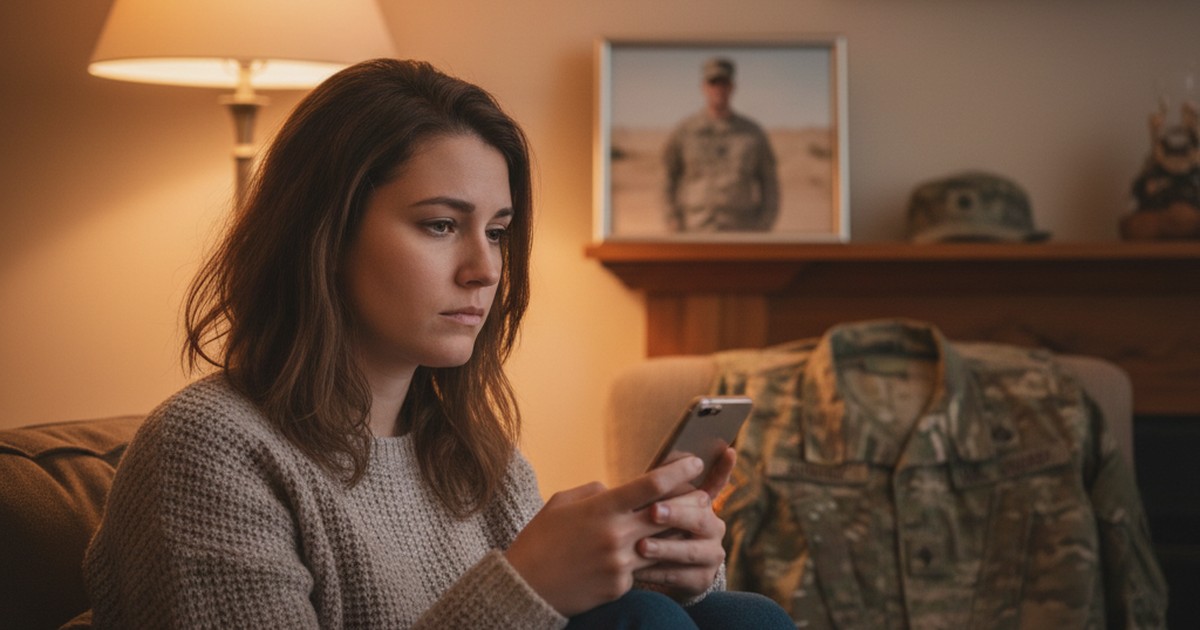
If you suspect your military spouse has a profile on a dating app, the digital trail is more accessible than most people realize. Dating platforms retain profile data even when a user goes offline, and a targeted search by name or email can surface active accounts across dozens of apps in minutes — no access to their device required.
Military relationships carry a documented and specific strain during extended separations. A 2017 study published in the Journal of Family Psychology found that roughly 1 in 5 military couples experienced some form of infidelity during a year-long deployment — a rate consistently higher than the general married population. Both deployed service members and stay-at-home partners face different but real vulnerabilities during this period, and technology has made it easier than ever to form new connections when loneliness accumulates.
This article covers the behavioral and digital warning signs specific to military deployment, which apps are most frequently involved, a structured method for assessing what you're seeing, the legal dimensions under military law, and what to do if your search turns up results.
One finding in particular challenges how most people think about military infidelity — and it changes the right approach significantly.
Why Are Dating Apps a Specific Risk During Military Deployment?
Dating apps become a higher-risk factor during military deployment because they lower the social barrier to new connections precisely when isolation is at its peak. The average U.S. military deployment lasts 6 to 12 months, with some reaching 15 months or longer. That duration, combined with limited communication windows, significant timezone gaps, and lives that diverge in real time on both sides, creates conditions where emotional disconnection can develop quietly without either person intending it.
The 2017 study published in the Journal of Family Psychology by Balderrama-Durbin and colleagues examined infidelity risk across the arc of a year-long deployment. It found that infidelity risk increased meaningfully over the course of that year and affected roughly 1 in 5 couples studied. Critically, both service members and their at-home partners were affected — though through different pathways. Deployed service members faced higher proximity-based social contact in unfamiliar environments. At-home partners reported heightened vulnerability to emotional connection through digital communication, particularly during the middle months when the deployment had normalized but return was still distant.
Dating apps serve both pathways efficiently. Tinder, Bumble, and Hinge all use location-based matching. A deployed service member at a forward operating base or near a duty station overseas is automatically sorted into a local pool of potential matches. A stay-at-home spouse in a U.S. base town faces those same apps in their neighborhood — and the emotional distance of a months-long deployment can make a new conversation feel like relief rather than a conscious decision.
| Deployment Phase | Primary Vulnerability | Pattern to Watch For |
|---|---|---|
| Days 1–60 | Adjustment and loneliness | Increased social media activity; new online friendships |
| Days 60–180 | Parallel lives diverging | Communication frequency drops; new routines established |
| Days 180–300 | Deepest emotional disconnection | Emotional affairs begin; phone privacy increases |
| Days 300+ | Pre-return anticipation | Account deletion before R&R; secretive behavior spikes |
This pattern doesn't imply inevitability. Most military couples navigate deployments intact. What it means is that deployment creates specific and identifiable conditions where app-based contact is both easier to initiate and easier to rationalize — and understanding those conditions helps distinguish between deployment-normal stress and something that warrants a direct look.
One detail worth knowing from a practical standpoint: dating apps record active session data. An account that was dormant for months can show recent activity without the account holder realizing that activity is visible to others. A pattern consistently seen in scans processed through CheatScanX is accounts that were created before deployment, paused, and then quietly reactivated at some point during the separation — often without any profile photo or bio update, suggesting the person's intent was contact rather than profile presentation. The reactivation timestamp becomes one of the more telling data points in a search, because it can be correlated against the deployment calendar.
Understanding deployment-related infidelity rates in broader context is useful here. The dating app cheating statistics we track show military-related searches producing active profile results at a rate roughly consistent with the academic literature — not dramatically higher than civilian partnerships, but concentrated in specific deployment phases rather than distributed evenly across time.
This risk is real. It's not a reason to assume the worst, but it is a reason to approach the situation with information rather than speculation.
CheatScanX scans all of these platforms — and more — in a single search. Enter a name, email, or phone number and get results in minutes.
Try a multi-platform search →What Does Military Infidelity Actually Look Like?
A useful starting point is recognizing that military infidelity rarely begins with a physical meeting. Research across multiple populations, including military families, consistently shows that the majority of infidelity starts as emotional connection rather than physical contact. By the time a physical encounter occurs — if it ever does — the emotional affair has typically been developing for weeks or months through messages, app-based contact, and private conversations.
For military relationships specifically, the timeline of a typical case follows a recognizable arc:
- Initial connection — on a dating app, a social media platform, or through a shared digital space (a gaming community, a neighborhood Facebook group, a deployed unit's informal social network)
- Messaging escalation — conversations that begin as friendly or innocuous and gradually become more personal over days or weeks
- Private channel shift — contact moves to a platform with disappearing messages or reduced visibility, such as Snapchat, Signal, or WhatsApp with disappearing messages enabled
- Profile management — the dating app is deleted before R&R or the return date, then reinstalled once the visit ends; or settings are changed to hide profile activity from anyone sharing the account
- Physical contact — if it occurs at all, typically during R&R or after return, not during active deployment
This sequence matters because the dating app profile is not the beginning of the problem — it's a marker that the connection has developed to the point of platform use. If you find a profile, the question isn't only whether it exists, but when the activity began relative to the deployment timeline.
One assumption worth examining directly: many people searching for information about military infidelity assume the deployed service member is the primary risk. The research does not support this framing as a reliable default. The Balderrama-Durbin study found infidelity occurring on both sides of the deployment relationship. Military family counselors consistently report that at-home partners — managing full household responsibilities alone, isolated from the daily routines that defined the relationship, and navigating a social environment without their partner — face a distinct and significant vulnerability, particularly during the middle months of a long deployment.
This is not a reason to redirect suspicion. It's a reason to approach the situation without a predetermined conclusion about which person is more likely to have acted.
The emotional dimension also means that the classic behavioral signals of cheating apply differently in a deployment context. Some people become more distant during calls. Others become more attentive — overcompensating for the guilt of a parallel connection. What you're assessing in the military context is a pattern of inconsistencies across both digital behavior and communication quality, not a single observable signal. The warning signs section below provides the specific indicators worth watching for.

What Apps Do Military Spouses Most Commonly Use?
No single app is associated exclusively with military infidelity. The platforms involved tend to reflect what's popular in the local area of the at-home partner or the duty station of the deployed service member. That said, certain platforms appear more frequently than others in searches involving military-connected accounts — and understanding why helps you prioritize where to look.
The apps most commonly used to hide infidelity span a range from standard dating platforms to messaging tools used for follow-up contact once an initial connection is established.
| App | Primary Function | Why It Appears in Military Searches | Key Privacy Feature |
|---|---|---|---|
| Tinder | Dating / casual | Largest global user base; available near overseas duty stations | Profile hides on delete but not on pause |
| Bumble | Dating / relationship | Strong U.S. adoption including base towns | Matches expire in 24h for women initiating |
| Hinge | Relationship-focused | Popular with younger enlisted members | "Pause" mode keeps profile active but hidden from new users |
| Ashley Madison | Affairs / married people | Specifically marketed to people in committed relationships | Discreet photo blurring; paid "fake delete" (historically problematic) |
| Snapchat | Messaging | Follow-up contact after meeting on another platform | Disappearing messages by default |
| Facebook Dating | Dating (via Facebook) | Consistently overlooked; uses existing Facebook account | Fully separate from Facebook profile; invisible to friends |
| MeetMe / Zoosk | Social discovery | Higher use in certain U.S. regions and international bases | Less known; unlikely to be thought to check |
Tinder remains the most commonly identified platform in multi-app searches, simply due to scale — roughly 75 million active users globally. A Tinder profile can be set up with a first name only, no linked social media, and no identifying photos, making it easy to create a presence that's technically active but difficult to attribute.
Ashley Madison is worth specific attention in the military context because it is explicitly marketed toward people already in relationships. Unlike general dating apps where users may have created profiles before the current relationship, Ashley Madison profiles are almost by definition created with awareness of a committed relationship. The platform's 2015 data breach — which revealed that paid "account deletion" did not actually remove profiles — also means older accounts from that era may still be discoverable through certain search methods.
Snapchat consistently appears in the follow-up contact phase. Once an initial connection forms through Tinder or Bumble, conversations often migrate to Snapchat specifically because messages disappear by default. A Snapchat account with newly-added contacts during a deployment period — particularly one that wasn't regularly used before deployment — is a signal worth noting alongside other indicators.
Facebook Dating is chronically underestimated. Because it operates within an existing Facebook account, there's no separate login or app download to hide. The Dating section is fully isolated from the main Facebook profile, invisible to friends and family, and not accessible through standard profile browsing. Many partners conducting their own searches forget to check it entirely.
One additional category: apps marketed as games or utilities that contain hidden messaging features. These appear more rarely in military-connected searches but exist — vault apps, calculator apps with passcode-protected messaging, and similar. If you discover an app that seems inconsistent with normal usage patterns on a shared or visible device, it's worth a search for "hidden messaging [app name]."
What Are the Warning Signs Your Military Spouse Is on a Dating App?
Military deployment creates a baseline of behavioral change that has nothing to do with infidelity. Sleep disruption, communication drops, and emotional unavailability are normal features of deployment stress — not evidence of anything. Because of this baseline, generic cheating signs lists create high false-positive rates for military families. The signals below are specifically associated with dating app activity rather than deployment stress generally.
Digital warning signs:
- Notification changes during calls — A phone that previously sat face-up on the table now stays face-down, stays pocketed, or is placed notification-side down during video calls. Notifications have been selectively silenced for specific apps.
- Screen angle shifts — The phone or laptop is consistently angled to prevent a view of the screen or the surrounding environment during calls. This is distinguishable from repositioning for better signal or sound by the fact that it's deliberate and consistent across multiple calls.
- App deletion before visits — Apps deleted 1 to 3 days before R&R or the return date, then reinstalled after the visit ends. Dating apps log deletion and reinstall dates; a recently reinstalled app that reconnects to an existing account indicates the account was not actually abandoned.
- Email alerts from dating platforms — Verification emails, "someone liked your profile" notifications, or subscription billing notices appearing in any email account you can see. These are difficult to suppress entirely, particularly if the app was set up with a frequently-used email address.
- Data usage spikes — Active dating app use — browsing profiles, sending messages, uploading photos — consumes significantly more mobile data than passive phone use. An unexplained increase in personal device data consumption, particularly when streaming and gaming activity haven't changed, is a specific signal.
Behavioral warning signs in the military context:
- Progressive emotional withdrawal — Some emotional distance during deployment is expected and normalizes after the first 4 to 6 weeks. What differs with app activity is withdrawal that continues to deepen rather than stabilize, particularly during the mid-deployment phase when communication typically improves.
- Vagueness about off-duty time — Deployed service members have legitimate operational security reasons to avoid specifics about duty activities. The tell is vagueness that extends to off-duty time: "I can't really talk about what I'm doing tonight" during hours that were previously the primary call window.
- Shortened call duration across multiple weeks — A consistent decline in average call length, without any cited operational reason, is more significant than a single short call. Look for the trend over 2 to 4 weeks rather than any individual instance.
- Account deletion before visits, normalized behavior after — This is the most specific behavioral pattern associated with app activity: someone who behaves more openly during R&R than during deployment, then reverts to privacy-focused behavior once they return to duty.
For a broader framework on phone behavior as a signal, signs your husband is cheating on his phone covers the full range of phone-based indicators and how to read them accurately across different contexts.
No single item from the list above constitutes evidence. The assessment worth making is about clusters. Two or three digital signals occurring simultaneously — particularly alongside progressive emotional withdrawal — moves the situation from "worth noting" to "worth a direct check." The next section provides a structured method for doing exactly that.
If you're mid-deployment and the pattern above feels familiar, CheatScanX can scan 15+ dating platforms for an active profile using a name or email address — no device access needed, results in minutes.
The DECA Method: A Structured Way to Assess Your Situation
Most people dealing with suspicion during a partner's deployment fall into one of two errors: they dismiss their concerns as deployment anxiety and do nothing, or they react immediately based on a single observation. Both approaches produce poor outcomes. The DECA Method is a structured four-category assessment designed for the specific context of a military deployment. It separates observable evidence from anxious interpretation by requiring you to gather observations across four distinct areas before drawing any conclusion.
Running through the full DECA assessment takes 20 to 30 minutes and can be done at any point in a deployment.
D — Digital footprint
What does the digital record actually show? Search the email addresses you have access to for subject lines including "verify your email," "someone liked your profile," "you have a new match," or billing statements from dating platforms. Check any shared cloud accounts (Google account activity, Apple ID device list) for app downloads or logins from unfamiliar devices. Note whether dating apps appear in a shared Apple ID purchase history, including deleted apps — the purchase record persists even after deletion.
Score: 0 if nothing unusual; 1 if one item is present; 2 if two or more items are present.
E — Emotional distance
This category is not about how often you communicate — it's about the quality of contact. Are conversations more surface-level than they were six months ago? Does the person seem less present during calls, quicker to end them, less interested in the continuity of your shared life? Deployment creates some emotional distance by default; what you're assessing here is whether that distance has grown progressively rather than stabilized.
Score: 0 if distance is consistent with adjustment and has leveled off; 1 if distance has increased progressively without operational explanation; 2 if distance began suddenly or coincides with other category changes.
C — Communication shifts
Specific, observable changes in how, when, and for how long communication happens. Call windows that shifted without explanation. Message response times that lengthened substantially during previously responsive periods. New "I can't talk right now" patterns appearing regularly during hours that were the standard window. These are logistical observations, not emotional interpretations.
Score: 0 if no shift or shift was explained by operational change; 1 if one unexplained shift occurred; 2 if multiple communication pattern changes have emerged across different channels.
A — Account activity
What does observable public or shared account activity show? Social media posting that became more frequent (or stopped entirely) at a specific point in the deployment. New followers or follows appearing on Instagram. App usage activity visible in shared account dashboards. Location data from shared Find My or Google Maps history showing places that don't fit the expected pattern.
Score: 0 if nothing unusual; 1 if one anomaly is present; 2 if multiple account activity changes are visible.
Interpreting the DECA score:
| Total Score | Interpretation | Recommended Next Step |
|---|---|---|
| 0–1 | Within deployment-normal range | Monitor; reassess in 30 days |
| 2–3 | Some indicators present | Run a targeted multi-platform profile search |
| 4–5 | Multiple indicators present | Profile search + document all findings |
| 6–8 | Strong pattern across categories | Profile search + legal or counseling consultation |
A DECA score above 3 does not prove infidelity — it means the pattern of observable signals warrants a concrete check rather than continued uncertainty. The value of this method is that it moves you from a generalized anxiety state to a structured position from which you can act clearly and document accurately.
One important nuance: DECA scores can be elevated by deployment stress alone. If the D category returns 0 and the A category returns 0, but E and C are both at 2, what you may be seeing is a relationship under the strain of a difficult deployment — not app activity. The digital categories (D and A) are the most diagnostic for the specific question of app usage. Emotional and communication signals are important context, but they're not dispositive on their own.

How Do You Check Whether Your Military Spouse Has a Dating Profile?
The practical question: what can you actually do to determine whether a profile exists, without accessing their device or their private accounts?
There are three approaches, ranging from quick to comprehensive. Running all three in sequence takes 30 to 45 minutes. How to find out if your partner is on dating apps covers the full multi-platform framework; what follows is adapted to the deployment-specific context.
Approach 1: Email audit (5–10 minutes)
Most dating apps send verification emails when an account is created, and send ongoing notification emails (match alerts, activity summaries, billing statements) to the registered address. Search any email account you have access to for the following terms:
- "verify your email" (combined with: Tinder, Bumble, Hinge, Zoosk, Ashley Madison, Match, OkCupid, MeetMe, Plenty of Fish)
- "you have a new match" or "someone liked your profile"
- Subscription billing from dating platforms
- Password reset emails — these confirm an account was recently accessed
If you have access to an Apple ID account or Google account, check the purchase history and app activity log. Dating app downloads appear in purchase histories even after deletion. A dating app downloaded during the deployment period, from an account you share, is a specific and documentable data point.
Approach 2: Search operators (10–15 minutes)
Google's `site:` operator can surface indexed dating profiles associated with a specific name, though this method only captures profiles that were indexed before deletion.
Search patterns:
- `"[First Name Last Name]" site:tinder.com`
- `"[First Name]" "[City or Base Town]" bumble profile`
- `"[First Name Last Name]" dating profile 2025 OR 2026`
These searches are imperfect — most profiles are not publicly indexed. But they occasionally surface cached profiles, forum references, or screenshots that would otherwise be invisible. They take 10 minutes and cost nothing.
Approach 3: Multi-platform profile search (10–15 minutes)
Profile search tools scan multiple dating platforms simultaneously using identifying information — name, email address, phone number, or photos. CheatScanX searches Tinder, Bumble, Hinge, and 12+ additional platforms in a single scan, returning profile matches with activity indicators in under 10 minutes.
What this approach reveals that manual methods miss: cross-platform presence (a person with profiles on both Tinder and Ashley Madison), recent activity timestamps (confirming the account is active now, not dormant from a previous period), and profile details like photos and bios that can be documented before any conversation happens.
Documenting what you find:
Regardless of which approach surfaces a result, documentation comes before any other action:
- Full-screen screenshot including the platform name and URL
- Screenshot of any activity timestamps visible on the profile
- Screenshot of all profile photos (these are deleted immediately upon confrontation in most cases)
- Record the exact date and time of the search
- Save all screenshots to cloud storage your partner cannot access
The order matters: document, then decide what to do next. This is not about building a legal case against someone — it's about making sure you have an accurate record of what you found, before any account deletions or explanations change the visible picture.
Does Having a Dating App Profile Violate Military Law?
This is the question most coverage of military infidelity either skips entirely or handles with a single sentence. The answer matters, because it shapes how both parties should think about the situation once evidence is found.
UCMJ Article 134 — revised in 2019 to cover "extramarital sexual conduct" rather than the more narrowly defined "adultery" — is the relevant statute. Military infidelity is a chargeable offense under this article, but only when three specific elements are met:
- Wrongful extramarital sexual conduct — actual sexual contact with someone other than the spouse, while either party is married
- Knowledge of marital status — the accused must have known that they or the other person was married to someone else at the time
- Service connection — the conduct must be "to the prejudice of good order and discipline in the armed forces" or "of a nature to bring discredit upon the armed forces"
Simply having a dating app profile satisfies none of these three elements on its own. Profile presence is not sexual conduct. Military prosecutors, as a matter of standard practice, do not pursue Article 134 cases based on app presence. Prosecution is typically reserved for conduct that is egregious, public, or directly damaging to unit cohesion.
That said, the practical consequences of discovered infidelity in the military extend well beyond the courtroom:
| Consequence | Likelihood | How It Happens |
|---|---|---|
| Article 134 prosecution | Low — unless conduct is egregious or public | Court-martial referral |
| Non-judicial punishment (NJP) | Moderate, if leadership is involved | Commander's discretion, Article 15 |
| Security clearance review | Moderate, at higher clearance levels | Perceived coercion vulnerability |
| Promotion impact | High if discovered through official channels | Performance review documentation |
| Administrative separation | Moderate in some circumstances | Discharge characterization proceedings |
| Civilian divorce proceedings | Depends on state | State family court, military divorce attorney |
The security clearance issue is frequently underestimated. Infidelity that becomes known within a unit or through official channels creates a coercion vulnerability in the eyes of clearance reviewers — the concern is that someone carrying a secret is susceptible to external pressure. At higher clearance levels (Secret and above), this is a concrete career risk even when no legal action is taken.
This article cannot and does not provide legal advice. If you're considering legal action based on discovered infidelity, or if you're a service member aware of a potential UCMJ matter, consult a licensed military attorney before taking any action. JAG officers are available at most installations, and many provide free initial consultations. The specific facts of a situation determine legal exposure in ways that general information cannot anticipate.
What Most Advice Gets Wrong About Military Infidelity
The majority of articles on this subject share three assumptions that the evidence does not support. Understanding where standard advice goes wrong is useful if you want to approach the situation with accuracy rather than with the framework that happens to be most commonly repeated.
Assumption 1: The deployed service member is the primary risk
Most advice is framed around the at-home partner worrying about the deployed service member. This framing is intuitive — the person who has physically left the relationship, moved to a new environment, and encountered new people seems like the more likely source of new connection.
The research doesn't support this as a reliable default. The Balderrama-Durbin (2017) study found infidelity occurring on both sides of the deployment. Military family counselors who work with these relationships consistently report that the at-home partner — navigating a social environment without their partner, carrying sole responsibility for the household, and experiencing a form of emotional abandonment that's not fully resolved by scheduled calls — faces a specific and real vulnerability during the mid-deployment period.
This isn't an accusation of at-home partners. It's a correction to a one-sided framing that leads people to look in the wrong place. If your DECA assessment is raising questions, apply it to what you can observe — not to a presumption about which person is more likely to have acted.
Assumption 2: Confrontation is the logical first step
Standard advice across nearly every article on the subject is some version of "have a conversation with your partner." In a civilian context with both people physically present, that approach at least allows for an immediate, in-person exchange where tone, body language, and immediate behavior are all readable.
In a deployment context, confrontation by text, WhatsApp, or video call has a predictable set of outcomes: denial, followed by account deletion, followed by migration to more private channels, followed by a conversation in which you have no documentation and they have had time to construct a narrative. You've closed your own window.
The sequence that produces better outcomes is: document first, seek support second, conversation third — when you're in the same physical space and have a complete record of what you found. This sequence is not adversarial. It's practical. A conversation informed by timestamped documentation is different from a confrontation based on a feeling.
Assumption 3: A found profile tells you what happened
Finding a profile — even an active one — tells you that the account exists and is accessible. It does not tell you how recently it was used with intent, whether any actual contact occurred, or whether the account predates the current relationship and was simply never deleted.
A pattern consistently visible in CheatScanX searches: a meaningful proportion of "found" profiles turn out to be dormant accounts from an earlier relationship period, reactivated by the platform's re-engagement algorithm rather than by the account holder. These show as "recently active" in search results, but their profile photos, bios, and location data reflect a period years before the current relationship.
This is not a reason to dismiss a found profile. It's a reason to read what you find accurately. A profile created during the current deployment, with photos taken recently and a location consistent with the current duty station or home address, carries different weight than a profile last edited three years ago that surfaced because the platform ran an automated re-engagement email.

What Should You Do After Finding a Dating Profile?
The steps below are ordered. The sequence matters more than the speed.
Step 1: Document everything before any other action
Before responding, telling anyone, or giving any indication that you've found something:
- Take full-screen screenshots of the profile with the platform name and URL visible in the image
- Capture any activity indicators visible on the profile — "active recently," "joined this week," last login timestamps
- Screenshot all profile photos in full resolution (these are typically the first thing deleted)
- Note the exact date and time of your search in writing
- If billing records or email confirmations are part of what you found, capture those as well
Save all documentation to a cloud storage location that your partner cannot access — not a shared Google Drive or iCloud account. A private email address or a storage account in your name alone is appropriate.
Step 2: Don't confront digitally
Confronting a deployed partner via text, WhatsApp, Signal, or video call consistently produces the same outcome: denial, then deletion, then a request that you "stop being paranoid" combined with a cleaned-up digital record. The conversation you need cannot happen effectively through a screen. The evidence you've gathered cannot be responded to honestly in a deployment context where privacy is limited and other people are nearby.
If you need to process what you've found before the return date, the right channel is a confidential one — a counselor, a therapist, or a trusted friend outside the unit's social network. Not the person whose profile you found.
Step 3: Consider what support you need before they return
Two resources are worth knowing about before the conversation happens:
Military OneSource is the primary support service for military families. It provides free, confidential counseling — available 24 hours a day, 7 days a week, by phone or video. Sessions are capped at a certain number per issue per year, but the service is genuinely confidential and not connected to command channels. This is appropriate for individual emotional support, couples counseling if both parties are willing, and general guidance about next steps.
A licensed military attorney or JAG officer is appropriate if the situation involves potential legal considerations — divorce, separation, BAH and benefit questions, or UCMJ-related concerns. Many JAG offices provide free initial consultations without appointment. A civilian military divorce attorney may also be appropriate depending on your state and situation.
Step 4: Plan the conversation for the right moment
When your spouse returns, you'll have a choice about timing and context. Most relationship counselors who work with military families note that the first 48 to 72 hours post-deployment are poor timing for difficult conversations. Both parties are adjusting to shared physical space after months apart, emotional regulation is harder than normal, and the intensity of the reunion period makes nuanced conversations difficult to conduct well.
The more productive window is typically 7 to 14 days after return, when routines have re-established. A conversation with a counselor present, particularly one familiar with military family dynamics, tends to produce better outcomes than a private confrontation.
For the full framework on managing the conversation and decisions that follow, what to do when you find your partner on a dating app covers the process in detail.
Protecting Your Mental Health During Deployment Uncertainty
Living with unresolved suspicion during a deployment is a particular kind of stress, and the standard advice given to people who suspect a civilian partner doesn't map cleanly onto this context. You can't observe behavior directly. Communication is already constrained by distance and operational schedules. Confrontation carries practical and legal consequences that don't exist in a non-deployment relationship. And the deployment itself may not end for months.
Several practices consistently help in this situation.
Separate the anxiety from the evidence
Deployment anxiety produces genuine symptoms — hypervigilance, disrupted sleep, difficulty concentrating, and a tendency to interpret neutral signals as negative. These are normal responses to an abnormal situation. They do not constitute evidence of anything wrong in the relationship.
The DECA Method described earlier helps here precisely because it requires observable evidence, not anxious interpretation. If your DECA score is 0 to 1 and a profile search returns nothing, you have actual information to work with rather than a loop of "what-ifs." Running a structured assessment and getting a clear result — in either direction — is more useful to your mental health than extended uncertainty.
Use available support structures, including the underused ones
Military OneSource is a genuinely useful resource that most military families know about and don't use. Free confidential counseling, available 24/7, with no connection to command channels. That last point matters: concerns you discuss with a Military OneSource counselor do not go to your spouse's commanding officer.
Most installations also have Military Family Life Counselors (MFLCs) embedded at the unit level, available for brief confidential sessions without appointment. These are specifically useful for processing immediate stress — they're not therapists and don't provide ongoing treatment, but they're accessible and available in ways that civilian therapists aren't during deployment.
If you have questions that go beyond emotional support — financial planning for a potential separation, understanding your benefit rights, knowing what documentation to gather — Military OneSource can also provide referrals to relevant specialists.
Maintain your own routines
The mental health research on military spouses consistently identifies routine maintenance as one of the most protective factors during deployment. This isn't about suppressing concern — it's about preventing that concern from expanding to fill every available hour. Spending each evening repeating searches or scrolling through social media for new signals does not produce more useful information; it amplifies anxiety.
A planned, structured check — conducted once, thoroughly, with proper documentation — is more useful than low-grade ongoing monitoring. If you've done the DECA assessment and run a profile search and found nothing, you have a finding. Treat it as one.
Acknowledge what you don't yet know
You may not know for certain what your spouse is doing or has done. That uncertainty is real. Acknowledging it honestly — rather than either catastrophizing or dismissing it — is a more stable position than either extreme. You have gathered the information available to you. You have documented what you found. The resolution will come when it comes. This is not passive acceptance of a bad situation. It's a realistic stance that leaves room for what actually happens when the deployment ends and the conversation becomes possible.
Conclusion
Military deployment creates specific, well-documented conditions where dating app activity becomes more likely for both parties. Extended separation, communication gaps, and parallel social environments on each side of the relationship don't guarantee infidelity — but they do raise the baseline risk in ways that are worth understanding clearly.
The practical points to carry forward: Dating app profiles persist even when accounts are paused or set to inactive. A targeted search across multiple platforms takes under 15 minutes and requires no device access. If a profile exists with recent activity, it can be documented thoroughly before any conversation changes the visible record.
The DECA Method — Digital footprint, Emotional distance, Communication shifts, Account activity — provides a structured framework for separating deployment-normal stress from patterns associated with app use. A score above 3 across the four categories is your signal to conduct a direct check. A score below 2 in the digital categories, regardless of how high the emotional or communication categories score, suggests deployment stress rather than app activity.
UCMJ Article 134 means that infidelity carries legal exposure in the military context, but profile presence alone does not reach the prosecutable threshold. Career and clearance consequences can still follow without formal charges. If legal questions are part of your situation, consult a licensed military attorney before acting.
The sequence that protects your options: document first, seek support second, have the conversation third — in person, after return, with enough time elapsed for both of you to be in a stable state.
You're not without resources. Military OneSource, JAG counsel, and civilian therapists familiar with military families are all accessible. Using them before you act is not a sign of weakness — it's the approach most likely to lead somewhere you can live with.
If you've worked through the DECA assessment and a profile search is your next step, CheatScanX scans 15+ dating platforms simultaneously using a name or email address — no device access, no installation, results in minutes.
Frequently Asked Questions
Research suggests deployment does raise infidelity risk for both parties. A 2017 study published in the Journal of Family Psychology found approximately 1 in 5 military couples experienced some form of infidelity during a year-long deployment. Factors include extended physical separation, limited communication, and reduced social accountability — these are structural pressures, not character deficiencies.
There is no single platform associated exclusively with military infidelity. Tinder and Bumble appear most frequently due to their large user bases. Snapchat is commonly used for follow-up contact because messages disappear by default. Apps marketed toward people already in relationships appear in military-connected searches more often than their general market share would predict.
Yes. Profile search tools like CheatScanX scan multiple platforms simultaneously using a name or email address and return results in minutes — regardless of whether the account was created at home or overseas. No device access or login credentials are required to run a search.
Under current UCMJ Article 134, profile existence alone does not meet prosecution standards. The charge requires proof of actual extramarital sexual conduct that is prejudicial to good order and discipline. A profile may be a contributing factor in a broader misconduct case but is not by itself grounds for formal action. Consult a licensed military attorney for advice specific to your situation.
Take screenshots with timestamps before doing anything else. Avoid confronting via text or video call while they're deployed — this typically leads to immediate account deletion. Once they return, decide whether to address it directly, with a counselor present, or through legal guidance. Military OneSource offers free, confidential counseling for military families at no cost.