
# Bumble BFF vs Dating: Is Your Partner Using It to Cheat?
Your partner has Bumble on their phone. When you ask about it, they say: "I only use the BFF feature — I'm looking for friends, not dates." Should you believe them?
The honest answer is: sometimes yes, sometimes no — and the difference is knowable if you know what to look for. Bumble BFF is a legitimate platform used by millions of people for genuine platonic connection. But it has also, for several years, been one of the most convenient cover stories available on a dating app — partly because of how Bumble was designed, and partly because the explanation contains enough truth to be difficult to disprove.
According to a 2024 analysis by DoTheySwipe, 40% of American adults have used dating apps while in committed relationships. That figure doesn't tell you what your partner is doing. But it confirms that this conversation is common, and that a clear-eyed approach to the evidence serves you better than either reflexive suspicion or reflexive trust.
This article gives you the tools to evaluate the claim. You'll learn exactly how Bumble BFF works technically, what the 2025 standalone app launch changed, seven specific signs that distinguish genuine friendship use from cover-up behavior, and a three-step verification framework you can use to assess the situation objectively. Understanding the technical reality cuts through the ambiguity faster than anything else.
What Is Bumble BFF and How Does It Actually Work?
Bumble BFF is a feature — and since late 2025 in the US, a completely standalone app called Bumble for Friends — that connects people seeking platonic friendships using the same swipe-and-match mechanics as Bumble Dating. In BFF mode, matches are same-gender only, and either person can send the first message. The dating and friendship profiles are separate.
That definition matters because most of the confusion around the "Bumble BFF excuse" comes from a misunderstanding of what the feature actually does versus what the dating app does. These are not the same thing — but for most of the app's history, they shared the same interface, the same login, and the same icon.
The 2025 Standalone App Launch Changes Everything
For years, BFF mode and dating mode coexisted inside the main Bumble app. One toggle in the app's settings switched between them. Visually, there was no difference from the outside: the same icon, the same notification badge, the same branding. A partner who claimed BFF-only use while running an active dating profile was functionally unverifiable without directly accessing their account.
In late 2025, Bumble launched Bumble for Friends as a completely separate standalone application in the US market. The two products now have distinct app icons, separate download pages, and separate accounts. If your partner is in the US and says they use Bumble for friendship, the visible question becomes: which app is on their phone?
- Standalone Bumble for Friends app installed, no main Bumble app = consistent with stated BFF intent
- Main Bumble dating app installed, no BFF app = the claim is technically inconsistent with current app architecture in the US
- Both apps installed = an explanation is warranted
If you're outside the US, the standalone split may not yet apply — Bumble's rollout varies by market. Check current availability before drawing conclusions specific to the app architecture.
What BFF Mode and Dating Mode Actually Do Differently
The table below captures the functional differences that matter most when evaluating a BFF claim:
| Feature | BFF Mode / BFF App | Dating Mode |
|---|---|---|
| Who you match with | Same gender only | Opposite gender (or any, for same-sex) |
| Who initiates conversation | Either person | Women only (for straight matches) |
| Profile | Separate from dating profile | Separate from BFF profile |
| Photos | User can use same photos | User can use same photos |
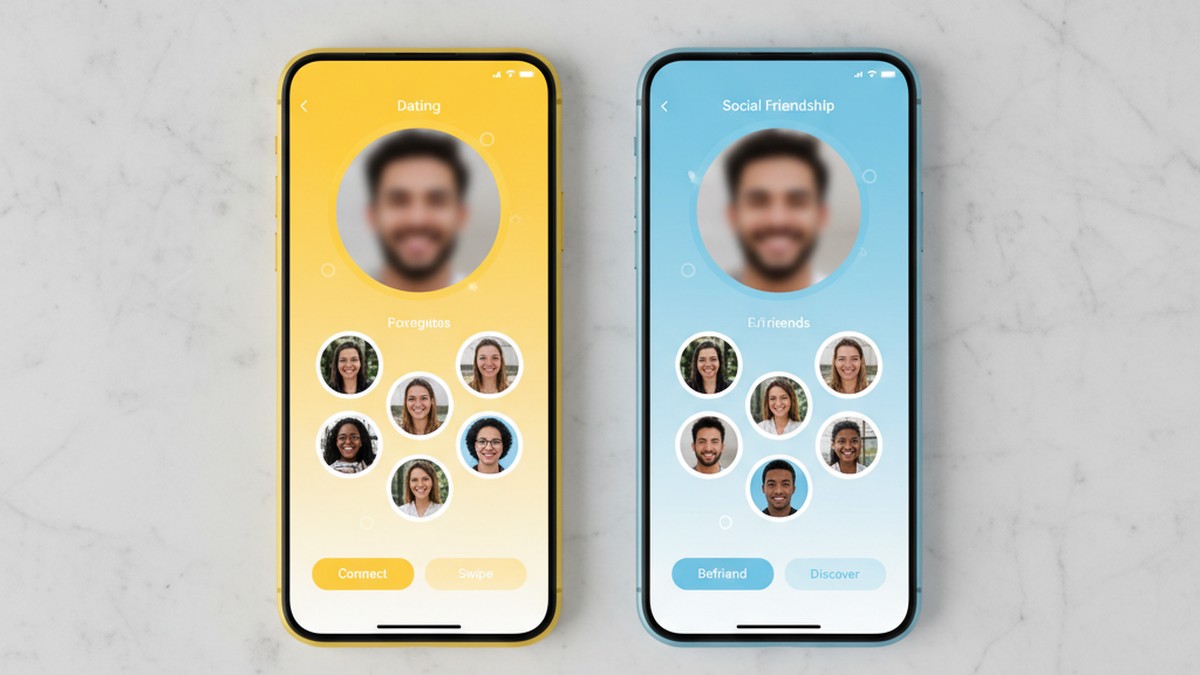
| Color identifier | Blue | Yellow |
| Message timer | 24 hours | 24 hours |
| Mode deletion | Deletes all BFF matches permanently | Deletes all dating matches permanently |
Two details in that table carry particular weight. First: same gender only. BFF mode is specifically designed to prevent it from functioning as a secondary dating channel. If you ever see opposite-gender connections in a claimed BFF account, that is not how the feature works — and it requires an explanation.
Second: mode deletion. Turning off a mode permanently deletes all matches and conversations in that mode. Someone who switches from BFF to dating "just to take a quick look" and then switches back has either deleted their dating matches (covering tracks) or kept them in a separate active profile. Neither of these is an innocent accident. Mode switching is a deliberate action with irreversible consequences.
How the Same Mechanics Create Different Problems
What makes the BFF situation genuinely complicated — not just suspicious — is that the underlying matching mechanics are identical. Swiping right, matching when both users swipe right, then chatting: same on BFF, same on dating. The 24-hour expiration timer applies to both. The interface feels the same.
That shared infrastructure is a design choice that made sense when BFF launched as a secondary feature. But it means a person who wants to cheat through Bumble doesn't need to learn a new interface. They already know it. The only change is the mode setting — a single toggle — and the plausible deniability that comes with pointing to the BFF feature if they're caught.
Understanding these mechanics is the foundation — but it's the history of how the BFF excuse developed that explains why so many partners default to it when confronted.
CheatScanX scans all of these platforms — and more — in a single search. Enter a name, email, or phone number and get results in minutes.
Try a multi-platform search →How Bumble BFF Became a Common Cheating Excuse
The "I was only using it for BFF" defense did not emerge from nowhere. It evolved in response to a real social dynamic: people discovered their partners had Bumble, the partners needed an explanation, and the BFF feature provided one with enough technical legitimacy to be difficult to dismiss outright.
Understanding how this defense developed helps you evaluate how seriously to take it.
The History of BFF Mode Inside the Dating App
Bumble launched in 2014 as a dating app. BFF mode arrived in 2016, marketed as a way for the platform to serve social needs beyond romance. The clever part of that positioning — and the problem for anyone evaluating a partner's explanation — was that the feature lived inside the exact same app as the dating function.
For nearly a decade, when someone said "I have Bumble but I'm only using BFF," there was no straightforward way to verify the claim without seeing their phone. The icon was identical. Notifications didn't indicate mode. A search of the phone would reveal the app but not which function was active. This structural ambiguity was never Bumble's intent — but it became a reliable loophole.
Why the Defense Persists Even Now
Community forums, relationship subreddits, and advice threads show the "BFF excuse" appearing consistently from roughly 2020 onward, peaking around 2022-2024. The defense typically follows one of three scripts:
- "I only have it for BFF — I haven't even looked at dating mode."
- "I switched modes once out of curiosity, but I switched right back."
- "The BFF mode is how I met [name of friend you may or may not have heard of before]."
Each version contains something defensible. BFF is real. Curiosity-switching is technically possible. Friends made through apps are real. But each version also relies on the listener accepting a claim they cannot verify — and that asymmetry is exactly what makes the defense function.
A consistent finding across infidelity research is that affairs beginning through digital platforms almost universally start with framing that emphasizes innocence. According to research compiled by multiple relationship-psychology sources, approximately 42% of people who had affairs described the initial contact as "harmless messaging" that gradually crossed lines. The BFF framing fits that trajectory precisely: a low-stakes connection that, if questioned, points to a legitimate feature.
What Changed When BFF Became Its Own App
The 2025 separation into distinct products meaningfully changed the verifiability problem. For US users, there is now a visible, checkable difference between having the friendship app and having the dating app. The icon is different. The download record in the App Store or Google Play is different. The notification source is different.
This doesn't eliminate the problem — someone could have both apps, or could have the standalone BFF app and still be misusing it. But it removed the most straightforward version of the defense. "I only use BFF" is now a claim that can be partially checked by looking at which app is actually installed, without needing access to the account itself.
Knowing the history helps you read the defense accurately. The deeper question is what the technical architecture actually lets you verify — and that requires understanding the differences between the two modes in detail.
The Technical Differences Between BFF and Dating Mode: What You Actually Need to Know
Beyond the high-level differences already covered, there are specific technical details that matter when you're trying to assess whether a partner's BFF claim is consistent with the evidence in front of you.
The Same-Gender Matching Rule Is a Key Verification Point
BFF mode matches users with the same gender identity. This rule was implemented to prevent BFF from operating as a secondary heterosexual dating pool — which early users attempted to use it as. The same-gender matching requirement means that:
- A heterosexual man using genuine BFF mode will match with other men
- A heterosexual woman using genuine BFF mode will match with other women
- Any opposite-gender connection in a claimed BFF account is technically impossible unless the account was set up with an incorrect gender or the dating app (not the BFF app) is what you're looking at
This is the single most checkable piece of technical evidence if you ever have access to the account. The gender of the matches tells you, definitively, whether you're looking at a BFF account or a dating account.
Profile Separation and What It Actually Means
BFF profiles are separate from dating profiles — different bios, potentially different photos, different settings. In practice, many users recycle photos across both profiles because the app allows it. The practical implication: you cannot determine from a photo on a BFF profile that the person is lying about using the app for friendship. Seeing the same photo doesn't prove anything.
What does matter: the bio text. A BFF bio that reads like a dating profile — emphasizing appearance, describing personality traits designed to attract romantic interest, using language about "spontaneity" or "adventures" — is not optimized for friendship. It's optimized for attraction. That's not decisive on its own, but it's informative.
The Message Deletion Consequence as Evidence
Every relationship advice thread that discusses the Bumble BFF topic eventually reaches the question: "Could they have deleted the evidence before showing me?" The answer is yes — but it requires deliberate action.
Turning off a mode in Bumble deletes all matches and messages in that mode immediately and permanently. There is no recovery path. If your partner switched from dating mode to BFF mode shortly before showing you their account, all dating matches and conversations would be gone. You'd see a BFF account with potentially limited activity — which would look consistent with genuine BFF use even if it wasn't.
This is not a reason to assume the worst. It's a reason to treat a recently-reset or sparse account with appropriate skepticism rather than as clean confirmation of innocent use.
Bumble Premium Features: A Reliable Signal
Bumble offers paid features — Beeline (see who already swiped right on you), SuperSwipe (signal exceptional interest to a potential match), Spotlight (boost profile visibility), and travel tools like Premium Pass. These features exist for one purpose: maximizing dating performance.
Someone paying for Bumble Premium while claiming to use the app exclusively for BFF is spending money on features that have no practical value in a friendship context. Beeline in a BFF account tells you who found you attractive enough to swipe right — not who might make a good friend. Spotlight increases your visibility to potential matches — not your access to potential friends. Premium features are a dating investment, full stop.
If your partner has active Bumble Premium, that is a meaningful signal worth incorporating into your overall assessment. The technical picture is now clear. The next question is whether Bumble BFF has genuine friendship users at all — because the answer shapes how you interpret the claim.
Is Bumble BFF Genuinely Used for Platonic Friendship?
Yes, many people use Bumble BFF legitimately — especially people who have relocated, lost a social network, or struggle with in-person friend-making. However, the platform also has a documented misuse problem: a meaningful share of users switch to BFF mode seeking romantic connections under a friendship framing, which creates genuine ambiguity.
The key is understanding who actually uses BFF genuinely versus who uses it as an alternative dating channel.
The Real Demand BFF Addresses
Adult friendship formation is harder than most people acknowledge openly. Research from the American Perspectives Survey (NORC, 2023){:target="_blank"} found that 12% of Americans report having no close friends — a figure that has increased significantly over the past two decades. Adults over 30 consistently report difficulty forming new platonic connections through organic social channels.
Against that backdrop, an app-based approach to friendship isn't unusual behavior. It's a rational response to a documented social problem. Bumble for Friends, Meetup, Hey! Vina, and similar platforms exist because the need is real — not because people want to cheat disguised as friends.
Who Uses BFF Legitimately: Common Profiles
Based on publicly available discussions and user research, the people most likely to use Bumble BFF genuinely tend to fit specific situations:
- Recent relocators — People who moved to a new city (often for work or to be with a partner) and need to rebuild a social network from scratch
- New parents — People whose previous social lives depended on mobility, nightlife, or childless friends who are no longer available
- Remote workers — People who lost their workplace social infrastructure when they stopped going to an office
- Recovery community members — People seeking sober social connections in environments that often center around alcohol
- Queer individuals in less-affirming areas — People for whom the LGBTQ+ community in their area is small, and who benefit from structured connection to find their people
Notice the specificity of these profiles. Each one involves a genuine structural barrier to friendship formation — not just general preference. When someone fits one of these categories, the BFF claim is more credible than when none of the above apply.
The Documented Misuse Problem
A 2025 analysis by MakeUseOf{:target="_blank"} identified a consistent misuse pattern on Bumble BFF: a meaningful number of users switch to BFF mode hoping it offers "a new, less intimidating pool of romantic prospects" rather than genuine platonic connection. These users approach BFF matches with romantic intent while framing their presence as friendship-seeking. Ghosting rates are high because matches quickly realize the other person's intent doesn't match the stated context.
For people legitimately using hidden dating apps on a phone, Bumble BFF is one of multiple apps that warrant investigation precisely because of this pattern. The concern is real — but it shouldn't collapse into treating every BFF user as a cheater.
Why Male Use Warrants More Questions
Community consensus — and it's nearly universal across relationship forums, Reddit threads, and advice communities — is that male use of Bumble BFF is considerably more suspicious than female use. This isn't reflexive bias; it reflects the app's actual user demographics.
BFF mode matches users with the same gender. A man in BFF mode primarily matches with other men. Forum discussions and the real-world data available from community threads consistently show that male users make up a much smaller share of the genuine BFF user base compared to women, who disproportionately use the feature for its stated purpose.
This doesn't mean a man can't legitimately use BFF. It means a man claiming BFF use should be able to explain who specifically he's connecting with and why Bumble is how he's doing it — questions that a genuine user can answer easily.
With the legitimate and illegitimate use cases established, the practical question becomes: what specific indicators distinguish one from the other?
What Are the Signs Your Partner Is Using BFF as a Cover?
The clearest signs include: having the main Bumble dating app instead of the standalone BFF app (post-2025 US split), opposite-gender matches in a claimed BFF account, a bio that reads like a dating profile, active Bumble Premium features, and consistent defensiveness or secrecy about showing you the account.
These signs fall into two categories: technical evidence visible in the app, and behavioral patterns in how your partner acts around the subject. Both are informative. Technical evidence is more objective; behavioral evidence tells you how they feel about scrutiny.
Technical Signs to Look For
Sign 1: They have the main Bumble app, not the standalone Bumble for Friends app
In the US, the standalone BFF app launched in 2025 and effectively replaced BFF mode inside the main app. A partner who says they use Bumble for friendship but has only the original yellow Bumble dating app installed is describing something technically inconsistent with current functionality. Ask them to show you which app it is — the icons and app names are visually distinct.
Sign 2: Their matches include opposite-gender connections
BFF mode is same-gender only. If the account has opposite-gender matches, you're looking at one of two things: the dating app (not the BFF app), or an account set up with misleading gender information. Either way, something is inconsistent with the stated claim.
Sign 3: Their bio reads like a dating profile
BFF profiles are meant to highlight personality, shared interests, and what someone is looking for in a friend. A BFF bio that emphasizes physical appearance, uses language designed to attract romantic interest, or mirrors what you'd find in a Tinder or Hinge profile is not written for friendship. It's written for attraction.
Sign 4: They have active Bumble Premium or paid features
Beeline, SuperSwipe, and Spotlight are paid features designed to increase dating success. If your partner has these active on a claimed BFF account, they're spending real money on tools that serve no purpose in a platonic friendship context. That's a meaningful inconsistency.
Sign 5: Their notification behavior changes around you
If your partner silences their phone, flips it face-down, or leaves the room specifically when Bumble notifications arrive, that behavioral pattern is worth noting. It doesn't prove anything on its own. But it combines with other evidence to form a fuller picture.
Behavioral Signs
Defensiveness about showing you the account
This is consistently the most informative indicator. Someone who uses Bumble genuinely for friendship has nothing to hide — and is typically willing to open the app and show you their matches without treating the request as an attack. If your partner reacts to "can you show me your account?" with anger, deflection, or lengthy justifications for why you shouldn't need to see it, that resistance is more informative than anything you'd see in the app itself.
A key finding from relationship research is that evasion around a specific question about app activity is behaviorally distinct from general privacy preferences. People who want privacy typically say "I don't share my phone generally" — and apply that standard consistently. People who are hiding something specific react with disproportionate defensiveness specifically around the topic they're concealing.
Discovered rather than disclosed
A partner who installed Bumble or Bumble for Friends and proactively told you about it — "I downloaded the friend app because I want to meet people in this city" — is operating with transparency. A partner whose app you discover through your own observation, without prior disclosure, made a choice about what to share. That choice tells you something, separate from what the app contains.
Vague or inconsistent answers about who they've matched with
Genuine friendships created through apps tend to surface in ordinary conversation. "I matched with someone who also does Brazilian jiu-jitsu, we're going to train together Saturday" is how a real BFF connection gets mentioned. Matches kept systematically private, with no social reference, no introduction, and no integration into shared social life, are harder to explain as genuine friendship.
For broader context on signs your partner is cheating on Bumble, the behavioral patterns extend well beyond app activity — body language, schedule changes, and phone habits all form a larger pattern.
The 3-Check Method: A Framework for Evaluating the Claim
Rather than approaching the Bumble BFF situation as a binary — cheating or not cheating — the 3-Check Method gives you a structured way to assess it based on verifiable factors rather than gut feeling alone.
This framework is designed for situations where your partner has agreed to show you the app, or where you have a clear view of their phone. It is not a framework for covert investigation — both because covert investigation has legal and relational costs, and because a partner who refuses to engage transparently has already provided the most significant data point.
Check 1: The App Identity Check
What you're looking for: Which specific app is installed — the standalone Bumble for Friends app, or the main Bumble dating app?
How to check: Look at the app icon and name. The standalone BFF app (launched 2025) has its own distinct icon and is listed in the App Store/Play Store as "BFF — Find New Friends" or "Bumble For Friends." The main Bumble dating app is listed as "Bumble — Dating & Make Friends." These are different downloads with different developer entries.
What the result tells you:
| App Present | Assessment |
|---|---|
| Standalone BFF app only | Consistent with stated BFF intent |
| Main Bumble dating app only | Inconsistent with BFF claim in US (post-2025 split) |
| Both apps installed | Explanation warranted |
| Neither | App may have been deleted |
Important context: If you're outside the US, the standalone app architecture may not yet apply in your market. Check Bumble's current market availability before treating this check as conclusive.
Check 2: The Match Profile Check
What you're looking for: Who are the matches in the account — their gender, the number of matches, and what the conversations contain.
How to check: With your partner's permission, open the app and look at the matches. Note gender. Note whether conversations exist. If conversations exist, note whether they read as friendship-building (plans, shared interests, group activities) or something else.
What the result tells you:
- Same-gender matches with friendship-oriented conversations: Consistent with genuine BFF use, even if not highly active
- Same-gender matches with sparse or absent conversations: Consistent with genuine use at low engagement — many BFF users ghost or go slow
- Opposite-gender matches in a claimed BFF account: Incompatible with BFF mode mechanics; something is inconsistent
- No matches, no conversations: App was downloaded but not used — or account was recently reset
On the question of account resets: Bumble permanently deletes all matches when a mode is turned off or when an account is deleted and recreated. An account with zero history could indicate genuine non-use, or it could indicate that history was cleared before being shown. You cannot determine which interpretation is correct from the account alone — but combined with other behavioral signals, the context becomes clearer.
Check 3: The Transparency Pattern Check
What you're looking for: Not technical evidence — behavioral. How did your partner respond when you raised the topic? This is the check that most reliably separates genuine from deceptive.
How to score the response:
| Partner's Response | Assessment |
|---|---|
| Offered to show the app before you asked | High transparency — no concern |
| Showed the app willingly when you asked | Reasonable transparency — low concern |
| Hesitated, then showed the app | Mild concern |
| Agreed to show you "later" but kept delaying | Moderate concern |
| Got defensive, argued about your right to ask | Significant concern |
| Refused to show you anything | Major concern — independent of what app contains |
| Deleted the app immediately when confronted | Pattern worth taking seriously |
The transparency check is often more informative than the technical evidence because it measures something that can't be retroactively altered. The app can be cleaned up, mode can be switched, history can be deleted — but how someone behaved in the moment you asked is fixed.
Relationship researcher and author Shirley Glass, in her seminal work Not Just Friends (2003), documented a specific pattern she called "information compartmentalization" — where one partner maintains hidden social connections, not necessarily sexual, but deliberately concealed. She found that the act of hiding a connection, independent of its nature, was a more reliable predictor of the connection's significance than its actual content. The transparency pattern check reflects this finding directly: what matters most is not what is in the app but whether your partner was willing to let you see it.
Running all three checks gives you more than a yes/no answer about the app. It tells you something broader about how your partner handles transparency — and that's the deeper question this situation is really asking.
What Does the Bumble BFF Excuse Actually Reveal About Your Relationship?
Whether or not cheating occurred, the discomfort you feel when discovering a hidden app tells you something true about the state of trust in the relationship.
This is not a gentle way of saying you're overreacting. It's a recognition that the Bumble BFF situation is almost always a secondary issue. The primary issue is that you didn't know about the app — and the discovery felt like secrecy, because it was.
The Cost-Free Disclosure That Didn't Happen
A relationship with strong communication handles this situation easily. The sentence "I downloaded the Bumble friends app because I want to meet people in our neighborhood — figured I'd mention it" costs nothing to say. It takes fifteen seconds. It pre-empts the entire problem you're now working through.
When that sentence isn't said — when an app is discovered rather than disclosed — the relationship's baseline transparency was already under strain. That strain exists regardless of what mode the app was being used in.
Relationship researcher John Gottman identified "turning away" from a partner — failing to share information, avoiding conversation about one's activities — as one of the earliest behavioral predictors of relational decline, separate from infidelity (The Relationship Cure, 2001). The Bumble situation often fits that pattern: not necessarily cheating, but a withdrawal of transparency that creates exactly the anxiety you're experiencing now.
If you want to find out if your partner is on dating apps more broadly, the transparency pattern you observe around this one app often reflects how information is managed across the relationship.
When the Anxiety Is the Real Problem
There's a second scenario worth naming clearly, because most guides skip it: sometimes the partner is completely innocent, and the suspicion is being driven by anxiety, prior relationship trauma, or attachment patterns — not by the partner's actual behavior.
A 2025 study published in Information, Communication & Society found that individuals with anxious attachment styles were significantly more likely to interpret neutral partner behaviors as threatening — including app usage, delayed message responses, and ambiguous social connections. If you find yourself regularly checking your partner's phone, interpreting ordinary social behavior as potential evidence of betrayal, or feeling a persistent low-grade dread about infidelity without specific new triggers, those patterns deserve independent attention — separate from whatever the Bumble situation turns out to be.
It's entirely possible that your partner's BFF explanation is truthful and that you still don't feel fully reassured after hearing it. If that's the case, the issue isn't the app. The issue is something that exists in the relationship or in your own processing of it — and a therapist, either individually or with your partner, is better positioned to address that than any app investigation.
The One Question That Cuts Through Everything
If you could ask only one question about this situation and had to decide based on the answer, this is it:
"Can you show me your Bumble account right now?"
Not "will you show me eventually" — right now. The response to that question, and the way it's delivered, is the most condensed version of the 3-Check Method available. Willingness, warmth, and transparency in the response reassures. Defensiveness, delay, or refusal to engage confirms that something is being protected — regardless of what it is.
Is Using Bumble BFF Always a Red Flag?
No. Bumble for Friends is not a default red flag. The question is not whether the app is present — it's whether the app was disclosed.
Most articles on this topic default to suspicion, treating the presence of Bumble as inherently concerning. This one takes a different position: the disclosed presence of Bumble for Friends is unremarkable. The undisclosed presence is the problem — not because it proves cheating, but because it reveals a choice about transparency.
Why This Distinction Matters
Adult loneliness is a documented, growing problem. A 2023 American Perspectives Survey found that 12% of Americans reported having no close friends — a figure that has roughly tripled since 1990. The US Surgeon General issued an advisory in 2023 naming loneliness a public health crisis, with social isolation carrying health risks comparable to smoking 15 cigarettes a day.
Against that backdrop, using a purpose-built app to find friends is not suspicious behavior. It's a rational, relatively healthy response to a documented problem. A partner who uses Bumble for Friends to meet people after relocating, after a job loss, or after a social network contracts is doing something unremarkable — something that, disclosed proactively, would be a non-issue.
The problem is not the app. The problem is concealment.
Scenarios Where BFF Use Is Completely Legitimate
Consider these situations:
- Your partner started a remote job and lost the social infrastructure that came with an office. Using a friendship app to rebuild that network is completely sensible.
- Your partner moved to a new city to be with you, and their existing friends are hundreds of miles away. Using Bumble for Friends is a logical response to genuine social isolation.
- Your partner is an introvert who finds traditional social settings effortful. Structured app-based connection lowers the barrier in a way that serves their personality and needs.
- Your partner is in recovery from alcohol or substance issues and needs to build a social life that doesn't center around bars or drinking events. BFF mode offers a structured alternative.
In every one of these scenarios, the question is not "why did they use this app?" — the answer to that is obvious. The question is "why didn't they tell me?" That question has a smaller set of benign explanations and is worth asking directly.
The Context Table: Same Behavior, Different Weight
The identical action — having Bumble for Friends installed — carries completely different significance depending on context:
| Context | Risk Assessment |
|---|---|
| Partner mentioned the app proactively before you saw it | None |
| Partner uses it openly; you've met the friends from it | None |
| App discovered; partner showed it immediately with no hesitation | Low |
| App discovered; partner explained clearly and offered to show account | Low to moderate |
| App discovered; partner got defensive and delayed showing account | Moderate to high |
| App discovered; partner has dating-mode connections alongside claimed BFF use | High |
| App discovered; partner deleted it immediately upon being asked | Pattern to investigate |
Context is not a way of explaining away concern. It's a way of making your concern proportionate to the actual evidence — which produces better conversations and better outcomes than treating every discovery of the app as equivalent.
Once you've assessed the context, the next step is practical: what do you actually do with what you know?
What to Do After Finding Your Partner on Bumble
Finding the app is a starting point, not a conclusion. What happens next determines whether this becomes a productive conversation or a damaging confrontation.
Step 1: Establish What You Actually Know
Before saying anything, write down — literally — what you actually observed versus what you're inferring:
- Did you see the app icon? Or did you see specific content inside the app?
- Do you know which mode was active, or are you assuming from the app icon?
- Have you seen any specific matches, messages, or dating-mode activity? Or just the app's presence?
- Is this the standalone BFF app or the main Bumble dating app?
This matters because the conversation should be based on what you know, not what you fear. "I noticed the Bumble app on your phone" leads to a very different conversation than "I can see you have an active dating profile with multiple matches." Both may be true — but you need to know which one you actually have before you start talking.
Step 2: Open the Conversation Without Accusation
There's a reliable difference between openings that produce information and openings that produce defensiveness:
Less effective: "I know you're cheating. I found Bumble on your phone."
More effective: "I noticed the Bumble app on your phone and felt anxious about it. Can you help me understand how you're using it?"
The second framing does three things: it states what you observed (fact), it shares how you feel (your response), and it invites explanation (open question). It keeps the conversation moving toward information rather than immediately forcing your partner into a defensive position.
If the explanation is thin, inconsistent, or accompanied by strong defensiveness, you'll know — and you'll have kept the conversation productive long enough to gather actual data.
Step 3: Ask to See the Account
After hearing the initial explanation, a reasonable next step is: "Would you be comfortable showing me the account?" This is not surveillance. It is a direct, proportionate response to a reasonable concern. A partner who has nothing to hide will typically agree, even if they're initially uncomfortable with being asked.
What to look at if they show you:
- Which app — BFF app or dating app?
- Gender of matches
- Content of conversations — friendship-oriented or otherwise
- Bio text — does it read as friendship-seeking?
- Any paid features active?
The Three Possible Outcomes
Outcome 1: Clear, consistent explanation with transparent account access. Your partner explains the context, shows you the account, and the content is consistent with BFF mode and genuine friendship use. Accept this outcome as it presents. If it feels consistent, it likely is.
Outcome 2: Unclear explanation, but willingness to be transparent over time. Your partner is initially defensive but engages, and the account raises some questions but nothing definitive. This outcome calls for ongoing conversation and possibly couples counseling to address the underlying trust dynamic — not a hard conclusion either way.
Outcome 3: Refusal to engage or show the account. This is not proof of cheating. But it is clear evidence of a significant breakdown in transparency. A partner who refuses to address a reasonable question is making a choice about how they engage in the relationship — and that choice is the problem, regardless of what the app actually contains.
If you want a definitive answer about whether your partner has an active dating profile on Bumble — without requiring access to their device — CheatScanX scans Bumble and 14 other major dating platforms and returns whether an active dating profile exists based on publicly accessible data.
Common Mistakes to Avoid When Investigating
These errors don't get you accurate information — they either generate more anxiety or make the eventual conversation harder to navigate.
Mistake 1: Checking Their Phone Without Their Knowledge
Accessing someone else's device without consent is legally murky in many jurisdictions — the specifics vary by location, but it's not a trivial matter. Beyond the legal dimension, covert snooping changes the dynamic of whatever conversation follows.
If you find something by going through their phone without permission, the conversation immediately pivots to how you found it rather than what you found. That deflection is predictable, often effective, and lets the real question — what were they doing in the app — get buried under a secondary conflict about privacy violation.
Mistake 2: Treating App Presence as Definitive
Finding the Bumble app installed is not proof of infidelity. It confirms the app was installed — nothing more. The mode, the activity level, the content of any matches, and the overall pattern of behavior are all relevant. Treating the icon alone as conclusive leads to conversations that begin in the wrong place.
Mistake 3: Demanding Deletion Without Understanding Why
"Delete it right now" as a first response produces compliance without information. Even if they delete it immediately — which is itself a behavioral signal worth noting — you haven't learned anything about why they had it, what they used it for, or whether the underlying behavior will recur in a different form on a different platform.
Understanding is more valuable than deletion. A partner who is willing to explain and then delete is in a different situation than a partner who deletes without explaining.
Mistake 4: Conflating the App's Presence With the Relationship's Future
The presence of Bumble on your partner's phone is one data point in a relationship that contains thousands. If everything else about the relationship is healthy, transparent, and trusting — and the app turns out to have a legitimate explanation — this incident doesn't have to be defining. If this discovery is consistent with a longer pattern of secrecy, boundary-pushing, or dishonesty, that larger pattern is the actual issue, and the app is one symptom of it.
Context — who you are, what your relationship is like, what the explanation is — determines the weight this particular discovery should carry.
For a broader view of apps cheaters commonly use, Bumble is one of several platforms that warrant attention, but none of them tell the full story on their own.
What Relationship Research Tells Us About This Pattern
The Bumble BFF situation sits at the intersection of two well-documented phenomena: digital opportunity as an enabler of boundary violations, and defensive deception as a response to discovery. Research on both is worth understanding.
Digital Opportunity and Infidelity
A 2024 analysis from the Institute for Family Studies found that a significant portion of recently discovered affairs had begun through digital platforms — apps, social media, or messaging services — before progressing to in-person contact. In the majority of cases, participants described the initial contact as coincidental, innocent, or friendship-focused. The shift from innocent to something more happened gradually, often without a clear moment of decision.
This trajectory is relevant to the BFF situation not because it proves that BFF use leads to affairs — it doesn't — but because it describes the structural path. A genuine friendship app match, conversations that grow more personal, an emotional connection that develops before either party acknowledges it as inappropriate: this is how digital-origin affairs tend to start. The BFF mode, with its lower social stakes framing, can function as a lower-barrier entry point to exactly that trajectory.
The "Plausible Deniability by Design" Problem
From a psychological standpoint, the "BFF excuse" functions as what clinicians sometimes call plausible deniability by design. The accused points to a legitimate use case — a real app feature with real legitimate users — and uses its existence to generate enough doubt to escape accountability. The defense doesn't require that the accusation is false. It requires only that the accusation cannot be proven with certainty.
What makes this pattern recognizable is its structure: the defense is always technically possible, the evidence is always ambiguous, and the accused partner consistently declines to provide the access that would resolve the ambiguity. That combination — a defense that can't be disproved, plus refusal to help disprove it — is more informative than either element alone.
CheatScanX Platform Observations
Based on patterns seen in profile searches processed through CheatScanX, individuals who claim BFF-only use but are subsequently found to have active dating profiles follow a consistent pattern: their dating profiles are typically newer than the apparent onset of their claimed BFF activity, suggesting the "just for friends" explanation was developed in response to the specific situation rather than being the original intent. This doesn't apply universally — but it appears often enough to be a pattern worth knowing when evaluating the timeline of someone's explanation.
What Actually Predicts Whether to Trust the Explanation
Infidelity research consistently identifies transparency and consistency as the most reliable behavioral markers of honest disclosure. Partners who are telling the truth about innocent app use tend to:
- Answer questions about the app without prompting additional questions
- Provide specific, verifiable details about who they've connected with
- Welcome the opportunity to show you the account, even if briefly uncomfortable
- Have a consistent account across multiple conversations about the same topic
Partners whose explanations are deceptive tend to:
- Give answers that are technically possible but vague
- Resist specific, verifiable follow-up
- React with disproportionate anger to proportionate questions
- Change details across multiple conversations about the same topic
You don't need specialized training to recognize these patterns. You've been assessing people's honesty your whole life. Trust your read of the conversation — but give that trust a firmer basis by asking specific, answerable questions rather than open-ended ones.
If you want a definitive technical answer before having the conversation, running a platform search to check whether your partner is on dating sites is the most direct method available without requiring access to their device.
Final Thoughts
The "I'm just using Bumble BFF" explanation deserves neither automatic belief nor automatic suspicion. It deserves clear-eyed evaluation based on what you actually know.
Bumble for Friends is a real app that serves a real need. Adult friendship formation is genuinely difficult, and the platform has helped millions of people build platonic connections they couldn't easily form through other channels. At the same time, the feature's decade-long history inside the Bumble dating app created a structural loophole that some people exploited intentionally — and that legacy shapes how the "BFF excuse" is received, fairly or not.
The 3-Check Method gives you a framework that cuts through the ambiguity. App identity, match gender, and transparency pattern — three checkpoints that don't require invasive behavior and that produce meaningful information. None of the three checks is individually conclusive. Together, they tell a coherent story.
The clearest signal remains the simplest one: a partner who uses a friendship app and tells you about it proactively isn't creating a problem. A partner who uses a friendship app and keeps it hidden has made a choice — about what to share, about what you get to know, about how information flows in the relationship. That choice is informative regardless of what the app contains.
That conversation is worth having. And you now have the framework to have it clearly.
Frequently Asked Questions
Bumble BFF is designed for platonic connection and is not inherently incompatible with being in a relationship. Many people use it after relocating or during major life transitions. Whether it's appropriate in your relationship depends on mutual expectations and, more importantly, whether both partners know about it. Transparency makes the difference.
Before 2025, switching modes left no visible trace unless you saw the account during the switch. Post-2025 in the US, the two products are separate apps with distinct icons. A partner with the main Bumble dating app (not the standalone BFF app) claiming BFF-only use is inconsistent with how the apps now work.
Yes. Bumble BFF is designed to match users with the same gender identity to prevent the feature from functioning as a secondary dating channel. If your partner's claimed BFF account shows opposite-gender connections, that is inconsistent with how the feature works and warrants a direct explanation.
No. Finding the app tells you it was installed—not which mode was active, whether matches were made, or whether any conversations were inappropriate. It is a starting point for a conversation, not a conclusion. How your partner responds to that conversation is often more informative than the app's presence alone.
Refusal to address a direct question about app activity is itself significant. It doesn't prove cheating, but it indicates your partner is choosing non-transparency over reassurance. That choice is worth discussing separately from what the app may contain. A couples therapist can help structure a conversation about transparency expectations.