
# Catch a Cheater Without Their Phone: 9 Proven Methods
You can catch a cheating partner without ever touching their phone. The most conclusive evidence rarely lives on the device itself — it lives in patterns: financial patterns, behavioral shifts, digital footprints scattered across platforms your partner thought were invisible. A locked phone is a minor obstacle, not a dead end.
The assumption that you need their phone to know anything is one of the most widespread misconceptions in relationship investigation. Research compiled by Magnum Investigations found that 84% of partners who ultimately confirmed cheating had already noticed behavioral changes before any device search began. The phone is the last piece of a puzzle that starts assembling itself far earlier.
This guide covers 9 specific methods for catching a cheating partner without accessing their phone, organized into a structured five-layer investigation framework. You'll understand what to search for, how to document what you find, and what to do with the evidence before you say a word. These methods are legal, leave no trace, and can be run without any cooperation from your partner.
Can You Really Catch a Cheater Without Their Phone?
Yes — and in many cases, the evidence gathered without their phone is stronger than what you'd find on it. A single deleted text is ambiguous. A recently active dating profile, three months of financial anomalies, and documented behavioral changes are not.
You can catch a cheater without their phone by searching dating app databases by name and photo, auditing their social media footprint, reviewing financial patterns, documenting behavioral shifts, and checking shared digital accounts. Multiple methods used together produce a clearer, harder-to-dismiss picture than any single piece of phone evidence.
The reason most people fixate on the phone is understandable: that's where communications happen. But it's also the most protected piece of evidence in an affair. Most cheaters lock their phones, use disappearing-message apps, and delete histories precisely because they know their partner sees the phone as the primary vulnerability.
What they're far less careful about: their dating profile, which often remains active. Their financial trail, which shows up in shared statements. Their schedule, which changes in predictable ways when someone else is involved. These are the layers where real evidence accumulates — unguarded, and often right in front of you.
The 71% Finding That Changes the Starting Point
Analysis compiled by Magnum Investigations found that 71% of discovered affairs were exposed by finding a new app the partner had installed — not by reading messages on an existing app. The phone itself wasn't the breakthrough; the new digital identity the cheater created on a separate platform was.
That's the investigative starting point this guide prioritizes: finding new accounts, new platforms, and new patterns. None of those require unlocking anything.
Why Most Investigations Start in the Wrong Place
Nearly every article on this topic opens with phone access. That approach creates a specific tactical problem: it alerts the cheater. If they notice the phone has been moved, or that an app was opened at a timestamp they don't remember, they'll run an immediate cleanup — deleted apps, cleared histories, changed passcodes. You get one shot at the element of surprise. Spending it on a locked phone that may yield nothing is poor strategy.
Data from investigative practice shows that among cases where partners confirmed infidelity, only 25% of cheaters ever admit unprompted (Smith Investigation Agency, 2024). The other 75% get caught — and the most common route to that confrontation isn't finding messages. It's an accumulation of evidence from layers the cheater didn't think to protect.
The Evidence Reliability Comparison
This table reflects how consistently each evidence category leads to confirmed discovery across private investigator case data:
| Evidence Layer | Reliability | Trace Left | Legal Risk |
|---|---|---|---|
| Dating app profile search | High | None | None |
| Behavioral observation | Very High | None | None |
| Financial audit (shared accounts) | High | Minimal | None |
| Social media audit | Moderate–High | None | None |
| Email / username search | Moderate–High | None | None |
| Physical evidence | Moderate | None | None |
| Shared digital ecosystem | Moderate | None | None |
| Direct phone access | Variable | High | Potentially high |
The phone appears at the bottom — not because it contains no information, but because it's the most protected and most likely to yield nothing after a cleanup. Starting with unguarded evidence is simply better strategy.
Want to skip straight to answers? CheatScanX scans Tinder, Bumble, Hinge, and 12+ other apps in minutes. Completely anonymous.
Start a confidential search →Search for Hidden Dating Profiles Online
The most direct path to confirmation requires no phone access at all. Dating app profile searches scan platforms like Tinder, Bumble, Hinge, Match, OkCupid, and more using a name, photo, or email address — returning active profiles your partner may not realize are findable.
How these searches work: Profile search tools index publicly accessible data from dating platforms. When you search by name and approximate location, they return profiles matching that identity. If a profile exists and shows recent activity, it surfaces in the results. The search is completely anonymous — your partner receives no notification and has no way to know a search was run.
This approach is covered in detail in how to find out if your partner is on dating apps, but the core steps are straightforward.
What You Need
At minimum:
- Their first name (last name significantly narrows results)
- Their approximate age
- Their current city or last known location
With a recent photo, photo-based facial matching catches profiles where your partner used a different name or age — a common tactic.
The Photo-Based Search Advantage
Based on patterns observed in CheatScanX searches, active hidden profiles frequently use a variation of the person's real first name — a nickname, middle name, or deliberate misspelling — paired with a secondary email address rather than a fully fabricated identity. This is why photo-based searches catch profiles that name-based searches miss. Investigative tool analysis suggests photo matching surfaces approximately 30–40% more profiles than name-only searches in cases where the person uses a modified identity.
CheatScanX scans 15+ dating platforms simultaneously using both name and photo information, returning matching profiles with activity indicators. If any of this feels familiar, CheatScanX checks 15+ dating platforms without any trace left on their end.
How to Read the Results
Significant findings:
- Photos are recent (identifiable by current hairstyle, clothing, or background)
- The location matches their current city
- The bio contains current information (present job, accurate age)
- The profile is complete and detailed
Less conclusive findings:
- Last activity indicators are years old
- Photos are clearly outdated
- The bio references a past job or location
Even a dormant old profile warrants a conversation about honesty. The focus for current cheating is recently active, currently located profiles.

Conduct a Social Media Audit
You don't need their password to audit their social media behavior. A significant portion of what matters is publicly visible, and additional layers are visible to connections — which you likely are.
The Instagram Finding
Instagram Direct Messages appear in 34% of documented infidelity cases (Magnum Investigations, 2024). The messages themselves aren't accessible without the account — but what IS visible is telling. Follows, mutual connections, comment patterns, story views, and the gap that appears when someone who previously engaged with everything suddenly goes quiet.
For a full breakdown of the apps cheaters use to hide activity, the list extends well beyond Instagram. But Instagram is where the audit typically starts.
Specific observations available without any account access:
New followers or following you don't recognize: Accounts that recently became mutual with minimal shared connections. An account that follows your partner with no mutual friends and limited public posts is worth noting.
Comment patterns: A sudden reduction in engagement with your posts or stories — when they previously liked or commented regularly — reflects attention moving elsewhere. This alone isn't conclusive, but it's a data point.
New accounts on shared devices: If you share a tablet, smart TV, or home computer, a previously unmentioned account appearing in saved browser logins is significant.
The Snapchat Problem
Snapchat appears in 19% of documented cases overall, and 31% of cases involving people under 35 (Magnum Investigations, 2024) — specifically because content disappears. Less audit trail, but some remains:
An active streak with an unfamiliar name is notable if you happen to see the screen. Streaks require daily contact. Snap Map inconsistencies — where the displayed location contradicts their claimed location — are timestamped, direct evidence.
The New App Signal
71% of discovered affairs were exposed via a new app the cheater had installed. If you share a family App Store or Google Play account, download history is visible to account holders. Dating apps, encrypted messaging apps (Signal, Telegram), and vault apps (apps disguised as calculators or utilities) are the most significant finds. Any new app you can't account for is worth looking up.
Run a Reverse Email and Username Search
Every dating app registration requires an email address. That email creates a thread running through your partner's entire digital identity — and with the right tools, you can follow it.
How a Reverse Email Search Works
People-search platforms allow you to enter an email address and see what publicly linked accounts exist for it. Additionally, the free service HaveIBeenPwned shows which platforms had data breaches involving a specific email — revealing which services that address was registered with, even if the profile itself is private.
This doesn't show message content. It shows which platforms they registered on using that email.
Most people maintain multiple email addresses: a primary personal account (likely known to you), a work account, and a secondary account used for app registrations and miscellaneous signups. The secondary account is the most likely associated with a hidden profile. Run the primary email as well — many people are less careful than they assume about which email they use.
Username Search
Cheaters frequently reuse usernames across platforms — a gaming tag, a forum handle, a Reddit username that's been the same for years. Tools like WhatsMyName.app and Usersearch.org scan hundreds of platforms simultaneously for a given username. If you know any username they use anywhere, run it. A match on a dating platform is highly significant, particularly if the account shows recent activity.
What to Document
When accounts surface through email or username searches:
- Screenshot the results showing the matched platform
- Note any visible account creation date
- Check whether the profile is recently active or dormant
- Stay within publicly visible data only
What Can Your Shared Digital Ecosystem Reveal?
Your shared digital ecosystem — iCloud or Google family accounts, smart home device logs, home Wi-Fi router history, and shared streaming subscriptions — creates a passive record of your partner's activity and location that most people never think to check. This data accumulates without any active effort from either party.
This is genuinely underused territory. Cheaters who carefully scrub their phone often forget entirely that the home router has been logging domains for months.
Shared iCloud or Google Accounts
If you share an Apple ID for purchases — common with family plan arrangements — downloaded apps are visible to account holders through Family Sharing. Apps downloaded under the shared account appear in the purchase history.
If your partner uses Google Maps with timeline enabled, and you have access to a shared profile on a family device (a tablet, home computer, or shared account), location history accumulates passively. The phone records where it's been. Repeated visits to an unfamiliar address, or consistent time spent somewhere they've never mentioned, is worth investigating further.
Google's "Find My Device" and Apple's "Find My" — if you share a family account — can show your partner's device location with their knowledge and consent, if they've enabled sharing. This is a legitimate feature designed for family coordination; using it doesn't require deception.
Smart Home Device Logs
Smart home technology generates logs that most people forget about. Amazon Echo and Google Home devices maintain conversation logs accessible through their companion apps. Smart locks log entry and exit timestamps. Ring and Nest doorbells record arrivals with timestamps.
If the physical presence pattern doesn't match the stated schedule — returning later than claimed, leaving earlier than described — that's a timeline discrepancy. These logs don't lie about timestamps.
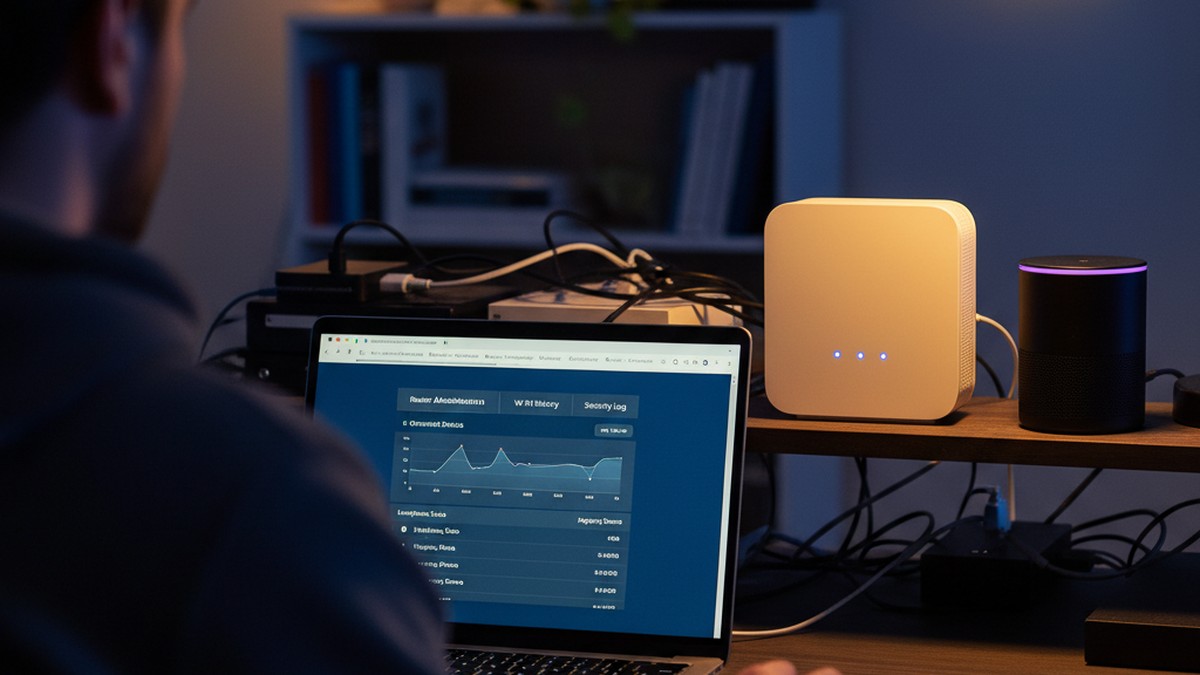
Your Wi-Fi Router History
Your home Wi-Fi router logs every domain that any connected device visits. Most people never check these logs. Neither do most cheaters.
How to access router logs:
- Open a browser and navigate to your router's admin panel — typically `192.168.1.1` or `192.168.0.1`
- Log in with the admin credentials — defaults are often printed on a sticker on the router itself
- Look for a section labeled "Log," "Traffic Logs," or "DNS Query Log"
Most consumer routers log by device and by domain. You'll see which domains were accessed, when, and from which device — typically identified by name ("[Name]'s iPhone" or similar).
Look for: Dating app domains (tinder.com, bumble.com, hinge.co, match.com), encrypted messaging app domains (signal.org, telegram.org), and any unfamiliar domains accessed consistently at unusual hours.
Critical limitation: If they use mobile data instead of home Wi-Fi for sensitive activity — which many cheaters learn to do — the router log will show nothing. Consistent mobile data usage for certain apps, when Wi-Fi is available, is its own behavioral signal worth noting.
Shared Streaming and Phone Plan Data
Netflix logs viewing history by device. Viewing activity in a city they didn't tell you they visited, or during hours they claimed to be asleep, can corroborate other findings.
If both phones are on the same carrier account and you're the account holder with legitimate access, carrier portals display call frequency to specific numbers and data usage patterns. You won't see message content — but a number receiving daily contact that you don't recognize is worth investigating.
Read the Behavioral Signals First
Here's what nearly every investigation guide misses: behavioral observation is statistically the most common precursor to confirmed infidelity discovery. Research compiled by Magnum Investigations found that 84% of partners who ultimately confirmed cheating had noticed behavioral changes before any device search or digital investigation began.
Behavioral signals require no technology, no account access, and no legal gray area. They also leave no trace of the investigation.
Behavioral signals are the most reliable early indicators of infidelity — 84% of partners who confirmed cheating noticed behavioral changes before finding any device evidence (Magnum Investigations, 2024). Changes in emotional availability, schedule patterns, communication habits, and appearance routines often appear weeks or months before a digital trail becomes visible.
This is the contrarian insight most guides ignore: the phone is the end of the evidence trail, not the beginning. Behavioral changes are the beginning. Searching for device evidence before documenting behavioral shifts is starting at the wrong end.
The 3-Signal Behavioral Checklist
Three categories of behavioral change most consistently correlate with infidelity. Document changes in each area with specific dates and details:
Signal Category 1 — Availability Patterns
- Schedule changes without clear explanation (working late more frequently, new social commitments described vaguely)
- Phone availability decreasing — calls going to voicemail when they previously answered, texts taking longer to return
- Unexplained gaps in their day that generate defensive responses when asked about
Signal Category 2 — Relational Quality Shifts
- Reduced emotional intimacy — less spontaneous conversation, less physical affection, a quality of mental absence even when physically present
- Increased irritability in response to normal questions about schedule or whereabouts
- Defensive reactions to check-ins that would previously have felt routine
- New distance that feels deliberate rather than situational or stress-related
Signal Category 3 — Appearance and Investment Changes
- Renewed attention to appearance, particularly before activities that don't historically warrant it
- New clothing, cologne or perfume, or grooming habits that appeared without explanation or occasion
- Reduced investment at home — less engagement with shared activities, less participation in household routines
For a comprehensive picture of what these behavioral patterns look like in practice, signs your partner is cheating documents the full behavioral spectrum across relationship types.
Why Behavioral Documentation Has Legal Value
If a relationship moves toward legal proceedings — separation, divorce, custody arrangements — legally gathered evidence is what matters. A behavioral log maintained consistently, with specific dated observations, is a legitimate form of evidence that can't be challenged the way device evidence can.
A note that reads "March 14, 11:40pm — returned home claiming to have worked late; office closed at 5pm that day; became defensive when I asked what project required the extra hours" is a factual record. It's also genuinely difficult to dismiss.
The Comparison Baseline
Behavioral changes are only meaningful against a baseline of normal behavior. Before concluding that something is significant, ask: is this genuinely different from their behavior six months ago? Depression, work stress, and personal health issues all produce behavioral shifts — but these typically have identifiable triggers or clear explanations when raised gently. The pattern that distinguishes infidelity-related changes is clustering: multiple signals appearing together without a plausible alternative explanation.

Follow the Financial Trail
Money is the least careful layer of a hidden relationship. Cheaters who are meticulous about deleting texts routinely leave unbroken financial records.
Financial evidence of cheating includes unusual cash withdrawals, dating app subscription charges on shared cards, restaurant or hotel charges at unfamiliar locations during claimed work hours, and gift purchases without corresponding occasions you knew about.
Bank and Credit Card Statements
If you have legitimate access to shared financial accounts — a joint checking account, a shared credit card — review three to six months of statements. Look for:
Subscription charges: Dating apps typically appear as small recurring charges ($9.99–$34.99/month). The app name may appear, or the parent company (Match Group covers Tinder, Match, OkCupid, Hinge, and others — a recurring charge you can't account for from this parent company is significant). Some charges appear through Apple or Google rather than the app name directly.
Cash withdrawals: A pattern of regular cash withdrawals — particularly if the person rarely used cash before — indicates deliberate financial erasure. Dates, gifts, and hotel stays become cash transactions when someone needs them to disappear from the record.
Restaurant and bar charges: Charges at restaurants you've never visited together, particularly during hours that don't align with their stated schedule. A dinner charge on a Tuesday when they claimed to be working late is directly verifiable against the timeline.
Hotel charges: A hotel charge in the city where you live — where there's no travel reason to stay in a hotel — is difficult to explain innocently.
Gift purchases: Charges from jewelry stores, flower delivery services, or similar retailers that don't correspond to any occasion you were part of.
A deeper breakdown of what financial patterns reveal across investigation case data is covered in financial signs of cheating.
Subscription Confirmation Emails
When someone joins a dating platform, they receive a welcome email. If you have access to a shared email account you legitimately use, a confirmation email from a dating platform you didn't jointly sign up for is direct evidence of registration. Note the platform, the date, and any account details visible in the email.
The Cash Pattern Baseline
Establish what normal cash use looks like for your partner. If they typically spent $100 in cash monthly and that number has shifted to $400, that change has a cause. Asking about it directly and observing the reaction — whether they explain it easily or become defensive — is itself informative.
Audit Physical Evidence
Physical evidence is the oldest investigative method, and it works. Cheaters who are digitally careful are frequently careless about physical traces.
The Car
The car is the single most productive physical evidence location in private investigator work. Partners rarely expect it.
Mileage inconsistencies: If your partner drives a regular route, you have a rough sense of expected odometer changes. A significant discrepancy on a specific day, particularly one that correlates with a claim of being somewhere specific, is measurable.
Receipts: Parking receipts, drive-through receipts, gas station receipts. These carry location data and timestamps. A receipt from an area they have no reason to visit, timestamped during a period they claimed to be elsewhere, is direct evidence of a location discrepancy.
Seat and mirror adjustments: If you occasionally drive their car, unexpected adjustments to the driver's seat or mirrors may indicate another person has driven or sat in it recently.
Work Bags and Personal Items
Work bags are the secondary physical evidence area. People carry items between parallel lives — a spare charger for a secondary phone, receipts folded in a pocket, a business card from a place never mentioned.
A secondary phone is one of the most conclusive physical findings. A separate device — not necessarily a smartphone, sometimes a basic prepaid phone — is a common method for maintaining a second communication identity. Jacket pockets, the glove compartment, and the back of desk drawers are common locations.
The behavioral patterns associated with device secrecy are covered separately, but the physical presence of a second device is one of the most definitive findings in any investigation.
Additional Physical Signals
New toiletries or grooming products in the car, a gym bag, or at the office that have no obvious purpose in the known routine are worth noting. A second deodorant in the car. A toothbrush in a work bag. Cologne kept in the glove compartment rather than at home. These are specific and difficult to explain casually.
Build Your Social Witness Picture
The people around your partner observe more than they mention. This is the most interpersonally delicate method — but potentially the most direct.
Mutual Friends
People in your shared social circle who spend time with both of you may have noticed something: an odd comment, an unexplained absence during a shared event, an interaction that struck them as unusual. They may not have raised it out of reluctance to interfere.
The correct approach is indirect and non-accusatory: "Have you noticed anything different about [partner] lately? They seem a bit distant and I'm trying to understand if it's work stress or something else." This opens the door without presenting suspicions as established facts.
Pay attention to the response. People who know something relevant often become slightly awkward when asked — shorter answers, changed subject, a slightly surprised look. That reaction itself is information.
Their Friend Group
Friends of a cheating partner often know more than they've volunteered — sometimes out of loyalty, sometimes out of discomfort, sometimes because they've assumed the other partner already knows. The same indirect framing applies: express concern rather than accusation.
If they know something and you're clearly in the dark, the discomfort of that position often produces some form of signal, even if they say nothing explicit.
The Office Landline Check
If your partner claims to be working late, calling their office landline — not their cell — at the claimed time is a straightforward verification. Most people lying about being at work don't account for a landline call. This carries no legal risk and leaves no digital trace.
What to Avoid
Don't present suspicions as facts to mutual friends — this creates unnecessary drama and potentially tips off your partner. Don't recruit friends into active surveillance. Don't create a situation where your partner hears that their social circle is being questioned. The social witness layer is about observation, not investigation-by-proxy.
How Does the 5-Layer Investigation Method Work?
All nine methods above map to a structured framework: the 5-Layer Investigation Method. This framework exists because running methods randomly produces scattered, hard-to-interpret evidence. Running them in deliberate layers produces a cumulative picture where each layer either corroborates or contradicts the previous one.
The 5-Layer Investigation Method organizes all nine investigation approaches into sequential layers: Digital Identity (dating profiles, social media, email search), Digital Behavior (shared accounts, router logs), Behavioral Signals, Financial Evidence, and Physical and Social Evidence. Each layer corroborates or contradicts the previous one, and the method stops when conclusive evidence is found.
The framework is designed to stop at any layer — if one layer produces conclusive evidence, you don't need to continue. If the picture remains unclear, the next layer adds depth.
Layer 1 — Digital Identity (Methods 1, 2, 3)
Search for accounts created with their name, photo, email, or username. Start here because it's completely anonymous, leaves no trace, and can produce conclusive evidence in 20 minutes. An active dating profile with recent photos and a current location is not ambiguous.
This layer covers dating profile search, social media audit, and email/username search. Run all three before moving deeper.
Layer 2 — Digital Behavior (Method 4: Shared Ecosystem + Router)
Examine the shared digital ecosystem and router logs. This layer reveals behavioral patterns — which platforms they're visiting, what location history shows, whether app downloads have changed. It corroborates or contradicts what Layer 1 found.
Layer 3 — Behavioral Signals (Method 5: Behavioral Observation)
Document behavioral changes systematically using the 3-Signal Behavioral Checklist. This layer runs in parallel with everything else from Day 1 and never stops. A behavioral log maintained over three to six weeks, with specific dated observations, is the kind of evidence that's both legally useful and genuinely difficult to gaslight.
Note: this is the most reliable layer by statistical frequency — 84% of confirmed discoveries involved behavioral observation. Start this regardless of what other layers show.
Layer 4 — Financial Evidence (Method 6: Financial Trail)
Review shared financial records. This layer converts suspicion into a documented timeline. A dated charge at a specific location during a claimed meeting is factual record, not interpretation. Financial evidence either aligns with or contradicts the behavioral timeline from Layer 3.
Layer 5 — Physical and Social Evidence (Methods 7, 8, 9)
Physical evidence and witness accounts confirm patterns from Layers 1–4. A receipt found in a car alone proves nothing. A receipt that aligns with a dating profile, a behavioral shift, and a financial anomaly is an overwhelming combination.
Decision Points in the Framework
After Layer 1: If you find an active dating profile, you have an answer. Document it and decide how to proceed.
After Layers 1–2: If no profile was found but digital behavior raises flags, continue to Layer 3.
After Layers 1–3: Well-documented behavioral changes corroborating other findings are typically enough to have a conversation. Continue to Layers 4–5 if you need evidence for legal proceedings.
After all five layers: You have a multi-source picture that is very difficult to explain away.
What Should You Do Once You Find Evidence?
The investigation doesn't end when you find something. What you do with evidence matters as much as finding it.
Once you find evidence of cheating, document everything before taking action — screenshot profiles, save financial records, and date your behavioral notes. Then decide whether to confront your partner with what you've found or seek independent counsel first. Acting on incomplete evidence often gives a cheater time to build a counter-narrative.
Step 1: Document Before You Act
Whatever you find, document it immediately. Dating profiles get deleted when cheaters become suspicious. A dated screenshot saved to a private account they don't know about is yours regardless of what happens next.
Specific documentation steps:
- Screenshot dating profiles with the date and time visible in the image
- Save bank statements and photographs of physical receipts to a private account in your name only
- Write dated behavioral notes while details are fresh — specific incidents, exact times, specific words
- Note any inconsistencies between stated location and evidence of actual location, with dates
Step 2: Evaluate What You Have
Rate your evidence before acting:
Conclusive: Active dating profile with recent photos, hotel receipt on a date they claimed to be elsewhere, physical discovery of a secondary phone.
Strong: Significant financial pattern corroborated by behavioral changes, router logs showing consistent dating app access, new encrypted messaging app installed.
Circumstantial: Behavioral changes alone, vague location inconsistencies, general defensiveness.
A confrontation based on only circumstantial evidence gives the cheater room to flip the narrative and position you as unreasonably suspicious. Wait until you have at least one conclusive piece, or multiple strong pieces that corroborate each other.
Step 3: Consider Independent Counsel
If legal proceedings may follow — divorce, asset division, custody — speaking with an attorney before confronting your partner has practical value. Evidence gathered legally is admissible. Evidence gathered through unauthorized access is not. An attorney can advise on jurisdiction-specific rules about what you can and cannot do during a separation.
Everything in this guide is legal. None of it involves accessing accounts without authorization, installing covert software, or intercepting communications. CheatScanX uses only publicly accessible platform data — no device access, no account intrusion, no legal exposure.
Step 4: Plan the Conversation
Go into the confrontation knowing more than you reveal. Let your partner fill in gaps. Cheaters who don't know the extent of what their partner knows frequently reveal more than they intend to.
A breakdown of what to say — and specifically what to avoid — when confronting a cheating partner is covered in how to confront a cheater.
What Common Mistakes Tip Off a Cheater and Ruin Your Case?
The methods above work — but only if your partner doesn't know you're investigating. These mistakes give you away before you have enough evidence to act.
The five biggest investigation-ending mistakes are: telling a mutual friend, attempting to access their phone and getting caught, confronting too early with only circumstantial evidence, changing your own behavior so visibly that they notice, and using investigation methods that generate alerts or notifications visible to the cheater.
Mistake 1 — Confiding in Someone Connected to Both of You
The most common investigation-ending error is telling a mutual friend or family member who also has a relationship with your partner. Information moves, even when people intend to keep it. A trusted friend who promises confidentiality may unconsciously change their tone around your partner or avoid certain topics in ways a perceptive person notices. Confide only in people who have no relationship with your partner.
Mistake 2 — Accessing the Phone and Getting Caught
If you attempt to check their phone and your partner notices — even just that it's been moved, or that an app was opened at a time they don't remember — they'll immediately run a cleanup. Deleted apps, cleared histories, changed passcodes. You've spent the element of surprise and prompted them to destroy evidence. Don't attempt phone access until you've exhausted the methods in this guide.
Mistake 3 — Confronting Before You Have Enough
Confronting on the basis of suspicion and minimal circumstantial evidence gives a cheater room to flip the narrative entirely. "You're accusing me of cheating because I worked late twice?" is an effective counter when that's genuinely all you have. Wait until you have at least one conclusive piece of evidence, or multiple strong pieces from different layers.
Mistake 4 — Changing Your Own Behavior
If you become visibly withdrawn, cold, or distressed because of what you suspect, a perceptive partner will notice the shift and become more careful. Maintaining your normal patterns during an investigation is difficult when you're feeling hurt — but it protects the investigation. Save the emotional response for the conversation, when you're ready to have it.
Mistake 5 — Using Methods That Leave a Trace
Some investigation approaches generate alerts. Creating a Find My Friends request sends a notification. Accessing a shared account from a new device triggers a login alert. Running certain background check services sends a notification to the subject. Every method in this guide is passive from the cheater's perspective — they generate no alerts, no notifications, and no evidence that an investigation occurred.
Conclusion — Finding Clarity Before the Conversation
Suspicion without certainty is its own form of damage. The anxiety of not knowing — running scenarios, second-guessing instincts, oscillating between certainty and doubt — takes a toll that's distinct from the hurt of confirmed betrayal, but not less real. The goal of this investigation framework is not to feed that anxiety, but to end it.
The 5-Layer Investigation Method moves systematically from the most conclusive and least intrusive evidence — dating profile searches — through behavioral documentation, financial analysis, and physical evidence, building a picture that becomes progressively harder to dismiss. Most investigations don't require all five layers. A single active dating profile, clearly current and recently updated, often resolves what weeks of doubt couldn't.
The framework exists for the cases that aren't that clear: where patterns need to accumulate across weeks, where individual data points need corroboration before a confrontation is warranted, where legal proceedings may be on the horizon and the quality of evidence matters.
Acknowledgment of limitation: these methods can confirm or provide strong evidence of cheating, but they cannot read minds or explain motivations. A found profile tells you the profile exists. It doesn't tell you what happened on those dates or how far things progressed. The conversation that follows the investigation is where those answers come from.
Whatever you find — or don't find — the goal is clarity. Clarity lets you make decisions based on reality rather than anxiety. That decision, whether it leads to a difficult conversation, a separation, a counselor's office, or a recognition that your instincts were misplaced this time, is yours alone to make. The investigation is simply what makes clarity possible.
Frequently Asked Questions
Yes. Dating app profile searches scan 15+ platforms by name and photo without any device access. Financial records, behavioral patterns, shared digital accounts, and social media audits all provide evidence independent of the phone. Multiple methods used together are typically more conclusive than phone access alone.
Run a dating app profile search first. It is fast, leaves no trace on either side, and can be conclusive in minutes. If an active profile surfaces, you have your answer. If not, you have ruled out the most direct evidence and can proceed through remaining investigation layers without alerting anyone.
Searching for someone's dating profile using a service that scans publicly accessible platform data by name and photo is entirely legal. What creates legal risk is accessing private accounts without consent, installing monitoring software without knowledge, or intercepting communications. Public profile searches carry no legal exposure.
Document it immediately — screenshot with timestamp visible, note the platform, record visible details including any last-active indicators. Then decide whether to confront directly or continue building a fuller picture. A confrontation backed by multiple corroborating findings is significantly harder for a cheater to dismiss than a single discovery.
Behavioral changes alone do not confirm cheating — they signal something worth investigating. The distinguishing factor is clustering: infidelity-related changes tend to appear together (reduced emotional availability, secretiveness about schedule, renewed attention to appearance) without another plausible explanation. Unexplained clusters that generate defensive responses when raised are the key pattern.