
# How to Catch a Cheating Partner in Australia
Catching a cheating partner in Australia means working within a legal framework that differs from every other English-speaking country — and most guides fail to tell you that. Several methods that are legal in the US and UK can expose you to criminal charges in certain Australian states, while methods that most guides skip entirely are both legal and highly effective here.
The good news: nine methods are fully legal across every Australian state and territory, and the most reliable one starts in under five minutes. Dating apps now play a central role in how Australian affairs begin — and they leave a searchable digital trail.
Approximately 60% of married men and 45% of married women in Australia have had an affair at some point, according to Sexual Health Australia. Understanding which apps to check first, what behavioural patterns to document, and how to approach the process without creating legal exposure puts you in the clearest possible position to know the truth.
This guide covers all nine methods, a state-by-state legal reference for recording laws, an original investigation framework built for Australian conditions, and the specific evidence documentation that Australian Family Court proceedings require.
Is Your Partner Cheating? What Australian Data Shows
Approximately 60% of married men and 45% of married women in Australia have had an affair at some point, according to Sexual Health Australia. One in five Australian divorces cites infidelity as the cause. Digital platforms now play a central role in how affairs begin, with Tinder, Bumble, and Hinge covering an estimated 90% of Australia's active dating app market.
These numbers don't mean suspicion is always justified — but they do mean it warrants investigation rather than dismissal. Understanding what Australian data actually shows about why and how infidelity happens gives important context before any investigation begins.
What Australian Research Actually Shows
A survey of approximately 1,800 Australians conducted by Relationships Australia found that 52% of men and 60% of women identified emotional disconnection as the primary cause of infidelity they had witnessed or experienced (Relationships Australia Infidelity Survey, 2018). Feeling unappreciated followed — cited by 23% of men and 16% of women.
This matters because it shifts the frame from "is my partner a bad person" to "is there something specific that happened in the relationship, and did they act on it digitally?" That reframe makes investigation feel more purposeful and less punitive.
Research by Knopp et al. published in the Journal of Family Psychology (2017) found that people who were unfaithful in one relationship are three times more likely to be unfaithful in their next. If your partner has a history of infidelity — in this relationship or previous ones — that statistical baseline is worth factoring in.
One demographic pattern specific to Australia, drawn from Spouse Spy Australia's analysis of their client intake data: infidelity rates for Australian men peak at approximately age 55, while rates for women peak at age 45. Affluent women are 80% more likely to cheat than women from average or low-income households, while men's rates remain relatively consistent across income levels. These are averages, not predictors — but they're useful calibration points.
How Australia's Dating App Market Amplifies the Problem
Digital infidelity in Australia almost always starts on a dating platform, not through workplace proximity or social connections as it once did. According to YouGov's 2024 Australian dating app survey, 64% of dating app users have used Tinder. Bumble comes second at 33%, and Hinge at 21%.
What matters as much as which apps exist is what each app's users are actually there for. YouGov's data shows that 56% of Tinder's Australian user base describes themselves as "casual daters" primarily seeking hookups. Hinge sits at the opposite end: 71% of Australian Hinge users describe themselves as serious daters seeking an exclusive relationship. That intent-profile data directly informs which platforms carry higher risk for a specific type of affair.
Hidden dating profiles are often not freshly created accounts. Many partners maintain a dormant profile created years earlier that sits inactive until reactivated. Tinder's own platform behaviour allows inactive profiles to remain visible in other users' swipe stacks for months after last login — meaning a profile may be active-visible even without recent use. This is why a search finding a profile doesn't automatically prove recent activity; it confirms presence, not frequency of use.
The One-in-Five Statistic That Matters Most
According to Sexual Health Australia, one in five Australian divorces lists infidelity as the primary cause. That's not a majority — and it means that in four out of five Australian separations, other factors dominate. Catching a cheating partner is sometimes the start of a long legal process, not just a personal confrontation. Understanding what the Australian legal framework does and doesn't do with that evidence is essential before you begin.
If any of this sounds familiar, there's a way to know for sure. CheatScanX checks 15+ dating platforms for hidden profiles using a name, email, or phone number.
Check for hidden profiles →How Does Australian Privacy Law Affect Cheating Investigations?
In Australia, you can legally monitor publicly visible social media, check jointly-held account statements, and observe behaviour in public spaces. You cannot legally tap phone calls, install tracking software without consent, or record conversations in most states without the other party's knowledge. State laws differ significantly — Victoria and Queensland allow participant recording; NSW, WA, SA, ACT, and Tasmania do not.
This distinction is the single most important thing to understand before any investigation. Australia does not have a single national surveillance law governing private citizens. The federal Surveillance Devices Act 2004 applies specifically to law enforcement agencies — it does not restrict or protect what individuals do to each other. Instead, each state and territory has enacted its own surveillance legislation, and the rules differ meaningfully between them.
State-by-State Recording Laws
The most consequential variable in an Australian cheating investigation is whether you can record a conversation you're participating in without the other party's consent. This table covers the current legal position in each jurisdiction:
| State/Territory | Can You Record Your Own Conversation Without Consent? | Governing Legislation |
|---|---|---|
| Victoria | Yes | Surveillance Devices Act 1999 (VIC) |
| Queensland | Yes | Invasion of Privacy Act 1971 (QLD) |
| Northern Territory | Yes | Surveillance Devices Act 2007 (NT) |
| NSW | No | Surveillance Devices Act 2007 (NSW) |
| Western Australia | No | Surveillance Devices Act 1998 (WA) |
| South Australia | No | Listening and Surveillance Devices Act 1972 (SA) |
| ACT | No | Listening Devices Act 1992 (ACT) |
| Tasmania | No | Listening Devices Act 1991 (TAS) |
If you live in Victoria, Queensland, or the Northern Territory, you can legally record a phone call or in-person conversation you're participating in — for example, a call where your partner makes admissions about their whereabouts or relationship — without their knowledge. That recording is both legal to make and admissible in Family Court proceedings.
If you live in NSW, WA, SA, ACT, or Tasmania, making the same recording is a criminal offence. Penalties vary by state but can include fines and jail time. Critically, Family Court has discretion to admit illegally-obtained evidence if the desirability of admitting it outweighs the undesirability — but that's a judicial decision you cannot rely on in advance.
The 2025 Privacy Act Reform: What Changed
Australia's Privacy and Other Legislation Amendment Act 2024 introduced a statutory tort of serious invasions of privacy, which came into effect in 2025. For the first time, Australian individuals have a personal right to sue another party for serious privacy invasion — either intrusion upon seclusion or misuse of personal information.
For cheating investigations, this affects what you do with evidence after you collect it. Posting screenshots of a partner's dating profile on social media, forwarding private communications to their employer or family, or publishing evidence publicly could now expose you to a civil claim. Collecting evidence for your own knowledge or presenting it to Family Court proceedings remains fully unaffected.
The practical advice: don't share evidence with third parties until you've spoken to a solicitor. This includes sending screenshots to friends or family for "advice" — once you share digital content, you lose control of where it goes.
What Remains Legal Across Every State
Regardless of where you are in Australia, these methods carry no legal risk:
- Viewing publicly visible social media profiles and noting activity (posts, tagged locations, new followers, timeline changes)
- Checking statements for joint bank accounts, shared credit cards, or family phone plans you're a named account holder on
- Using a dating app profile search service — this accesses publicly visible information on platforms designed to be seen
- Observing your partner's behaviour in public places and documenting what you observe (noting dates, times, locations, what you saw)
- Hiring a licensed Australian private investigator who operates within state surveillance law
- Reviewing browser history, search data, or app activity on devices you jointly own (not password-protected accounts belonging to the other person)

The TRACE Method: A Framework for Australian Investigations
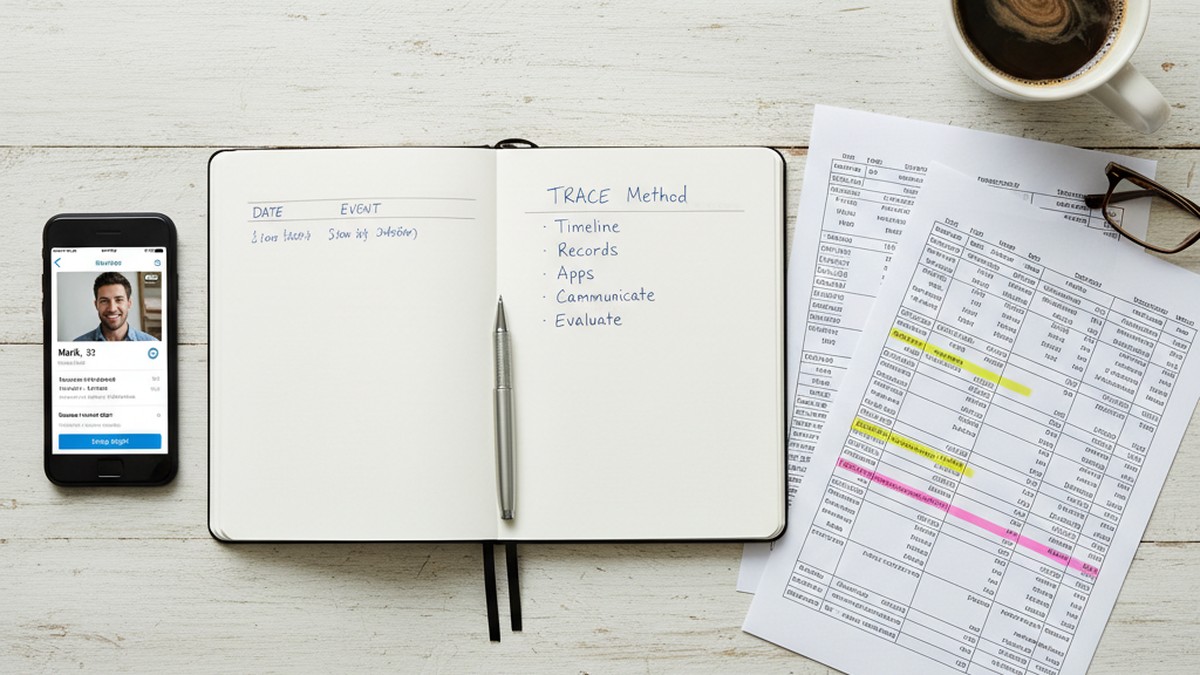
The most damaging error in a cheating investigation is acting before you have evidence — confronting your partner based on suspicion, which puts them on guard and makes everything harder to find. The TRACE Method is a five-step sequence designed specifically for the Australian legal context. It works within the law in every state, produces documentation appropriate for Family Court, and avoids the tactical mistakes that most investigations make.
TRACE stands for: Timeline, Registry, App Behaviour, Cross-reference, Evidence documentation.
T — Timeline Analysis
Before touching any digital platform, spend twenty minutes writing down the specific incidents that raised your suspicion: dates, times, what you observed, and what explanation you were given or not given. Do this before you start searching — the timeline anchors your investigation and prevents you from searching randomly.
The timeline serves two distinct purposes. First, it gives you search anchors: if your partner became secretive about their phone in March, that's when to look for new app registrations or account reactivations. Second, it becomes your evidence baseline — Family Court documentation is significantly stronger when paired with a clear chronological record of behavioural changes that preceded any digital discovery.
For each entry in your timeline, note: what specifically you observed (not your interpretation of it), any explanation given, and whether that explanation was verifiable or unverifiable. "He said he was at the office until 10pm" is a verifiable claim. "She said she needed space to think" is not.
R — Registry Scan
A registry scan means checking whether your partner has an active profile on Australian dating platforms. This is both fully legal across all states and the most direct form of digital evidence available.
The most efficient method is using a service that searches multiple platforms simultaneously. Manual searches on Tinder, Bumble, and Hinge each require creating an account, building a profile, setting your location, and then filtering by age and distance to find a match — a process that takes hours and depends on the platform's algorithm surfacing the specific profile to you.
A dedicated search tool like CheatScanX scans 15+ platforms simultaneously using a name and location, returning confirmed profile matches within minutes. For Australian users, this covers Tinder, Bumble, and Hinge (the three platforms that account for the vast majority of the Australian market) plus internationally active platforms with Australian user bases.
If you find a profile, document: the display name used, the photos shown (note whether they match photos you know, or whether they're different images that suggest deliberate distancing from their known identity), any bio text, and any last-active indicator the platform displays.
A — App Behaviour Analysis
App behaviour analysis means observing the pattern of apps on your partner's phone from what's visible on the home screen or in the app switcher — not accessing the apps themselves, which requires their password and is illegal.
What you can legally observe:
- New apps appearing: Dating apps (Tinder, Bumble, Hinge, Feeld, Grindr), encrypted messaging apps (Signal, Wickr, Telegram), vault or privacy apps that hide content behind a decoy interface
- App disappearances: Previously visible apps that are no longer on the home screen may have been moved to the App Library (iOS), a secure folder (Android), or a folder with an innocuous name like "Finance" or "Utilities"
- Screen time patterns: If you're on a family sharing plan with screen time visibility, a significant increase in social networking or dating category use is a relevant data point
For a complete reference on how apps are concealed on both iOS and Android — including the specific vault apps that disguise themselves as calculators — the guide on hidden dating apps on a partner's phone covers each platform's hiding methods in detail.
C — Cross-Reference
Cross-referencing means checking whether your timeline observations align with your digital findings. This is the step that converts circumstantial observations into a coherent evidentiary picture.
If your timeline shows that your partner became evasive about their whereabouts in February, and your registry scan returns a Tinder profile using a photo taken in January, those two facts corroborate each other. If the registry scan returns nothing and the app behaviour changes have an alternative explanation, your evidence set is thin.
Cross-referencing also includes checking location data you have legal access to. If you share an Apple Family Sharing plan where your partner has consented to location sharing, their location history is accessible and admissible. Google Maps Timeline data on a shared Google account is similarly accessible — it shows where the device has been, with timestamps, and doesn't require any action on the device itself.
E — Evidence Documentation
Documentation for Australian Family Court needs to meet a specific standard. Record everything you find through legal means in a format that includes visible timestamps and notes how each item was obtained.
For each piece of evidence:
- Take screenshots with the date and time bar visible (either the device status bar or a timestamp overlay)
- Note the exact date and time you captured it
- Record the method used to obtain it and confirm it was obtained legally
- Store it somewhere your partner cannot access (a personal-only cloud folder, a USB drive kept offsite, or an encrypted note app with a password they don't know)
- Do not edit, crop, or alter any screenshot — altered evidence is inadmissible and may be considered tampering
If you're in Victoria, Queensland, or the NT and have legally recorded a conversation containing relevant admissions, preserve the original audio file with its creation date metadata intact. Do not share it until a family law solicitor has reviewed whether and how to use it.
How Can I Search Australian Dating Apps for Hidden Profiles?
You can search Tinder, Bumble, and Hinge for a partner's profile using their first name, age, and approximate location — no account needed with tools like CheatScanX. The search scans real-time profile data across 15+ platforms simultaneously, returning results within minutes without alerting the person being searched.
Here's what manual searches on each major Australian platform require, and where their limitations are.
Searching Tinder in Australia
Tinder is used by 64% of Australian dating app users — by far the dominant platform in Australia. To search Tinder manually, you need an active account. Create a new account (separate from any existing one), set your gender to what your partner is attracted to, set your age range to bracket your partner's age, and set your location to where they live or regularly spend time.
The limitation of manual Tinder searches is significant: Tinder controls what profiles you see using its algorithm. It does not simply show you every profile in your radius — it factors in both users' preferences, activity levels, and matching patterns. You may not see your partner's profile even if it exists, particularly if their preferences filter out your demographic.
A search service that queries Tinder's profile database directly (bypassing the consumer swipe interface) is far more reliable. If a Tinder profile for your partner exists and is visible to others, it will appear regardless of algorithmic filtering.
Searching Bumble in Australia
Bumble is used by 33% of Australian dating app users and skews slightly older in age demographic than Tinder. Like Tinder, manual profile searches require creating an account and setting your demographic parameters.
Bumble has one useful feature for investigation purposes: the "Beehive" section allows browsing of public profiles without matching. This gives broader visibility than the standard swipe mode, though it still won't reliably surface a specific individual on demand.
Note that Bumble operates three modes: dating, BFF (friendship), and professional networking (Bumble Bizz). A partner who acknowledges having Bumble might claim it's for BFF or Bizz — both legitimate uses. If you're searching, check the dating mode specifically, not just the app's existence on the phone.
Searching Hinge in Australia
Hinge is used by 21% of Australian dating app users. It has the highest proportion of serious relationship seekers at 71% (YouGov, 2024), which surprises people who associate affairs with casual platforms. Partners who are seeking emotional connection rather than casual encounters often appear on Hinge specifically because of its relationship-oriented positioning.
Hinge does not offer any anonymous browsing. Creating an account to search means your profile will potentially be shown to the person you're looking for, depending on the algorithm. If discretion is important, a third-party search service is the appropriate method for Hinge.
Other Apps with Active Australian User Bases
Beyond the main three, these platforms operate actively in Australia and are worth including in a thorough search:
| Platform | Focus | Australian Presence |
|---|---|---|
| Ashley Madison | Explicitly discreet/affair-focused | Active |
| Victoria Milan | Married people seeking affairs | Active |
| Gleeden | Women-initiated affairs | Active |
| OkCupid | Personality-matching, broader age range | Active |
| Plenty of Fish (POF) | Broad demographic, older average age | Active |
| Grindr | LGBTQ+ men | Active |
| Feeld | Open relationships, kink community | Growing |
What a Profile Match Actually Tells You
Finding a profile confirms presence on the platform — it does not automatically confirm active infidelity. Before drawing conclusions, note the profile's last active date if visible, whether the photos are current (a profile using photos from several years ago may be genuinely dormant), and whether the location shown matches your partner's actual location or a different city.
A profile with recent photos, an active-looking location, and a freshly written bio is strong evidence of current use. A profile with old photos and no activity indicators may be an inactive account from before your relationship. Both findings are worth documenting — but they call for different responses. The distinction between an old dormant profile and an actively maintained one is one of the most important judgement calls in any investigation.
For a full walkthrough of how to find out if your partner is on dating apps across multiple platforms simultaneously, that guide covers both the manual approach and service-based searches in detail.

What Are the Digital Signs Your Partner Is On Dating Apps?
The clearest digital signs that a partner has an active dating app profile are sudden phone security changes (new PIN, Face ID only, hidden notifications), unexplained new apps or significant increases in social networking screen time, and behavioural patterns around their phone that create a physical barrier between you and the screen.
These signs don't prove infidelity — but they indicate privacy-seeking behaviour around their device that warrants investigation.
Phone Behaviour Red Flags
Changed security settings: A partner who suddenly enables a PIN where none existed before, or changes a PIN you knew, is the most common early signal. This is especially significant when paired with a specific incident — a moment when they seemed nervous about you touching their phone or looking at their screen.
Notification management: Most dating apps allow notifications to appear as generic previews ("1 new message") rather than showing sender names or message content. A partner who has recently switched their phone to hide notification previews across all apps, or who has set specific apps to silent with no lock-screen preview, is managing what you can see in passing.
Screen positioning: Habitually angling the phone screen away, turning it face-down when you sit nearby, or taking calls in another room are common patterns. None of these are conclusive individually — but combined with other signals and noted in your timeline, they contribute to the overall picture.
The bathroom phone habit: Taking the phone to the bathroom for extended periods — particularly late at night after you've gone to bed — is one of the most consistently reported behaviours in digital infidelity cases. This is frequently where messaging happens in private.
App and Account Signals
Encrypted messaging apps: Signal, Wickr, and Telegram are not inherently suspicious — many people use them for privacy or professional reasons. But a partner who wasn't previously using any of these apps and suddenly installs one may be establishing a private communication channel. Wickr in particular is associated with affair communication because it offers message self-destruction.
New email address: Most dating apps require an email for registration. A partner who has created an email address you weren't aware of may have done so specifically for dating app registration. You may notice this if you have access to shared devices and see a new account listed in a browser's autofill.
Cloud storage separation: Switching from a shared iCloud Family Sharing account to a personal Apple ID, or changing a Google account to a separate profile, removes you from visibility into their device data, purchases, and location. This can happen for legitimate reasons — but combined with other signals, it's worth noting.
Social media behaviour changes: A sudden increase in Instagram activity (viewing stories, posting at unusual times), new follows of unfamiliar accounts, or a transition from public to private profile settings can indicate new social connections worth examining.
Vault apps disguised as utilities: A growing category of apps in Australia specifically designed to hide content behind an innocent-looking interface — typically a functioning calculator, a fake note-taking app, or a weather app. Tapping the icon opens what appears to be a normal utility. Entering a secret PIN reveals hidden photos, videos, and messages. Common examples available on the Australian App Store include Private Photo Vault, Calculator+, and Vaulty. If your partner has an app that replicates the function of a default system app (a second calculator on an iPhone, for example), that duplication is worth examining.
What These Signs Mean in Context
No single sign is diagnostic. A changed PIN may reflect a genuine privacy concern about a stolen or lost phone. Signal may be for a work group. A new email address might be for a spam-free newsletter subscription. The TRACE Method's timeline step is designed specifically to give individual signals context — when three or four of these patterns appear within the same short period, that's the appropriate trigger to move to a registry scan rather than waiting for more evidence.
What Is Legally Permissible in Australia When Suspecting Cheating?
In Australia, you can legally monitor publicly visible social media, check jointly-held account statements, and observe behaviour in public spaces. You cannot legally tap phone calls, install tracking software without consent, or record conversations in most states without the other party's knowledge. State laws differ significantly — Victoria and Queensland allow participant recording; NSW, WA, SA, ACT, and Tasmania do not.
What You CAN Do Without Breaking the Law
Search publicly visible social media: Any public profile on Instagram, Facebook, TikTok, or X is accessible to anyone. If your partner's social accounts are public, their activity — posts, check-in locations, tagged photos, new followers, comments they leave on other accounts — is observable. This is the most consistently underused free method in cheating investigations.
Check statements for shared financial accounts: Joint bank accounts, credit cards you're a named holder on, and joint phone plans are accounts you have legal access to. Dating app subscription charges (Tinder Gold at approximately $28-$45/month in Australia, Bumble Boost, Hinge Subscription) appear as line items with the app name. Hotel charges, restaurant bookings, and unexplained travel on dates that were claimed to be elsewhere are all visible.
Conduct a dating app profile search: Using a service that scans dating platforms, or manually creating your own account to search, accesses publicly available information. Dating app profiles are designed to be visible to other users — searching for one is not surveillance.
Hire a licensed Australian private investigator: Private investigators licensed under the relevant state Act (e.g., the Security Industry Act in NSW, the Private Security Act in Victoria) can legally conduct surveillance in public places, photograph activities in public view, and produce reports that are admissible in Family Court. They understand each state's specific limitations and work within them. Look for membership in the Australian Security Industry Association (ASIAL) or the Council of Private Investigators of Australia.
Review data on shared devices: If your partner used a shared computer, family tablet, or device that's jointly owned to access dating apps while logged into a shared account, that browser history, app activity, and downloaded content is on a device you have legitimate access to.
What You CANNOT Do — And the Penalties
Install tracking or monitoring software without consent: Installing spyware, keyloggers, stalkerware, or location-tracking apps on your partner's device without their knowledge is illegal across every Australian state and territory. Under state-level Crimes Acts, penalties can include imprisonment of up to five years in NSW, with similar provisions in other states.
Record private conversations without consent (in restricted states): As detailed in the recording law table above, doing this in NSW, WA, SA, ACT, or Tasmania is a criminal offence. Even if the recording captures a clear admission of cheating, you could face charges for making it.
Access their private accounts without permission: Logging into your partner's email, social media accounts, or dating app accounts using their credentials is an offence under section 478.1 of the Commonwealth Criminal Code Act 1995 (unauthorised access to restricted data). This applies regardless of whether you know the password, and regardless of your relationship. Evidence obtained this way may be inadmissible and can result in counter-complaints.
Place GPS trackers without consent: Most Australian states prohibit attaching a tracking device to a vehicle without the registered owner's consent. This is covered under the respective state Surveillance Devices Acts and, in some cases, specific road transport legislation.
Does Cheating Affect Australian Family Law?
Generally no. Australian Family Courts follow the Family Law Act 1975, which focuses on financial contributions and future needs rather than moral fault. Cheating itself does not change how assets are divided. However, if a partner spent significant marital funds on an affair — hotels, gifts, dating app subscriptions — courts can treat that spending as financial waste from the joint asset pool.
This surprises many Australians who expect infidelity to carry weight in divorce proceedings. Understanding exactly what does and doesn't matter legally allows you to focus your evidence-gathering on what's actually useful.
Why Australia's No-Fault System Is Different
Australia introduced no-fault divorce under the Family Law Act 1975 — making it one of the first countries in the world to do so. The sole legal ground for divorce in Australia is 12 months of separation. You don't need to prove why the marriage ended, and proving infidelity doesn't speed up or simplify the process.
This is a meaningful distinction from the UK (which only moved to no-fault divorce in April 2022) and from US states that still operate fault-based divorce systems. In Australia, there is no legal mechanism for a judge to punish a cheating partner through reduced asset allocation simply because they cheated. The moral dimension of infidelity is explicitly outside Family Court's mandate.
When Evidence of Cheating Becomes Financially Relevant
Financial waste from the joint asset pool: If your partner spent marital funds on their affair — hotel stays, flights, gifts, restaurant bills on a joint credit card, dating app subscription charges from a shared account — this constitutes what Family Court treats as financial waste. Judges can factor this into property settlement calculations, effectively treating the expenditure as an advance on the cheating partner's share of the asset pool.
The key is documentation: a detailed record of affair-related expenditure from shared accounts, supported by statements and a timeline showing the affair period, gives your solicitor the basis to make this argument.
Parenting order proceedings: While moral fault doesn't determine property division, it can be relevant in parenting orders in specific circumstances. If the affair partner was introduced to children without disclosure, if the cheating partner lied under oath about the relationship during proceedings, or if the domestic situation created by the affair demonstrably affected the children's welfare, those facts become relevant.
Binding Financial Agreements: If you're negotiating a financial settlement through a Binding Financial Agreement (Australia's version of a post-separation property agreement, not requiring court involvement), evidence of affair-related financial waste gives you a stronger negotiating position even if it would carry limited weight in court.
How to Document Evidence for Family Law Use
For property proceedings, the most useful documentation includes:
- Bank and credit card statements with affair-related charges highlighted and annotated with dates and context
- Screenshots of dating profiles found during legal searches, with timestamps
- A written chronological record of when specific behaviours changed and what you observed
- Hotel, restaurant, or travel receipts from shared accounts that correspond with dates in your timeline
Keep everything in a format that preserves original metadata (timestamps, device information). If you're anticipating Family Court involvement, consult a family law solicitor before organising or presenting any of this — they can advise on how to present it most effectively within the rules of evidence.
Seven Mistakes That Destroy an Australian Cheating Investigation
Most investigations fail not because evidence doesn't exist, but because tactical errors were made before or during the search. These are the most common ones — and every one can be avoided with the TRACE sequence.
1. Confronting Before You Have Evidence
Confronting a partner based on suspicion alone gives them the opportunity to delete apps, change passwords, clear browser history, and establish consistent cover stories before you've found anything. Once they know you're watching, digital evidence becomes significantly harder to gather. The TRACE Method addresses this directly: document first, confront with specifics once you have them.
2. Accessing Their Private Accounts
Even knowing their password doesn't make it legal. Section 478.1 of the Commonwealth Criminal Code prohibits unauthorised access to restricted data — and a personal email account or social media account, even one belonging to your partner, is restricted data. Evidence obtained this way may be inadmissible, and you could face a counter-complaint that complicates your own legal position.
3. Installing Monitoring Software
Spyware is illegal in Australia regardless of the relationship. Full stop. Many "catch a cheater" apps sold on overseas websites, when installed on an Australian partner's device without their consent, constitute a criminal offence under state surveillance law.
4. Sharing Evidence Publicly
Posting screenshots on social media, sending evidence to your partner's employer or family, or forwarding private communications to others can expose you to civil liability under Australia's 2025 statutory privacy tort. Get legal advice before sharing evidence with anyone other than your own legal representative.
5. Treating Circumstantial Signs as Conclusions
A changed PIN, a hidden phone, and an unexplained late night are worth documenting in your timeline. They're not evidence of infidelity — they're observations that warrant a registry scan. Taking major legal or financial action based solely on behavioural signals, before any digital evidence is gathered, creates an unstable foundation that a partner can easily contest.
6. Not Securing Evidence Before Separating
Separation is the moment when a cheating partner has the greatest motivation to destroy evidence. A partner who discovers they're about to be confronted or separated from will change passwords, delete dating app accounts, clear financial records, and restrict your access within hours. Secure everything you've found before any confrontation or legal filing, in a location they cannot access.
7. Searching Only One Platform
A negative result on Tinder doesn't mean there's no profile. It means there's no Tinder profile. Thorough investigations cover at minimum the four platforms most used in Australian affairs: Tinder, Bumble, Hinge, and Ashley Madison. Partners often use less obvious apps precisely because they're less obvious. For a comprehensive picture of apps cheaters use in Australia, a broader platform list helps.
Why Confronting Without Evidence Usually Backfires
The most common piece of relationship advice — "just talk to your partner about what you're feeling" — is sound guidance for most relationship difficulties. For suspected infidelity specifically, it consistently produces worse outcomes than a structured evidence-first approach.
Relationships Australia's research on infidelity and recovery outcomes consistently shows that couples where the suspicious partner confronted without verifiable evidence reported worse emotional clarity and lower rates of reaching a definitive understanding of what happened compared to couples who approached the conversation with specific, corroborated information (Relationships Australia Infidelity Survey, 2018).
Why Early Confrontation Backfires Psychologically and Strategically
When confronted without evidence, a cheating partner faces no imperative to confess. Denial is the statistically normal response because it's low-risk: without evidence, it's your word against theirs. Immediately after the confrontation, they become motivated to remove any digital trace — dating apps are deleted, passwords change, message histories clear, and contact with the other person becomes more guarded.
You've now spent significant emotional capital on a confrontation that produced no information, and your partner has hardened their position and secured their evidence. That's a materially worse position than where you started.
The secondary effect is gaslighting. Without evidence, a cheating partner can reframe your suspicion as the relationship problem — questioning your trust history, your mental health, your previous relationship insecurities. With specific, documentable evidence, that reframe is unavailable to them.
The Evidence-First Sequence
The approach that produces the best outcomes for clarity and resolution:
- Build your timeline of specific observations (Step T of the TRACE Method)
- Conduct a registry scan and app behaviour review (Steps R and A)
- Cross-reference what you find with your timeline (Step C)
- Document everything securely (Step E)
- Decide what you want from the conversation: confirmation, an explanation, or a decision about the relationship
- Enter the conversation with what you know, not what you suspect
This approach gives you certainty going in — you're not asking if they're cheating, you're telling them what you found. That shifts the entire dynamic of the conversation. For guidance on what happens after you've found evidence, the complete walkthrough on what to do when you find your partner on a dating app covers the conversation and decision-making process in detail.
When to Get Professional Help in Australia
Some investigations genuinely require professional support rather than a self-directed search. Knowing when you've reached that point saves time, protects your legal position, and often produces more reliable evidence.
Hiring a Licensed Australian Private Investigator
A licensed private investigator is the right choice when:
- Your investigation involves significant assets (property, a joint business, substantial superannuation) and you're preparing for Family Court proceedings
- You've found informal evidence but need it corroborated professionally to use in legal proceedings
- You're concerned about staying within your state's specific legal boundaries
- The relationship involves circumstances where your direct investigation could be perceived as harassment or stalking
Private investigators in Australia are licensed at the state level. In NSW, look for a valid Security Industry Licence with surveillance endorsement. In Victoria, investigators must hold a Private Agent licence under the Private Security Act 2004. In Queensland, a Security Occupational Licence under the Security Providers Act 1993 is required. The Australian Security Industry Association (ASIAL) maintains a searchable member directory that covers all states.
Investigation costs in Australian capital cities typically range from $80-$150 per hour, with complete investigations costing $500-$2,500 depending on duration and complexity. Most offer a free initial consultation where they can advise on the legal viability of your specific situation before you commit.
Relationships Australia and Other Support Services
Regardless of what your investigation finds, the emotional weight of suspected infidelity warrants independent support. Relationships Australia operates nationally, offering affordable counselling for individuals and couples navigating infidelity — whether confirmed or still suspected.
Their services operate on a sliding fee scale and are available both in-person and via telehealth. The national phone line (1300 364 277) operates Monday-Friday and connects you to your nearest local service. Individual sessions — to process what you've found and decide what to do next — are available separately from couples counselling.
For immediate support at any hour, Lifeline (13 11 14) and Beyond Blue (1300 22 4636) both operate 24/7.
Legal Advice Before Taking Action
If you share significant assets and are moving toward separation, consult a family law solicitor before confronting your partner or taking any legal steps. Many Australian family law firms offer a free 30-minute initial consultation. The Law Council of Australia's family law specialist directory provides a state-by-state list of accredited practitioners.
This is particularly important if your evidence-gathering identified affair-related financial waste from shared accounts — a solicitor can advise how to present that evidence in property proceedings and how to preserve your position during the separation process.
What to Expect From an Initial Consultation
Family law solicitors who offer a free initial consultation will typically want to understand the nature and duration of the relationship, what assets are jointly held, whether there are children, and whether any legal action has already been taken (such as filing a police report or contacting a domestic violence service). They'll advise on what evidence is useful, what to preserve, and what steps carry legal risk.
Bring to that consultation: your timeline document, any screenshots you've gathered through legal means, and bank or credit card statements showing affair-related expenditure. Coming prepared with organised documentation allows the solicitor to give concrete advice rather than general guidance. Most will tell you clearly whether your evidence is sufficient to make a financial waste argument, and how to strengthen it if it isn't.
What Comes Next: Making Your Decision
Catching a cheating partner in Australia is ultimately about reaching a point of accurate information rather than prolonged uncertainty. The methods in this guide — built around the TRACE framework and Australia's specific legal boundaries — give you nine legal pathways to that information.
The process doesn't require breaking any law. It doesn't require confronting your partner before you're ready. It starts with the questions you can answer in under five minutes (does a dating profile exist?) and builds toward the documentation you'd need for any legal outcome. Most investigations resolve one way or another at the registry scan stage — either a profile exists, which is concrete confirmation, or it doesn't, which shifts the investigation to other methods.
If you've followed these steps and found evidence that your partner is maintaining a hidden dating profile, you have something specific to work with. The next decisions — whether to confront, separate, seek counselling, or pursue legal action — are yours to make with real information rather than suspicion.
If the investigation came up empty, that's information too. It's worth speaking to a counsellor about what concern drove the suspicion in the first place, since that concern may have its own answer regardless of infidelity.
CheatScanX searches 15+ Australian dating platforms simultaneously and returns confirmed profile matches within minutes — a direct way to answer the most immediate question.
Frequently Asked Questions
No. Adultery has not been a criminal offence in Australia since the Family Law Act 1975. Australia operates a no-fault divorce system — courts grant divorce based on 12 months of separation, not the reason for breakdown. Cheating may still be relevant in property settlements if marital funds were spent on an affair, but it carries no criminal penalty.
It depends on your state. In Victoria, Queensland, and the Northern Territory, you may legally record a conversation you are actively participating in without the other party's consent. In NSW, Western Australia, South Australia, the ACT, and Tasmania, recording a private conversation without all parties' consent is a criminal offence carrying fines and potentially jail time.
Tinder is used by 64% of Australian dating app users (YouGov, 2024), followed by Bumble at 33% and Hinge at 21%. Apps designed for discreet relationships — Ashley Madison, Victoria Milan, and Gleeden — also have active Australian user bases. Tinder's casual-dating demographic (56% seeking hookups) makes it the most common platform where hidden profiles appear.
The most reliable method is a profile search tool that scans multiple Australian dating platforms simultaneously using your partner's first name, age, and city. Manual searches on individual apps are possible but slow and unreliable — the app's algorithm controls what profiles you see. A service that accesses platform databases directly is far more comprehensive.
Generally no — Australian Family Courts focus on financial contributions and future needs, not marital fault. However, if the cheating partner spent significant joint assets on their affair, courts can treat this as financial waste when calculating each party's share. Keep records of any affair-related expenditure from shared accounts, as this is directly relevant to property proceedings.