
# Cheating Wife Text Message Patterns: 7 Signs
Cheating wife text message patterns show up in behavior long before they show up in content. Before a single flirtatious word gets sent, before contact names are changed or message histories are cleared, the behavioral pattern is already visible: the phone tilts away when you walk into the room, her replies to your texts slow to a crawl while notifications make her reach for the phone immediately, and the spontaneous "thinking of you" messages she used to send have stopped.
The General Social Survey (2024) reports that 20% of married men and 13% of married women have engaged in extramarital sex. When emotional affairs are included, research published in Personal Relationships (Warach et al., 2024) puts the combined figure substantially higher. Across the data, a consistent finding holds: the overwhelming majority of these relationships began through digital communication — and they left observable behavioral traces before they left content traces.
This article covers 7 core behavioral patterns that precede content-based evidence, a 4-stage model for understanding how text-based affairs develop, the coded language patterns common to active concealment, and innocent explanations worth ruling out before drawing conclusions. The final sections address how to respond and what legal and ethical options are available to you.
What Do Cheating Text Message Patterns Actually Look Like?
Cheating text message patterns appear first as behavioral changes, not content changes. The phone angles away, delete histories clear more often, and replies to the suspected contact arrive within seconds while your own texts sit unanswered for hours. These behavioral signs precede content changes by days or weeks.
The instinct most people have when they suspect something is wrong is to focus on content: what is she saying, who is she saying it to, can I see the messages? That instinct is natural but misdirects the investigation at the stage when it matters most. Content can be disguised easily — contact names changed in seconds, messages deleted with a swipe, conversations moved to apps with disappearing message settings. Behavioral patterns are far harder to sustain consistently, because doing so requires conscious, continuous effort across dozens of small daily moments.
What researchers call "technoference" — the habitual intrusion of mobile device use into face-to-face relationship interactions — increases measurably when a partner is managing a secret digital relationship. According to research published in Psychology of Popular Media Culture (2019), technoference rates spike significantly among partners who are emotionally involved with someone outside the relationship. The behavior around the phone changes before the content does.
Three observable categories contain the meaningful behavioral signals:
Active concealment behaviors: Deliberate actions taken to prevent you from seeing the screen — phone tilting, app-switching the moment you enter the room, sudden passcode changes on a previously unlocked phone. These are conscious decisions, repeated until they become habitual.
Reactive timing patterns: Texting at unusual hours, physical movement to another room when receiving certain messages, longer reply delays to your texts while other notifications receive immediate attention. The phone's behavior around you has changed.
Digital hygiene changes: Selective clearing of specific message threads while others remain full, switching notification preview from "Show Preview" to "No Preview" (so incoming message content no longer appears on the lock screen), new communication apps appearing on the phone with no explanation.
Each category contains specific patterns worth knowing by name. The 7 most consistently documented follow in the next section.
If any of this sounds familiar, there's a way to know for sure. CheatScanX checks 15+ dating platforms for hidden profiles using a name, email, or phone number.
Check for hidden profiles →The 7 Behavioral Patterns That Appear Before the Content Does
This is where observable evidence lives. Before messages get deleted and contact names get changed, these behavioral shifts emerge. Most people notice one or two in isolation and dismiss them. The sustained pattern across multiple signs is what carries meaningful weight.
Pattern 1: The Timing Shift
Late-night texting with someone outside the household is one of the earliest and most consistent behavioral indicators — not 11 PM, but 1 AM, 2 AM, or phone use in the bathroom at 3 AM.
The timing shift is significant because it requires being awake when sleep would normally occur, and having a reason compelling enough to sustain that. Text exchanges with friends don't reliably produce middle-of-the-night responses; a conversation that does suggests emotional urgency, intense investment, or a deliberate effort to communicate during hours when you're not present.
This pattern often presents as a change in sleep schedule with no external explanation. She was an early sleeper; now she stays up after you've gone to bed. Or she's awake before dawn, phone in hand, before you've opened your eyes. The timing correlates with when she can text without you in the room.
Pattern 2: The Screen Guard
Watch how she holds her phone when you're nearby. A consistent screen-guard pattern — the phone face angled away, tilted toward the body, or placed face-down the moment you approach — is a form of active information management that happens below the level of conscious deliberation, once the habit is formed.
Everyone looks at their phone privately sometimes. The red flag is the automaticity: it happens each time you enter the room, not occasionally. Consistent, automatic behavior suggests trained habit rather than situational privacy.
A closely related signal is switching apps as you walk in. If she's mid-text and transitions to her camera roll, home screen, or weather app as you appear, that's a deliberate action. Accidentally hitting the home button happens; consistently arriving at a neutral screen the moment someone enters the room does not.
Pattern 3: Accelerating and Selective Message Deletion
Most people periodically clear old messages — for storage management, out of habit, or general tidiness. What stands out is a change in frequency combined with selectivity. If her message history was previously full of conversations — with you, her family, friends — and now specific threads consistently show only the last 24-48 hours while everything else remains intact, the deletion pattern is targeted.
Wholesale clearing of all texts is consistent with a storage habit. Clearing one or two specific conversations while leaving everything else untouched is deliberate management of specific relationships — a meaningful behavioral distinction.
Pattern 4: Contact Name Disguise
This pattern typically appears later in the escalation sequence, once active concealment has begun. An outside partner gets saved under a neutral or misleading name: a female name when the contact is male, a vague professional label like "Work — M" or "Vendor — Chris," or occasionally a real mutual acquaintance's name used as cover.
The tell isn't the name itself. It's the mismatch between the contact label and the observable communication behavior. A "work contact" generating late-night texts, an automatic screen-guard response every time, and near-instant replies at 1 AM is not, in practice, a work contact.
Pattern 5: The Warm-Cold Communication Split
This is the pattern most consistently missed — and often the most significant. A cheating wife's communication with an outside partner warms up substantially while her communication with her husband cools, frequently at the same time.
You experience this as: shorter replies to your messages, fewer check-ins during the day, texts that are purely logistical ("dinner's in the fridge," "I'll be home at 7"), and a reduction in the spontaneous personal communication that characterized earlier years of the relationship. Meanwhile, if the outside conversation were visible, it would read like the beginning of a relationship — enthusiastic replies, inside jokes, the level of engagement she once showed with you.
Based on patterns from CheatScanX scan requests, the warm-cold communication split is one of the observations most frequently cited by husbands who discovered their wife had an active dating profile. The emotional energy doesn't disappear from her texting behavior — it redirects. The change in her texts to you can be more immediately visible than anything hidden on her phone.
Pattern 6: New Apps and Changed Notification Settings
Signal, Telegram, Snapchat, and WhatsApp are favored channels for affairs specifically because they offer disappearing messages, end-to-end encryption, and notification management separate from the standard SMS thread. A new communication app appearing on her phone with no obvious context — she hasn't mentioned starting to use it, her existing friend group isn't on it — is worth noting.
Equally telling is a settings change to notification preview. Switching from "Show Preview" to "No Preview" means incoming messages no longer display their content on the lock screen. This specific settings change has one primary practical purpose: preventing a nearby person from reading incoming texts at a glance. You can read more about which secret messaging apps are used for cheating and why specific platforms appear most often in this pattern.
Pattern 7: Response Time Asymmetry
Your texts sit on "Delivered" for two hours. A notification arrives from another contact, she picks up the phone, and she's typing within 30 seconds.
This asymmetry is observable in real time and requires no access to her device. You can see the notification arrive, see the immediate pickup, and see the rapid response — while your own message sits unread. Response speed is a direct behavioral measure of conversational priority and emotional investment. The asymmetry reflects where both currently sit.
With these 7 behavioral patterns in mind, the next question is what the content of the outside conversation looks like when it does become visible — and what her texts to you reveal about the shift.

What Does the Language and Tone of Cheating Texts Look Like?
The language in cheating texts is emotionally intensive with an outside contact and simultaneously transactional with a spouse. Key signals include intimacy language inconsistent with the stated relationship, coded location and time references, and warmth-depletion in her texts to you — shorter messages, fewer personal details, logistics-only communication.
When text content does become visible — through an unlocked screen, an accidental disclosure, or after a direct confrontation — several language patterns appear consistently in relationship therapists' case reports and in published research on infidelity communication.
Intimacy markers that don't match the stated relationship
Texts between an affair partner and a cheating wife often contain phrases that are inconsistent with the relationship as described. "I can't stop thinking about you" from someone presented as "just a coworker" creates a clear mismatch. Relationship therapists consistently flag phrases like:
- "You understand me in a way he doesn't"
- "I haven't felt this way in years"
- "I'm so glad I found you"
- "I wish I could just tell you everything"
Each of these signals emotional intimacy at a depth that doesn't fit the stated relationship at any stage of a platonic friendship.
Emoji divergence as a behavioral signal
Emoji use is a useful signal precisely because it's largely subconscious. Most people don't consciously manage which emojis they use with which contacts. If she uses heart emojis, winking faces, and playful emotional responses with a specific contact while her texts to you are emoji-free and functional, that divergence is meaningful data. It's not definitive alone — some people have different communication registers with different people — but combined with behavioral signals from the previous section, it adds weight.
Coded language and plausible deniability
Once active concealment is underway, deliberate misdirection becomes part of the text pattern. Common examples include:
- Vague location references: "I'm heading there now" with no location specified
- Time codes without shared context: "Same time as last week" when no scheduled event is on your shared calendar
- Coordination texts that imply regular contact: "I'll message you when he leaves"
That last phrase is one of the clearest indicators in relationship therapy literature. It encodes both the ongoing relationship and the husband's schedule — while appearing to be an ordinary scheduling text to anyone who saw it out of context.
What her texts to you reveal about the pattern
The absence is as informative as the presence. If your wife's texts to you have shifted from personal and expressive to purely functional — logistics, schedules, brief acknowledgments — that change is data worth tracking. The key question is duration: a brief period of reduced warmth during a stressful period is different from a sustained, months-long shift with no clear external cause.
Relationship researcher Dr. Shirley Glass described this as the "wall and window" dynamic: when someone turns the window of emotional intimacy toward an outside person, they simultaneously build a corresponding wall with their spouse. Text behavior is typically where this shift first becomes visible.
If you're observing signs of emotional cheating through texting alongside the behavioral patterns in the previous section, the combination of language shifts and behavioral signals is more meaningful than either would be alone.
The "information diet" reduction
One specific change worth tracking separately: a cheating wife's texts to her husband often become information-deprived. She stops sharing spontaneous life updates — the minor work frustrations, the funny thing she heard on the radio, the observation about something she noticed in the neighborhood. These small shares are the connective tissue of an intimate relationship conducted through text.
Their absence is subtle enough to miss individually but accumulates into a distinct pattern. She communicates what she needs to communicate — schedules, logistics, shared responsibilities — and nothing more. The conversation stops being exploratory. You're exchanging operational information rather than sharing your days.
This reduction in spontaneous personal disclosure often precedes the behavioral secrecy patterns. It can appear as early as Stage 2, when the outside relationship has begun absorbing the emotional energy that used to flow into her texts to you. Noticing it early creates an opportunity for a direct conversation before concealment becomes active.
If any of this sounds familiar, CheatScanX checks 15+ dating platforms for an active profile matching your wife's details — without accessing her phone or any private account. It's a concrete step that doesn't require any covert action on your part.
Understanding how these language patterns emerge requires understanding the sequence affairs follow — which is where the 4-Stage Escalation Model becomes useful.
The 4-Stage Escalation Model: How Texting Affairs Develop
Most text-based affairs don't begin as deliberate deception. They escalate through a predictable sequence — what I'll call the 4-Stage Escalation Model — and the observable behavioral signatures change at each stage. Understanding which stage you're observing is essential for calibrating how you respond. Treating Stage 2 behavior as if it were Stage 4 produces either unnecessary escalation or the wrong kind of intervention.
Stage 1: Friendly Contact (Weeks 1-4)
Contact is open and unremarkable. Texts are brief, infrequent, and would raise no suspicion if seen. Topics are shared interests, work, or mutual acquaintances. No concealment behavior is present yet — messages aren't deleted, the phone isn't guarded.
The only early signal at Stage 1 is disproportionate enthusiasm: she mentions this person more than the relationship's depth warrants, seems energized after their exchanges, or checks her phone with slightly more frequency. This alone doesn't indicate cheating. It indicates growing emotional investment in a new connection — which is worth noting but not confronting.
Stage 2: Private Territory (Weeks 4-8)
The relationship moves toward more private communication. Texts become more personal — shared vulnerabilities, expressions of mutual understanding, conversations that go beyond what the stated friendship would naturally warrant at that stage.
Behavioral signals begin emerging here for the first time. The screen guard appears. Late-night texting starts. Message deletion becomes more deliberate. She hasn't crossed a line she'd define as cheating — but she's aware that the content wouldn't comfortably hold up to scrutiny.
Writer Kelly McMasters documented her own experience of this transition in the Wall Street Journal (October 2024): "I knew, on some level, that we were not above board." That self-awareness is a near-universal feature of Stage 2 — which is precisely why behavioral concealment begins at this point.
Stage 3: Active Concealment (Months 2-4)
The relationship is now actively managed as a secret. Contact names are changed. A separate communication app handles primary contact. Message previews are disabled. Conversation histories are regularly cleared.
The warm-cold split described in Pattern 5 intensifies substantially at this stage. Investment in the outside relationship increases while the marriage communication becomes minimal and logistical. A direct question about the pattern at this stage is most likely to meet with minimization or denial: "I'm just talking to a friend," "it's nothing, you're reading into it," "this is just work stuff." The concealment has been in place long enough that responses to likely questions have been rehearsed.
Stage 4: Parallel Relationship (Months 4+)
The text relationship carries the characteristics of a primary relationship: daily contact, emotional dependency, shared future plans, and typically a physical dimension. The outside partner communicates more frequently with your wife than you do.
Behavioral signals at this stage are typically unmistakable: the phone is never out of her possession, certain messages require her to physically leave the room, and the emotional withdrawal from the marriage is profound. Partners at this stage often describe feeling like they're sharing a house with someone who isn't fully present.
Recognizing the stage matters for strategy. Stage 2 warrants a direct, calm conversation about connection and drift. Stage 4 warrants documentation, a clearer evidence base, and possibly professional guidance before confrontation. Treating them as equivalent produces poor outcomes in both directions.
One of the clearest stage indicators is how her texts to you have changed — often the most visible shift of all.
Does a Cheating Wife Text Her Husband Differently Too?
A cheating wife typically does text her husband differently. Texts become shorter, more transactional, and emotionally flat. Spontaneous daytime check-ins stop. Replies come later and contain less personal content. This communication shift — the change in her texts to you, not the outside conversation — is often the most immediately observable signal.
This is the pattern that partners most consistently describe clearly in retrospect: not discovering the outside conversation, but realizing that their own text thread had changed months before they knew why.
Research on digital communication in long-term relationships is consistent on this point. A 2020 study published in the Journal of Social and Personal Relationships found that decreased texting warmth from a partner correlated reliably with lower relationship satisfaction — and inversely correlated with increased digital communication with people outside the primary relationship. The warmth doesn't evaporate; it moves.
Several specific changes commonly appear in texts from a wife who is managing an active external relationship:
Length reduction: Average text length drops noticeably. Where complete sentences, follow-up questions, and multiple messages in sequence were standard, you now get single-line responses or brief acknowledgments.
Emotional content disappears: No spontaneous "thinking of you." No check-ins about your day. No sharing of something funny that happened at work. Texts now serve purely functional purposes: logistics, schedules, shared household tasks.
Reply speed slows: The asymmetry described in Pattern 7 is most visible here. You're lower on her notification priority, and the difference becomes apparent when you're in the same room and can observe her picking up the phone quickly for some messages while your own sits.
Tone flattens: The characteristic warmth, humor, or personal style of your couple's private communication disappears from her side of the thread. The conversational effort now comes primarily from you.
The "fine" pattern: Responses become consistently brief and neutral. "How was your day?" returns "Fine." "I was thinking about you" returns "That's sweet." These are not engaged responses — they're minimum-acceptable replies from someone whose attention is elsewhere.
The warm-cold split is worth emphasizing: if she's in an active external relationship, she's texting someone else the way she used to text you. The communication energy hasn't changed; its destination has. The contrast only becomes visible from the outside when you can see both sides — but the change in your thread is directly observable without access to anything on her phone.
What makes this pattern hard to confront
The warm-cold shift in her texts to you is emotionally significant but difficult to name in the moment. Saying "your texts have felt colder lately" is easy to dismiss — there are a hundred plausible explanations, from work stress to a bad week to distracted phone habits. The shift feels real but is hard to document with the same specificity as a screen-guard or a 1 AM text.
This is why relationship therapists often recommend the dual-observation approach: track both the change in her texts to you AND the parallel behavioral signals (timing, screen guarding, deletion) together. Either observation alone is dismissible. The combination across several weeks is not.
It also matters because the warm-cold split is directional. If the reduced warmth is due to stress or disconnection, it typically affects communication with other close relationships too — friends, family, you. If the reduced warmth with you exists simultaneously with increased engagement with one specific contact, the directionality is meaningful and points toward a specific external relationship rather than a general emotional state.
Many people notice this shift gradually enough that they can't identify exactly when it started. If you feel like you can't remember the last text from her that felt genuinely warm and personal, and you can't attribute that to a specific external stressor, the absence is meaningful data.
What makes this pattern harder to act on is that the outside conversation looks innocent at the stage when behavioral changes first appear — a counterintuitive fact that changes how you should interpret early signals.
Why Do Most Affairs Start With Texts That Look Completely Innocent?
Most affairs begin with texts that are genuinely innocent. Infidelity surveys consistently find that the majority of people who had affairs said the connection started as normal conversation. The boundary crossing happens gradually through frequency, personal disclosure, and availability patterns — not through early flirtatious content.
This is the point most articles on cheating text patterns fail to make: the texts that initiate an affair are almost never suspicious. If you could review the first two weeks of message history between your wife and her eventual affair partner, you'd likely find nothing alarming. That's not evidence the concern is misplaced — it's how affairs progress.
The psychological mechanism is well-documented. Receiving a text response activates the brain's dopamine reward system — the same pathway involved in gambling, social media, and other variable-reward behaviors. The unpredictability of when the next response will arrive creates a compulsive checking pattern. When this mechanism operates with someone who's emotionally resonant and attentive, the neurochemical reinforcement loop builds quickly, below the level of conscious awareness.
Research published in Personal Relationships (Warach et al., 2024) — a systematic review and meta-analysis of infidelity prevalence and its moderators — documents what researchers call the "stranger on the train" effect: digital communication produces levels of personal disclosure that wouldn't occur face-to-face at the same stage of acquaintance. The medium strips away the social friction that normally regulates intimacy escalation. Two people texting can reach a level of emotional familiarity in three weeks that would take six months to develop through in-person interaction.
Writing about the psychological mechanics of this in Psychology Today (2018), the research framing noted that potential romantic interests "carefully and strategically craft witty, charming messages specifically designed for their target audience." The texts feel personal and resonant because they're constructed to. This isn't necessarily calculated deception in early stages — the structure of text communication inherently reinforces escalation through strategic self-presentation and rapid reciprocal disclosure.
What this means for recognizing cheating text patterns
Content-based suspicion in the early stages is largely useless as an investigative tool. The texts look innocent because they are innocent — initially. What you're looking for instead is the behavioral pattern: frequency of contact, hours of communication, secrecy behavior, the direction of emotional energy, and the changes in her communication with you.
A useful contrast: a genuine friendship with a coworker involves occasional texts during work hours, no deletion, no screen-guarding, and she'd show you the conversation without hesitation if you asked. A friendship in transition shows the same surface topics but carries all the behavioral signatures described in the first section of this article.
Content becomes suspicious at Stage 3 and 4 of the escalation model. Behavior becomes suspicious at Stage 2. If you're waiting for suspicious content to appear before addressing what you're observing, you're waiting past the point where a direct conversation is most effective.
When concealment does begin, it often takes specific language forms worth knowing by name.
What Coded Language and Hidden Contact Patterns Actually Signal
Coded language in cheating texts serves one purpose: plausible deniability. Common signals include vague location references, time codes without shared context, and contact names that don't match the communication behavior. A work contact generating late-night texts and a consistent screen-guard response is among the most reliable combined indicators.
Once a text-based relationship reaches Stage 3 (active concealment), coded communication often becomes part of the pattern. Both parties in the relationship are aware that texts create a permanent record, and that record needs to be manageable in the event of discovery. This awareness drives specific language and contact management behaviors.
Contact name disguise patterns
Common strategies for saving an affair partner's contact include:
- A female name when the contact is male ("Laura," "Amy")
- A vague professional label ("Work — J" or "Account Manager")
- A real mutual acquaintance's name co-opted as cover
- No name at all — the number appears as a raw phone number in the thread
- A service category without a personal name ("Gym," "Accountant")
The contact name tells you something beyond the label itself. If this contact never comes up naturally in conversation, yet the number generates consistent late-night texts, immediate responses, and an automatic screen-guard reaction, the label is serving a function beyond contact identification.
Location and time codes
Vague location references in texts that should be specific are worth noting. "I'm heading there now" (to where?), "I'll be at the usual place" (which place?), "Running five minutes late" when no scheduled event is on your shared calendar — these are coordination texts that assume shared context you're not party to.
Time references like "same as last week" or "message me when you have a minute" imply established regular contact that hasn't been mentioned to you. Each of these phrases assumes a second layer of communication infrastructure that you're unaware of.
What coded patterns indicate versus what they don't
Not every private shorthand indicates an affair. Couples develop communication shorthand. Work teams use project nicknames. Friends have inside references. A "TBD on the thing tomorrow" in a work text is not a code.
The distinguishing feature of concealment-related coded language is that the phrase would reveal a hidden second layer if explained honestly. A plausible-deniability text only needs to exist if there's something to deny. That's the meaningful distinction.
How to respond when you notice coded language
The instinct when noticing a vague or coded-seeming text is to ask immediately — "What place?" or "What time are you talking about?" This instinct is worth managing carefully.
Direct questions about specific texts tend to produce either plausible explanations (she's thought this through) or defensive reactions that escalate into a larger confrontation before you're ready for one. Both outcomes leave you with less rather than more.
A more effective approach is to note what you observed and continue documenting for a few more days. A single vague text can be coincidental. A pattern of them — across multiple days and multiple contacts — is harder to explain away. Waiting for a pattern before asking also means you have more specific, documentable examples when you do raise it.
If you decide to ask directly, frame it as curiosity rather than suspicion: "I saw you mention the usual place — I didn't know you had plans, are you going somewhere?" This opens the door for an honest answer without triggering a defensive response based on feeling monitored.
For context on the full range of apps commonly used by cheaters as primary communication channels, the breakdown there covers why Signal, Telegram, and specific secondary apps appear most frequently in Stage 3 and 4 patterns — and what the technical properties of each app make them useful for concealment.
Before acting on any of these patterns, the next step is ruling out the innocent explanations that produce the same observable behavior.
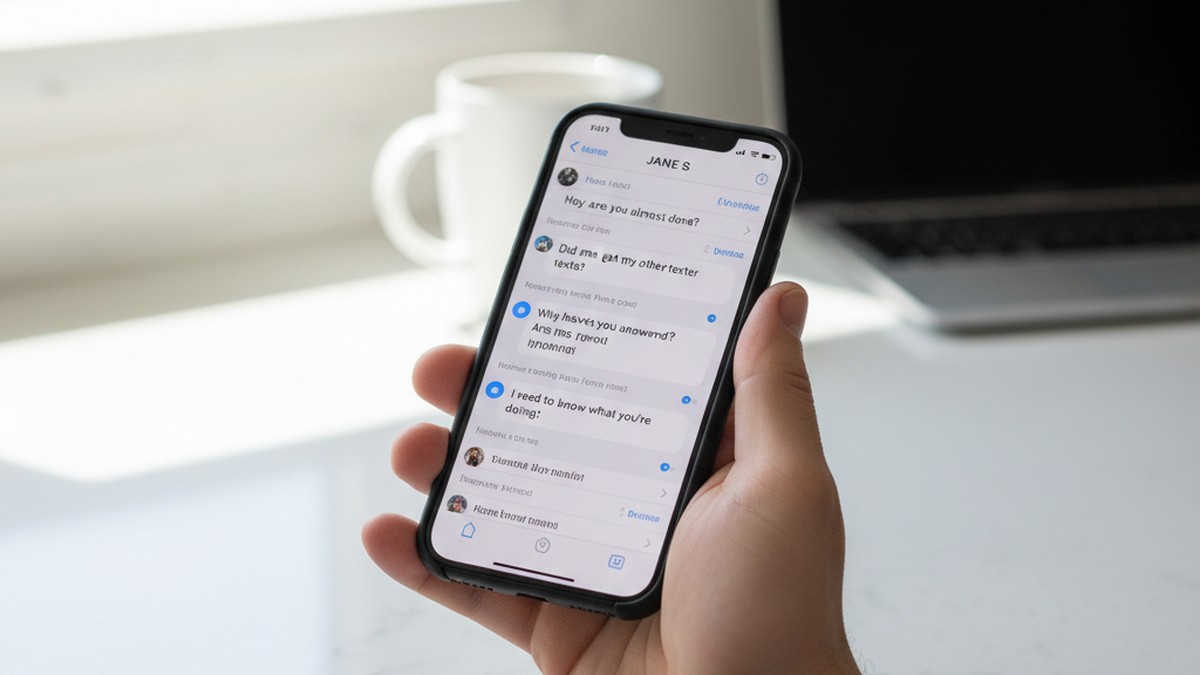
Innocent Explanations to Rule Out Before Drawing Conclusions
Before treating the patterns above as confirmed evidence, consider these alternative explanations systematically. This step is not about dismissing your concern — it's about grounding a direct conversation in a pattern of clustered evidence rather than a single observation.
Mental health and stress responses
Anxiety disorders, depression, work-related burnout, and ADHD all produce phone-guarding and communication withdrawal behaviors that closely resemble the patterns described in this article. A partner managing significant stress, a difficult family situation, or an untreated mental health episode may become more private about her phone, more withdrawn in texts to you, and more likely to use the phone late at night as a coping behavior — for entirely unrelated reasons.
The distinguishing factor: mental health-related withdrawal typically affects her warmth across all relationships, not just with you. If she's equally withdrawn from close friends and family members, the cause is more likely internal than relational.
Work-related confidentiality
Certain professions — law, HR, healthcare, financial services, executive leadership — require legitimate confidentiality around client or internal communications that can't always be explained without violating professional obligations. A wife in one of these roles may maintain strict phone privacy around specific contacts for reasons she genuinely cannot fully disclose.
If the privacy is consistent across all work-related communications rather than concentrated on one specific contact outside of work hours, professional confidentiality is a genuine explanation worth taking seriously before drawing conclusions.
Surprise planning
A temporary spike in secretive phone behavior — app-switching when you approach, deleted texts, avoidance of certain topics — is entirely consistent with planning a significant surprise for you or for a family member. This pattern has a clear temporal start, resolves after the event, and is typically inconsistently applied: she's guarding one conversation, not all of them.
A confidential third-party situation
A close friend dealing with domestic violence, pregnancy, addiction, or a mental health crisis may share sensitive information with your wife under strict confidence — information she can't relay to you without violating someone else's trust. The phone privacy in this case protects someone else, not her.
Applying the pattern-clustering test
A single behavioral pattern paired with one of these innocent explanations warrants continued observation, not confrontation. What warrants a direct conversation is the clustering of multiple patterns across several weeks, combined with the absence of a plausible innocent explanation for the combination.
Research on wrongful accusations in relationships is consistent: accusing a partner of cheating without sufficient basis causes lasting damage to relationship trust that is comparable in impact to the damage caused by actual infidelity. Rule out the alternatives systematically before acting.
A useful calibration: if three people who knew you both well reviewed the behavioral cluster you've documented, would they immediately suggest an obvious innocent explanation? If yes, extend your observation window. If no, the pattern is substantial enough to address directly.
Once you've ruled out the alternatives, the question becomes how to respond — and there's a right sequence that preserves your options regardless of what the conversation reveals.
How to Respond When You Notice These Patterns
The least effective responses to observed cheating text patterns are covert phone surveillance, demands for immediate passcode access, or confrontation based on a single sign. The most effective response is measured, documented, and preserves your options regardless of what the conversation reveals.
Step 1: Document specific observations before acting
Spend one to two weeks recording what you observe — specific events, dates, and contexts — without acting on them. Write them down in a private note. This produces two outcomes: you have concrete, specific detail for a potential conversation rather than vague impressions, and you can assess whether the pattern is consistent across time or incidental.
"Your phone was face-down and you switched apps when I walked into the kitchen on four separate evenings this week" is grounded and specific. "You've been acting weird about your phone" will be dismissed. The specificity is what makes the conversation productive.
Step 2: Have a direct, non-accusatory conversation first
Before investigating further, have a calm direct conversation about what you've noticed. Frame it around your observation and your experience: "I've noticed you seem to be messaging someone a lot more than usual, and your texts to me have felt different lately. I wanted to talk about it."
This approach matters because it preserves the relationship if the explanation turns out to be innocent, and it creates space for partial disclosure if your wife is at a stage where she might come forward. Many relationship therapists report that affairs are disclosed through a partner simply asking directly — not through investigation.
The conversation's success depends on several things: having it when you're calm rather than in the immediate aftermath of noticing something, not presenting an accusation as your opening, and being genuinely open to an innocent explanation. If you go in certain she's cheating and looking for confirmation, she'll sense that — and the conversation will shut down rather than open up.
What you're genuinely trying to accomplish is information. You want to understand what's happening, not win an argument. That distinction should drive every word choice. Leading with "I've been feeling disconnected from you" is more likely to get you a real response than "who are you texting at 1 AM." One invites your wife into a relationship conversation; the other puts her in a defense posture.
Step 3: Couples therapy as early intervention
If the patterns persist and a direct conversation doesn't resolve them, a couples therapist provides a structured space for addressing emotional drift before a physical affair occurs. The American Association for Marriage and Family Therapy (AAMFT, 2012) found that 74% of couples who sought professional therapy after a confirmed affair successfully recovered. Couples who engage therapy earlier — at the drift stage rather than the confirmed infidelity stage — typically have better outcomes.
Step 4: Prepare before confronting at Stage 3 or 4
If behavioral patterns have persisted across several weeks, have been confirmed by multiple specific observations, and fit the Stage 3 or 4 escalation profile, a confrontation is appropriate — but preparation matters. Knowing exactly what you've observed, having documentation, and understanding your legal position produces a more focused conversation than going in with only pattern-based suspicion.
The full range of methods for catching a cheater covers evidence-gathering approaches from digital searches to third-party records, and which approaches are legally and ethically appropriate.
The question of what you can legally and ethically do to gather information is the next critical consideration — particularly before taking any technical steps.

What Are the Legal and Ethical Limits of Investigating Text Patterns?
Accessing a spouse's text messages without their knowledge may violate the Electronic Communications Privacy Act and state-level laws, regardless of marital status. Reading texts on an unlocked screen differs legally from installing monitoring software. Consult a licensed attorney in your jurisdiction before taking any technical steps.
This article does not provide legal advice. It can, however, provide a framework for understanding where the general legal lines tend to sit — and why those lines matter beyond strict compliance.
What is generally considered permissible
Observing what is visible on a shared device to which you have legitimate access is legally distinct from covert interception. If your wife uses a shared family computer and iMessage syncs to it through a joint account you both established, reviewing those messages is generally in a different legal category from installing covert monitoring software.
Similarly, reading a text conversation visible on an unlocked phone left on a shared surface is generally distinct from accessing a locked device or intercepting messages in transit. Legal distinctions in this area typically revolve around consent, covertness, and interception.
What requires a licensed attorney's guidance
Installing any monitoring software on your spouse's phone — including apps marketed as parental controls, tracking apps, or background monitoring tools — requires specific legal advice before proceeding. In many states, this constitutes an illegal wiretap regardless of marital status. Do not rely on internet forums, tech articles, or secondhand accounts for legal guidance on this question. The consequences of getting this wrong are serious.
Why the ethical dimension matters
Relationship therapists consistently note that surveillance, even when it uncovers actual infidelity, complicates the recovery process significantly. The manner of discovery becomes part of the relationship narrative — one both parties will return to regardless of outcome.
Many family law attorneys and relationship therapists recommend pursuing information through channels that don't require covert action on your part. Dating profile scans, publicly visible social media activity, and direct conversation all preserve your personal integrity in a way that covert phone monitoring does not — regardless of what they reveal.
One of those clean, open channels is a dating platform scan — and it connects more directly to the text behavior you're observing than most people realize.
How Dating App Activity Connects to Texting Affairs
Text-based affairs and dating app activity connect more often than most people expect. Most affairs that involve active texting with an outside partner either began on a dating platform or involve continued dating app use alongside the primary text-based relationship. Understanding this connection gives you access to concrete, verifiable information without requiring access to her phone.
Research from Statista (2024) found that 38% of affairs now begin through digital platforms, with dating apps as the dominant channel. The progression from app to text is the standard pipeline: initial contact happens on the dating platform, the conversation moves to standard SMS, WhatsApp, or Signal once trust is established, and the dating profile frequently remains active — either to maintain the existing connection or to pursue additional ones.
The practical implication
If your wife is actively texting someone she met through a dating app, that profile may still exist and may be currently active. A dating profile is a piece of external, concrete information that doesn't require accessing her device, installing monitoring software, or any covert technical action.
What a platform scan can and cannot tell you
CheatScanX searches Tinder, Bumble, Hinge, OkCupid, Plenty of Fish, and 12+ additional platforms for an active profile matching your wife's name, age range, and location. If a current profile exists and matches, you have concrete information — not behavioral evidence requiring interpretation, but a factual finding.
What a platform scan cannot reveal is the content of existing private text conversations. But an active dating profile maintained during a committed marriage is itself significant evidence — and one that doesn't require any covert action.
Cross-referencing with behavioral patterns
The behavioral patterns described throughout this article become substantially more meaningful when combined with a platform scan result. Behavioral evidence is observable but interpretable — individual signs have innocent explanations. An active dating profile doesn't.
If the text behavior you're observing fits the Stage 2 or Stage 3 escalation profile, and a dating platform scan returns an active profile, you have a clear, concrete basis for the direct conversation this article has recommended throughout. The scan result provides the fact; the behavioral pattern provides the context.
With both the behavioral evidence framework and the concrete evidence options covered, the final section distills what matters most.
What the Pattern Tells You
Three things stand out across everything covered here.
Behavior, not content, is the reliable early signal. By the time text content becomes clearly suspicious, behavioral concealment has typically been in place for weeks. The timing shift, screen guard, selective deletion, and response time asymmetry are all visible without phone access — and they appear at Stage 2, before deliberate content management begins.
The warm-cold communication split is the most consistently missed signal. The change in how she texts you is directly observable, requires no access to her device, and reflects a genuine shift in the direction of emotional investment. If her texts to you have been functionally flat while her phone activity has increased, the communication energy hasn't gone away — it's moved.
Pattern clustering, not single signs, is the threshold for action. Any one behavioral signal can have an innocent explanation. Three or more sustained across several weeks, without a plausible alternative cause, warrants a direct conversation. That conversation is better held from a clear evidence base than from acute suspicion.
Research from the AAMFT (2012) found that 74% of couples who sought professional therapy after a confirmed affair successfully recovered — a figure most people find unexpectedly high. Recovery depends more on both partners' willingness to engage the process than on the severity of what happened. Whatever decision follows the direct conversation is made better from clarity than from prolonged uncertainty.
If you want a concrete first step that doesn't require accessing her phone, CheatScanX checks 15+ dating platforms in minutes for an active profile matching your wife's details.
Frequently Asked Questions
Text message behavioral patterns are strong circumstantial evidence, not proof. Screen guarding, selective deletion, and response time asymmetry indicate concealment — but concealment can have innocent explanations. Behavioral patterns should inform a direct conversation rather than serve as standalone proof of infidelity.
Deleted messages are not necessarily gone permanently, though recovery requires professional tools and may not be legal without consent. More practically, handing over a phone with conveniently deleted conversations is itself meaningful. A partner with nothing to hide typically has no reason for selective deletion before granting access.
An emotional affair conducted primarily through text can cause as much damage as a physical affair. Research by Dr. Shirley Glass, published in Not Just Friends (2003), found that many partners consider emotional affairs more threatening than physical ones because they involve sustained intimacy and consistent investment of emotional energy over time.
Frame the conversation around what you've observed and how you feel, not what you've concluded. Saying you've noticed her phone habits have changed and that you've been feeling disconnected opens the conversation without an accusation and is more likely to produce an honest response than a direct challenge.
Noticing changes in a partner's behavior and wanting to understand them is reasonable, not controlling. If your concern is met with counter-accusation rather than reassurance and context, that response is itself meaningful data. Partners with nothing to hide typically provide comfort and explanation, not deflection into counter-accusations.