
# How Private Investigators Catch Cheaters in 2026
Here's how private investigators catch cheaters: through five core methods — physical surveillance, digital OSINT analysis, GPS location tracking, financial pattern review, and undercover honey-trap operations. Most infidelity cases are resolved using the first two alone, without ever reaching the more expensive techniques.
You're here because something doesn't add up. The late nights, the phone that stays face-down, the explanations that almost fit but leave a gap. Suspicion without evidence puts you in an impossible position — too uncertain to act, too unsettled to ignore. According to the Institute for Family Studies (2024), 20% of married men and 13% of married women admit to extramarital sex, and those figures climb when emotional infidelity is included.
This article walks through every method professional PIs use, what each costs in real numbers, what's legal versus what isn't, and — perhaps most importantly — when hiring a PI is the right call versus when a less expensive digital search should come first. Understanding the difference could save you several thousand dollars and weeks of waiting.
How Do Private Investigators Catch Cheaters?
Private investigators catch cheaters through a structured escalation of methods, starting with the least invasive and moving to more intensive techniques only when early evidence justifies the cost. These five methods — physical surveillance, digital OSINT, GPS tracking, financial analysis, and honey-trap operations — form what professionals call the investigation pyramid. Most infidelity cases are resolved at level one or two, well before the most resource-intensive methods become necessary.
The specific method a PI leads with depends on what you already know. If you have a name, a likely location, or a pattern of times when your partner is unaccounted for, physical surveillance is the fastest path to documented evidence. If you have only a suspicion and nothing concrete to go on, digital investigation and financial analysis often reveal whether further surveillance is even warranted — and can save you the cost of hiring a PI at all.
The PI Investigation Pyramid
This five-level framework reflects how professional investigators structure infidelity cases in practice, moving from fastest and cheapest to most intensive:
| Level | Method | Typical Cost | What It Reveals |
|---|---|---|---|
| 1 | Digital OSINT (social media, dating profiles, public records) | $300–$800 | Active dating profiles, new contacts, location patterns in public posts |
| 2 | Financial Pattern Analysis (bank/credit statements, receipts) | $500–$1,500 | Hotel stays, gifts, unexplained cash withdrawals, unfamiliar charges |
| 3 | Physical Surveillance (stationary and mobile) | $500–$1,500/day | Direct observation of meetings, locations visited, behavioral patterns |
| 4 | GPS Tracking (vehicle location data) | $200–$500/month | Exact routes and destinations, duration at unknown addresses |
| 5 | Honey Trap (undercover decoy operations) | $1,500–$5,000 | Whether subject initiates contact with an attractive stranger |
Starting at Level 5 because you want answers quickly is like calling a demolition crew before checking which wall hides the wiring. Professional investigators nearly always begin at Level 1 and escalate only when earlier findings justify the additional cost and intensity. A licensed PI who pushes immediately for a honey trap without any prior digital or surveillance work is billing you aggressively, not serving your case.
In practice, what we commonly see: Most infidelity cases that reach a PI already have Level 1 or Level 2 red flags the client discovered independently — an unfamiliar name that keeps appearing, a suspicious credit card charge, a timestamped location that doesn't align with the stated alibi. The PI's job is to document and corroborate, not to start from zero.
Want to skip straight to answers? CheatScanX scans Tinder, Bumble, Hinge, and 12+ other apps in minutes. Completely anonymous.
Start a confidential search →Physical Surveillance: What PIs Actually Watch
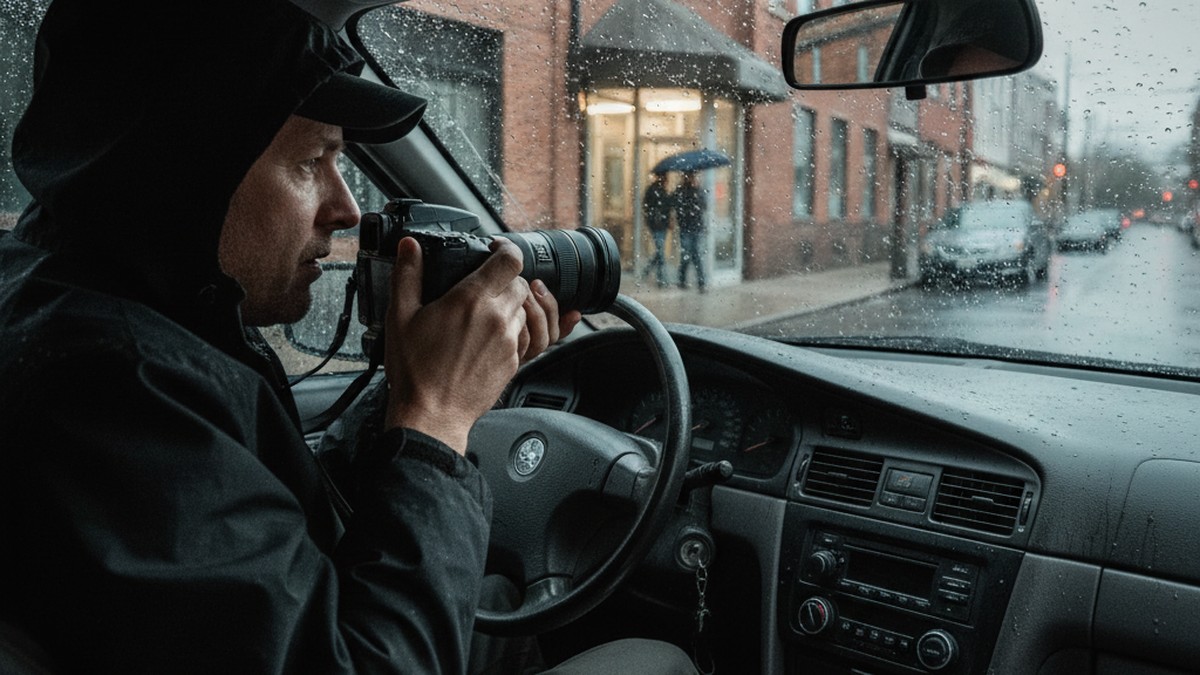
Physical surveillance is the method most people picture when they imagine a private investigator at work. It's also the most resource-intensive component of any infidelity investigation, requiring trained personnel, specialized equipment, and patience measured in hours rather than minutes. Understanding how it actually works helps you evaluate what a PI can realistically deliver and what you'll be paying for.
A PI conducting physical surveillance may work alone or in a two-to-three-person team, depending on how predictable the subject's routine is and how cautious they appear to be. Solo surveillance works when the subject follows a consistent daily pattern and isn't actively watching for a tail. Team surveillance is used when the subject is security-conscious, frequently changes routes, or has previously detected that they were being followed.
Stationary vs. Mobile Surveillance
Stationary surveillance positions the investigator at a known or likely destination — a suspected partner's home address, a workplace parking lot, a specific restaurant or hotel. The PI watches, photographs, and logs arrivals, departures, and who the subject meets with. This approach requires advance intelligence about where the subject is likely to appear.
Mobile surveillance follows the subject from their departure point — typically home or work — to wherever they go next. In urban environments, this requires multi-vehicle coordination. A single unmarked car following someone through several turns and stops becomes obvious within a few minutes to anyone who's paying attention. Experienced PI teams use rotating vehicles: one drops back while another takes the lead position, cycling through so no single vehicle stays close for long.
Equipment Used in the Field
Professional PIs carry long-range camera lenses — typically 300mm to 600mm telephoto — that produce clear photographs from distances at which the photographer is invisible to the subject. Video cameras with night-vision or low-light capability are standard for evening surveillance. Audio-recording equipment is carried but strictly limited to situations where consent laws permit its use.
Everything captured during surveillance is timestamped automatically by the recording equipment and paired with GPS coordinates showing where the photograph or video was taken. This metadata is what makes surveillance evidence usable in legal proceedings. A photograph alone is an assertion. A timestamped photograph with confirmed GPS coordinates at a specific location, matching a time when your partner claimed to be elsewhere, is documentation.
What PIs Watch for Beyond the Obvious
Beyond photographing meetings between a subject and a third party, experienced investigators watch for specific behavioral patterns that cautious cheaters adopt to avoid detection:
- Route deviations: Driving past their destination before circling back, taking sudden unnecessary detours, or reversing direction — behaviors used to identify whether someone is following
- Meeting location choices: Parking structures, underground lots, or locations without street-level sightlines that make surveillance difficult
- Vehicle preparation: Connecticut PI Ray Ranno noted that men who are about to cheat frequently have their cars cleaned beforehand — a behavioral tell that experienced investigators recognize
- Extended time at unknown residential addresses: Especially when those addresses appear repeatedly across multiple surveillance sessions
- Dual device behavior: A second phone that appears briefly in a parking lot before disappearing back into a pocket
Most professional PIs conduct a minimum of three surveillance sessions before drawing conclusions. A single session produces an incomplete picture. A pattern documented across multiple sessions — the same location on the same days of the week, the same vehicle in the same parking space — is what produces evidence that holds up to scrutiny and cannot be explained as coincidence.
What Surveillance Won't Show
Physical surveillance documents what happens in spaces where the subject has no expectation of privacy. It cannot produce evidence of digital communication, financial transactions, or conversations that happen inside private spaces. Surveillance and digital investigation are complementary, not interchangeable — the strongest infidelity cases combine both.
Digital Investigation and OSINT Methods
Digital investigation has transformed infidelity cases more than any other development in the past decade. Where physical surveillance requires knowing where someone will be, digital OSINT can reveal who they're communicating with, what profiles they maintain, and where their photographs were taken — all without the subject knowing an investigation is underway.
OSINT stands for Open Source Intelligence: the collection and analysis of information from publicly available sources. No unauthorized access, no privacy law violations. Every piece of information a PI accesses through OSINT is data the subject has made publicly available or that public records already contain.
Social Media Analysis
A trained digital investigator reviews public social media profiles methodically — not a casual scroll through someone's feed, but a structured analysis looking for behavioral changes that emerged during the period when suspicion arose.
The specific things they look for:
- New follower patterns: Accounts followed recently that didn't exist six months ago, particularly accounts with limited posting history and photos of a specific person
- Engagement shifts: Whether the subject has begun regularly liking or commenting on a specific person's content in a way that didn't occur previously
- Geotags and check-ins: Location tags on photographs that place the subject somewhere different from their stated location
- Post timing anomalies: Activity appearing at times inconsistent with the subject's reported schedule (11pm engagement with an account while supposedly sleeping, activity from a city they didn't mention visiting)
Dating App Profile Searches
One of the most direct digital checks available — to investigators and to you — is whether someone maintains an active profile on major dating platforms. Tinder, Bumble, Hinge, OkCupid, and a dozen other platforms are searchable by name and approximate location.
According to a 2024 PR Newswire infidelity study, 38% of affairs now begin on dating platforms or social media — the single largest origin point for new affairs, ahead of workplace connections at 31%. An active dating profile is one of the most reliable indicators of active infidelity currently recognized in the investigation field.
A dating profile search by name can surface active profiles in minutes, at a fraction of the cost of hiring a PI for surveillance. Professional investigators do use specialized search tools for this — but this is also one area where you can get the same information before spending thousands on a PI. If a profile exists, that finding alone substantially changes your next steps.
Photo Metadata (EXIF Data) Analysis
Every photograph taken with a modern smartphone embeds metadata into the image file: device model, timestamp, and — if location services are enabled — GPS coordinates of where the photo was taken. This metadata is invisible when viewing the image normally but is accessible using free tools like ExifTool.
A PI examining photos shared to social media or sent in direct messages can extract this embedded location data. A photograph claimed to have been taken at a work event, but whose EXIF data places it at a residential address three miles away at 10pm, is a discrepancy that's difficult to explain away.
One limitation: major social platforms including Instagram, Facebook, and X strip EXIF data when images are uploaded. Photos shared directly via iMessage, WhatsApp, email, or Snapchat often retain their full metadata. The investigative value depends on how the photos were transmitted.
Want to skip straight to answers? CheatScanX scans Tinder, Bumble, Hinge, and 12+ other apps in minutes — before you commit to a full investigation.
Open-Source Public Record Searches
Public records — property ownership, court filings, business registrations, voter rolls, vehicle registrations — are accessible without special permissions and are a standard starting point in any PI's early investigation phase. These records can surface addresses the subject hasn't disclosed, businesses they're associated with under a different name, or legal matters that suggest a pattern of hidden behavior.
This layer of investigation is particularly useful when you suspect your partner has a secondary life — a second home, an address they receive deliveries at, or a business connection to an unfamiliar name.
GPS Tracking: What's Legal, What's Not
GPS tracking devices attached to vehicles provide precise location data — routes taken, time spent at specific addresses, deviation from stated routines. For an infidelity investigation, this data can be compelling evidence. But the legal rules governing GPS tracking are strict, and getting them wrong can invalidate evidence and create legal exposure for both you and the investigator.
The Core Legal Rule
You can only legally attach a GPS tracker to a vehicle you own or co-own. If you're married and the vehicle is titled in both names, you generally have legal authority to track it. If the vehicle is titled solely in your partner's name, neither you nor your PI can legally place a GPS device on it without risking criminal liability under federal and state anti-stalking statutes.
The specifics vary meaningfully by state. Some states require consent from the vehicle owner regardless of co-ownership. Others permit tracking by a co-owner without explicit consent. A handful of states prohibit GPS tracking without a court order, full stop. A PI who doesn't verify your state's specific rules before placing a device is a PI who is either uninformed or indifferent to your legal exposure.
What GPS Data Actually Reveals
When GPS tracking is legally authorized, the data it produces can be specific and useful:
- Exact routes driven from known locations to previously unknown destinations
- Duration at specific addresses (a GPS log showing four visits to the same residential address between 6pm and 9pm over a two-week period is significant documentation)
- Distance from claimed location at a specific time ("working late at the office" paired with GPS records placing the vehicle 22 miles away in a different part of the city)
- Patterns that correlate with the unexplained absences you've already documented on your own
GPS data is most useful when combined with physical surveillance. Location records tell you where someone went and how long they stayed. Surveillance provides visual confirmation of who they met. The combination — timestamped location data plus photographic evidence of the encounter — is what makes infidelity cases legally coherent.
State-by-State Variability
Given how much GPS tracking law varies by jurisdiction, always ask your PI explicitly: "What is the legal basis for GPS tracking in our state, and do I co-own the vehicle to be tracked?" A legitimate PI can answer this clearly. One who is vague about the legal basis for tracking is either working outside their license area or not current on applicable law.
When GPS Tracking Isn't an Option
If the vehicle isn't co-owned or if state law prohibits tracking without a court order, experienced investigators pivot to alternative location-based methods that don't require a device on the car.
Stationary surveillance at known departure and arrival points — home, office, suspected destination — produces location data through observation rather than electronic tracking. It requires more investigator hours and greater precision about where the subject is likely to appear, but it produces the same fundamental result: documented evidence of where someone went and when.
Cell phone location data, separate from GPS devices, can also be subpoenaed through legal proceedings if you've already initiated divorce or other civil action. In cases where legal proceedings are underway, your attorney can request carrier records that establish location patterns over a defined period. This is not available to a PI acting independently — it requires an active legal case — but it's worth knowing that the option exists if you're already in that process.
The important point: GPS unavailability doesn't eliminate location evidence as a category. It shifts the method. A skilled investigator plans around the legal constraints rather than treating them as a full stop.
Financial Analysis Techniques That Expose Infidelity
Financial records are among the most reliable sources of evidence in infidelity investigations, for a straightforward reason: sustained affairs cost money. Hotel rooms, restaurant dinners, gifts, travel, and subscriptions to dating platforms all generate financial traces. A partner who is conducting an affair typically cannot hide all of those traces from a co-account holder who knows what to look for.
Bank Statement Red Flags
Investigators review bank and credit card statements looking for specific anomaly patterns, not just general spending increases. The patterns that most reliably indicate an affair:
- ATM withdrawals at unfamiliar locations: Cash doesn't generate itemized receipts, which is why serial affairs often involve higher-volume cash withdrawals from ATMs in neighborhoods the subject doesn't normally frequent
- Hotel charges from brands inconsistent with work travel: A partner who normally uses a specific hotel chain for business appearing on a different, unfamiliar brand in a city they didn't mention
- Restaurant charges for two during supposedly solo trips: A dinner-for-two charge at a restaurant in a city where the subject claimed to be dining alone or eating room service
- Gift purchases outside normal occasions: Jewelry, flowers, or luxury retail purchases during periods that don't correspond to birthdays, anniversaries, or holidays
Building a Financial Timeline
Experienced investigators don't evaluate individual charges in isolation. They build a timeline that maps financial transactions against the subject's stated activities and location claims. A credit card charge at a restaurant five miles from the claimed work dinner location, timestamped during the window of that dinner, is a discrepancy. That single discrepancy, cross-referenced against three other similar anomalies over the same month, is a pattern.
You have legal access to financial statements in shared accounts without involving a PI. Reviewing those statements systematically before hiring an investigator is worth the time. The apps cheaters use most often generate specific types of charges — dating platform subscriptions, in-app purchases, gift card purchases — that appear on shared statements and are worth identifying before an investigation begins.
How to Build Your Own Financial Review
Before engaging a PI, a self-directed financial review takes two to three hours and covers three months of statements. The process:
- Pull statements for all joint accounts and any accounts you have access to — checking, savings, shared credit cards
- Create a simple spreadsheet with columns for date, merchant, city, amount, and a "matches stated activity" flag
- Mark every charge where you can verify the location matches where your partner said they were
- Flag anything in an unfamiliar city, at an unfamiliar merchant, or that doesn't fit the stated routine
- Cross-reference flagged charges against your calendar or any documented communication about that date
At the end of this exercise, you'll have either a clear pattern of unexplained activity or a record that confirms what you already knew. Either outcome is useful. If anomalies do appear, bring the spreadsheet to any PI consultation — it gives the investigator an immediate operational focus and reduces the billable time spent building context from scratch.
A common misconception is that cash withdrawals make financial traces disappear entirely. In practice, cash withdrawal patterns are themselves informative: consistent withdrawals on specific days of the week, from ATMs in locations outside the subject's normal geography, or in amounts that suggest specific types of purchases (hotel rooms typically run $100–$300/night; dinner for two is $60–$150) are financial fingerprints even without itemized receipts.

What Is a Honey Trap and When Do PIs Use It?
A honey trap is an undercover operation in which a private investigator — or someone hired by the PI — approaches the subject of an investigation as an attractive stranger and attempts to initiate a flirtatious or romantic interaction. The encounter is secretly recorded. The subject's response either confirms or fails to confirm whether they're willing to engage in behavior that would constitute infidelity.
Honey traps are the most widely misunderstood PI technique. They're far less common in practice than popular culture suggests, and their success rate at confirming infidelity is considerably lower than physical surveillance or digital investigation.
How a Honey Trap Works in Practice
The PI identifies a location the subject is likely to frequent — a bar, a gym, a coffee shop, or a regular social venue. A trained operative, typically of the gender the subject is attracted to, initiates a casual conversation and escalates based on the subject's response. The interaction can range from light flirtation to a direct invitation, depending on parameters agreed upon between the client and PI in advance.
The entire interaction is recorded — typically with a body camera worn by the operative or with a nearby fixed camera. Results are delivered to the client with video documentation, timestamped and location-matched.
The Honest Success Rate Data
Here is what the data actually shows: Harry Kazakian, a PI with a 27-year career and over 4,000 infidelity cases at USA Express Legal & Investigative Services, reported in Newsweek that his firm deploys honey traps approximately 10 times per year. Of those 10 operations, only one or two subjects actually proposition or accept an invitation from the operative. That's an 80–90% rate of subjects who, when presented with a direct opportunity, decline.
This doesn't mean 80–90% of honey-trap subjects are faithful. Some who are actively cheating still won't take bait they don't trust. The point is that honey traps produce actionable evidence far less reliably than surveillance or digital investigation — and they cost significantly more. A honey trap that finds nothing has still cost you $1,500 to $5,000.
Most professional PIs treat honey traps as a last resort: appropriate when other methods have been inconclusive and the client needs evidence of a specific behavioral type — usually for a particular legal proceeding. They're not a logical starting point, and any PI who recommends a honey trap before exhausting Level 1 and Level 2 methods is making a billing decision, not an investigative one.
How Much Does a Private Investigator Cost to Catch a Cheater?
Infidelity investigations cost more than most people anticipate. The total for a standard cheating spouse investigation runs $2,000 to $6,000, with complex multi-location or extended cases reaching $10,000 or beyond. Understanding the cost structure helps you authorize what's needed without paying for what isn't.
Cost by Service Type
| Service | Cost Range | What's Included |
|---|---|---|
| Hourly rate | $85–$225/hr | Investigator time during active surveillance or investigation |
| Single surveillance day | $500–$1,500 | One investigator, travel, reporting |
| Multi-day surveillance package | $2,000–$5,000 | Typically 3–5 full days |
| Digital OSINT / social media analysis | $300–$800 | Profile searches, public record review, social media analysis |
| Full digital forensics | $1,500–$5,000 | Device extraction where authorized, deep account analysis |
| Honey trap operation | $1,500–$5,000 | Operative, equipment, recording, reporting |
| Full infidelity investigation | $2,000–$6,000 | Surveillance plus digital investigation combined |
Hourly rates increased 5–15% industry-wide between 2024 and 2026, reflecting higher operational costs and rising demand for investigators with specialized digital forensics training (NowPI Cost Guide, 2026).
How the Billing Model Works
Most PIs operate on a retainer-plus-hourly model. You pay a retainer upfront — typically $1,000 to $2,500 — which is drawn against as hours are billed. When the retainer is exhausted, the PI contacts you for authorization to continue. Travel time may or may not be billed separately from the hourly rate; this varies by firm and should be confirmed before signing.
Always clarify in writing before committing:
- Does the retainer cover surveillance only, or does it include digital research and reporting?
- Is travel time billed at the full hourly rate or a reduced rate?
- What's the process for authorizing additional hours beyond the initial retainer?
- Are written reports, court testimony preparation, or evidence storage charged separately?
The Cost of Investigating an Innocent Partner
If your suspicion turns out to be unfounded, you've still paid for the investigation. Approximately 30% of infidelity investigations find no evidence of cheating — meaning one in three clients receives a report confirming their partner's innocence. That is not a failure of PI work; it is the honest result of investigation. But it is a compelling argument for starting at Level 1 of the investigation pyramid — a dating profile check, a social media review, a financial statement audit — before committing to the cost of professional surveillance.
Can PI Evidence Be Used in Divorce Court?
PI evidence — surveillance video, photographs, GPS records, documented meeting patterns, financial analysis — is generally admissible in civil divorce proceedings. The more precise question is: does admissibility translate into impact on the outcome?
What Courts Actually Do With Infidelity Evidence
Divorce law in the United States has shifted substantially toward no-fault frameworks over the past 30 years. In the majority of states, courts do not use infidelity evidence to influence child custody decisions or the division of marital assets, even when that evidence is properly admitted. The evidence appears in the record, but its practical weight in the judgment is limited.
Where infidelity evidence genuinely changes outcomes:
- Fault-based divorce states: Several states still recognize fault grounds for divorce, where documented infidelity can affect alimony awards or asset distribution
- Pre-trial settlement negotiations: The majority of divorce cases settle before reaching trial. Documented infidelity evidence shifts the negotiating position significantly — even in states where a judge would give it limited weight, the other party's attorney knows the evidence exists
- Cases where the affair partner is directly relevant: If the affair partner had contact with children, or if the circumstances of the affair create a demonstrable relevance to custody, the evidence carries more direct weight
What Makes PI Evidence Legally Usable
For surveillance evidence to be admissible, it must have been gathered in spaces where the subject had no reasonable expectation of privacy. Surveillance conducted in public — parking lots, sidewalks, restaurant interiors visible from the street, public parks — meets this standard consistently.
A PI photographing two people through the window of a public coffee shop is collecting admissible evidence. A PI trespassing on private property, using a microphone to capture conversations inside a private residence, or accessing a phone or email account without consent is collecting evidence that will almost certainly be inadmissible and may expose both the investigator and the client to criminal liability.
Text messages, emails, and private digital communications remain off-limits unless one party to the communication consents to having them recorded. Clients who access their partner's accounts without authorization — even accounts they've previously had password access to — risk having that evidence thrown out and facing civil or criminal consequences for the access itself.
What Can a Private Investigator Legally Do?
Understanding where the legal lines are helps you evaluate what an investigator can realistically deliver and protects you from hiring someone who will create legal exposure by crossing boundaries that should never be crossed.
A licensed PI can legally:
- Conduct surveillance in any public space — streets, sidewalks, parking lots, parks, restaurant dining areas visible from public access points, building lobbies with public access
- Photograph and video-record individuals in public spaces without their consent
- Use GPS tracking devices on vehicles the client owns or co-owns (with state law applying — always verify)
- Analyze publicly available social media, dating profiles, open-source records, and court documents
- Review financial records that the client has legal access to — joint accounts, shared credit cards, business records where the client is a party
- Interview witnesses who are willing to speak
- Conduct honey-trap operations within the applicable consent framework of the relevant jurisdiction
A licensed PI cannot legally:
- Wiretap phone calls or record conversations without the consent of at least one party to the conversation (some states require all-party consent — verify your state's recording laws)
- Access private social media accounts, email accounts, or any online account without the account holder's authorization
- Place GPS trackers on vehicles owned solely by the subject
- Trespass onto private property to conduct surveillance
- Impersonate law enforcement officers or government officials
- Access phone carrier records without a court order
- Intercept text messages or digital communications without authorization
The dividing line is consistently whether the subject had a reasonable expectation of privacy in the space or communication being monitored. Someone walking into a hotel lobby has no expectation of privacy. Someone speaking inside their home does.
When Should You Actually Hire a Private Investigator?
Hiring a PI is the right choice in some situations and the wrong choice in others. The most common mistake is treating a professional investigator as the default first step when suspicion arises — a decision that regularly costs $2,000 to $5,000 to confirm what a digital search could have surfaced in less than an hour.
The Decision Matrix
| Your situation | Recommended first step | Escalate to a PI when... |
|---|---|---|
| Suspicion only, no specific evidence | Digital profile search + financial review | Digital search finds activity but you need documented proof |
| Specific name or location already identified | Social media OSINT + dating profile search | OSINT confirms activity but you need court-ready evidence |
| Need evidence for divorce proceedings | Consult a divorce attorney first | Attorney confirms PI evidence is relevant to your case |
| Partner caught on dating app but denying | Screenshot documentation | You need corroborating behavioral evidence for confrontation |
| Unexplained absences with no digital trace | Financial statement review | Pattern is confirmed and behavioral documentation is needed |
The Case Against Hiring Too Early
Most articles about private investigators suggest calling one at the first hint of suspicion. That guidance benefits PI firms. It doesn't necessarily benefit you.
Here's the pattern that actually plays out: roughly 30% of PI clients receive a report showing no evidence of cheating. That's not a criticism of the investigators — it's what honest investigation produces when the underlying suspicion wasn't founded. It does mean that one in three people who spend $2,000 to $6,000 pay for certainty that their partner was innocent.
The dating app cheating statistics show that 38% of affairs begin on digital platforms. An active dating profile is one of the strongest single indicators of active infidelity. If that's the core of your concern, checking those platforms first is rational before committing to professional surveillance. If a profile exists, you have evidence. If it doesn't, you've eliminated the most common digital avenue at minimal cost and can reassess from there.
The PI becomes the right call when:
- Digital and financial methods have been exhausted and the behavior pattern continues to suggest infidelity
- You need documented, timestamped, legally admissible proof for court proceedings
- You have specific names, locations, or vehicles involved and need behavioral documentation
- You've identified the situation but need corroborating evidence for a confrontation or legal process

How to Choose the Right PI for an Infidelity Investigation
Not all private investigators operate at the same standard, and some are actively poor choices. Knowing how to evaluate a PI before hiring protects your money, your case, and your legal standing.
Licensing Requirements by State
Every state except a handful requires PIs to hold a state-issued license, typically obtained by passing a background check, completing supervised work under a licensed investigator, and passing a state examination. Kentucky, Mississippi, Idaho, Alaska, Alabama, and Wyoming do not require PI licensing, which means no enforced quality standard in those states. Most state licensing boards maintain searchable public databases — verifying a license number takes two minutes.
In any state, ask:
- What is your PI license number, and in which states are you licensed?
- Do you carry professional liability insurance?
- How many infidelity cases have you handled in the last two years, and in what jurisdictions?
Questions That Reveal Whether a PI Is Worth Hiring
- How often will I receive progress updates, and in what format?
- What exactly is covered by the retainer, and what triggers additional billing?
- How is evidence stored and secured, and who has access to it?
- What happens to the evidence and documentation if I decide not to pursue legal action?
- Will you testify in court if required, and what is your fee for testimony preparation?
A reputable PI answers every one of these questions directly. Evasiveness about billing, evidence handling, or court availability is a meaningful warning sign.
What to Expect From the Initial Consultation
Most licensed PI firms offer an initial consultation — by phone or in-person — at no charge or for a nominal fee. Use this consultation to evaluate how the investigator communicates, not just what they say.
Bring your documented observations: the timeline you've built, dates and times of unexplained absences, any digital findings from your own preliminary search. A professional investigator will ask clarifying questions, outline what methods are appropriate for your situation, and provide a realistic range for cost and timeline. They should be able to tell you what they can and cannot do under your state's laws without needing to look it up.
Pay attention to how they handle uncertainty. A PI who says "I'll need two or three days of surveillance before I can tell you what we're dealing with" is being honest. One who says "we should have evidence within a week" before knowing anything about the subject's routine is telling you what you want to hear.
The consultation also helps you gauge whether this is someone you can work with over what may be a stressful multi-week process. Clear communication, professional demeanor, and direct answers to your questions are the baseline.
Red Flags That Should End the Conversation
Walk away from any investigator who:
- Guarantees specific results — "I will get you proof of cheating." No honest investigator makes this promise. Evidence follows what actually happened.
- Cannot produce a verifiable license or provides a license number that doesn't appear in the state database
- Suggests accessing your partner's phone, email, or accounts without consent — this is illegal, and a PI who recommends it is either ignorant of the law or willing to expose you to criminal liability
- Won't provide a written contract specifying billing rates, scope of services, and authorization procedures for additional work
- Pushes immediately toward the most expensive options — extended surveillance, honey trap, full digital forensics — without starting at lower-cost methods
What to Do Before Calling a Private Investigator
There's a structured approach to gathering preliminary information independently that takes hours, not days. This legwork either confirms enough to act on directly or saves you the substantial cost of a professional investigation — and if you do eventually hire a PI, it eliminates billable hours spent establishing context the investigator would otherwise need to develop from scratch.
Step 1: Run a Dating App Profile Search
The fastest and most direct check available is whether your partner has an active profile on major dating platforms. Tinder, Bumble, Hinge, OkCupid, and other apps are searchable by name and approximate location. Scanning multiple platforms manually requires creating accounts on each; dedicated search tools that cross-reference all major apps simultaneously are more efficient and cover platforms you might otherwise miss.
Based on platform scan data from infidelity investigation tools, active cheaters typically maintain profiles using first-name variations — shortened names, nicknames, or middle names — combined with an age that's one to three years younger than their actual age. This pattern appears consistently in discovered profiles and is worth accounting for when searching.
If a profile exists, document it with screenshots including the URL and any visible timestamps before taking any other action. Profiles can be deleted quickly once a partner suspects they've been found.
Step 2: Review Financial Statements Systematically
Access any joint accounts, shared credit cards, or accounts you're authorized to view. You're not looking for unusual total spending — you're looking for specific pattern anomalies. Build a simple spreadsheet listing charges by date, location, and amount for any transaction that doesn't immediately fit your partner's stated routine.
Organize anything that seems inconsistent into a timeline. Three unexplained charges from the same city on the same night your partner claimed to be at a work event in a different location is a pattern, not a coincidence. That timeline becomes immediately useful to any PI you subsequently hire.
Step 3: Analyze Social Media Systematically
Review your partner's social media activity with analytical rather than emotional attention. Make a note of names that appear consistently in likes, comments, or recent follows that you don't recognize. Look at post times relative to what you know about their schedule. Check whether there are recent check-ins or geotagged photos at locations that weren't mentioned.
If you observe signs a husband is cheating on his phone — a phone that's suddenly always face-down, recently changed passcodes, deleted message threads that previously existed — document what you observe with dates and times. Don't raise the subject yet; documentation first.
Step 4: Write Down What You Already Know
Every incident that has contributed to your suspicion deserves a timestamped entry in a simple document: what you observed, when, and any context. This serves two purposes. It gives a PI immediate operational context and saves billing hours. It also gives you an objective record to review — sometimes writing down observations makes the pattern clearer, and sometimes it reveals that anxiety has been manufacturing connections that aren't actually there.
If you hire a PI, bring this document to the initial consultation. A professional investigator will use it as a starting point and can orient their investigation accordingly, rather than spending retainer hours on setup work you've already completed.
What Private Investigators Know That Most People Don't
After thousands of infidelity cases, experienced PIs develop pattern recognition that changes how they interpret what they're seeing. Understanding how investigators actually read behavior gives you a more accurate framework for evaluating your own suspicions — and avoids some of the most common mistakes people make when they're in the middle of a stressful situation.
The most consistent insight from experienced investigators is this: guilty partners do not typically behave the way films portray them. They don't become obviously reckless. They become more careful, more attentive to their cover story, and frequently more considerate of their partner at home — using attentiveness as a preemptive shield against suspicion. The behavioral changes that tip off a skilled investigator are often the opposite of what people expect.
Harry Kazakian noted in a Newsweek interview that a significant portion of his male clients — men who hired him convinced their wives were cheating — turned out to be wrong. Meanwhile, many confirmed cases involved partners that clients' friends and family would never have suspected. Emotional certainty doesn't reliably predict what investigation will find. Don Aviv of Interfor International, a firm founded in 1979 with decades of infidelity case experience, estimated in the same Newsweek report that approximately 95% of his infidelity clients are women — a pattern consistent across multiple major PI firms — which reflects who, statistically, tends to suspect a partner and act on that suspicion by hiring a professional.
The behavioral patterns that most consistently prompt PIs to escalate from Level 1 to active surveillance:
- A partner who has always been casually private about their phone becoming intensely protective of it — specifically blocking sight lines when unlocking it or taking it everywhere including the bathroom
- A significant, unexplained change in sexual behavior — withdrawal or a sudden increase — sustained over weeks, not attributable to identifiable life stress
- Introduction of a new name into regular conversation ("a colleague") paired with consistent vagueness about the nature of the relationship whenever the name comes up
- The partner who is cheating often begins accusing you of jealousy, suspicion, or controlling behavior during this period — a preemptive defensive posture that functions as deflection
One pattern investigators observe repeatedly: the moment a subject becomes aware they're being watched, they adapt. Someone who has been carelessly maintaining a separate relationship will suddenly become scrupulously careful — changing locations, switching to cash, using different vehicles or rideshares. This is why the preliminary digital work matters so much. Once a direct investigation begins, the window of careless behavior often closes.
The most common reason investigations run longer than expected isn't investigator skill — it's that the subject had some prior warning. A partner who was behaving normally three weeks ago and suddenly became much more careful about their schedule, their phone, and their location claims may have picked up on early surveillance or noticed their partner's behavior change. This is why experienced PIs begin surveillance quietly and at a distance, often without the client's day-by-day involvement.
A common misconception about infidelity investigations: many clients believe they'll receive a definitive yes-or-no answer within days. Professional investigations work within evidence, not assumptions. What a PI can deliver is documented proof of specific activities — who someone met, where they went, how long they stayed. What they cannot deliver is a statement about the nature of a relationship, the intent behind a meeting, or the emotional truth of a situation. Evidence establishes facts. Interpretation is the client's work.
The most effective PI is not the one who pursues every lead simultaneously. It's the one who identifies the pattern and positions to be where the evidence will appear on its own. An investigation that takes three weeks and produces clear evidence is more valuable than one that takes eight days and produces ambiguous findings that can be explained away.
If you've checked digital platforms, reviewed financial records, and documented a consistent behavioral pattern — and the picture still suggests something is wrong — that's when professional investigation produces its clearest value. You're not asking a PI to find something. You're asking them to document something that the preliminary evidence already suggests exists.
If you're at the starting point of an investigation, a dating app profile scan is the most direct first step. CheatScanX checks 15+ platforms simultaneously before you commit to a larger investigation — and if a profile surfaces, you'll have something concrete to work with.
Frequently Asked Questions
Most infidelity investigations take one to four weeks, depending on the subject's schedule and how cautious they are. A PI typically needs two to five surveillance sessions to gather usable evidence. Cases involving highly cautious subjects, irregular schedules, or multiple locations can extend to six to eight weeks before a conclusive pattern emerges.
If you have suspicion but no specific evidence, start with a digital search — check dating app profiles, review social media, and look at financial patterns. Hire a PI when digital methods are exhausted, you need legally admissible evidence for court, or you have a consistent behavioral pattern and already know specific people or locations involved.
No. A private investigator cannot legally access private text messages, emails, or any account without the account holder's consent. Accessing those accounts without consent constitutes wiretapping or unauthorized computer access — both federal crimes. PIs work within public surveillance, open-source digital data, and information their client already has legal access to.
Legally gathered PI evidence that holds up in court includes surveillance video and photographs taken in public spaces, GPS location records from vehicles the client co-owns, documented activity patterns with timestamps and locations, financial transaction records the client is authorized to access, and signed witness statements from willing parties.
Yes, and approximately 30% of infidelity investigations find no evidence of cheating. A professional PI reports factually — if surveillance shows nothing suspicious, the report says so. Reputable investigators do not extend billable hours unnecessarily. Request interim reports every five to seven days to evaluate findings before authorizing additional investigation time.