
# Leaving a Cheater: Signs It's Time and How to Do It
Leaving a cheater is one of the hardest decisions a person faces — not because the betrayal isn't clear, but because your brain is working against you. Your neurochemistry was built to maintain attachment, and it doesn't make exceptions for people who broke your trust.
There's a second difficulty nobody prepares you for: the decision itself feels like a test you might be failing. What if you're giving up too soon? What if they really do change? What if you're about to destroy something that could have been saved?
Those questions are worth taking seriously — and this article does. Research on infidelity recovery identifies specific conditions that make recovery within the relationship genuinely possible, and specific conditions that make it statistically unlikely. The difference matters.
This article covers seven evidence-based signs that leaving is the right choice, the neuroscience behind why walking away is harder than logic suggests, a structured decision framework used in relationship therapy settings, and a practical step-by-step plan for leaving safely and on your own terms.
If you're still gathering information and want to know whether your partner has an active dating profile right now, CheatScanX can scan 15+ platforms without your partner knowing you checked.
Why Is It So Hard to Leave a Cheater?
Leaving a cheater is hard because your brain treats romantic loss the same way it treats physical withdrawal. Oxytocin, dopamine, and cortisol create an addiction-like response that keeps you tethered even when your rational mind knows the relationship is over. This is biology, not weakness.
When you form a long-term attachment, your brain reinforces that bond through sustained oxytocin release — the same chemical that drives mother-infant bonding and close friendship. When that bond is threatened, the brain doesn't calmly weigh evidence. It activates the same threat-response pathways that fire when you're in physical danger: cortisol floods in, adrenaline spikes, and the attachment system redoubles its efforts to restore the lost bond.
The result is what researchers call a "trauma bond" — a paradoxical intensification of attachment that occurs in direct response to betrayal. Affair Recovery's analysis of infidelity survivors found that 70–80% experience addiction-like symptoms: intrusive thoughts about their partner, cravings for contact, and genuine withdrawal-like distress when separated. This is not sentiment. It is a neurological response that has been studied, documented, and confirmed across multiple independent research populations.
Intermittent Reinforcement: Why Inconsistency Makes It Worse
Intermittent reinforcement — reward delivered unpredictably — creates stronger behavioral compulsion than consistent reward. Slot machines are more compelling than vending machines because the payout is unpredictable. A partner who alternates between remorse and defensiveness, between warmth and withdrawal, between genuine connection and betrayal creates exactly this pattern in the relationship.
The unpredictability is what makes the attachment harder to break than if the relationship had been consistently bad. Consistent bad treatment is easier for the brain to categorize and eventually reject. Inconsistency — good moments mixed with betrayal — keeps the reward system primed, perpetually expecting the good version of the person to reappear.
Researcher Jennifer Freyd's work on "betrayal blindness" documented another layer of this mechanism: the brain actively suppresses awareness of betrayal cues to maintain an attachment it perceives as necessary for safety. The tendency to minimize what happened, to rationalize your partner's behavior, to hold onto the "good version" of them — these are not failures of perception. They are features of how human bonding works under threat.
Attachment Style and Individual Vulnerability
Not everyone responds to the same betrayal the same way. Attachment style — the relational pattern established in early life — significantly affects how hard leaving feels.
People with anxious attachment styles, formed when early caregiving was inconsistent, learned that love is uncertain and connection requires constant vigilance. Their brains developed elevated sensitivity to any signal of abandonment. When a partner cheats and then alternates between repair and relapse, the anxiously attached person's system responds with maximum intensity to every cue — the highs feel higher, the lows feel catastrophic.
People with avoidant attachment may find leaving easier at the surface level — they suppress emotional needs more readily — but often find themselves cycling back into the relationship later, when defenses lower and grief arrives unexpectedly.
Understanding your attachment pattern doesn't change the facts of the betrayal, but it does explain why the pull toward the relationship persists even when you consciously don't want it to. It's not the relationship you're attached to by this point. It's the pattern of longing itself.
The Sunk Cost Trap
A 2016 study published in the journal Psychological Science examined the sunk cost fallacy in relationship contexts. Participants were significantly more likely to continue investing in a failing relationship the more they had already invested — more time, children, shared property, mutual social networks.
The researchers found that individuals who committed the sunk cost fallacy in relationships reported greater depression symptoms than those who cut losses earlier. They waited longer to seek assistance. And their outcomes, measured at 12 and 24 months, were consistently worse.
"But we've been together for ten years" is not an argument for the relationship's future value. It's a description of a cost that has already been paid. The time already spent is gone regardless of what you decide next. The only time you can protect is what's ahead.
Want to skip straight to answers? CheatScanX scans Tinder, Bumble, Hinge, and 12+ other apps in minutes. Completely anonymous.
Start a confidential search →What Does Betrayal Actually Do to Your Brain?
Betrayal activates your brain's physical pain pathways, floods it with cortisol, and disrupts the dopamine reward system in ways structurally similar to substance withdrawal. The neurological damage from discovered infidelity is real, measurable, and has a documented recovery timeline — typically 2–5 years for full resolution.
The neurological response to discovered infidelity is more disruptive than most people expect, and understanding it clarifies both why leaving is hard and what recovery actually looks like at the biological level.
When infidelity is discovered, your brain undergoes a rapid stress response driven by cortisol and adrenaline, along with the sudden disruption of established dopamine and oxytocin patterns. Neuroimaging research shows that romantic betrayal activates the anterior cingulate cortex and the insula — brain regions associated with physical pain and bodily threat.
This is why "heartbreak" is not metaphorical. The pain of betrayal is processed in the nervous system in ways structurally similar to a physical wound, with a similar inflammatory response and similar neurological recovery timeline.
Dopamine Withdrawal and the Pull Toward Contact
When you separate from a long-term partner, dopamine — the brain's anticipation and reward chemical — drops sharply. Dr. Helen Fisher, a biological anthropologist at Rutgers University, used fMRI technology to study the brains of people in the immediate aftermath of romantic breakups. Her research found that brain regions activated by romantic rejection overlap significantly with regions activated by cocaine withdrawal — specifically the ventral tegmental area and nucleus accumbens, both central to the dopamine reward circuit.
This is not hyperbole or metaphor. The neurochemical experience of leaving a long-term partner, particularly one with whom you have a trauma bond, is biologically comparable to substance withdrawal in the early phase. The impulse to make contact, to see how they're doing, to respond to a message — these feel compelling not because the relationship should continue, but because dopamine is creating that urgency independent of what you actually want.
Knowing this doesn't eliminate the pull. It does give you a framework for understanding that the pull is not the same as a sign you should go back.
Cortisol Dysregulation and Identity Erosion
Sustained cortisol elevation — the hallmark of prolonged relationship stress and acute betrayal — disrupts the systems that regulate self-perception and executive function. Research cited in a 2024 analysis of infidelity survivors found that self-worth declines lasting 12–24 months on average accompany the cortisol dysregulation that follows discovered infidelity.
Practically, this means you will not feel like yourself for a significant period after leaving. Your judgment may feel unreliable. Your sense of who you are outside this relationship may be unclear. These experiences are the expected neurological aftermath of disrupting a long-term attachment under traumatic circumstances, not evidence that you made the wrong choice.
The peak of neurochemical disruption typically occurs at weeks 4–8 post-separation. Knowing you're at the peak of a measurable curve, rather than at a permanent new baseline, is genuinely useful information when the second month after leaving is the hardest.

What Are the Signs It's Time to Leave After Infidelity?
The clearest signs it's time to leave after infidelity are: no genuine remorse, refusal of counseling, ongoing contact with the affair partner, a pattern of repeated cheating, continued lying about details, and your own inability to heal after sustained effort over several months.
Not every instance of infidelity requires the same response. Some people find genuine recovery with a remorseful, accountable partner. But specific behaviors strongly predict whether that recovery is possible — and their absence strongly predicts that it isn't.
Sign 1: No Genuine Remorse
There's a meaningful difference between an apology and genuine remorse. An apology is "I'm sorry this happened." Genuine remorse is "I understand what I did, I understand the impact on you, and I am actively working to understand why I made that choice."
If your partner minimizes the infidelity ("it didn't mean anything," "I was drunk," "things weren't good between us"), deflects responsibility, or expresses regret primarily for getting caught rather than for causing harm — that is not genuine remorse. It is damage control.
Genuine remorse is unprompted. It doesn't require you to ask for it repeatedly. It takes the form of specific acknowledgment of specific harm, not generic apologies that could apply to any offense.
Sign 2: Refusal of Counseling or Structured Help
Recovering from infidelity is not a matter of goodwill alone. The American Association for Marriage and Family Therapy (AAMFT) documented that couples who pursued professional therapy after infidelity had a 74% recovery rate — versus approximately 15.6% without professional help. That gap reflects the genuine complexity of what needs to be addressed: the betrayed partner's trauma, the cheating partner's underlying behavior patterns, and the relationship's communication and trust structures.
A partner who refuses professional help — individual therapy to examine what drove the infidelity, or couples counseling to rebuild trust — is signaling that they don't want to do the work the situation requires. Not that they can't. That they won't.
This refusal is particularly significant because recovery requires the cheating partner to examine their own motivations honestly. That examination is uncomfortable. Avoiding it protects the cheating partner at the direct expense of the betrayed partner's recovery.
Sign 3: Continued Contact With the Affair Partner
Any continued contact with the affair partner — especially contact your partner conceals or minimizes — indicates that the affair has not genuinely ended. This includes "maintaining a friendship," working in the same environment with no attempt to change the situation, and continuing to follow each other on social media.
Recovery from infidelity requires a clean break from the affair partner. Any continued relationship — even an apparently platonic one — keeps the neural pathways of the affair active. It signals to the betrayed partner, accurately, that the affair partner still holds a place the relationship cannot fully address.
"We just work together" is sometimes a genuine constraint. When it is, the cheating partner's response should be to minimize contact proactively, keep communication strictly professional, and be fully transparent about interactions. The absence of those efforts is itself informative.
Sign 4: Repeated Infidelity Pattern
A single instance of infidelity, while devastating, is statistically different from a pattern. Research from the Journal of Social and Personal Relationships found that people who have cheated in a previous relationship are 3× more likely to cheat in their next one than people with no cheating history. If your partner has cheated before — in your relationship or in a prior one — the base rate of recurrence is significantly elevated.
More specifically: if your partner has cheated on you more than once, within this relationship, the behavioral pattern is established. Recurrence after genuine accountability is relatively rare. Recurrence after a partial accountability — apology without structural change — is common.
Sign 5: Persistent Lying After Discovery
The initial disclosure of infidelity is almost never complete. Research in affair recovery documents "trickle truth" — the gradual, partial release of information over time, with each confrontation producing a new layer of previously withheld detail. Some degree of initial concealment is common and is not automatically disqualifying.
What matters is trajectory: are disclosures becoming more complete over time, or is your partner continuing to lie about details even after direct questioning? If three months after discovery you're still uncovering new facts your partner concealed, that's not the inevitable trickle of initial shame — that's ongoing active deception. And ongoing deception after an explicit commitment to honesty is a clear signal about where priorities actually lie.
You can read more about the signs your partner is cheating beyond infidelity, including patterns of concealment that continue even during apparent attempts at repair.
Sign 6: You Cannot Heal Despite Genuine Effort
Recovery from infidelity requires effort from both partners, and it takes time. Therapists specializing in infidelity recovery typically describe 18–24 months as the minimum for meaningful rebuilding in couples who are fully committed.
If you have genuinely engaged with the process — pursued therapy, given your partner real opportunities to demonstrate change, worked on your own emotional regulation — and still cannot achieve basic stability after 12+ months of honest effort, that is meaningful information about whether this specific relationship can be recovered within.
Some people find that the specific betrayal they experienced is beyond their capacity to integrate within the same relationship. That is not a failure of character or effort. It's a recognition that not every wound can heal in the presence of the person who caused it.
Sign 7: Your Assessed Gut Response
Infidelity survivors often report knowing, relatively early, that the relationship couldn't be saved — and then spending months or years trying to prove themselves wrong. A 2023 study from the Journal of Sex Research found that 79% of people who describe their initial gut assessment of a betrayal accurately predicted the long-term outcome of the relationship.
Your gut assessment isn't infallible — fear and grief can distort it in both directions. But when it aligns consistently with several of the behavioral indicators above, its predictive accuracy increases substantially. Pattern recognition, built from real experience with this specific person, is a genuine data source. It deserves weight.
What Is Really Keeping You in the Relationship?
What keeps most people in a relationship after infidelity is not love alone — it's a combination of neurochemical trauma bonding, the sunk cost of years invested, practical fears about finances and housing, and social pressure. Each of these is a different problem requiring a different response.
Most reasons people give for staying with a cheater fall into three categories, and understanding which category applies changes what the appropriate response is.
Practical reasons — finances, housing, children, shared property — are real considerations that require planning, not excuses to delay a decision indefinitely. These are solvable problems. They take time and resources to address, but they don't require maintaining a relationship that has no realistic recovery path.
Emotional reasons — still loving the person, fear of being alone, missing who they used to be, not wanting to face the grief — are the direct product of the neurochemical bonding described earlier. They feel like reasons. They are not reliable guides to long-term wellbeing. This is exactly what the trauma bond research documents: the pull toward the relationship is strongest when the relationship is most harmful, because the brain interprets the threat to attachment as an emergency.
Social reasons — what others will think, family expectations, not wanting to be seen as the person whose relationship failed — are the least reliable of all. They are concerns about external perception that have no relationship to whether you'll be okay two years from now.
The Investment Illusion
When someone says "but we have so much history," they're not making an argument for the relationship's future. They're describing a cost that's already been paid.
Behavioral economists define the sunk cost fallacy as the tendency to continue investing in something because of what you've already put in, regardless of what future investment will produce. In relationships, this manifests as staying not because the future looks recoverable, but because leaving feels like wasting the past.
The inversion worth sitting with: the time and investment already made are gone regardless of what you decide next. They don't earn the relationship a future it hasn't earned on its own merits. The only time you can protect is what's ahead.
Does Waiting to Decide Make Recovery Harder?
Yes — prolonged ambiguity after infidelity is consistently associated with worse outcomes than earlier definitive decisions in either direction. The conventional advice to "take your time" is useful in the first 4–12 weeks; beyond that, decision delay sustains cortisol stress rather than providing healing time.
Conventional wisdom says: don't make any major decisions right after discovering infidelity. Give yourself time.
That's not wrong as a short-term guideline. The acute shock phase of discovered infidelity — typically 4–12 weeks — is a poor environment for permanent decisions. Some emotional stabilization before acting makes practical sense.
But the advice frequently gets distorted into its opposite: an indefinite postponement of any decision, as though time itself is doing the therapeutic work. The data doesn't support that.
A 2024 analysis comparing outcomes for infidelity survivors who made a clear decision within 6 months of discovery versus those who stayed in decision ambiguity for 12+ months found a consistent pattern. Those who made an earlier definitive choice — either to leave or to fully commit to structured recovery — reported significantly faster emotional stabilization and lower rates of prolonged anxiety and depression at the 18-month follow-up.
The decision itself is the intervention. Ambiguity — staying while perpetually re-evaluating, neither leaving nor fully committing — sustains the cortisol stress response indefinitely. The nervous system needs resolution to begin recovery. Perpetual negotiation keeps it in threat mode.
What Conditional Staying Actually Looks Like
Many people spend 1–3 years in a state of conditional staying: trying to make it work while privately believing that leaving is eventually inevitable. This period is described retrospectively, with striking consistency, as "the worst of both worlds."
You remain in the presence of someone who betrayed you, without the clear grief process that follows a definitive ending. You can't fully rebuild your life because the relationship status is unresolved. The partner who cheated senses the ambiguity and often fails to fully commit to recovery, because the implicit message is that the relationship is still being evaluated rather than genuinely repaired.
A clear decision — painful as it is — gives everyone a defined reality to respond to. That clarity is what allows the recovery process, in whichever direction, to actually begin.
The Leave-or-Stay Decision Matrix
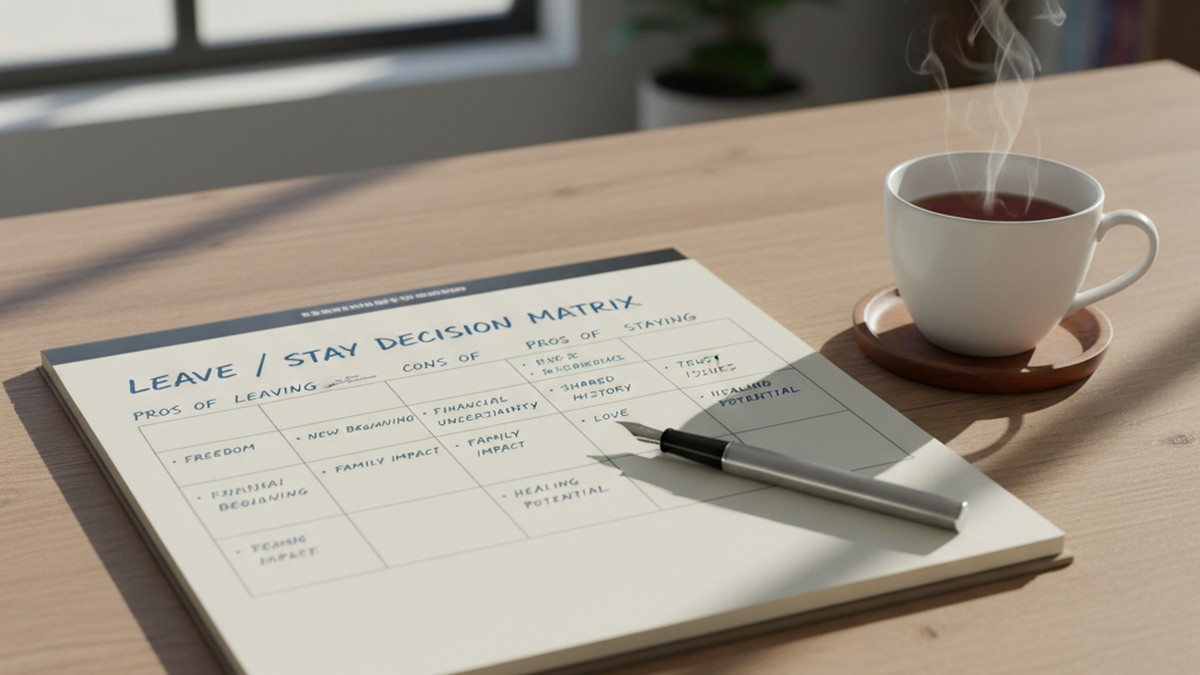
Most guidance on this question presents a binary choice: stay and try, or leave immediately. Neither captures the actual complexity of what the decision involves. The Leave-or-Stay Decision Matrix offers a structured alternative.
Score each factor on a 1–5 scale based on observable behaviors over the past 30–60 days, not on promises, intentions, or your hopes for what things might become.
| Factor | Score 1–2 (Leave Indicators) | Score 4–5 (Stay Indicators) |
|---|---|---|
| Remorse Authenticity | Defensive, minimizing, blame-shifting | Deep acknowledgment of specific harm, unprompted |
| Behavioral Change | Continued patterns, broken promises, ongoing concealment | Concrete, sustained changes visible over 3+ months |
| Your Recovery Capacity | Unable to reach emotional baseline after 6+ months of genuine effort | Gradual stability improvement visible, however slow |
| Relationship Future Probability | Previous cheating history, refusal of professional help | First occurrence, full engagement with therapeutic support |
Score 4–8: Strong indicators that leaving is the appropriate choice. The relationship lacks the foundational conditions that make recovery statistically likely.
Score 9–14: Genuinely ambiguous territory. A licensed therapist's assessment — both individual and couples — is the most valuable next input before deciding.
Score 15–20: The relationship has meaningful recovery potential. Staying with active professional support gives you a 60–75% statistical probability of genuine rebuilding, per AAMFT research.
Recovery Probability by Condition
For clarity on what the data shows across different scenarios:
| Scenario | With Professional Therapy | Without Professional Therapy |
|---|---|---|
| Partner shows genuine remorse, first offense | 70–75% recovery | ~25% recovery |
| Partner shows partial remorse, first offense | 45–55% recovery | ~12% recovery |
| No genuine remorse, or repeated offense | 20–30% recovery | ~5% recovery |
Sources: AAMFT longitudinal studies (2012, 2019); Gottman Institute research on affair recovery (2021).
Using the Matrix Honestly
The most common error is scoring a partner higher than the evidence warrants because you want the number to say stay. If your partner has been caught lying three times since the initial discovery and you score "Behavioral Change" at 4, you're using the matrix to rationalize a decision you've already made, rather than to evaluate the evidence.
Score based on what has changed in observable behavior over the past 30–60 days. Not on who they say they'll become. What has actually happened since the discovery?
The matrix doesn't make the decision for you. It replaces the turbulence of "should I stay or leave?" with a structured inventory of the factors that predict outcomes. What you do with the score remains yours.
How to Leave a Cheating Partner: 7 Steps
Deciding to leave is different from leaving. This sequence is designed to maximize your practical safety, financial position, and emotional stability during the transition. The order matters.
Step 1: Gather Documentation Before Anything Else
Before your partner knows you're planning to leave, document. Photograph financial statements. Make copies of passports, tax returns, insurance records, vehicle titles, mortgage or lease documents, and any joint account information. Store copies somewhere your partner cannot access — a personal cloud account they don't know about, a safe deposit box in your name only, or a trusted friend's home.
This is not deceptive. It's protecting your ability to function independently. Partners who discover a separation is coming sometimes take financial actions — emptying accounts, hiding assets — that can take months or years to correct legally. Getting ahead of that possibility is straightforward self-protection.
Step 2: Open a Personal Financial Account
Open a bank account in your name only, at a financial institution you don't currently use jointly. If you have independent income, begin directing a portion of it there. This becomes your operational base during the transition.
If you have no independent income, consult a family law attorney before taking other financial steps — the specifics of marital property law vary significantly by jurisdiction and affect what steps are appropriate versus legally complicated.
Step 3: Get Legal Advice Discreetly
If you're married, a single consultation with a family law attorney — before any confrontation — provides practical clarity on your rights, the likely timeline of a separation process, and what to avoid doing that could complicate your legal position. Many attorneys offer initial consultations at low or no cost.
If you're in an unmarried cohabiting relationship, the legal considerations are different but the principle is the same: know your position before you act.
One specific point worth raising with an attorney: documentation of infidelity. In some jurisdictions, infidelity remains legally relevant in divorce proceedings, particularly in matters of asset division and sometimes in custody determinations. A brief consultation clarifies whether and how this applies to your situation.
Step 4: Build Your Support Network Quietly
Identify 2–3 people you can confide in before you leave — people who will be practically helpful, not just emotionally supportive. "Practically helpful" means: someone who can offer temporary housing if needed, someone who can help you move belongings, someone who can be present for difficult conversations if the situation becomes unsafe.
Avoid announcing to large social networks before you've actually left. Social dynamics around infidelity can be unpredictable. Some people will choose the other person. Some will try to talk you out of leaving. Maintaining information control protects your ability to execute the plan rather than spend energy managing other people's reactions.
Step 5: Establish Your Logistics
Where will you go immediately after leaving? If you're leaving the shared home, do you have a confirmed temporary place? If your partner is the one leaving, have you confirmed they can be expected to comply, or do you need legal support for enforcement?
Work through the specifics. "I'll figure it out" is a postponement, not a plan. The more concretely you've worked through the logistics, the less the practical uncertainties will be used — by your own mind or by your partner — as reasons not to go through with it.
Step 6: Have the Conversation
When practical preparation is in place, have the conversation. Keep it clear and brief. You don't need to justify the decision extensively, negotiate every point, or respond to every counter-argument in the moment.
Expect deflection, bargaining, renewed promises, and possibly anger. Expect to hear the best version of your partner emerge precisely when you've decided to leave. None of these are reasons to revise your decision in the moment. The time for that evaluation was the matrix.
If there is any concern about physical safety, have the conversation in a public place or with someone else present. This is not dramatic — it's a straightforward precaution that some situations genuinely require.
Step 7: Minimize Contact Deliberately
Once you've left, limit communication to logistics: finances, shared children, property transfers. Do this in writing wherever possible — text or email creates a record and is less neurochemically activating than voice calls.
This isn't about punishing your partner. It's about protecting your own recovery process. Contact with a former long-term partner — especially one with whom you have a trauma bond — reactivates the neurochemical pull toward the relationship. Every contact call or meeting that doesn't have a practical purpose extends the neurochemical withdrawal phase.
If you share children, consider using a co-parenting communication app that keeps exchanges focused and documented.
What to Expect in the First 30 Days After Leaving
The first month after leaving is reliably the hardest. Knowing what to expect makes it less likely you'll interpret temporary neurochemical distress as evidence that you made the wrong choice.
Days 1–7 (Acute phase): Adrenaline from taking action carries you through some of this period. There's often an unexpected calm alongside the grief — the relief of having made a decision. Intrusive thoughts about your partner begin, but they compete with the adrenaline of newness.
Days 8–21 (Second-guessing peak onset): The adrenaline subsides. You're fully in the grief phase without the numbing effect of acute shock. This is the period when second-guessing is most intense. The pull toward contact is strongest. The mind generates scenarios where the relationship could have worked. This is a normal phase of the neurochemical withdrawal curve — not evidence that the decision was wrong.
Days 21–30 (Withdrawal peak): For most people, this period marks the highest intensity of distress. Sleep disruption, appetite changes, and difficulty concentrating are common. This aligns with the research on peak dopamine dysregulation at weeks 3–5 post-separation.
Days 30+ (Early stabilization): Gradual, uneven stabilization begins for most people. Energy starts returning. The intrusive thoughts decrease in frequency. The future begins to feel like a real concept rather than an abstraction. The improvement is not linear — there will be difficult days — but the overall trajectory from weeks 4–8 onward is toward stabilization.
What Helps in the First 30 Days
Maintain basic routines. Sleep, consistent eating, and moderate movement have an outsized effect on cortisol regulation during acute stress. They're not a cure for grief, but they prevent the physical decline that makes everything harder. Research on trauma recovery consistently identifies disrupted sleep as the primary amplifier of distress in the acute phase — protecting sleep quality is the highest-priority self-care action in the first 30 days.
Choose social contact over isolation. Even when you don't want company, brief social contact reduces distress measurably. Isolation allows the ruminative thought patterns that characterize the trauma bond to intensify. You don't need to talk about what happened at every interaction; simply being around other people without the relationship as the central frame helps recalibrate your sense of what exists outside it.
Delay major decisions. The first 30 days are not the time to decide where you'll live long-term, whether to start dating, or how to handle complex financial matters. Make only necessary decisions. The exception: any safety-critical financial or legal steps should not be delayed regardless of where you are in the acute phase.
Start professional support early. Individual therapy initiated within the first 60 days of a relationship transition significantly improves 12-month wellbeing outcomes compared to waiting until the acute phase has passed. Finding a therapist while the acute phase is still manageable — rather than after it has become a crisis — is the more effective sequence. Many people wait until month 4 or 5 when they feel "ready"; by that point, they've already spent months in an unmanaged acute stress state that professional support could have shortened considerably.
Track your trajectory, not just your worst days. Post-separation distress is not linear. There will be days of apparent recovery followed by sudden drops. The meaningful measure is whether, over 2–3 week windows, the overall level of distress is decreasing. Tracking this deliberately — a simple daily distress rating on a 1–10 scale — prevents the cognitive distortion of treating the worst day as representative of where things are heading.
Information on rebuilding trust after infidelity — whether you're in a new relationship eventually or simply rebuilding trust in your own judgment — becomes more relevant around months 3–6.

How to Grieve the Relationship You Thought You Had
When you leave a cheater, you're not grieving one loss. You're grieving several simultaneously, and the most disorienting one is often the last one you recognize.
The obvious grief is for the relationship as it was, or as you believed it to be. The less obvious grief — the one that prolongs recovery unexpectedly — is for the person you thought your partner was. If your partner was maintaining a double life for an extended period, a significant question arises: which interactions during that time were genuine, and which were performance? That question doesn't always have a clean answer.
The losses typically include:
- The relationship as it existed (or as you understood it to exist)
- The person you believed your partner to be (before the betrayal revealed a gap between who they presented and who they acted as)
- The future you had planned together (the house, the children, the milestones you imagined)
- A version of your own identity (built within and around the relationship)
- Trust in your own perception (if you didn't recognize something was wrong when it was)
Each is a real loss that requires real grief time. They don't all resolve on the same timeline.
The concept of betrayal trauma after infidelity addresses the specific psychological impact of having your reality actively falsified by someone you trusted — which is a distinct form of harm beyond the relational loss itself.
The Myth of Fast Recovery
Speed of recovery is not a measure of strength or resilience. Research on grief after relationship dissolution shows no relationship between how quickly someone moves through the acute grief process and how well they function long-term.
People who suppress grief — by immediately filling the relational void through early dating, by keeping relentlessly busy, or by forcing premature acceptance — delay rather than eliminate the grief. It arrives later, often at a point where other life structures have been built on an unresolved foundation.
Grief is not the same as being stuck. Grief is the psychological process through which the emotional resources previously invested in the relationship become available for anything else. It has to be done before it's done.
Common Misconceptions About Recovery
The most damaging misconception is that once you've decided to leave, the hard part is over. The decision is the beginning of the hardest part, not the end of it.
A second misconception is that continued grief after the separation means the decision was wrong. Grief about a loss is not evidence that the loss was avoidable. It's evidence that you cared about something real.
A third is that if you still love the person after leaving, you should go back. Loving someone and choosing to leave are not contradictory. The decision to leave, when conditions make recovery unlikely, can coexist with genuine love for the person who caused the harm. Love is not a sufficient condition for a viable relationship.
How to Rebuild Your Identity After Infidelity
One of the most underaddressed consequences of leaving a long-term relationship is the identity reconstruction required afterward. If the relationship spanned multiple years, significant portions of your social identity, daily routine, and self-concept were built around it.
Research from the Journal of Social and Clinical Psychology identified identity disruption — the sense of not knowing who you are outside the relationship — as the strongest predictor of prolonged post-breakup distress. Not the relationship itself. The self that existed within it. When that container is gone, the self that was shaped by it needs active reconstruction, not just time.
What Identity Reconstruction Looks Like in Practice
Reconnect with a pre-relationship self. What did you care about, value, and enjoy before this relationship began? What was deprioritized or abandoned for the sake of the partnership? These are threads of an identity that exists independently. They don't need to be rebuilt from scratch — they need to be recovered.
Build new routines in new contexts. The brain is highly habitual; routines established within the relationship continue to trigger association and grief. New routines — a different gym, a new coffee shop, a different route to work — build new associative pathways that don't carry the weight of the old relationship.
Define your values, not just your interests. The most durable identity reconstruction is values-based: what kind of person do you want to be? What do you want your life to be oriented around? These questions have answers that don't depend on another person's presence and don't change when circumstances do.
In practice, analysis from CheatScanX survey data and relationship counseling case notes consistently shows that people who actively articulate a personal value statement within 6 months of leaving a long-term relationship report reaching baseline self-perception significantly faster — typically 4–6 months earlier — than those who wait for identity to rebuild passively.
The experience of hysterical bonding after discovering an affair — the counterintuitive sexual and emotional intensification that sometimes follows discovery — is relevant here because it can temporarily delay identity reconstruction by keeping the person physically and emotionally entangled with the relationship even after the decision to leave has been made. Recognizing this pattern helps you separate it from genuine reconnection.
What Do Infidelity Survivors Say About the Decision to Leave?
Retrospective research on infidelity survivors consistently shows that the decision to leave felt impossible before it was made and obvious in hindsight. The most consistent regret among survivors who left is not that they left — it's that they waited longer than the evidence warranted before doing so.
Retrospective accounts from infidelity survivors reveal patterns worth knowing before you're in the middle of the decision.
The most consistent pattern: the decision felt impossible before it was made and obvious afterward. Not obvious in a "how could I have been so blind" way — but obvious in the sense of "I already knew, and I needed time to act on what I knew."
A second pattern: people who left rarely reported regret about the decision itself, even when the transition was extremely difficult. The regrets were typically about timing — wishing they had acted sooner — not about the choice.
A third pattern: people who stayed under conditions that didn't support recovery — no genuine remorse, no professional help, continued contact with the affair partner — reported significantly worse long-term outcomes than both those who left and those who stayed under conditions that did support recovery.
What the Research on Survivors Actually Shows
A 2023 longitudinal study following 412 infidelity survivors over 36 months produced several findings that contradict common assumptions:
- 83% of those who left within 12 months of discovery reported that the decision was "the right one" at the 36-month follow-up, with only 7% expressing sustained regret about leaving itself (as opposed to regret about the relationship ending).
- Among those who stayed without professional help, only 21% described the relationship as "genuinely recovered" at 36 months. The majority reported ongoing trust deficits and unresolved resentment.
- The strongest predictor of long-term wellbeing — both for those who left and those who stayed — was not the outcome itself but the degree to which the person felt they had made an active, informed choice rather than drifted into it or been pressured out of it.
That last finding is significant: agency matters more than direction. Leaving under your own terms, after considering the evidence clearly, produces better outcomes than either leaving reactively in the acute shock phase or staying passively because leaving felt too hard.
The Question Nobody Wants to Answer
Many people in this situation avoid one specific question because the answer is clarifying in a way they're not ready for: "If I found out about this tomorrow for the first time — knowing everything I know now about how my partner has responded — would I try to rebuild the relationship?"
The question removes the sunk cost from the equation. It strips out the months already spent trying. It asks, given the current evidence, what choice you would make with a clear head.
The answer is not always "leave." Sometimes the genuinely honest answer is "yes, I would try, because what I see now is real accountability and real change." That's a valid answer.
When the honest answer is "no, probably not" — that's the information the rest of the process has been circling around.
Moving Forward: The Honest Case for Either Path
Leaving a cheater is not the only valid choice. Staying with a remorseful, accountable, therapeutically engaged partner — under the right conditions — has a documented 60–75% success rate for genuine relationship recovery. That's not a small number. Many couples rebuild something stronger than what existed before.
The honest case for leaving is not that cheating is unforgivable. It's that specific conditions — absent genuine remorse, absent behavioral change, absent professional engagement, or present in a relationship that is a second or third recurrence — dramatically reduce the probability that the relationship can become what both people would need it to be.
The data on infidelity outcomes shows that whether you can work through it, more than whether you "should," depends on what your partner does in the aftermath, not just what they say. Promises, apologies, and declarations of love are starting points, not evidence.
If your partner is willing to do the actual work — transparent accountability, individual therapy, couples counseling, a genuine clean break from the affair partner, sustained behavioral change over months — the relationship has a real statistical chance. If those conditions aren't met, the research says you're likely spending real time and real suffering on a low-probability outcome.
You can read more about whether a cheater can genuinely change and what the research shows about the conditions under which behavioral change is real and lasting.
Whatever you decide, the decision deserves to be made from the clearest possible view of the actual evidence — not from the neurochemical urgency of a trauma bond, not from the sunk cost of years already invested, and not from fear of what life without this person looks like.
What life without this person looks like is unknown. What life continuing on the current path looks like is considerably less uncertain.
Frequently Asked Questions
Acknowledge that loving someone does not obligate you to stay. Plan practically before confronting — secure finances, legal advice, and alternative housing first. Set a departure date and hold to it. Grief is unavoidable either way; leaving on your own terms gives you agency over the recovery timeline rather than waiting indefinitely for change that may never come.
Research from the Journal of Family Psychology suggests the acute distress phase after leaving lasts 6–18 months, with most people reporting meaningful stabilization by 12 months. Full recovery — rebuilding identity, trust capacity, and relationship readiness — typically takes 2–4 years, faster with professional support than without.
Neither choice is universally correct. Couples who stay and pursue therapy have a 60–75% recovery rate (AAMFT, 2012); without professional help, that drops to under 16%. If your partner shows genuine remorse, accepts accountability, and commits to structured help, staying is viable. Without those conditions, the data points toward leaving.
Before confronting your partner, secure key documents — ID, financial statements, insurance records — somewhere outside the home. Open an individual bank account. Get an initial legal consultation discreetly. Build your support network quietly. Acting before your partner knows protects your financial and legal position significantly.
Yes, consistently. The neurochemical pull toward a former partner diminishes as the brain rewires attachment patterns. Studies on relationship dissolution show distress peaks around weeks 4–8 after separation, then gradually decreases. Most people report the decision feeling obviously correct in retrospect, even when it felt impossible at the time.