
# Online Cheating vs Physical Cheating: Is It the Same?
Online cheating and physical cheating are both forms of infidelity — they both involve deception, a secret emotional or sexual connection with someone outside your relationship, and a fundamental breach of trust. The two are not identical in every respect, but both cause real, lasting psychological damage.
If you just discovered your partner has been messaging someone intimately online, sexting a stranger, or running a secret dating profile, your pain is valid. Nearly 40% of married individuals report some form of online infidelity, and the psychological impact on betrayed partners is often indistinguishable from that of physical affairs (Net Psychology, 2024).
But the differences do matter — especially when you're trying to understand what happened, process how you feel, and decide what comes next.
This article breaks down how online and physical cheating compare across intent, intimacy, and impact — using a structured three-part framework that most guides skip. You'll also find one critical way online infidelity can actually be more damaging than a physical affair, how men and women tend to respond differently, and concrete steps for what to do if you've discovered your partner has been cheating digitally.
What Is Online Cheating?
Online cheating — also called cyber infidelity or digital infidelity — is any intimate or romantic engagement with someone outside your committed relationship that occurs through digital channels. This includes sexting, intimate video calls, emotional affairs conducted through messaging apps, secret dating profiles, and sustained romantic or sexual flirtation via social media.
The defining feature of online cheating isn't the platform — it's the secrecy and the nature of the connection. A routine work exchange on Slack isn't online cheating. A months-long thread of sexual messages that your partner has been deleting is.
Online infidelity takes several distinct forms:
- Sexting and explicit messaging — exchanging sexually explicit texts, images, or videos with someone outside the relationship
- Emotional cyber affairs — forming a romantic emotional bond with someone online while hiding the relationship from your partner
- Secret dating profiles — maintaining an active presence on dating apps while in a committed relationship
- Virtual sex — engaging in sexual acts via video call or in online environments
- Sustained intimate flirtation — a pattern of romantic messaging or comment behavior that both parties understand as more than friendship
What separates any of these from innocent contact is the combination of secrecy, romantic or sexual intent, and the deliberate decision to hide it from a partner. The absence of one of these elements doesn't automatically clear behavior — context always matters — but all three together define what most people and researchers recognize as digital infidelity.
The Psychological Distance Factor
Screens create what psychologists call psychological distance — a mental separation between an action and its perceived consequences that makes people feel their behavior is less real or less serious. This helps explain why 42% of cheaters describe their digital affair as having started as "harmless messaging" (Magnum Investigations, 2024). The rationalization fades only once emotional investment is deep and secrecy is already well established.
In practice, what starts as online flirtation tends to follow a predictable escalation path: casual contact → increased personal sharing → emotional intimacy → explicit content → consideration or arrangement of physical meeting. Research consistently shows this progression across different age groups, relationship types, and digital platforms. Understanding the escalation pattern matters because each stage involves active decisions — at no point is continuation automatic or passive.
Why Online Cheating Is Increasingly Common
Digital infidelity has expanded sharply because opportunity has expanded. Social media maintains permanent access to ex-partners, work contacts, and strangers. Dating apps are downloaded on devices that go everywhere. Private messaging apps make secret communication easier than it has ever been. According to Magnum Investigations' 2024 digital infidelity research, 38% of affairs now begin through social media platforms — not in-person contact. That proportion continues to grow.
The signs of hidden dating apps on your partner's phone are often subtle. Unlike physical affairs that require time away from home, online affairs can happen at the kitchen table, in the bedroom, or during a work lunch break. The logistical footprint is much smaller, which makes both starting and concealing them significantly easier.
If any of this sounds familiar, there's a way to know for sure. CheatScanX checks 15+ dating platforms for hidden profiles using a name, email, or phone number.
Check for hidden profiles →What Is Physical Cheating?
Physical cheating — sometimes called sexual infidelity — involves any sexual or physically intimate contact with someone outside a committed relationship without the partner's knowledge or consent. This includes sexual intercourse, oral sex, and other sexual acts, though individual definitions vary on behaviors like kissing or physical affection that stops short of intercourse.
Physical cheating has historically been treated as the default definition of infidelity, partly because it was the only category measurable by traditional research surveys. The General Social Survey (GSS), which has tracked American sexual behavior for decades, asked only about extramarital sexual intercourse — a definition that researchers now acknowledge misses approximately 76% of what Americans actually consider infidelity (Institute for Family Studies, 2024). That measurement gap explains why physical-only infidelity statistics have long underrepresented the true scope of betrayal that people experience.
Physical cheating carries several features that distinguish it from digital forms:
| Feature | Physical Cheating | Online Cheating |
|---|---|---|
| Requires physical proximity | Yes | No |
| Can occur anonymously | Rarely | Often |
| Leaves physical evidence | Frequently | Digital records instead |
| Carries health risks (STIs) | Yes | No |
| Logistical complexity | High | Low |
| Discovery evidence volume | Limited | Often extensive |
Physical cheating typically requires planning — lies about location, often financial traces, and a physical partner willing to engage. This logistical complexity means physical affairs usually leave more external evidence: changed schedules, receipts, phone records showing time away from home.
Physical cheating is often easier for a betrayed partner to categorize definitively. The violation is concrete. But ease of categorization doesn't mean greater harm — a point research increasingly supports.
Is Online Cheating Considered Real Cheating?
Online cheating is real cheating. The question itself reflects one of the most common rationalizations cheaters use to minimize what they've done: "we never actually met," "it was just texting," "nothing physical happened." The research doesn't support the idea that digital infidelity belongs in a lesser category.
The core elements of infidelity are present in online affairs: deception, secret emotional or sexual investment in someone outside the relationship, and a breach of the explicit or implicit terms of commitment. Whether those actions happen face-to-face or through a screen doesn't change what they fundamentally are.
A 2024 study published in the Journal of Sex and Marital Therapy found that betrayed partners reported equivalent emotional distress regardless of whether the infidelity was physical or digital. The specific pain point differed — partners betrayed through emotional online affairs often described the intimacy betrayal as particularly cutting — but the overall psychological impact showed no statistically significant difference in severity.
The General Social Survey data illustrates the definitional gap well: when Americans are asked what they consider to be infidelity, 76% include secret in-person emotional relationships — yet the traditional survey measure used by researchers for decades captured only sexual intercourse. That gap between what people consider betrayal and what surveys used to measure tells you something important about how broadly infidelity is understood to extend beyond physical contact.
CheatScanX platform data: In scans processed through our platform, active dating profiles are consistently among the most frequent discoveries — suggesting that what many partners dismiss as "just browsing" has become a primary concern for people questioning fidelity. Many of these profiles show recent activity, indicating regular engagement rather than forgotten accounts.
The more useful question isn't "Is this real cheating?" but "Does this violate the boundaries and expectations of our relationship?" For most couples in committed, monogamous relationships — even those who've never explicitly discussed digital boundaries — the answer is yes.
If you have a gut feeling your partner is cheating but aren't sure how to identify whether it's happening online, that instinct is worth taking seriously. Behavioral shifts around phone use are often the first detectable signal, and they're worth examining before the rationalization of "it's not really cheating" has time to take hold.
How Online and Physical Cheating Compare: The 3-Dimension Model
Most discussions of online versus physical cheating treat them as a simple binary — either it happened or it didn't, either it counts or it doesn't. That framing misses the genuine variation between the two. A more useful approach is comparing both types across three dimensions: Intent, Intimacy, and Impact.
Dimension 1: Intent
Physical cheating typically requires more deliberate decision-making — identifying a partner, arranging a meeting, making a clear physical choice in a specific moment. Online cheating can begin without fully conscious intent, escalating gradually from innocent contact to intimate engagement over weeks or months.
This doesn't make online infidelity less of a choice. Every stage in the escalation involves an active decision to continue — to send the next message, to share something more personal, to not stop. But the subjective experience of intent differs between the two types, and that difference has implications for how betrayed partners understand what happened and how cheating partners describe it.
Intent also determines the evidence trail. Physical affairs are often reconstructed from circumstantial evidence. Online affairs tend to leave comprehensive written records of the entire progression, including exchanges from before either party would have described things as an "affair."
Dimension 2: Intimacy
Online affairs can reach high levels of emotional and sexual intimacy — sometimes higher than what exists in the committed relationship. The psychological distance created by screens paradoxically lowers inhibitions and accelerates disclosure. People share things online with near-strangers that they've never told people they've known for years — therapists call this the stranger-on-a-train effect, and it's well-documented in social psychology research.
Physical cheating, meanwhile, can range from a single impulsive encounter with minimal emotional content to a sustained affair with deep emotional intimacy. A one-night stand and a six-month physical relationship represent very different violations — just as a single flirtatious text exchange and a year-long emotional online affair are fundamentally different in depth.
The intimacy dimension reveals why treating either type as monolithically "worse" misses the point. A brief, sexually explicit physical encounter may cause acute sexual jealousy but limited emotional displacement. A year of daily emotional intimacy with someone online may leave the betrayed partner feeling like a stranger to their own relationship.
Dimension 3: Impact
Both types produce what researchers call betrayal trauma — a specific form of relational injury with features overlapping post-traumatic stress disorder. Research published in the Journal of Marital and Family Therapy (2023) found that 70% of betrayed partners showed PTSD-consistent symptoms regardless of infidelity type.
The texture of that trauma differs:
- Physical affair discovery tends to trigger immediate acute shock, disgust, and sexual jealousy
- Online affair discovery tends to trigger obsessive rumination, compulsive evidence-reading, and prolonged identity questioning — "Was everything in our relationship a lie?"
The 3-Dimension Model shows that online and physical cheating aren't better or worse than each other in any universal sense — they hurt differently, and understanding how they differ helps betrayed partners make sense of their specific experience rather than measuring it against someone else's.
Which Is Worse: Online or Physical Cheating?
There is no universal answer to which form of cheating is worse, and any claim to the contrary oversimplifies the psychology involved. What research consistently shows is that the answer depends substantially on who is asking — with a well-replicated pattern by gender.
According to research synthesized from multiple studies including data from the Journal of Personality and Social Psychology, 54% of heterosexual men report that sexual infidelity would upset them more than emotional infidelity. Among heterosexual women, 65% say emotional infidelity would cause greater distress than purely sexual cheating. This pattern — men more distressed by sexual betrayal, women more distressed by emotional betrayal — has been replicated across multiple cultures and study designs spanning three decades.
Why this difference? Evolutionary psychology researchers propose that men have historically placed higher weight on sexual exclusivity because of paternity certainty concerns, while women have historically prioritized emotional exclusivity because a partner's emotional commitment affects resource provision and parenting involvement. These are general tendencies, not rules — individual responses vary significantly based on personality, attachment style, relationship history, and cultural background.
The practical implication is significant. For many women, an online emotional affair — where a partner has been sharing their deepest thoughts, fears, and intimate feelings with someone else for months — can feel more devastating than learning their partner had a single sexual encounter. The emotional transfer of allegiance hits something different.
For many men, discovering explicit sexual content — images, videos, graphic messaging — in a partner's secret exchanges is more likely to trigger an acute trauma response than learning about a sustained emotional connection that remained non-sexual.
Neither response is disproportionate. Neither type of infidelity is objectively more forgivable. The research on outcomes is clear: both produce comparable levels of long-term psychological harm, and both require comparable levels of work to recover from, regardless of which hits harder in the first days after discovery.
Why Online Cheating Can Be More Damaging Than You Think
Here is the position most guides don't address directly: in specific and important ways, online cheating can be more damaging than physical infidelity — not less.
The reason is what researchers describe as the digital trail trauma paradox.
Physical affairs rarely come with a complete transcript. When someone discovers a partner has had a physical affair, they typically learn the fact of it — that it happened, roughly when, possibly with whom. The details of what was said, what was felt, what intimate things were shared, usually remain unknown. The betrayed partner's imagination may fill gaps, but there is a natural limit to how much evidence they're confronted with at once.
Online affairs are fundamentally different. They leave comprehensive written records. Discovery often means reading months or years of messages — the first flirtatious exchange, the escalation into explicit content, the declarations of feeling, the casual cruelties about the betrayed partner, the plans to meet in person. Everything. In chronological order.
This creates what clinical psychologists describe as condensed evidence trauma — an all-at-once exposure to the full arc of the affair that physical discovery rarely replicates. Betrayed partners report re-reading these messages compulsively in the days and weeks after discovery, each re-read restimulating an acute trauma response. Research from the Journal of Sex and Marital Therapy (2024) identifies this compulsive review pattern as one of the primary obstacles to early recovery from digital infidelity — and one that has no direct equivalent in physical affair recovery.
A second way online affairs cause distinct harm is through emotional intimacy displacement. People disclose more to strangers online than face-to-face, a phenomenon documented in social psychology for over three decades. This means an online affair may involve sharing emotional depths that the betrayed partner never received. Reading evidence that your partner told someone else things they never told you — their childhood wounds, their fears about the relationship, their frustrations with your marriage — carries a specific kind of pain that sexual jealousy alone doesn't capture.
A third factor: intermittent reinforcement. Digital platforms — messaging apps in particular — operate on the same variable reward schedule that makes slot machines addictive. The unpredictability of when the next message will arrive, the anticipation, the dopamine response to the notification sound — these create powerful behavioral conditioning. Research cited by Net Psychology (2024) notes that this reward system makes online affairs, counterintuitively, harder to discontinue than physical ones, even for people who claim to want to stop. This matters for betrayed partners trying to understand why their partner "couldn't just stop."
Does Online Cheating Lead to Physical Infidelity?
Online affairs don't automatically escalate to physical involvement, but the research suggests the pathway is common enough to take seriously. Data on affair progression indicates that online affairs involving sustained contact over three or more months lead to some form of in-person physical contact in roughly 50% of cases.
The escalation dynamic operates through the intimacy already established digitally. By the time two people consider meeting physically, they've built trust, attraction, and emotional connection that could take months to develop from a cold first meeting. The perceived emotional risk of meeting — the "what if it's awkward" hesitation — is already resolved. Only the logistical barrier remains, and logistics are solvable.
The risk factors for escalation from online to physical are specific:
- Geographic proximity — online affairs with people within practical travel distance escalate significantly faster than those across countries
- Shared real-world context — coworkers, former partners, and people within existing social circles have built-in pretexts for in-person contact that require no unusual explanation
- Duration of the online affair — affairs lasting more than six months show markedly higher rates of physical escalation than shorter connections
- Explicit sexual content — sexting and explicit exchanges predict in-person physical involvement more reliably than purely emotional connections, probably because they've already crossed a key threshold
Understanding whether an online affair has escalated physically is relevant both for how betrayed partners process the betrayal and for health reasons — physical involvement introduces health risks that an emotional-only digital affair doesn't.
The signs of emotional cheating through texting often reveal themselves before explicit content does — unusually guarded phone behavior, message notifications that get dismissed quickly, or a partner who suddenly starts sleeping with their phone face-down. These early signs may indicate an online affair that hasn't yet become sexual, which is significant context for anyone trying to understand how far things have progressed.
How Men and Women React Differently to Online vs Physical Cheating
Gender differences in response to infidelity type are among the most consistently replicated findings in relationship research across the past three decades. Understanding these differences helps betrayed partners make sense of their own reactions and anticipate what recovery may involve — without suggesting that any particular response is wrong.
Men's Typical Response to Online vs Physical Cheating
Men generally show stronger acute distress responses to sexual infidelity — including online sexual infidelity like sexting and explicit messaging exchanges — than to purely emotional connections without sexual content. This reflects the well-documented pattern of men placing higher weight on sexual exclusivity as the core of relationship boundaries.
This doesn't mean men are unaffected by emotional online affairs. Research published in the Journal of Social and Personal Relationships (University of Wisconsin, 2024) found that while men's initial distress was typically lower in response to emotional-only online affairs compared to sexual ones, sustained recovery proved equally challenging regardless of affair type. The initial response differs; the long-term psychological impact often does not.
For men, the discovery of explicit sexual content — images, videos, graphic messages — tends to be the specific trigger for acute trauma. The sexual violation is experienced as the primary betrayal. This shapes what information feels necessary in the aftermath: men are more likely to press for details about physical contact and sexual content than about the emotional content of conversations.
Women's Typical Response to Online vs Physical Cheating
Women consistently report higher distress in response to emotional infidelity — which makes online emotional affairs particularly devastating for many women. When a partner has been sharing their inner world with someone else online for months, many women experience this as a deeper betrayal than sexual contact would represent.
Research from the Institute for Family Studies (2024) found that women who discovered emotional online affairs reported significantly higher rates of identity disruption — questioning their own judgment, their understanding of their partner, and their adequacy in the relationship — than women who discovered primarily physical affairs. This likely reflects the nature of emotional intimacy violations: they don't just reveal an action, they undermine the entire narrative of the relationship.
For women, the discovery of months of intimate emotional exchange — conversations that went deeper than anything the committed couple shared — can trigger a grief response distinct from the anger that more commonly characterizes initial physical affair discovery. The loss being mourned isn't just the breach of fidelity; it's the relationship story the betrayed partner thought they were in.
What Both Genders Share
Despite the differences in immediate response, the long-term psychological effects of both affair types are remarkably similar across genders. Both produce elevated anxiety, depressive symptoms, intrusive thoughts, and hypervigilance — the hallmarks of betrayal trauma. Both impair the ability to trust in subsequent relationships without deliberate therapeutic work. The path to recovery looks substantially the same regardless of which type of infidelity occurred.
Recovery timelines are also comparable. Research consistently finds that gender doesn't predict the length of recovery — it only predicts where the sharpest pain is initially located.
How to Tell If Your Partner Is Cheating Online
Detecting online infidelity differs from detecting physical affairs because the evidence exists in digital form. But the behavioral signals that accompany it often overlap with those of any form of infidelity — because secrecy produces predictable behavioral changes regardless of what's being hidden.
Behavioral Red Flags
Changes in phone behavior are among the earliest and most reliable signals. Partners engaged in online affairs become more protective of their devices: carrying phones everywhere, tilting screens away from view, setting new passcodes or changing existing ones, becoming agitated when asked to use speakerphone or hand the phone over briefly. A partner who previously left their phone on the kitchen counter and now keeps it in their pocket at all times has changed their behavior for a reason.
Increased digital secrecy extends beyond the phone itself. Frequent deletion of browser history, logging out of apps they previously stayed logged into, switching to private browsing for searches they previously did openly, or using apps you don't recognize or that they explain away quickly — all indicate heightened digital concealment. Look also for new messaging apps installed that weren't there before, particularly apps marketed around privacy or message deletion.
Usage at unusual hours is a consistent indicator. Partners conducting online affairs typically communicate during windows when their partner is asleep, occupied elsewhere, or not paying attention — very late at night, early morning before the household wakes, or during commutes. Noticing that a partner's phone is active at 2 a.m. when they've claimed to be asleep is a concrete behavioral signal worth noting.
Emotional withdrawal from the relationship often precedes any concrete evidence. The partner's primary emotional investment has shifted elsewhere. Conversations that used to feel engaged feel perfunctory. Shared activities that previously drew genuine participation now get minimal attention. This isn't always infidelity — depression, work stress, and health issues can cause emotional withdrawal — but combined with device behavior changes, it shifts the probability.
Digital Methods That Actually Work
The most reliable way to detect active online infidelity is through dating platform scanning. If your partner has an active profile on Tinder, Bumble, Hinge, or other apps, that's objective evidence of at least one form of digital infidelity — maintaining a dating presence while in a committed relationship is not ambiguous. Finding out if your partner is on dating apps doesn't require access to their device; scanning services can check multiple platforms using only a name and age.
If you've noticed behavioral signals and want a definitive answer, CheatScanX scans 15+ dating platforms simultaneously. It gives you a factual result rather than leaving you with compounding suspicion.
Beyond app scanning, several additional approaches can provide useful information:
- App store purchase history — on both iOS and Android, purchase and download history includes apps that have been deleted from a device, revealing what was installed and when
- Network router logs — home router admin panels often record which apps and sites connect through the network, including apps with distinctive traffic patterns
- Shared account notifications — if you share an iCloud or Google account, notification previews can surface unexpected app activity
- Credit card and billing statements — premium subscriptions to dating apps show up as charges, sometimes listed under the parent company's name rather than the app name
What to Do After Discovering Online Infidelity
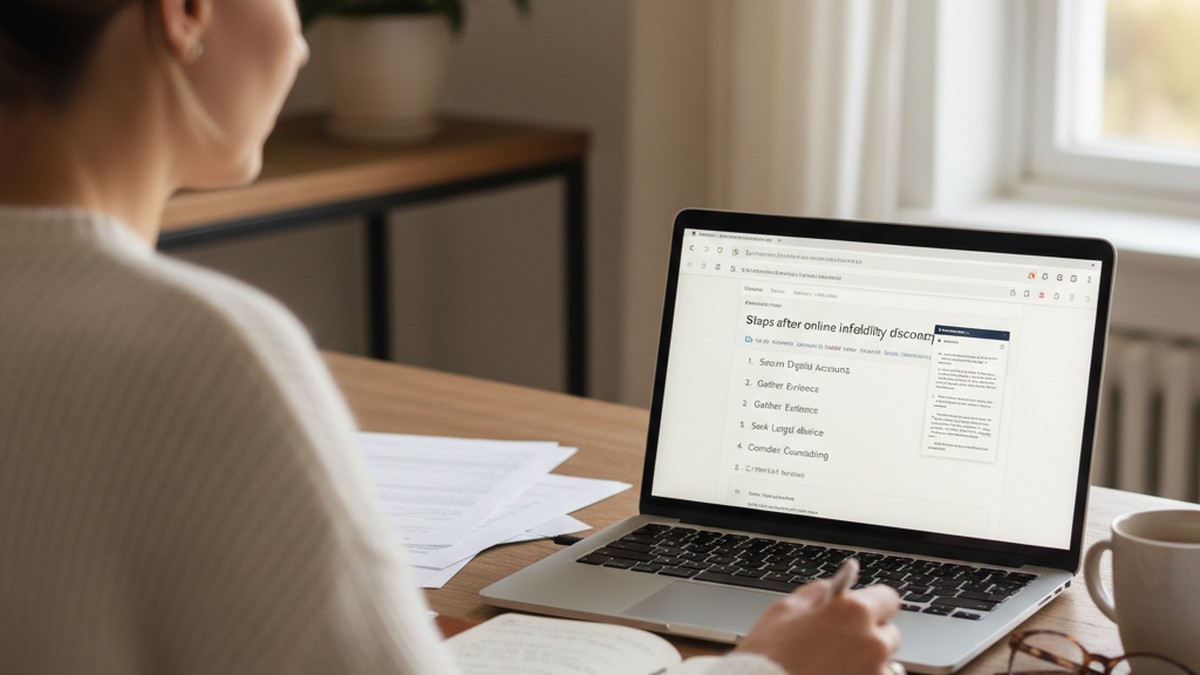
Discovery is one of the most destabilizing experiences in a relationship. What you do in the hours and days immediately after finding evidence shapes both your psychological recovery and the relationship's trajectory. Acting from acute shock rarely produces useful results; acting strategically gives you more control over what happens next.
Step 1: Document What You Found Before Confronting
Before saying anything to your partner, document what you've discovered. Screenshot messages with timestamps visible, note platform names and account handles, and save any relevant images or conversations to a device your partner doesn't have access to. Do this immediately, before any confrontation — partners who are confronted without warning often delete evidence quickly and begin constructing denials.
This documentation serves multiple purposes. It gives you a concrete record to refer back to rather than relying on memory that may be distorted by shock. It also preserves information you may need later — in some jurisdictions, documented infidelity is relevant to divorce proceedings.
Step 2: Give Yourself Time Before the Conversation
The impulse to confront immediately is understandable, but acting in acute emotional shock rarely produces useful information. Partners confronted before they've had any time to process tend to minimize, deny, and deflect rather than disclose. Give yourself 24-48 hours minimum — enough time to move from acute shock toward something you can direct rather than just react from.
This waiting period isn't about protecting your partner. It's about you having the presence of mind to gather what you actually need from the conversation.
Step 3: Decide What You Need From the Confrontation
Going into any difficult conversation without knowing your goal leaves you reactive. Before confronting your partner about what you've found, clarify for yourself: What do you want to know? What decision are you trying to make? Are you seeking full disclosure of everything? An acknowledgment and apology? A clear statement about what happens next?
Partners who approach infidelity confrontations without a clear goal often walk away feeling worse — not because the conversation failed, but because they didn't know what they needed it to produce.
Step 4: Consider Professional Support Before and After
Individual therapy is valuable immediately after discovery — not to save the relationship, but to process the trauma response you're experiencing and clarify what you actually want. A therapist who works with infidelity can help you identify what information you need, what you're feeling, and what options are available.
If both partners are open to it, couples therapy should begin as quickly as possible. Research on cheating recovery consistently shows that couples who enter professional support within three months of discovery have significantly better outcomes than those who wait. The underlying question in couples therapy isn't "can we get past this?" — it's "do we understand what happened, and is there enough left to rebuild on?"
For understanding how to rebuild trust after cheating, know that recovery from online infidelity has one specific additional challenge: the temptation to re-read the evidence. Therapists increasingly recommend establishing clear agreements about evidence access during early recovery — not to protect the cheating partner, but to protect the betrayed partner from repeated acute trauma exposure.
Common Myths About Online Cheating
Misinformation about digital infidelity runs deep — much of it originating with people who want to minimize what they've done. These myths persist because they're psychologically useful to the people who benefit from them. Here's what the evidence actually shows.
Myth 1: "If we never met in person, nothing really happened."
This is the most common minimization, and it's false. Meeting in person is not what makes infidelity real. Months of secret intimate exchanges, sexual content, and emotional investment constitute a genuine relationship conducted outside your committed one. The absence of physical contact doesn't change what the connection was.
Myth 2: "Online relationships aren't as emotionally intense as real-life ones."
Research consistently contradicts this. The stranger-on-a-train effect — people's documented tendency to disclose more personal information to strangers online than face-to-face — means online relationships can reach deep emotional intimacy relatively quickly. Many people who've conducted online affairs report them as more emotionally intense than physical affairs they've had, precisely because the disclosure was so concentrated and the inhibitions so low.
Myth 3: "Sexting isn't cheating — it's just words and images."
If your partner was explicitly sexual with someone outside your relationship, the medium doesn't change what that is. The content and intent of sexual messaging are identical to physical sexual communication; only the format differs. The distinction between "just text" and "real" sexual interaction isn't supported by the psychological harm data — betrayed partners who discover sexting show comparable trauma responses to those who discover physical sexual contact.
Myth 4: "A dating app profile is just harmless browsing."
This rationalization is particularly common in early confrontations. Maintaining an active dating profile while in a committed relationship represents ongoing deception — it means keeping an available, searchable presence on a platform whose entire purpose is finding romantic or sexual partners. Whether messages have been sent or matches acted upon is a separate question; the profile itself represents a choice to remain available.
Myth 5: "Online affairs don't affect the real relationship."
The evidence is clear. Partners engaged in online affairs show measurably reduced relationship satisfaction, decreased sexual desire for their committed partner, lower quality of attention during shared time, and more frequent emotional withdrawal. The time and emotional energy — the mental bandwidth — invested in an online affair comes directly out of what's available for the committed relationship.
Can a Relationship Survive Online Cheating?
Most relationships can survive online infidelity — but surviving and genuinely recovering are different outcomes, and the distinction matters. Research suggests 60-75% of couples remain together after an affair discovery (Institute for Family Studies, 2024), but staying together doesn't automatically mean healing the relationship. Some couples stay together in ongoing dysfunction rather than genuine recovery; others separate and heal individually.
What predicts successful recovery after online infidelity isn't the type of infidelity that occurred — it's the quality of the response to discovery on both sides.
Full disclosure is the most powerful single predictor. Partial disclosure — where the cheating partner reveals only what has already been discovered — consistently undermines recovery regardless of how earnest subsequent behavior appears. Betrayed partners who sense they haven't gotten the whole truth continue searching for it, maintaining a state of hypervigilance that makes healing impossible. Research finds that partners who offer full, unsolicited disclosure — even when it reveals more than the betrayed partner found — have significantly better recovery outcomes than those who manage information strategically.
Accountability without defensiveness means the cheating partner can acknowledge the specific harm caused without pivoting to explanations, minimizations, or counteraccusations about relationship problems. Explanations for why the affair happened belong in therapy, not in the initial conversation. The sequence matters: acknowledgment of harm first, understanding of causes later.
Meaningful transparency going forward is uncomfortable but necessary. During the early rebuilding period, arrangements that allow the betrayed partner to rebuild trust — shared location, open device access, transparency about social contacts — are not permanent punishments; they're temporary supports while trust is rebuilt. Partners who refuse any transparency after discovery have significantly lower rates of genuine reconciliation.
Professional support remains the single most evidence-backed intervention available. Couples therapy with an infidelity-experienced therapist provides both partners with tools that aren't available through willpower alone — frameworks for understanding what happened, communication structures for the rebuilding period, and professional mediation for conversations that tend to derail when attempted privately.
A note on the emotional affair vs physical affair distinction: many couples wonder whether the type of infidelity affects the likelihood of recovery. The research is consistent here — it doesn't. What matters is commitment, disclosure, and professional support, not whether the affair was physical or digital, sexual or emotional.
Frequently Asked Questions
Online cheating causes equivalent psychological harm to physical cheating in most cases. Research shows 70% of betrayed partners show PTSD symptoms regardless of whether the infidelity was digital or physical. While the specific experience differs — emotional affairs feel more like a loss of intimacy, sexual affairs more like a violation — neither is inherently more or less serious.
Yes. Sexual-only online interactions — sexting, exchanging explicit images, engaging in virtual sex without emotional attachment — qualify as online cheating in most committed relationships even without romantic feelings. The defining elements are secrecy and violation of relationship boundaries, not the emotional depth of the connection.
Not always, but it's a common pathway. Research tracking online affair escalation suggests roughly 50% of online affairs involving sustained contact over three or more months eventually include some form of in-person contact. Geographic proximity and shared real-world context are the strongest predictors of physical escalation.
Behavioral signals include increased phone secrecy, deleting apps and browser history, using devices at unusual hours, and emotional withdrawal. Dating platform scanning is the most reliable digital method — if your partner has an active profile on dating apps while committed to you, that's objective evidence of online infidelity. CheatScanX scans 15+ platforms in a single search.
Yes, with genuine commitment from both partners. Research shows 60-75% of couples remain together after infidelity discovery, and those who enter couples therapy within the first three months have significantly better outcomes. The strongest predictor of successful recovery is whether the cheating partner provides full disclosure and takes genuine accountability.