
# How to Spot a Fake Dating Profile (2026 Guide)
A fake dating profile has three reliable tells: photos that look too polished or were generated by AI, a bio that lacks verifiable personal detail, and messages that escalate emotionally faster than any real person would. Identifying them requires knowing what to look for — because one of the most trusted detection methods is now broken.
Romance scams cost Americans $1.16 billion in the first nine months of 2025 alone, according to the Federal Trade Commission. That money didn't disappear overnight. It was lost through slow-building trust constructed on fake profiles, scripted conversations, and manufactured emotional connection that sometimes ran for months before any financial request appeared.
This guide covers 12 specific red flags across three categories: photo and profile signals, messaging behavior, and verification gaps. You'll also find the FACE Check — a 4-step framework for systematically evaluating any profile before you invest real time or emotion in it. One section will likely surprise you: the verification method that millions of people rely on most has been quietly broken by AI for over a year. Knowing why matters more than the technique it replaced.
What Types of Fake Profiles Are Actually Out There?
There are four main types of fake dating profiles: automated bots running scripted responses, human-operated scammer accounts using stolen photos, AI-generated synthetic profiles with no searchable source images, and catfish accounts created by real people misrepresenting their identity. Each type has different tells and requires different detection methods.
Understanding which category you're dealing with changes how you respond — and what evidence to look for. Treating them all the same leads to missed signals.
Automated Bots
Bots are the cheapest and most widespread form of fake profile. Fraud operations deploy them in bulk — sometimes thousands of accounts simultaneously — to generate traffic to external sites. A bot's sole purpose is engagement: keep you interested long enough to click a link to a fake cam site, a "dating verification" portal that harvests credit card data, or an offshore app that charges subscription fees.
Bots are recognizable by their mechanical consistency. They respond within seconds regardless of when you message them. They never reference anything specific you said — instead, they respond to general categories of message content and then redirect the conversation. Their profiles are thin: one or two photos, a bio copied from a template, and often an Instagram handle or phone number embedded in the text to pull you off-platform.
The good news about bots is that they're the easiest type to catch. A single specific question they can't answer generically will expose them within two exchanges.
Human-Operated Scammer Accounts
These are significantly more dangerous than bots because the person behind them adapts in real time. A real human sits behind the account — often as part of an organized operation managing dozens of profiles simultaneously. They use stolen photos, typically pulled from the social media of someone attractive with limited public presence, and they invest weeks or months building what feels like genuine emotional connection before any financial request appears.
These operations frequently run from overseas. Profiles often claim to be U.S. military personnel deployed abroad, doctors working with international health organizations, engineers on offshore oil rigs, or project managers overseeing international construction — all professions that conveniently explain why they can't meet in person or reliably video chat.
Based on patterns from CheatScanX users who've flagged and reported suspicious matches, military and offshore worker cover stories appear in approximately three times as many documented scam reports as any other stated profession. This isn't coincidence. The "deployed abroad" or "working offshore" cover is deliberately chosen because it provides a ready-made explanation for every limitation: no in-person meeting, no video calls, financial emergencies that need outside help.
The timeline of these operations varies, but most investigators who study romance scam transcripts identify a consistent pattern: rapport building runs for two to four weeks before any emotional dependency is established, and financial requests don't typically appear until week four through eight. The investment in time is intentional — it makes the eventual request feel less suspicious to someone who's already emotionally committed.
AI-Generated Synthetic Profiles
This is the category that has rewritten the rules since 2023. AI image generation tools can now produce photorealistic faces of people who don't exist — with consistent features across multiple generated images, no original source photo that can be traced, and increasingly convincing contextual details in the surrounding image.
According to a 2025 study published in ScienceDirect examining visual deception in online dating, only 46% of participants correctly identified AI-generated photos when tested. That's roughly the performance of a coin flip. Human judgment, it turns out, is not well-calibrated for detecting AI-synthesized faces — particularly when those faces are attractive, the photos appear in a plausible context, and there's no reason to be suspicious.
The critical implication: these photos cannot be found with a reverse image search because they have never been posted anywhere before the scammer created the profile. They are original images with no searchable duplicates. This breaks the most commonly recommended detection method — and we'll cover this in detail in the next section.
Catfishing by Real People
Not every fake profile is financially motivated. Some are created by real people using someone else's photos because they feel insecure about their own appearance, by people investigating a partner, by individuals who want to maintain anonymity, or simply by people who aren't being honest about who they are.
These profiles are harder to categorize as dangerous in the same way as scam operations. The deception is real, but the motivation differs. If you eventually meet someone from a catfishing situation, the discovery that the photos don't match the person in front of you causes genuine harm — emotionally and practically, if you've invested time, money, or emotional energy in the relationship.
The verification steps in this guide apply regardless of whether a fake profile is financially motivated. Catfishing by a real person fails the same diagnostic tests as a scam operation — because deception, regardless of motive, leaves the same structural inconsistencies.
Want to skip straight to answers? CheatScanX scans Tinder, Bumble, Hinge, and 12+ other apps in minutes. Completely anonymous.
Start a confidential search →What Do Fake Profile Photos Look Like?
Fake dating profile photos typically show only one or two images, all professionally lit and similar in style. AI-generated photos won't appear in reverse image searches but show subtle tells: ears with impossible symmetry, skin that looks too smooth, backgrounds with minor geometric distortions, and hands with incorrect finger anatomy.
Photos are the fastest diagnostic you have, and they're where most people focus first — correctly, but often without knowing precisely what to examine.
The Minimal Photo Problem
Real dating profiles from genuine users almost always contain multiple photos that show different settings, time periods, and aspects of the person's life. Real profiles have photos from weekends, photos with friends, photos from hobbies, photos in different locations. The variety is natural because real people have lived-in lives that produce varied images.
A profile with only one or two photos — especially if both are professionally composed, similarly lit, and show the person at a similar angle — is a meaningful signal. It says: whoever built this profile had a limited set of images to work with. That's the situation of a scammer working from a small cache of stolen photos, or someone who generated two consistent images from an AI tool and stopped there.
One photo, no matter how attractive, tells you nothing verifiable about who this person is.
The AI Detection Checklist
Because AI-generated faces produce no results in a reverse image search — there's nothing to find — you need a visual inspection protocol. Current AI image generators have made significant advances, but they still produce characteristic artifacts that careful inspection can find.
Ears and hairlines. AI models have struggled historically with ear geometry. Look for ears that appear too symmetrical, have cartilage structure that doesn't quite match human anatomy, or show subtle blurring where the ear meets the hair. The hairline along the temples and forehead is another area where AI images often show slight texture inconsistency.
Background coherence. Real photos have backgrounds that are real places with physically coherent perspective. AI-generated backgrounds sometimes show subtle impossible geometry — furniture that doesn't quite obey physical space, architectural elements that don't align, or lighting on background objects that contradicts the implied light source.
Skin texture uniformity. Real skin has pores, imperfections, and texture variation across different areas of the face. AI-generated faces often show a slightly over-smooth quality in well-lit areas, particularly on the forehead and cheeks, where the texture appears more uniform than human skin actually is.
Reflective surfaces. Glasses, watches, and any reflective surface in an AI-generated image are consistently problematic. The reflections in the lenses of glasses, for example, often don't correspond spatially to the scene depicted in the photo. If someone is wearing glasses, look at what's reflected in the lenses and whether it makes sense.
Hands. This remains the most reliable tell across all current AI image generators. Hands in AI photos frequently show incorrect anatomy: finger counts that don't add up, proportions that look subtly wrong, fused fingers, or fingernails that attach at the wrong angle. Any photo where hands are visible and prominent is worth examining.
Stolen Authentic Photos: A Different Problem
Not every fake profile uses AI. Many still use real photos stolen from someone's social media account — an attractive stranger whose profile was either public or had weak privacy settings. These images will, when searched, surface elsewhere online — attached to a completely different name, country, and profession than whatever the dating profile claims.
The reverse image search still works for this category. To run one on a mobile app, take a screenshot of the profile photo, then upload it to Google Images or TinEye. On desktop, most browsers support right-clicking directly on a profile photo and selecting "Search image." A result showing that face attached to someone named differently, living elsewhere, or appearing on a stock photo site answers your question definitively.
When reverse image search returns nothing at all, the question is no longer "is this stolen?" — it becomes "is this synthesized?" Apply the visual checklist above for the answer.
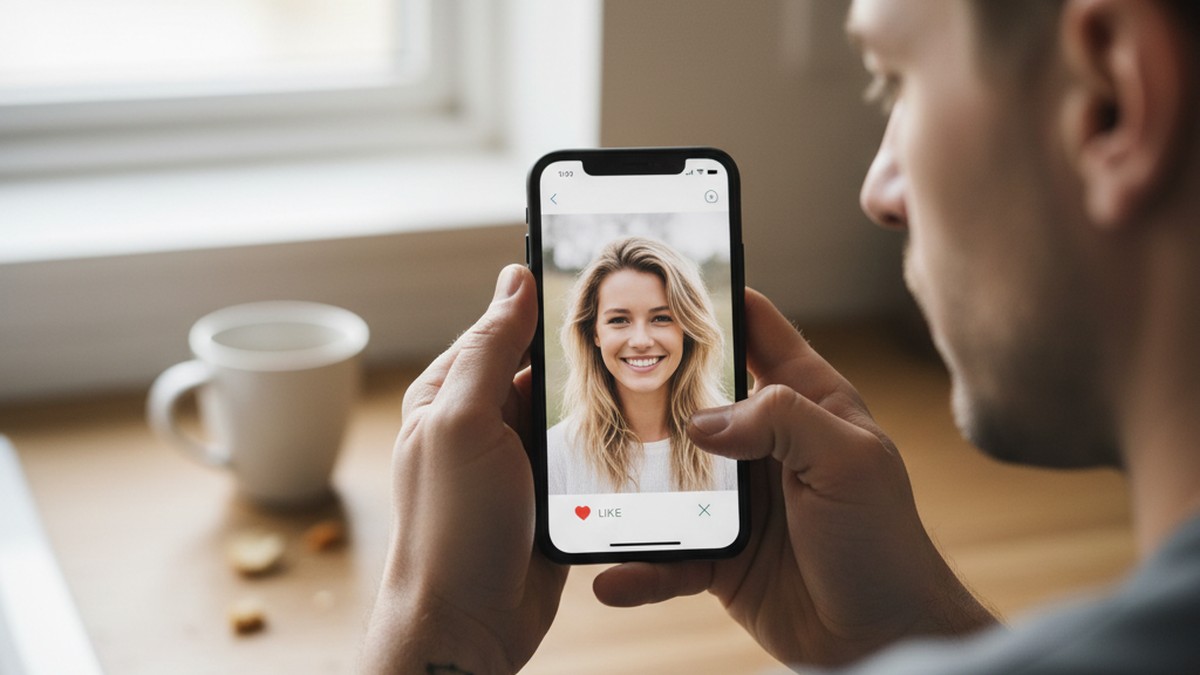
Why Is Reverse Image Search No Longer Enough in 2026?
A reverse image search can only detect fake profiles using existing, searchable photos. It cannot detect AI-generated images because those photos have never existed anywhere before — no search engine has indexed them. Treating a clean reverse image search as proof of authenticity is now one of the most consequential mistakes you can make in online dating safety.
This is the most significant shift in fake profile detection since dating apps became mainstream. For years, "did you Google the photos?" was reliable gold-standard advice for verifying a match. It still works for catching profiles using stolen real-person photos. But for AI-generated synthetic profiles — a growing fraction of romance scam reports analyzed by cybersecurity researchers throughout 2025 — a clean search result provides false confidence, which is arguably worse than no check at all.
Reporting from the Washington Times in March 2026 cited cybersecurity experts who noted a clear industry-wide shift: scammers are moving from stolen photos to AI-generated originals precisely because they're search-proof. The practical effect is a detection gap. Scam operators have essentially patched the most widely recommended defense.
Gen Digital's 2025 Cyber Safety Report found that 60% of online daters believe they've been contacted by someone using AI. Awareness is there. The problem is that awareness hasn't translated into updated verification habits — most people still rely on reverse image search as their primary check.
The practical fix requires running two separate methods rather than one. Use the photo analysis checklist from the previous section to screen for AI-generated images. Run reverse image search separately to screen for stolen authentic photos. A clean result on reverse search now only eliminates one of the two possibilities. By itself, it eliminates nothing.
This section is the one most missing from competitor guides on this topic. The advice to "just do a reverse image search" is repeated nearly universally — and it's now incomplete advice that can actively mislead someone who follows it and gets a clean result.
What Does a Fake Dating Bio Look Like?
Fake dating profile bios tend toward one of two failure modes: either extreme vagueness that could describe anyone, or suspicious perfection that reads as engineered appeal rather than genuine self-description. Both patterns exist because specific, verifiable detail creates risk for whoever built the fake profile.
Real people write specific bios because real people are specific. They mention actual neighborhoods, real hobbies with enough detail to be falsifiable, pets by name, actual habits. A genuine bio commits to things that could be checked.
The Vagueness Pattern
The most common bio pattern in fake profiles describes the person in terms that apply to roughly half of adults on any dating app. "I love to travel, try new restaurants, and spend time with people who matter to me. Looking for someone genuine to share adventures with."
Not one word of that bio is specific. Every claim is uncheckable. The "love to travel" claim appears in an estimated 38% of dating profiles according to app research, which means it signals nothing about the actual person — and for a scammer, that's exactly the point. Specificity creates verifiable claims. Verifiable claims can be checked. Fake profile operators avoid them.
Compare this to a genuine bio: "Software engineer in Midtown, 3-year-old rescue beagle named Wrenley. I make good pasta and bad decisions. Working through the 46 Adirondack peaks — 31 down, 15 to go." Every detail is specific, falsifiable, and opens natural conversation threads while also committing to things that could be confirmed or contradicted.
Inconsistency in Basic Facts
Pay attention to whether a person's stated age, profession, and life experience align in a way that makes sense. A profile claiming to be 32 years old but describing 18 years in international surgical medicine is doing arithmetic that doesn't work. A claimed location that doesn't match the visual backgrounds in photos, a profession that implies specific credentials with no supporting detail, or a life story that changes between conversations — these are writing-level tells that compound across an interaction.
Keep a mental record of what someone tells you in early messages and compare it against later exchanges. Human-operated scam accounts are often staffed by multiple operators — the person "you" are talking to on Thursday isn't necessarily the same person who was handling the account on Monday. The tell is repetition of questions you've already answered: asking where you grew up again, what your job is, or whether you've been in a long-distance relationship before, after you already covered that ground. This is a script reset or an operator handoff.
The Too-Perfect Profile
Some fake profiles overcorrect in the opposite direction. Instead of generic vagueness, they present a suspiciously complete portrait of someone who seems purpose-built to appeal. Every listed interest matches the most common dating preferences. Every stated value is maximally sympathetic. Every photo is perfect. The bio reads like a copywriter wrote it.
Real people have contradictions, quirks, and things they're not proud of. Real bios have personality but also awkwardness. When a profile reads like it was optimized for maximum positive response rather than written honestly, that precision itself is a warning sign.
Job Red Flags
Certain professions appear disproportionately in fake profiles, not by coincidence but because they provide convenient, emotionally resonant explanations for unavailability. None of these occupations make someone automatically a scammer — but each warrants additional scrutiny when they appear:
| Stated Profession | Why Scammers Use It |
|---|---|
| Military, currently deployed | Explains no in-person meeting, creates respect/sympathy |
| Doctor with international health organization | Explains absence, implies stability and care |
| Offshore oil engineer | Explains absence, implies financial means |
| International construction project manager | Generic enough to be unverifiable |
| Recently widowed (prominent early mention) | Designed to trigger empathy and lower defenses |
The "recently widowed" framing specifically has become a scammer staple. It isn't a profession but it appears in first or second exchanges in many human-operated scam transcripts, designed to establish emotional resonance before any real connection exists.
How Do You Know if a Message Is Scripted?
A scripted message doesn't respond to what you actually said — it responds to a category or trigger in your message while steering the conversation toward a pre-planned goal. The reliable tells are rapid emotional escalation, questions that ignore your specific answers, and pivot attempts toward taking the conversation off-platform or building financial dependency.
What Scripted Responses Sound Like
Real conversation follows the logical thread of what came before it. If you mention your dog and the next message is a paragraph about how rare it is to find someone who values honest connection, that message didn't register what you wrote. That's a script advancing its agenda regardless of your input.
Both bots and human-operated scammer accounts work from conversation frameworks — either explicit scripts or practiced flows designed to move through emotional stages on a predetermined schedule. The result is conversation that feels slightly off: too warm too fast, too generic despite apparent engagement, or consistently steered toward particular themes regardless of what you raise.
Watch for these specific patterns:
Response speed inconsistency. Messages that arrive within seconds at any hour — 2am, 7am, across time zones — suggest either an automated system or an operation running 24-hour shifts. Real people have lives that create natural response gaps.
Topic drift after specific questions. You ask where in Portland they grew up. They answer "oh, I spent time all over — I've always been someone who adapts to new places" and pivot to asking about your relationships. That deflection-and-redirect pattern, repeated across different questions, is a reliable indicator of evasion.
Unusual formality for casual communication. Scammers often copy-paste phrases between accounts, and some of those phrases are noticeably formal or polished for text messages. If someone's casual texting sounds like it was written for a corporate pitch, that register mismatch is worth noting.
Repetition of emotional themes. Real conversation evolves. Scam scripts cycle through the same emotional themes regardless of where actual conversation has gone: honesty, destiny, rare connection, trust. If you feel like you keep hearing the same emotional notes across different topics, that's a pattern the script returns to.
The Emotional Escalation Script
One of the most consistent markers of a romance scam in progress is emotional intensity that arrives too soon, then builds faster than any real relationship would.
Within a few exchanges, you're "the most real person I've talked to on this app." Within a week, they've never felt this way before. Within two weeks, the word "love" appears. This acceleration is not organic — it's the playbook. It's called love bombing, and it exploits a genuine human tendency: when someone seems utterly entranced by us before they've actually learned much about us, our instinct is often to rise to meet their apparent investment rather than question it.
Norton's 2026 Insights Report found that 24% of online daters acknowledge loneliness influences them to make riskier trust decisions. This is the exact vulnerability the escalation script targets. The emotional acceleration in a fake-profile interaction isn't coincidence or chemistry — it's a calculated technique applied at scale.
Requests to Move Off-Platform
Dating apps have fraud reporting systems. Scam operators know this. Within a few messages, many fake profiles will request that you move to WhatsApp, Telegram, or another messaging app — framed as convenience but actually designed to remove you from any environment where the platform can detect and flag them.
"I barely check this app, let's text on WhatsApp" is one of the most consistent lines across documented romance scam transcripts. Resist it. If someone is genuinely interested in you, they can sustain a normal conversation within whatever app you're both using. Insistence on moving elsewhere before any real rapport is established is a structural tell, regardless of how reasonably it's framed.

How Scammers Escalate: The Romance Scam Playbook
Understanding how romance scam operations actually run makes individual red flags much easier to recognize in context. These aren't improvised, opportunistic acts — they're structured operations with defined phases and specific goals at each stage.
The typical romance scam follows four phases, with some variation by operation:
Phase 1 — Targeting (Days 1-7). The account initiates contact, establishes basic rapport, and quickly identifies shared values and emotional preferences through a series of probing questions. Compliments are early and frequent. The stated profession and personal situation are selected to sound impressive while explaining unavailability. The goal of Phase 1 is to establish daily communication and a sense of mutual discovery.
Phase 2 — Investment (Weeks 2-6). Daily contact becomes established and expected. Emotional intimacy accelerates on a schedule, not organically. The operator "remembers" details you've shared and references them to create the feeling of being genuinely seen and known. Consistency is manufactured through note-taking or scripted reference points. The relationship feels like it's developing. It is — but toward a predetermined end rather than genuine connection.
Phase 3 — Crisis Introduction (Weeks 4-10). The first financial request arrives, framed as an emergency: a medical situation, customs fees on a package being shipped to you, a temporarily blocked bank account, or a business opportunity requiring a short-term transfer. The request is presented as embarrassing and painful to make — the scammer expresses reluctance and emotional cost at having to ask. This framing is intentional: it makes compliance feel like support rather than financial transfer to a stranger.
Phase 4 — Extraction or Exit (Week 8+). If you comply, additional requests follow, often escalating in amount. If you question the narrative or refuse, the scammer either disappears immediately or applies emotional pressure: guilt, disappointment, accusations that you never really cared. Some operations at this stage will also threaten to share intimate photos or information if any was exchanged — a pivot to extortion.
The FTC reported a median romance scam loss of $2,218 in Q3 2025. That median obscures the distribution: older adults were nearly twice as likely as younger adults to report six-figure losses, according to the same FTC data. These aren't small transactions at the tail end of the data — they're representative of how some of these operations play out over time.
The FACE Check: A 4-Step Verification Framework
The FACE Check is a systematic method for evaluating any new match before you invest emotional time or share personal information. It covers four dimensions that fake profiles consistently fail: Photos, Activity, Consistency, and Engagement. Each dimension takes about a minute to assess. Together they provide a reliable aggregate signal.
This framework exists because no single red flag is conclusive. Attractive people have thin photo galleries too. Real people work unusual hours. A single scripted-sounding response might just be an off day. What's reliable is the pattern across multiple dimensions — and the FACE Check is built around that principle.
F: Photos
Before reading the bio or engaging with any message, spend two minutes on the photos. Ask:
- How many photos are there?
- Are they all similar in style, lighting, and setting?
- Do any look candid, group, or spontaneous — or are they all composed?
- Run a reverse image search on the primary photo.
- Apply the AI visual checklist: check ears, background geometry, skin texture, and any visible hands.
Pass: Three or more photos showing different settings and time periods, at least one candid or group shot, clean reverse image search with no mismatched results, no AI artifacts under examination.
Fail: One to two photos, all professionally styled, same setting and angle, plus either a match in reverse image search or visible AI artifacts.
A: Activity
Many apps show when someone was last active. A profile that has been dormant for six months but is now actively messaging you is worth questioning. Similarly, look for clues about account age — some apps display this directly, others allow you to infer it from profile structure.
An account created in the last few weeks that is sending highly engaged, emotionally escalating messages is a signal worth noting. Real people on dating apps tend to have some history of activity — past matches, profile updates, periods of active use interspersed with quiet periods.
Pass: Recent activity history that predates your match, evidence of normal use patterns over time.
Fail: Brand-new account, no visible history, or activity timestamps that suggest the account was created specifically for your match.
C: Consistency
Look for alignment across all the information available: photos, bio, stated age, location, profession, and what they say in messages. Does the stated life story hold together internally? Does the claimed job match the apparent lifestyle? Does the stated city match any visual detail you can identify in background elements?
Then test consistency directly. Ask a specific follow-up about something mentioned in their bio. "You said you're from Portland — which neighborhood?" or "You mentioned you work in emergency medicine — what hospital?" Real people have specific answers to these questions. Fake profiles deflect, give vague non-answers, or redirect to a different topic.
Pass: Details align across all sources, specific follow-up questions get specific answers without deflection.
Fail: Bio is either too vague or inconsistent, specific questions get redirected, or stated details contradict each other across the conversation.
E: Engagement
Pay attention to whether responses track what you actually said. Does the conversation feel reciprocal, with them picking up on specifics you've shared? Or does it feel like you're talking alongside them rather than with them — like both of you are following different scripts?
The most reliable engagement test is to volunteer an unusual specific detail — something genuinely unexpected — and watch whether it appears in subsequent messages. A real person who was paying attention references it. A scripted interaction moves on as if you never said it.
Pass: Responses directly engage with what you said. The conversation builds on specific prior exchanges. Unusual details you share are acknowledged.
Fail: Generic responses that could fit almost any input. Emotional escalation that doesn't track conversational content. A sense that the other person is steering toward certain topics regardless of where you go.
Scoring: If a profile passes all four dimensions, that's a reasonable indicator of authenticity — no framework is perfect, but consistent performance across all four dimensions is a strong signal. If it fails two or more dimensions, treat the profile as likely fake until you have specific contradictory evidence.
Platform-Specific Red Flags on Tinder, Bumble, and Hinge
Dating apps have different cultures, verification standards, and user bases — which means fake profiles operate differently across platforms and concentrate on different tactics depending on the environment.
Tinder
Tinder has historically been the platform most targeted by automated bot operations, partly because of its large user base and relatively low barrier to account creation. Common Tinder-specific fake profile tactics include:
- Profiles with a single photo and an Instagram handle embedded in the bio or username (the immediate goal is migration off-app before fraud detection can flag the account)
- Accounts using location spoofing to appear locally relevant when operating from overseas (Tinder Passport, legitimately designed for travelers, is frequently misused this way)
- "Verification scam" messages claiming the app requires identity verification through a third-party site (Tinder verification is done within the app itself — any link asking you to verify elsewhere is a scam)
Tinder's photo verification feature lets users confirm their photos are genuine by submitting selfies. Profiles with this verification badge are significantly harder to fake, though not impossible. A profile without any verification and with urgency around moving off-app is a high-risk combination.
Bumble
Bumble's requirement that women message first in heterosexual matches means bot operators frequently set accounts to female — the bot then responds after the male user replies to a match. Bumble's own verification features (video and photo verification) significantly reduce fake profile prevalence on the platform. According to Bumble's data, verified profiles are 56% more likely to receive matches, reflecting how much genuine users value that signal of authenticity.
For same-gender matches on Bumble, be aware that the first-message requirement doesn't apply, which means the tactical landscape is different. The same FACE Check principles apply, but the bot patterns differ.
Hinge
Hinge reportedly has among the lowest rates of fake account encounters of the major apps, partly due to more stringent account setup requirements and the app's design philosophy of prompting specific personal content. The platform has announced plans to require identity verification for all profiles by the end of 2026.
Even on platforms with better verification, human-operated scam accounts exist — they're just harder to create at scale. More rigorous platforms shift the composition of fake profiles toward the human-operated category and away from bots.
Cross-Platform Tells
Regardless of which app you're using, these behaviors signal a fake:
- Immediate pressure to move the conversation to WhatsApp, Telegram, or text
- Profile that prompted a match but has since limited its visibility or gone inactive (suggesting the account was flagged or deleted)
- Photo verification badge absent on platforms where it's commonly used and visible
- Any request to click an external link within the first few exchanges
- Claims about technical problems that prevent video chat, appearing reliably before every proposed call
The apps cheaters use to hide activity follow some of the same operational logic as scammer accounts — both are designed to maintain a hidden presence on apps their partner doesn't know about, and both exploit the same privacy features.

How Do You Verify Someone Is Real — And What to Do When They Resist
Ask a specific casual question about something in their photos or bio and watch whether they give a concrete answer or deflect. Suggest a brief video call framed as a personal safety habit. Check their social media for account age and genuine activity. Most real people understand these requests and won't push back on them.
The Casual Specificity Test
This is the most natural verification method available, and it doesn't feel like an interrogation when done well. Pick something specific from their profile — a photo location, a mentioned hobby, a referenced place, a pet's name — and ask about it conversationally.
"Is that photo at Arches National Park? I've been wanting to go" is a normal question. So is "You mentioned you make your own pasta — what's your go-to recipe?" These aren't tests that feel like tests. They're the kind of specific follow-up genuine people ask each other.
A real person engages with the specific detail: they confirm or correct it, expand on it, ask you a follow-up from their own experience. A scripted interaction either ignores the specific and responds generically, or gives a vague answer designed to seem like confirmation without committing to facts.
Test consistency by doing this across multiple exchanges. Each answer is a data point in the Consistency dimension of the FACE Check.
The Video Chat Suggestion
Video calls are now normal enough in early-stage online dating that suggesting one shouldn't feel confrontational. Frame it as a personal preference: "I like to do a quick video chat before meeting anyone, just my comfort thing — works for you?"
Real people who are interested in you either agree readily or propose a specific alternative time. Fake profiles produce excuses — camera problems, noisy environments, bad timing — that then repeat whenever video comes up. A single excuse is nothing. A pattern of consistent unavailability for video, across multiple attempts over multiple weeks, is definitive.
Some human-operated scam accounts will agree to video and then cancel repeatedly. The pattern of agreement-followed-by-cancellation-with-excuse, repeating more than twice, is as meaningful as outright refusal. Real people can find five minutes for a video call.
Checking Social Media
If someone has given you their name and city, a quick social media search is reasonable. Look for:
- Account age relative to when it was apparently created (a profile claiming to be 35 with a social media account created four months ago is a mismatch)
- Photo consistency (do the images on their dating profile also appear on their social media, in a way that would make sense if it were the same person?)
- Genuine activity over time (real posts that built up organically, comments from friends who also have history, life events that leave traces)
- Follower and following ratio (a three-year-old account with 11 followers and 3 posts is unusual unless the person is deliberately very private)
Completely invisible people — no social media presence, no searchable professional history, nothing at all — aren't automatically fake. Some people are genuinely private. But combined with other FACE Check flags, total absence of any digital footprint becomes more significant.
What Pushback Looks Like From Different Types of Fakes
When you question a profile's story, propose a video call, or apply pressure through a specific factual question, the response pattern is one of the most reliable diagnostics available.
From bots: Either total non-registration of your question — responding as if you'd said something else entirely and continuing the script — or a restart to an earlier point in the conversation. If you ask a pointed question and receive a generic response about connection and honesty, you're likely dealing with an automated system.
From human scammer accounts: More adaptive. When questioned, they typically respond with emotional hurt ("I can't believe you'd think that after everything we've shared"), technical explanation ("my camera doesn't work on this app but I can WhatsApp video"), or a cycling pattern of defensive hurt followed quickly by warmth and reaffirmation. What they reliably don't do is simply comply with the straightforward version of your request — show their face on the same app, give a specific answer to a specific question, or respond to inconsistency without deflection.
A useful test: Deliberately introduce a false fact about something they told you — misremember a detail and see if they correct it. A person who was paying genuine attention corrects you. A scammer running multiple accounts simultaneously from scripts or notes often accepts the false version because they weren't tracking the conversation closely enough to notice.
This isn't a standalone test. Treat it as one more data point in the Engagement dimension.
What Should You Do If You Find a Fake Profile?
Report the profile using the dating app's built-in reporting tool before taking any other action, then block the account. Screenshot the profile and all message exchanges first — once you block or report, you may lose access to that documentation.
Reporting on Each Platform
Every major dating app has a report function accessible from the profile view. Use it. Reports from multiple users about the same account accumulate — they're what trigger platform review and removal. A single report may not be enough to remove an account immediately, but it creates a record and contributes to eventual action.
Don't skip this step even if you're certain the account is gone or you didn't engage much. Reports help protect the next person who might have been more vulnerable.
If You've Shared Personal Information
Risk varies by what was shared:
- Full name and city: Relatively low risk in isolation. Monitor for unusual contacts but no urgent action required.
- Phone number: Be alert for phishing calls or texts from unknown numbers in the following weeks. Don't answer unknown numbers and don't click links in unexpected texts.
- Email address: Check your account for unauthorized access attempts. Change your password and enable two-factor authentication if you haven't.
- Financial information or money: Contact your bank or credit card company immediately. If you transferred money via wire, gift card, or cryptocurrency, recovery is difficult — but report to the FTC at ReportFraud.ftc.gov regardless. The documentation supports investigations even when the money isn't recoverable.
- Intimate photos or personal content: If there's any threat to share this material, document the threat (screenshot), report to the platform, and contact the FBI's IC3 at ic3.gov. Non-consensual intimate image sharing is illegal in most U.S. states and increasingly prosecuted.
Reporting to Authorities
Romance scams using fake profiles to extract money are federal fraud crimes. Two reporting destinations are appropriate:
- FTC: ReportFraud.ftc.gov — handles consumer fraud reports and builds the data that informs prosecutions
- FBI IC3: ic3.gov — handles internet crime complaints, including romance scams and extortion
Even if you lost no money, reporting a fake profile contributes to aggregate intelligence that helps investigators identify and disrupt scam operations. Volume of reports on similar accounts and methods is how these operations eventually get shut down.
What Cheating Partners and Fake Profiles Have in Common
There's a specific situation where fake profile detection overlaps with relationship investigation: when someone suspects their partner is actively using dating apps and wants to verify without direct confrontation. The same profile evaluation skills apply, because a partner who claims not to be on dating apps is also hiding a presence deliberately — which creates the same structural inconsistencies as a scammer.
Dating apps are designed to allow semi-anonymous presence. A partner who maintains a hidden profile is using those privacy features intentionally. The dating app cheating statistics suggest this situation is more common than most people assume, and the emotional stakes are just as real as any romance scam.
If you're trying to find out if your partner is on dating apps, a profile scan can search multiple platforms simultaneously rather than checking each one manually. CheatScanX searches 15+ apps in a single query and returns whether a profile matching your search exists. If you want a broader look at behavioral signals alongside digital evidence, the guide on signs of phone-based cheating covers what to observe in day-to-day behavior.
What profile searches can and can't tell you is worth stating clearly: they confirm presence or absence of a profile. They don't interpret what that presence means — a profile that was never deleted from before a relationship is different from one with recent active use. Context and judgment still matter after the search.
Real vs. Fake: The Full Signal Reference
| Signal | Genuine Profile | Fake Profile |
|---|---|---|
| Photo count | 4+ photos, varied settings | 1-3 photos, similar in style |
| Photo type | Mix of candid, group, casual | All headshots or professional quality |
| Reverse image search | Nothing, or their own social media | Stolen photo found elsewhere, or nothing (AI-generated) |
| AI visual tells | None under examination | Ear issues, background geometry, skin smoothness |
| Bio specificity | Specific places, hobbies, details | Vague or suspiciously perfect |
| Stated profession | Realistic, varied | Military, oil rig, doctor abroad |
| Response speed | Variable, reflects real schedule | Instant at any hour (bot) or oddly consistent |
| Emotional pace | Gradual, tracks conversation | Rapid, doesn't track what you said |
| Video chat | Flexible, follows through | Excuses, repeated cancellations |
| Platform behavior | Uses the app normally | Pushes to move off-app quickly |
| Social media | Exists, aged normally | Thin, new, or completely absent |
| Specific question response | Specific answer | Deflection or vague answer |
| Financial topic | Never comes up early | Appears after emotional investment established |
No single signal is conclusive on its own. The FACE Check works because it aggregates across all four dimensions. A profile that raises concerns in two or more categories deserves serious skepticism regardless of how appealing the individual signals are.
Conclusion
Spotting a fake dating profile in 2026 is harder than it was three years ago for one specific reason: AI-generated photos have broken the verification method that millions of people rely on most. A clean reverse image search no longer means anything definitive — it may just mean the photos were synthesized rather than stolen, which is exactly what makes them undetectable through search.
What still works is systematic evaluation. The FACE Check — Photos, Activity, Consistency, Engagement — provides a framework that doesn't depend on any single signal. Most genuine people pass all four dimensions without effort. Most fakes fail at least two.
The behavioral tells remain consistent across both automated bots and human-operated scam accounts: responses that don't track what you said, emotional intensity that doesn't match the pace of real relationship development, and consistent unavailability for video contact. These patterns are harder to sustain across time than convincing photos.
Discomfort you can't immediately explain often means your pattern recognition is working. Use the FACE Check to find out what specifically is causing it. If the answer is two or more failing dimensions, you have your answer — and the reporting steps above are the right response.
For situations where you suspect a real partner rather than a stranger, the same verification logic applies, and dedicated tools exist to do the search systematically rather than platform by platform.
Frequently Asked Questions
Photos are the best starting point but not enough on their own. AI-generated profile photos won't appear in a reverse image search, so look for visual tells: unnatural skin texture, ears that don't match normal anatomy, or backgrounds with subtle distortions. Real people also have imperfect, varied photo galleries — not a curated set of perfect headshots taken in the same setting.
Yes — both bots and human-operated fake accounts respond. Bots reply within seconds at any hour and stick to scripted questions that don't track what you said. Human-operated scammer accounts respond more naturally but steer every conversation toward emotional escalation, moving off-platform, or eventually requesting money. Scripted repetition and topic-avoidance are the most reliable tells.
Report the profile using the app's built-in reporting tool, then block the account. Screenshot the profile and any messages first as documentation. If you've already shared personal information or sent money, contact your bank immediately and report the incident to the FTC at ReportFraud.ftc.gov. Don't try to expose or confront the account operator yourself.
Creating a fake dating profile to deceive someone isn't illegal on its own in most jurisdictions, but using one to commit fraud — obtaining money under false pretenses, identity theft, or extortion — is a federal crime. The FTC and FBI both investigate romance scam operations. Reporting fake profiles creates documentation that supports those prosecutions even if you lost no money.
The FTC reported $1.16 billion lost to romance scams in the first nine months of 2025. Norton's 2026 Insights Report found 34% of online daters have been targeted by scams. Gen Digital's 2025 Cyber Safety Report found 1 in 4 daters globally have encountered catfishing. The scale has grown significantly due to AI tools that generate convincing synthetic profile photos at near-zero cost.