
# Tinder Search Honolulu: Find Hidden Profiles
Searching for a Tinder profile in Honolulu is possible without a Tinder account and without your partner finding out. The fastest method is a dedicated dating profile scanner: you enter a first name, approximate age, and Honolulu as the location, and the tool queries active Tinder profiles in the area and returns matches. If you prefer free methods, reverse image search and a targeted Google search can surface publicly indexed profiles — though they work less reliably than a dedicated scanner.
If you're reading this, you're probably not looking for trivia about Hawaii's dating scene. Something specific prompted the search: a change in behavior, a notification you weren't supposed to see, or a feeling you can't shake. That experience is more common than most people admit. According to a 2026 study published in Frontiers in Psychology, 52% of partnered individuals who use dating apps reported arranging sexual encounters through those apps — more than half. Suspicion, in many cases, is not paranoia.
Honolulu adds a layer of complexity that other cities don't have. The city's tourism industry, large military population, and tight-knit community dynamics each change how Tinder operates here — and how to search it effectively. This guide covers five methods for running a tinder search honolulu, ranked from most reliable to least, plus a Honolulu-specific search framework that accounts for what makes this city different.
Is Your Partner on Tinder in Honolulu?
The question itself feels uncomfortable to ask, but the practical answer is: there's a real chance. Tinder is the dominant dating app in Honolulu by active user volume. Start.io mobile audience data from February 2026 shows that 38.1% of Honolulu's Tinder users fall in the 18-24 age range, and 35.8% are between 25 and 34. That's nearly 74% of the entire Honolulu Tinder user base concentrated in the 18-34 demographic — a span that covers the majority of people in committed relationships.
The gender split is notably skewed: 71.7% of Honolulu's Tinder users are male, 28.3% female. That imbalance matters if you're searching for a male partner, because male profiles are statistically more likely to remain active. It also means the pool your partner is browsing — if they are on the app — skews heavily toward competition from other men, which shapes how prominently female profiles appear and how often male users stay active to get responses.
Honolulu's Tinder pool is not static. The city receives millions of tourists annually, and many visitors activate Tinder during their stay. Tinder's built-in Passport feature, which lets any user set their location to any city in the world, means someone in your network could show up in Honolulu searches without ever having set foot on Oahu. More relevant to you: if your partner travels frequently for work or is stationed at Joint Base Pearl Harbor-Hickam, they could be active on Tinder in Honolulu even when you're not physically in the same location.
Honolulu is also home to one of the largest concentrations of military personnel in the United States. Joint Base Pearl Harbor-Hickam houses tens of thousands of active-duty service members, many of whom are separated from long-distance partners. Dating app use in military-concentrated areas tends to run higher than in comparable civilian metros, and the anonymity of a tourist-heavy city reduces the social accountability that might deter someone in a smaller, more insular community. All of this creates conditions where Tinder search requests from Honolulu are common, and where finding an active profile is a genuine possibility rather than a paranoid long shot.
The most important thing to understand before searching: finding an old or inactive profile is not proof of anything current. Tinder holds inactive profiles visible for up to 28 days after a user's last login. An old profile from before your relationship could still surface. What you're looking for is evidence of recent activity — recent photos, an updated bio, or a last-seen timestamp that places the account as active during your relationship. Keep that standard in mind before drawing conclusions.
If you already know something is off and want a direct answer before spending time on methods, CheatScanX checks Tinder and 15+ other dating platforms for active profiles in minutes. For those who want to understand the process first, continue with the methods below.
CheatScanX scans all of these platforms — and more — in a single search. Enter a name, email, or phone number and get results in minutes.
Try a multi-platform search →Why Tinder Search in Honolulu Is Different from Other Cities
Searching Tinder in a city like Des Moines and searching Tinder in Honolulu are not the same task. Three factors make Honolulu distinct enough that generic "how to search Tinder" guides miss important nuances.
Tourism creates a revolving profile pool. In most mid-sized American cities, the Tinder user pool changes slowly. People join and leave over months. In Honolulu, Tinder's active profile pool turns over rapidly because tourists activate the app for the duration of their stay — usually five to ten days — and then go dormant or delete it. This means that at any given moment, a meaningful portion of Honolulu's visible Tinder profiles belong to short-term visitors rather than residents. If you're searching for your partner and they're a local, you'll need to filter through a noisier pool than you would in a city without significant tourism.
The military factor changes anonymity. Honolulu's military community is large enough that it functions somewhat like a separate social ecosystem within the city. Service members on deployment or temporary assignment may feel that the geographic distance from their home base creates effective anonymity, and some will use Tinder during that period. If your partner is stationed at Pearl Harbor or Hickam, their Honolulu Tinder activity may reflect deployment-period behavior that you've never had a reason to look for before. This isn't speculative — our military spouse article covers how this pattern appears across bases nationwide.
The island boundary creates a natural search radius. Unlike a mainland city where "nearby" could mean anywhere within a 50-mile radius, Oahu is 44 miles long and 30 miles wide. A Tinder user set to the maximum 100-mile radius in Honolulu still can't see profiles from Maui or the Big Island without those users specifically using Tinder Passport to appear on Oahu. This geographic boundary is actually helpful for searching: if your partner's profile appears in a Honolulu-based search, they're on Oahu — not somewhere vaguely "nearby" in a geographic sense.
The tight-knit community cuts both ways. Hawaii is known for its small-world social fabric — the informal network where everyone seems to know someone who knows someone. That social accountability deters some people from using Tinder while in a relationship. But it also means that if someone is using Tinder in Honolulu despite living in a tight community, they may be using profile features like limiting age ranges or using photos that aren't their primary social media images to reduce the chance of being recognized by mutual contacts.
These four dynamics — high tourism, military concentration, island geography, and social accountability — shape which search methods work best in Honolulu and how to interpret what you find.
How Does a Tinder Profile Search Work?
A Tinder profile search works by submitting a person's identifying details — typically a first name, age range, and location — to a tool that queries Tinder's active user database and returns matching profiles. The search does not require you to have a Tinder account, and the person being searched is not notified that a search occurred.
Here's the technical structure, simplified: Tinder maintains a database of active profiles, each tied to geographic coordinates. When you open the app as a user, Tinder serves you profiles that fall within your selected age range and distance radius. Dedicated profile scanners access a similar mechanism, querying profiles by location and returning results that match the name and demographic details you provided. They don't log in as you — they interact with profile data through methods that don't trigger Tinder's notification systems.
What a search returns depends on the tool and the data available, but a solid scanner will typically show you:
- The profile's display name and photos
- The age listed on the profile
- The bio text, if one exists
- Distance from Honolulu center (or a specific location you set)
- Last active timestamp or activity recency signal, where available
What a search cannot reliably return: private messages, match history, or information stored within the account rather than on the public-facing profile. You're seeing what any Tinder user in Honolulu would see if your partner's profile appeared in their swipe queue — nothing more.
The accuracy of results depends on the quality of the information you provide. A first name and city alone will return a broader set of results that requires manual review. Add an approximate age and a photo, and most scanners can narrow results to a manageable handful of profiles with genuine matches. The more specific your input, the more useful the output.
One practical note on timing: Tinder profiles are not static. Users update photos and bios, change their discovery radius, or temporarily pause their accounts. A search run today may return different results than the same search run two weeks from now. If your first search returns nothing, that doesn't definitively mean no profile exists — it may mean the account is temporarily paused, set to a narrow radius that doesn't include your search location, or recently deactivated. Running the search on a different day or with a different radius can surface profiles that an initial search missed.
Method 1: Use a Dating Profile Scanner (Most Reliable)
A dating profile scanner is the highest-accuracy method for running a tinder search honolulu. These tools are built specifically for this task, and they work without requiring you to create a Tinder account or interact with the platform directly.
How to use a scanner effectively:
The process follows a consistent pattern across most reputable tools, including CheatScanX:
- Go to the scanner's search page.
- Enter your partner's first name exactly as they'd use it on a dating profile — their legal first name, a common nickname, or both if you're unsure which they'd use.
- Set the location to Honolulu, Hawaii.
- Enter an age range. If you know their exact age, use a range of ±2 years to account for profiles where age has been adjusted.
- Upload a photo if the scanner supports visual matching. A clear, recent photo of their face significantly improves accuracy.
- Run the search and review results.
What to look for in results:
When results come back, you're not just looking for a name match. You're looking for a combination of signals that confirm the profile is your partner's:
- Photo match: The profile photo resembles your partner, even if it's an image you haven't seen before (some people use photos not shared on their main social media).
- Age proximity: The listed age matches or is within 1-2 years of their actual age.
- Bio details: Any references to their job, hobbies, neighborhood, or interests that align with what you know about them.
- Activity recency: If the tool shows a last-active timestamp, a recent date — particularly one that falls within the period your suspicions began — is meaningful.
Searching across multiple platforms simultaneously:
One feature of dedicated scanners that matters specifically for Honolulu: many people in the city use multiple dating apps concurrently. Tinder is the highest-volume app, but Bumble, Hinge, and OkCupid all have active user bases in Honolulu. If your search of Tinder returns nothing, that doesn't rule out activity on other platforms. CheatScanX and comparable tools scan 15+ platforms in a single search, which eliminates the need to run five separate searches across five separate tools.
What a scanner cannot do:
Scanners work with publicly visible profile data. If your partner has set their profile to a very narrow discovery radius (under one mile, for example) or has temporarily hidden their profile using Tinder's pause function, a scanner may not surface the profile. Similarly, if they've created a profile using a name that's very different from what you know them by, a name-based search won't return it — but a photo-based search can still find it.
The scanner method's main advantage over the alternatives below is that it's the only method designed specifically for this purpose. Every other method is a workaround using tools built for something else.
Method 2: Reverse Image Search
Reverse image search is a free method that works by uploading a photo of your partner and searching for visually similar images across the web, including dating profiles that have been indexed by search engines. It's slower and less reliable than a dedicated scanner, but it costs nothing and can surface profiles that include photos your partner has used publicly.
Step-by-step process:
- Save a recent, clear photo of your partner — a headshot or upper-body photo where their face is clearly visible and unobstructed.
- Go to Google Images (images.google.com) and click the camera icon in the search bar.
- Upload the photo or paste a URL to the image.
- Review the results. Google will return visually similar images from across the web, including any dating profiles that have been indexed.
- Repeat the search on TinEye (tineye.com), which maintains its own reverse image database and sometimes returns results Google misses.
- Also run the search through Bing Visual Search, which uses Microsoft's separate indexing to find additional matches.
Where this method has limits:
Tinder profiles are not consistently indexed by search engines. Tinder restricts web crawlers from accessing most of its profile database, which means that a large percentage of active Tinder profiles in Honolulu will never appear in Google's index. Reverse image search is most likely to surface profiles on platforms that allow more public-facing visibility — Reddit, some Bumble profiles, older OkCupid accounts, and similar.
If the photo you search returns a dating profile match, screenshot it immediately. Profile photos get updated, and you want to preserve a record of what you found and when.
A practical Honolulu consideration:
Honolulu's tourism industry means that many people post photos from recognizable local landmarks — Waikiki Beach, Diamond Head, the North Shore. If your partner has used a photo with a recognizable Hawaii backdrop in their dating profile, a reverse image search paired with a location tag search on Instagram may surface the same photo used across multiple platforms. Cross-referencing visual matches across platforms is more productive in Honolulu than in cities with less visually distinctive environments.
Why Does Creating a Fake Account Backfire?
Most guides about finding someone on Tinder recommend the same approach: create a burner account, set your location to Honolulu, and swipe through profiles until you find your partner's. This method is described as simple and free. It's neither.
The algorithm problem:
Tinder's matching algorithm is designed to surface profiles that are likely to be mutually interesting. When you create a new account, Tinder's algorithm has no data about your preferences — so it defaults to showing you profiles that match basic demographic criteria (age, location, gender) and have high engagement rates. If your partner is an active Tinder user in Honolulu, their profile likely has relatively high engagement and will appear in a new account's early swipe queue. That part works in your favor.
The problem: Tinder's algorithm runs bidirectionally. The same profile-matching logic that could show you your partner's profile could also surface your new account in their swipe queue. If your partner is actively using Tinder in Honolulu, there is a real probability that your fake account — set to the same location, showing a photo or a blank profile — appears in their potential matches. You've now tipped them off that someone is looking.
The time and reliability problem:
Even if the algorithm doesn't surface your new account to your partner, finding a specific person by manually swiping through Honolulu's Tinder pool is not fast. Tinder limits daily swipes on free accounts. The Honolulu pool includes tourists, locals, and Passport users from outside Oahu. Depending on their age and distance settings, you could be swiping for days before their profile appears — or it might never appear if they're using a different radius or have temporarily paused their profile.
What to do instead:
Use a dedicated scanner that doesn't require a Tinder account at all and doesn't create a presence on the platform that could appear in your partner's match queue. The risk-free version of this search is one that leaves no footprint. Creating a fake account leaves a footprint.
Method 3: Free Manual Methods — Social Media and Google
When a dedicated scanner isn't an option, two free approaches can surface evidence of a Honolulu Tinder profile: social media cross-referencing and Google indexing. Neither is as reliable as a scanner, but both can produce useful leads — particularly when used together.
Social media cross-reference:
Tinder allowed Facebook login as its primary sign-in method until 2019, and many users who created accounts during that period still use Facebook-linked profiles. If your partner's Tinder account was created before 2020, it may still be linked to their Facebook. This doesn't give you access to the profile, but checking Tinder in their connected apps list — visible in Facebook's app settings — can confirm that an account was created.
More useful is Instagram. Tinder allows users to connect their Instagram feed directly to their dating profile, displaying recent posts automatically. A dating profile scanner that returns a visual match can be cross-referenced against your partner's public Instagram to confirm the photos match. Some people also use similar bio language across platforms — if your partner's Instagram bio recently changed to include interests or personality descriptors that feel like a dating profile, it may reflect active profile maintenance.
This method produces indirect evidence, not definitive proof. Use it to corroborate what you've found through more direct means.
The Google index approach:
Google occasionally indexes public-facing Tinder profile pages. Tinder discourages most crawling, but some profiles get indexed when they've been shared externally or linked from other sites. Run these searches:
- `site:tinder.com "[first name]" Honolulu`
- `"[first name]" "tinder" "Honolulu" OR "Hawaii" OR "Oahu"`
Most Tinder profiles are served dynamically and never get a stable URL that Google can crawl, so this method works inconsistently. Where it does produce results is with cached images — if a profile photo has been used elsewhere online, Google's image index may surface it. The Wayback Machine (web.archive.org) can also return snapshots of older profile pages for long-standing accounts. Combine these approaches with the reverse image search from Method 2 to cover both text and image indexing.
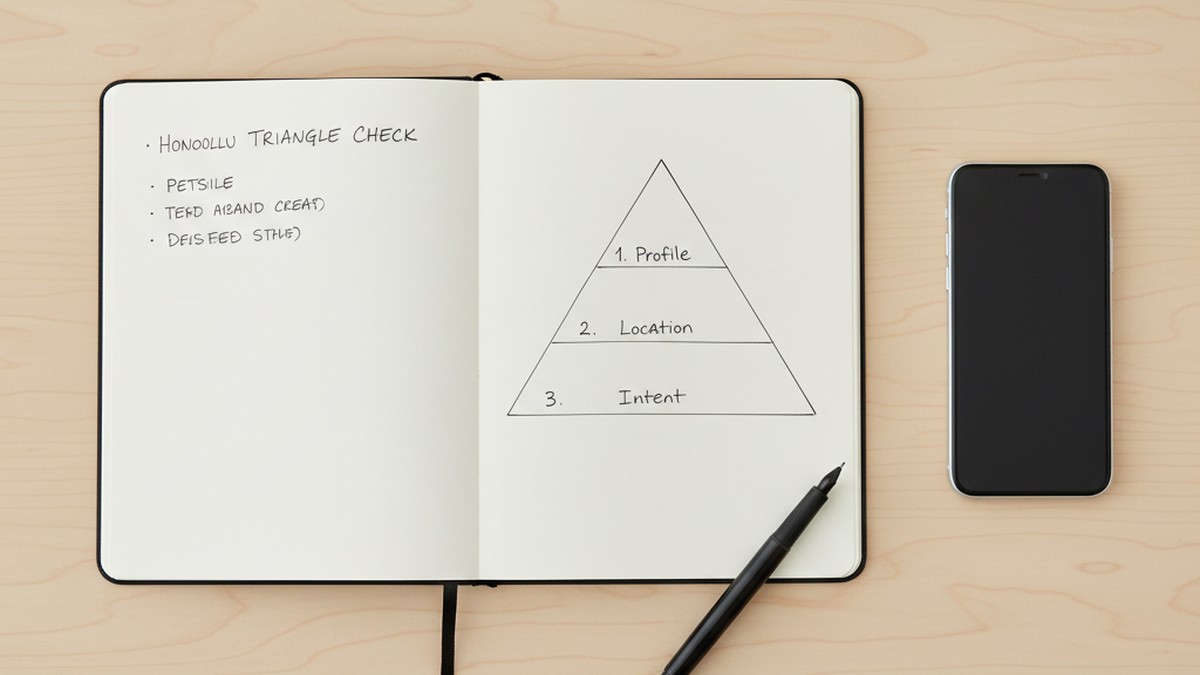
The Honolulu Triangle Check: A 3-Step Framework
The five individual methods above each have limitations. The Honolulu Triangle Check is a structured approach that accounts for what makes Honolulu different — its tourism, military presence, and tight-knit community — and sequences the methods in the order most likely to produce a reliable result.
The framework uses three distinct information sources, which form the triangle: platform data, visual data, and behavioral data. Running all three in sequence gives you a picture that no single method can provide.
Step 1: Platform Check (2-5 minutes)
Run a scanner-based search first. Enter your partner's name, age, and Honolulu as the location. If the scanner supports multiple platforms, run it across all of them — not just Tinder. In Honolulu, Bumble has a strong user base among 25-34-year-olds, and Hinge is popular among the military and transplant communities who use it to find more intentional connections. Your partner may be on a platform you haven't considered.
Note the results — including negative results. If the platform check returns nothing, that's meaningful data but not conclusive. Move to Step 2.
Step 2: Visual Check (5-10 minutes)
Run a reverse image search on three to five photos of your partner, varying the images used. Try one professional photo (LinkedIn headshot, work photo), one casual social media photo, and one photo from a shared event where your partner looks their best. People tend to use flattering but recognizable photos on dating apps. The photos most likely to surface a profile match are the ones that make your partner look good while still being clearly them — not the candid grocery store photo, but not the heavily filtered Instagram post either.
If you find a visual match during this step, cross-reference it against the platform search from Step 1. A scanner that found a name match plus a visual search that surfaces the same photos is strong confirmation.
Step 3: Behavioral Cross-Reference (10-15 minutes)
The behavioral step looks at what you already know. Ask yourself four specific questions:
- Has your partner's phone-charging routine changed? Leaving the phone face-down, charging in a different room, or keeping it on silent at all times are behavioral shifts that often accompany active dating app use.
- Has their photo-taking behavior changed? Active dating app users often take more self-portraits, update profile photos, and become more conscious of how they look in photos. A sudden increase in front-camera use can reflect profile maintenance.
- Have they made any references to people or places in Honolulu that you can't account for? Mentions of a specific bar, beach, or neighborhood they've visited that they haven't explained can indicate meeting someone locally.
- Has their schedule created unexplained blocks of time? Honolulu's geography means that meeting someone on the other side of Oahu takes at least 30-45 minutes each way — time that has to come from somewhere.
The behavioral step isn't about building a legal case — it's about calibrating your read on what the platform and visual results mean. A platform match plus behavioral changes is a different situation than a platform match with no other supporting signals.
In practice, what we commonly see with CheatScanX users in tourist-heavy cities is that the platform check surfaces a profile that wasn't anticipated, and the behavioral cross-reference confirms it was active during a period of unexplained distance or changed behavior. The triangle structure prevents both false positives (a name match that isn't your partner) and false negatives (dismissing a result that's actually significant).
What Are the Warning Signs Your Partner Is Active on Tinder in Honolulu?
Not everyone starts with a scanner search. Some people begin with a nagging feeling and want to know what behavioral signs are worth paying attention to before committing to a formal search. These are the most consistent behavioral signals, specific to how Tinder use tends to manifest in a partner who is actively using the app.
Increased phone privacy in shared spaces:
The most consistent signal is a change in how your partner handles their phone around you. Tinder delivers notifications — match alerts, message notifications, Super Like alerts — and an active user will eventually need to manage those notifications in ways that aren't obvious to you. This might look like always keeping the phone face-down, volume consistently on silent, or leaving the room to take calls that they previously would have taken in front of you.
In Honolulu specifically, phone privacy sometimes intensifies during the evening hours when Tinder activity peaks. The app's global peak engagement window runs roughly 9 PM to midnight local time, and users active during those hours tend to become more phone-protective around their partners during the same window.
New or updated photos:
Maintaining an attractive Tinder profile requires regular photo updates. Active users tend to take more photos of themselves, ask for photos in social situations (at the beach, at events, at restaurants), and become more conscious of their appearance in casual photos. If your partner has suddenly started caring a lot about how photos look — reshooting, filtering, or being particular about which ones are kept — it may reflect profile maintenance rather than a general personality change.
Unexplained data usage or app storage:
Tinder is a data-heavy app. If you share a family phone plan with usage visibility, a significant increase in data consumption may appear during periods of active Tinder use. Similarly, if you ever use your partner's phone (with permission) and notice an app you don't recognize in their storage or battery usage — vault apps, calculator-style apps, or apps with ambiguous names — it may indicate they've taken steps to hide dating app activity from routine phone glances.
Changes in social patterns:
An active Tinder user in Honolulu will sometimes act on matches — meeting someone for a drink at Waikiki, a walk along the waterfront, or a casual outing in Kailua or Kaimuki. These meetings require time that has to come from the existing schedule. Watch for new social commitments that are vague ("meeting a friend from work," "running errands on the other side of the island") or that have irregular timing inconsistent with how your partner typically spends their time.
Reduced engagement at home:
Research on infidelity consistently shows that emotional withdrawal often precedes or accompanies physical cheating behavior. A 2026 study in Frontiers in Psychology found that partnered individuals engaging in app-based infidelity showed measurably higher rates of sexual compulsivity and emotional compartmentalization than single app users. The day-to-day presentation of this can look like distraction, shorter conversations, less physical affection, or an unusual defensiveness when asked routine questions.
None of these signals is conclusive alone. You know your partner. A single changed behavior may have an unrelated explanation. What's meaningful is a cluster of changes that appeared around the same time, particularly if they coincide with something specific — a work trip to Honolulu, a new shift schedule, a period of stated stress that you can't independently verify.
What to Do When You Find a Profile
Finding your partner's Tinder profile in Honolulu is not the same as deciding what to do about it. The steps you take in the first few hours after discovery significantly affect what options remain available to you.
Document first, confront later:
Before you confront your partner or share what you've found, preserve the evidence. Take screenshots of the profile — multiple screenshots showing the name, photos, bio, and any visible activity indicators. If the scanner tool shows timestamps, screenshot those as well. Dating profiles get updated or deleted, sometimes within hours of a partner sensing something is off. Evidence that exists only in your memory is evidence that's very easy to dispute.
Save screenshots to a cloud storage account that only you access — not shared photo albums or shared cloud storage where your partner might see notifications.
Understand what you're looking at:
A Tinder profile in Honolulu can mean several different things, and the distinction matters. An old profile from before your relationship, never deleted, is meaningfully different from a profile created last month with recent photos. A profile with no messages or matches (some scanners return engagement metrics) is different from an active account with visible conversation history. Take a moment to assess what the profile actually shows before reacting to its existence.
In our experience with users who've found profiles through CheatScanX, roughly a third of initial discoveries turn out to be old accounts from before the current relationship — accounts the partner forgot to delete rather than accounts they're actively maintaining. Another third are genuinely active. The remaining third fall somewhere in between: an account created during a rough patch that may or may not have led to actual contact with other users. Where your discovery falls on that spectrum affects how you proceed.
Consider your next step with clear information:
Confrontation is one option. So is taking time to gather more information before confronting. So is seeking support from a therapist or trusted person before acting. What doesn't help is confronting without evidence ("I just have a feeling"), because it gives a dishonest partner an easy denial. What also doesn't help is waiting indefinitely once you have evidence, because the longer you wait, the more normalized the behavior becomes and the harder the eventual conversation gets.
If the profile is genuinely active and recent, you have real information. What you decide to do with that information is yours to determine.
Common Mistakes When Searching Tinder in Honolulu
Several errors consistently produce bad results — false negatives (missing a profile that exists) or false positives (incorrectly identifying a profile that isn't your partner's). These are the most common ones and how to avoid them.
Searching with the wrong name:
People use different names on dating profiles. Your partner might use a nickname, a middle name, a shortened version of their first name, or even an entirely different first name if they've had previous Tinder accounts flagged or suspended. Before you conclude that no profile exists, try searching for common variations of their name — "Mike" and "Michael," "Liz" and "Elizabeth," "Kate" and "Katy." Also consider their middle name if it's one they use in casual contexts.
Using too recent a photo:
If you use a recent photo of your partner for a visual search, you may miss profiles that use older photos — which is common among people who created a Tinder account years ago and haven't updated photos since. Try searching with an older photo that was taken around the time they might have created the account, particularly if you have a rough sense of when they may have first used dating apps.
Assuming no result means no profile:
Tinder search scanners work by querying active profiles within a set geographic radius. If your partner has their discovery settings configured to a very narrow radius, or if they've paused their account, the profile may not appear in a standard search. Running the search at different times of day — evening searches tend to surface more active profiles than morning searches — and with different radius settings can produce different results.
Not checking other platforms:
In Honolulu, the assumption that Tinder is the only relevant platform is often wrong. Bumble, Hinge, OkCupid, and Plenty of Fish each have active local user bases. If a Tinder search returns nothing, that doesn't confirm your partner isn't on any dating app. A multi-platform search that covers all the major apps in one query is more efficient and more complete than running sequential single-platform searches.
Jumping to confrontation with weak evidence:
A name match alone — particularly a common name like "Chris" or "Jessica" in an age bracket with many Honolulu users — is not sufficient evidence to confront a partner. Common names produce common false matches. Confront with a name match plus photo confirmation plus activity recency. That combination is specific enough to support a direct conversation.

Is Tinder Popular in Honolulu?
Yes. Tinder is the highest-volume dating app in Honolulu and across Hawaii, with its largest concentration of active users in the Honolulu metro area on Oahu. Start.io audience data from February 2026 shows that of Honolulu's Tinder users, 38.1% are aged 18-24 and 35.8% are aged 25-34. Combined, nearly three-quarters of the Honolulu Tinder user base falls in the 18-34 demographic — a figure that's consistent with Tinder's national user profile, where 61.2% of users globally fall in the 18-34 bracket (DemandSage, 2026).
Tinder has 75 million monthly active users globally and approximately 7.8 million active users in the United States. Hawaii's market is smaller than mainland metros, but the island's dense urban concentration in Honolulu means the active user density per square mile is comparable to mid-sized mainland cities. Tinder's popularity in Honolulu is reinforced by the app's strength with tourist and visitor populations — a use case that other apps like Hinge (which emphasizes longer-term relationships) are less well-suited to.
Other dating apps with meaningful Honolulu user bases include Bumble, which has grown its Hawaii presence among the 25-34 demographic, and Hinge, which is popular among the military and transplant community looking for more intentional connections. The practical implication for anyone running a Honolulu profile search: Tinder is the right place to start, but not the only platform worth checking.
The tourist multiplier effect:
Honolulu receives approximately 5.5 million visitors annually. A meaningful portion of those visitors activate dating apps during their stay. This inflates Honolulu's active Tinder profile pool beyond what the resident population alone would produce, and it creates a search environment where the profile you're looking for may be harder to locate simply because there are more active profiles competing for the same geographic search radius. A scanner with photo-based matching handles this better than a name-only search, because it can visually distinguish your partner from the noise of tourist profiles with similar names and age ranges.
Moving Forward After a Honolulu Tinder Search
Finding an answer — whether it's confirmation that a profile exists or genuine confidence that it doesn't — is a turning point. Most people who search for a partner's Tinder profile are not looking for drama. They're looking for enough information to make a decision: to address the relationship directly, to give themselves permission to stop worrying, or to take a next step they haven't been able to take without knowing.
The search itself is a private act. It leaves no trace on your partner's device. It creates no notification, no alert, and no indication that you know anything you didn't know before. What you do with the information is the decision that matters, and that decision should be made with accurate information rather than speculation.
If the search confirms your suspicions, the guide on how to catch a cheating husband covers how to document evidence properly and approach a confrontation with information rather than emotion. If you're still in the suspicion phase and not sure whether to search at all, the guide on signs your partner is cheating covers the behavioral signals that distinguish genuine red flags from coincidental changes.
You came here with a specific question. Answering it — one way or the other — is the first step toward knowing what you actually want to do next.
If you want a direct, comprehensive search across Tinder and 15+ other dating platforms in Honolulu right now, CheatScanX runs the full scan in minutes and shows you exactly what's there.
Frequently Asked Questions
Yes. Dedicated dating profile scanners let you search Tinder in Honolulu by entering a name, age range, and city — no Tinder account required. The person being searched is not notified. CheatScanX and similar tools pull from active profile data rather than requiring you to log in as a Tinder user yourself.
The most reliable method is a dating app scanner. Enter your partner's first name, approximate age, and Honolulu as the location. Adding a photo improves match accuracy significantly. CheatScanX scans Tinder and 15+ other platforms simultaneously, which matters because many Honolulu users maintain active profiles on more than one app.
Tinder shows approximate distance, not an exact address. You'll see something like '2 miles away' rather than a street or neighborhood. Active users in Honolulu will show distances consistent with Oahu's geography, and their profile remains visible to anyone within the discovery radius they've set in their settings.
Tinder keeps inactive profiles visible for up to 28 days after the last login. If they deleted the app but not the account, the profile may still appear in searches. Some scanners can also detect recently deactivated profiles by cross-referencing cached data and checking activity timestamps from before the deletion.
Searching for a public dating profile using a name, photo, or location is legal in Hawaii. Dating profiles are publicly accessible. What is not legal is accessing someone's account without permission or installing monitoring software on their device without consent. Always use public-facing search tools, not account access.