# Does Bumble Notify When You Screenshot?
Bumble does not notify the other person when you take a screenshot. Whether you capture a profile, a photo, or an entire conversation, your match receives no alert — no ping, no notification, nothing. This holds true on iPhone and Android, for free accounts and paid tiers alike.
That's the direct answer. But the full picture is more nuanced than a simple yes or no, and for many people searching this question, the answer they need goes well beyond whether Bumble sends a notification.
A 2025 survey by HighSpeedInternet.com found that 27% of respondents admitted to using a dating app while in a committed relationship. A 2026 Frontiers in Psychology study on dating app-facilitated infidelity found that discovery patterns closely tracked digital evidence collection. For the people on the other side of those matches — documenting what they found — knowing what Bumble can and cannot detect matters practically.
This article covers exactly what Bumble does and doesn't track, how iOS and Android handle screenshot detection at the system level, which apps genuinely do send alerts, the real legal risks of sharing screenshots in 2026, and a three-part framework for assessing screenshot risk on any platform. By the end, you'll have a complete picture of your actual privacy exposure on Bumble — from both sides.
Does Bumble Send a Screenshot Notification?
Bumble does not send a screenshot notification to the other person. When you take a screenshot on iPhone or Android, the action happens at the operating system level — entirely outside Bumble's detection range. The app has no built-in mechanism to alert your match that you captured their profile, photos, or chat messages.
This isn't a policy gap that a future update could easily close — it reflects a fundamental technical architecture constraint. Understanding why requires a brief look at how screenshots actually work.
How Screenshots Work at the OS Level
When you press the volume-plus and power buttons simultaneously on an iPhone, or the equivalent combination on an Android device, the screenshot is processed entirely by the device's operating system. The screen buffer — every pixel visible at that moment — is captured and saved to your camera roll by the OS, not by any individual app. From Bumble's perspective, nothing happened. The app received no event, no hook, no notification.
For an app to detect a screenshot, it would need one of two things: (1) the operating system to expose a screenshot event API that the app has implemented, or (2) the app to have elevated system-level permissions that no standard consumer app is granted. Neither applies to Bumble.
iOS does expose a limited screenshot detection API. Apps can subscribe to receive a notification that a screenshot occurred while the app was in the foreground. Snapchat uses this API as the technical foundation for its screenshot alert system. Bumble simply doesn't implement it — and the reasons for that choice are explored later in this article.
What You Can Screenshot Without Detection
- Any Bumble profile, including photos and bio text
- Any matched user's full profile view
- Any conversation or individual message
- The "Beeline" or "Likes You" views
- Any notification that appears on your screen while using the app
None of these will trigger any alert to the person you screenshotted. The image exists only on your device until you do something with it.
Bumble's Privacy Policy on Screenshots
Bumble's official privacy policy includes language that implicitly acknowledges the screenshot situation: "A user may recommend you as a match to another person by taking a screenshot of your profile picture and sharing it, regardless of whether such person is also a user of the app." The matter-of-fact tone confirms that Bumble treats screenshots as ordinary user behavior outside their control.
The policy also notes that "even after you remove information from your profile or delete your account, copies of that information may still be viewable and/or accessed to the extent such information has been previously shared with others, or copied or stored by others." Bumble is explicitly telling you: once someone has your photos or messages, the app cannot retrieve or undo that. Understanding this asymmetry is important for both sides of any dating app interaction.
CheatScanX scans all of these platforms — and more — in a single search. Enter a name, email, or phone number and get results in minutes.
Try a multi-platform search →Does Bumble Notify When You Screenshot a Chat or Message?
No. Bumble does not notify anyone when you screenshot a private chat or individual messages. The same OS-level invisibility that applies to profile screenshots also applies to conversation screenshots. Whether you capture a single message or a full thread, the other person receives no alert — now or later.
This surprises people who associate screenshot notifications with messaging apps. The confusion usually traces back to Snapchat's well-known alert system — the same platform that generates its own relationship red flags, as covered in our guide to Snapchat cheating signs — or to Instagram's short-lived experiment with notifying users when someone screenshotted disappearing messages (a feature Instagram later removed). Neither pattern applies to Bumble.
Private Conversations vs. Public Profile Content
Some users assume that conversation content receives special protection because it's "private." Bumble treats both profiles and chats identically from a screenshot detection standpoint: neither triggers any notification. The word "private" in "private message" describes the visibility setting within the app, not any technical protection against capture.
The distinction that matters isn't technical — it's legal and ethical. A screenshot of someone's profile photos occupies different territory than a screenshot of intimate images shared in a private conversation. The former is closer to capturing publicly shared information; the latter increasingly falls under legal protections. More on that in the legal section.
What Bumble's Chat System Does Track
While screenshots operate below the app's visibility, Bumble's chat system does actively monitor several user behaviors:
Read receipts: Bumble shows when a message has been seen, with a small indicator in the conversation view. Depending on settings and subscription tier, this can show both delivery and read status.
Typing indicators: The animated ellipsis that appears when the other person is composing a response.
Active status: Premium subscribers can see "recently active" indicators on profiles, giving a sense of recent app use without real-time tracking.
Message delivery status: Bumble distinguishes between messages delivered to the app (device received it) and messages read (opened in-app).
Report tracking: Bumble logs user reports for moderation purposes — who reported whom, for what reason, and what action was taken.
Screenshots fall entirely outside this monitored behavior set. Bumble's tracking focuses on real-time in-app events. Device-level actions like screenshots are invisible to the app layer.
Can Bumble See What You Screenshot After the Fact?
No. There is no mechanism — automatic or manual — by which Bumble can determine whether a screenshot was taken after the fact. If a user files a report alleging screenshot misuse, Bumble's moderation team reviews the report and the reported account's history, but they cannot access any record of screenshot activity. Evidence of misuse would need to come from the content itself (if re-shared somewhere Bumble can see) rather than any internal log.
Can You Screen Record Bumble Without the Other Person Knowing?
Yes. Bumble cannot detect screen recordings any more than it can detect standard screenshots. Screen recording on iOS and Android operates at the system level, which apps cannot access or monitor. Bumble has no mechanism to identify when you start or stop a screen recording session on your device.
This matters in practice because screen recording captures something standard screenshots cannot: continuous interaction. You can record yourself scrolling through a conversation history, viewing a match's profile photos one by one, or capturing the full context of a message exchange — all without triggering any alert.
Screen Recording on iOS
On iPhone, screen recording is initiated through the Control Center, an OS-level interface. The recording is handled by Apple's ReplayKit framework, which operates in the background independently of any app. The app being recorded receives no notification that a recording is in progress and has no access to the recording file while it's being created.
iOS does provide a mechanism for apps to protect their content from screen recording — the same FLAG_SECURE equivalent exists in iOS for protected content (used by streaming apps to prevent capturing DRM-protected video). Bumble does not use this protection.
Screen Recording on Android
Android's screen recording behavior varies slightly by manufacturer — Samsung, Google Pixel, and OnePlus all have slightly different implementations — but all operate at the OS level. The app sandbox model on Android means Bumble's code runs in an isolated environment with no visibility into OS recording events.
One nuance on Android: some aggressive security configurations (common in banking apps and certain enterprise software) use WindowManager's FLAG_SECURE flag to prevent both screenshots and screen recordings. Bumble does not use FLAG_SECURE.
Bumble's Private Detector: What It Actually Does
Bumble does have a content-monitoring feature worth knowing about, and it's important to understand what it actually does to avoid confusing it with screenshot detection.
Private Detector is an AI-powered system that scans images sent within conversations. When someone sends an image that the AI classifies as potentially explicit or lewd, the system automatically blurs the image before the recipient sees it. The recipient gets a warning: "This image may be inappropriate." They can choose to view or delete it without ever seeing the content directly.
What Private Detector does not do:
- Detect or prevent screenshots of any content
- Alert the sender that their image was blurred or reviewed
- Monitor whether recipients capture or share images
- Create any notification about how in-app content is handled after receipt
Private Detector is an inbound content filter designed to stop unsolicited explicit images from being viewed — not an outbound surveillance system. Its existence actually reveals something useful: Bumble has the AI infrastructure to analyze in-app content but has chosen to apply it to harassment prevention rather than screenshot surveillance.
How iOS and Android Handle Dating App Screenshots
Understanding why Bumble can't detect screenshots requires a practical look at how mobile operating systems manage the process. This isn't abstract — it explains why no update to the Bumble app alone can make it screenshot-aware without cooperation from Apple or Google.
The App Sandbox Architecture
Modern mobile OSes run apps in isolated sandboxes. Each app can observe its own data and actions but cannot monitor other apps or OS-level events unless explicitly granted permission by the operating system. Screenshots are an OS-level event — they happen above the sandbox boundary.
When you take a screenshot, the OS captures the entire screen buffer and saves it to your camera roll. The app never receives any signal. It's architecturally similar to taking a photo of your screen with a second phone — there's no technical path for the app to know about it.
The Screenshot Detection API: What It Allows
Apple's screenshot detection API for iOS gives apps the ability to receive a notification that a screenshot was taken while the app was the active foreground application. Critically, the API is detection-only:
- The app is notified that a screenshot occurred
- The app cannot prevent the screenshot
- The app cannot access the screenshot file
- The app cannot determine what portion of the screen was captured
This is the API Snapchat uses. When you screenshot a Snapchat snap, Snapchat receives the iOS notification, identifies which content was on screen, and sends an alert to the original sender.
Bumble doesn't implement this API. The technical capability to receive the notification exists; Bumble has simply chosen not to subscribe to it.
Why Technical Screenshot Prevention Is Largely Ineffective
Even the most aggressive screenshot prevention — like Android's FLAG_SECURE used by Badoo — has a fundamental limitation: any visual interface that can be seen can be photographed with another device. Take a screenshot with your main phone while viewing Bumble on your tablet. Use a computer connected via screen mirroring. Simply point a second phone's camera at the screen.
None of these bypass methods trigger any in-app detection. The digital privacy of dating app content is ultimately protected by laws and social norms more than by technical controls — which is precisely why the legal framework around screenshot sharing has been evolving rapidly.
The Deeper Reason Dating Apps Skip Screenshot Detection
Implementing the screenshot detection API would change user behavior in ways that undermine the dating experience. Consider what changes if Bumble sent screenshot alerts:
People would screenshot less — including entirely harmless behavior like saving a conversation with someone they genuinely like. Recipients would receive odd notifications about innocuous captures ("Jordan screenshotted your photo"). Users would become self-conscious and guarded in their profiles and messages, reducing the candid quality that makes dating app conversations work. First-date photo sharing, profile reference, and the normal pattern of showing a friend "look at this person I matched with" would all generate disruptive alerts.
Dating apps are in the business of reducing social friction. Screenshot notifications introduce friction without meaningfully improving privacy, given how easily they're bypassed.
Which Dating Apps DO Notify About Screenshots?
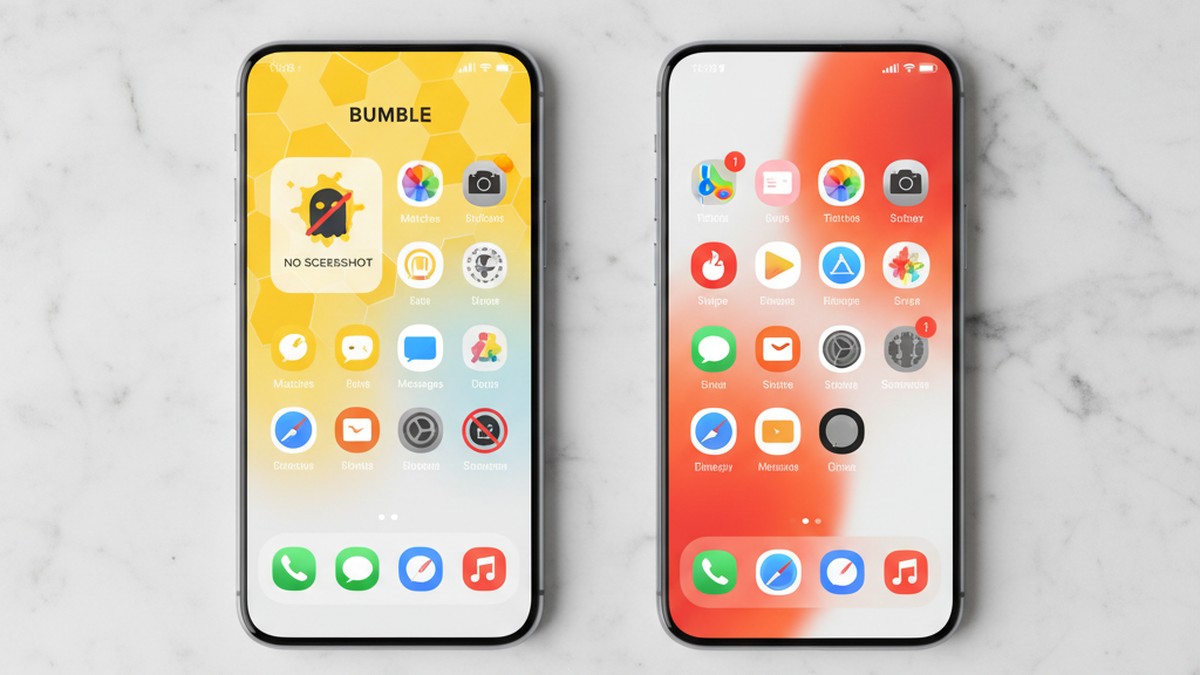
Badoo is the only mainstream dating app that actively blocks and alerts users when someone screenshots a conversation. Raya enforces a strict no-screenshot policy and permanently bans accounts caught sharing profile screenshots. All other major apps — Tinder, Hinge, OkCupid, Match, and Bumble — send no screenshot alerts whatsoever.
Here's the full comparison across major platforms:
| Platform | Screenshot Notification | Screen Recording | Enforcement Method | Notes |
|---|---|---|---|---|
| Bumble | No | No | Complaint-only | OS-level, no API implementation |
| Tinder | No | No | Complaint-only | Explicitly confirmed, no detection |
| Hinge | No | No | Complaint-only | Consistent with low-pressure brand philosophy |
| OkCupid | No | No | Complaint-only | No detection mechanism |
| Match.com | No | No | Complaint-only | No alerts for any content capture |
| Badoo | Yes | Partial | Active + complaint | Blocks and alerts in conversation view |
| Raya | Policy only | Policy only | Community ban | No real-time detection; enforced manually |
| Snapchat | Yes | Yes | Real-time alert | Core feature; screenshot and recording alerts |
Why Badoo Is the Outlier
Badoo's screenshot blocking is implemented using Android's FLAG_SECURE window flag and its iOS equivalent. When this flag is set, the operating system prevents its own screenshot function from capturing the app's content — the resulting screenshot is either black or shows a blank screen instead of the app. The other user also receives a notification that a screenshot was attempted.
This approach genuinely works for device-native screenshots. Its limitation: screen recording via mirroring (connecting your phone to a computer, for instance) or a second physical device can still capture the content. FLAG_SECURE prevents the OS from helping with the capture, but it can't prevent a human with a second camera.
Badoo's model is more common in markets where the app is popular — Eastern Europe and Latin America particularly — where user expectations around privacy may differ from North American defaults.
The Raya Model: Community Enforcement Without Technology
Raya takes an entirely different approach. The invitation-only app, popular with celebrities and creative professionals, doesn't use technical controls to detect screenshots. Instead, it relies on social accountability and manual review.
If screenshots of Raya profiles are found publicly shared — on Twitter, Reddit, gossip sites — the account responsible gets banned after investigation. This works because Raya's user base has unusually strong incentives to protect each other's privacy. Leaking another user's profile is a social violation serious enough that community pressure provides real enforcement.
The distinction matters: Raya's no-screenshot policy is a community norm with manual enforcement, not a technical control. Technically, screenshotting Raya profiles is as easy as screenshotting Bumble profiles. The consequences come from community enforcement, not detection.
What Snapchat's Model Reveals About the Trade-Off
Snapchat's screenshot detection is frequently cited as the standard other apps "should" adopt. But Snapchat's model only makes sense in Snapchat's product context: the entire value proposition is temporary content that disappears. Screenshot detection enforces the product's core promise.
Dating apps don't make that promise. Bumble profiles are designed to be viewed, shared with friends for feedback, and referenced over time. Imposing screenshot detection on that context would solve a problem that most users don't experience while creating friction that all users would feel.
Bumble's Actual Privacy Features: What Does It Track?
Bumble monitors considerably less than most users assume — and is more transparent than they realize about the gaps. A clear inventory of what Bumble can and cannot detect helps calibrate actual privacy exposure.
What Bumble Cannot Detect or Record
- Screenshots of profiles, photos, or messages (no API implementation)
- Screen recordings of any in-app content
- Whether you copy and paste a message or bio text
- Whether you share a profile link outside the app
- Whether you photograph your phone screen with a second device
- Whether you show your phone to someone else in person
What Bumble Does Track
Profile interactions: Bumble tracks swipes and likes to power its matching algorithm. The app can see that you liked a profile; the other user cannot see that you viewed or swiped left.
Message delivery and read status: Bumble shows message delivery (sent to device) and read (opened in app) indicators. If you've read someone's message, a small check-mark or eye indicator appears.
Active status indicators: Bumble Premium subscribers can see a green dot or "recently active" badge on profiles, indicating recent app use. This is not real-time — it reflects activity within a window of hours, not live status.
Connection expirations: Bumble notifies both parties when a match is about to expire due to the 24-hour first-message window. If your partner is receiving unexpected dating app notifications, that pattern itself can be telling — our breakdown of partner getting dating app notifications covers what different notification types actually signal.
Report history: Bumble's moderation system logs reports made against accounts and tracks any patterns. Accounts with multiple reports enter a review queue.
App activity for their own analytics: Like any platform, Bumble collects anonymized usage data — session length, features used, screens viewed — for product improvement. This doesn't expose individual behavior to other users.
Private Detector: The Full Picture
Private Detector is worth revisiting with more technical detail because it's the one place where Bumble does apply AI to content monitoring.
The system processes incoming image attachments before they render in the recipient's chat view. The image classification runs on Bumble's servers — not on the device — which means Bumble does see and analyze images sent through the app. Flagged images are blurred with an overlay, and the recipient can choose to view or decline.
What this tells you practically: images you send on Bumble are processed by Bumble's servers. This is standard for cloud-based messaging services and is disclosed in the privacy policy. It does not mean Bumble stores or reviews individual images manually, but it does mean "private" conversations involve a third-party server in the delivery chain.
For screenshots: this analysis pipeline has no connection to screenshot behavior. Bumble analyzes incoming image content, not what devices capture on their screens.
The Legal Reality: When Screenshots Cross a Line
The absence of a Bumble notification has no bearing on your legal exposure. Whether an action is technically detectable by an app and whether it's legal are completely separate questions. Taking a screenshot is legal. Sharing certain screenshots can be a federal crime.
This is the most practically important section of this article for many readers, and it's the part that nearly every competitor article either omits entirely or treats with a vague "be responsible" disclaimer. The legal landscape in 2026 has changed substantially.
The TAKE IT DOWN Act (May 2025)
The TAKE IT DOWN Act was signed into federal law on May 19, 2025, and represents one of the most significant digital privacy statutes passed in the United States in recent years. It directly applies to content shared from dating apps, including Bumble.
Key provisions under the TAKE IT DOWN Act (Library of Congress, 2025):
- Publishing intimate images of adults without consent: criminal fines and imprisonment of up to two years
- Publishing intimate depictions of minors: penalties of up to three years imprisonment
- Covered platforms (including major dating apps) had until May 19, 2026 to establish notice-and-removal processes — meaning platforms are now legally required to act on removal requests for non-consensual intimate images
"Intimate images" under the Act includes sexual or nude photographs, but also images that depict someone in a context clearly intended to remain private. A photo someone sent you during a private Bumble conversation — even if not explicitly sexual — can qualify under this definition when the surrounding context (romantic relationship, app-based communication) establishes a reasonable expectation of privacy.
State-Level Non-Consensual Image Laws
As of 2026, 48 states have enacted non-consensual pornography statutes (often called revenge porn laws). These vary in scope — some require sexual content specifically, others cover any private image — but collectively they mean that sharing intimate screenshots from dating apps without consent is illegal in nearly every U.S. jurisdiction.
What courts examine when assessing whether sharing violates these laws:
- Reasonable expectation of privacy: Images sent within a dating app conversation carry a strong expectation of privacy. The private messaging context establishes this almost automatically.
- Intent at time of original sharing: Sending an image to a match on Bumble is consent to that one person receiving it — not consent to redistribution. Courts have consistently treated limited-context consent as non-transferable.
- Intent at time of sharing publicly: Laws distinguish between accidental exposure and deliberate distribution. Deliberate sharing intended to embarrass or harm the subject draws the most severe treatment.
- Intimate nature of content: The more personal and sexual the content, the more aggressively prosecutors pursue cases and the more seriously courts treat damages.
Screenshots That Carry No Legal Risk
Not every Bumble screenshot creates exposure. These uses are generally legally unproblematic:
- Saving a profile photo or bio for personal reference (not redistribution)
- Capturing chat messages as personal documentation of a relationship
- Sharing privately with a therapist, attorney, or trusted person for advice
- Using as supporting material in legal proceedings through proper channels
- Sharing profile screenshots in clearly non-harmful contexts (showing a friend, keeping a record)
The line is meaningful redistribution: sharing someone's Bumble content with third parties for the purpose of embarrassing, harassing, or harming them, particularly when the content is intimate.
A Common Misconception Worth Clarifying
Many people assume that because Bumble doesn't notify about screenshots, they have no legal accountability for what they capture. This reasoning conflates technical invisibility with legal protection — they're unrelated. A crime committed in the dark is still a crime. The TAKE IT DOWN Act specifically does not require that the victim know their images were shared or that any platform detected the sharing. The offense is the act of sharing, not the detection of it.

Why Bumble Chose Not to Implement Screenshot Detection
The technical capability exists. Bumble could implement the iOS screenshot notification API with a relatively modest engineering effort. The decision not to reflects genuine product reasoning, not oversight.
Screenshot Detection Creates More Problems Than It Solves
Consider the user experience in a world where Bumble sends screenshot alerts:
You're talking to a match who seems interesting. You screenshot their profile to show a friend and get a second opinion — something millions of Bumble users do regularly and harmlessly. Your match immediately receives a notification: "[Your name] screenshotted your profile." They wonder why. You feel surveilled. The easy, casual quality of the interaction is disrupted.
Now imagine this from the match's perspective. You're chatting with someone. You get a notification that they screenshotted something. Is that alarming? Probably not, in isolation — but it changes the texture of the interaction. You become aware that the other person is treating the conversation as documentable. The natural candor that makes dating conversations work gets replaced by self-consciousness.
Hinge built its entire brand identity around being "designed to be deleted" — a low-pressure, low-surveillance experience. Tinder's product team has explicitly stated that screenshot notifications create "more awkwardness than prevention." Bumble operates in the same philosophical territory.
The Bypass Problem Makes Technical Detection Largely Futile
Even if Bumble implemented the maximum technically available screenshot protection, determined users would bypass it in seconds. Options that don't trigger any app-level detection:
- Photograph the phone screen with a second device
- Use AirPlay or screen mirroring to capture via a connected device
- Record via a computer with screen capture software while mirroring the phone
- Use an emulator environment where screenshot APIs don't fire to the app
Any visual interface that can be viewed can be captured by a sufficiently motivated person. Technical controls stop casual, accidental captures — they don't stop anyone who actually intends to capture something.
Given this, screenshot detection on Bumble would primarily inconvenience casual users (the large majority) while barely slowing down anyone who wanted to capture content for harmful purposes (the small minority). That's not a favorable trade-off.
What Bumble Is Actually Investing In for Privacy
Bumble's actual privacy investments focus on harassment prevention and identity verification rather than screenshot detection. In addition to Private Detector, Bumble has invested in photo verification (matching a live selfie to profile photos), block and report tools, and transparency reporting about enforcement actions.
These investments address the problems that actually harm users at scale: fake profiles, catfishing, and in-app harassment. Screenshot misuse is real but comparatively rare, and largely addressable through legal channels that exist regardless of whether the app detects the capture.
Can Screenshots Prove Cheating on Bumble?
Screenshots of a Bumble profile or chat document that an account with certain photos and content existed at the time of capture. Most family attorneys treat them as supporting evidence rather than conclusive proof — screenshots can be edited, lack authoritative metadata, and don't establish whether the account was actively used or simply forgotten.
This question sits at the heart of why many people search "does Bumble notify screenshots." The concern isn't hypothetical privacy curiosity — it's practical documentation of potential infidelity.
What a Screenshot Actually Demonstrates
A profile screenshot shows:
- An account with specific photos and bio content existed at the time of capture
- The profile was visible at that moment (consistent with an active account, though not proof of recent activity without timestamps)
- The photos match a specific person (probative, not conclusive)
A conversation screenshot shows:
- Messages were exchanged using specific language at visible timestamps
- The app identifies both parties by username or profile reference
- The content of specific exchanges
What screenshots don't conclusively establish:
- When the Bumble account was originally created
- Whether the account reflects recent deliberate use vs. a forgotten profile never deleted
- Proof of in-person meetings or physical contact
- That the person behind the profile is actively pursuing matches (vs. dormant on the platform)
The "Active Profile" vs. Dormant Account Question
One scenario that comes up frequently: a partner's Bumble profile appears in a search, and a screenshot is captured. The profile exists — but does it prove active use?
A screenshot of the profile alone doesn't answer this well. Screenshots that capture active-use indicators carry more weight:
- "Recently active" timestamps visible on Premium accounts
- Recent photos (identifiable by clothing, location, or context dating them to after the relationship began)
- Message exchange dates visible in a conversation screenshot
- Profile updates (bio changes, new photos) that didn't exist in earlier captures
For a more systematic understanding of active dating app behavior, the behavioral patterns in our article on signs your partner is using Bumble to cheat go well beyond what a single screenshot can show.
Screenshots and Legal Proceedings
In divorce or custody proceedings, Bumble screenshots are typically treated as circumstantial evidence — relevant and potentially significant, but requiring corroboration. Courts have generally allowed screenshot evidence when:
- The screenshot's authenticity can be reasonably established (the original file with intact metadata, visible platform details, account information that matches the alleged user)
- The person who took the screenshot can testify about when and how they captured it, and that it hasn't been altered
- The screenshot is presented alongside other evidence (data records, third-party accounts, communication patterns)
Screenshots that appear cropped, filtered, or otherwise modified face more scrutiny. Full-screen, unaltered captures with visible timestamps and account identifiers preserve the strongest evidentiary value.
Importantly: if you're collecting screenshots for potential use in legal proceedings, consult an attorney before doing so. Some jurisdictions have specific rules about how evidence must be collected and preserved to be admissible.
How to Protect Your Own Bumble Profile From Being Screenshotted
You can't prevent someone from screenshotting your Bumble profile. That's a technical reality. What you can do is make deliberate choices about what you share that limit the potential harm if screenshots are taken and misused.
Photo Strategy for Reduced Risk
The photos on your Bumble profile are the most likely candidates for screenshot capture and potential redistribution. Practical considerations:
Limit location-identifiable content: Photos that reveal your home exterior, street, neighborhood, workplace building, or regular daily locations create risks beyond the dating context — particularly for women concerned about stalking or harassment. Bumble's photo crop can help, but distinctive backgrounds are often recognizable.
Separate dating app photos from general social media: If the same photos appear on your public Instagram, anyone can find them easily. Photos used exclusively for dating apps (not publicly posted elsewhere) limit redistribution reach.
Linked accounts expand your exposure: Bumble allows linking Instagram, Spotify, and other accounts. Linking a public Instagram account makes all your Instagram posts visible to any match. That's a far larger content set than your Bumble profile alone — and all of it can be screenshotted.
Photos already exist on the internet: If you've used these photos on other platforms before, they've likely been indexed. The screenshot-prevention value of omitting them from Bumble is limited if they're publicly findable anyway.
Message and Conversation Strategy
In conversation, the calculus changes. Messages shared in a Bumble chat carry a reasonable expectation of privacy — and increasingly, legal protection. Still, the person receiving messages can capture them.
The practical rule: don't share in Bumble chats content that would cause you serious harm if screenshotted and shared. Not because it's normal or acceptable for your conversations to be misused — it isn't — but because the practical protection of not sharing is more reliable than the legal protection that applies after the fact.
Reporting misuse is an option: If someone does misuse your content — shares your photos publicly, uses your messages out of context to harass you, or shares intimate images without consent — Bumble has a reporting and escalation path. Document the misuse with your own screenshots and contact support through the app. For intimate image sharing, the TAKE IT DOWN Act creates a separate legal pathway.
After You've Left the App
For people who have moved off Bumble after meeting someone: if you shared intimate images through the app during the early stages of a relationship, the protections of the TAKE IT DOWN Act apply retroactively to any future misuse of that content. Keep a record of the original Bumble conversations — the timestamp and platform metadata in those messages are more authoritative than screenshots of screenshots.
Deleting your Bumble account removes your profile from active search, but Bumble's privacy policy notes that content previously shared with others may still exist outside the app. Deletion reduces new exposure; it doesn't undo prior sharing.
The 3-Layer Privacy Test: Evaluating Any Dating App Screenshot
Most people ask one question about screenshots on dating apps: "Will they know?" That's actually the least important of three distinct questions you should ask. The conventional worry about Bumble detecting screenshots focuses on Layer 1 of a three-layer risk profile — and Layer 1 is where your exposure is lowest.
Layer 1: Technical Detection — Can the App Detect It?
The first question: does the platform have the technical capability to detect and alert on screenshots?
For Bumble: No detection. Screenshots and screen recordings operate at OS level, outside the app's visibility. Bumble has not implemented the iOS screenshot notification API and does not use FLAG_SECURE.
How to assess any app: Look for explicit marketing of screenshot protection (Snapchat, Badoo market this clearly). Check whether the app uses FLAG_SECURE by attempting a screenshot — if it produces a black screen, the flag is set. If neither signal is present, assume no detection.
Layer 1 risk for Bumble: Very low. No technical detection exists.
Layer 2: Policy Consequences — Will Your Account Be Affected?
The second question: even without technical detection, does the platform have policies that create consequences for screenshot misuse?
For Bumble: Limited policy risk for the act of taking screenshots. Bumble's terms prohibit sharing other users' content without consent, and accounts reported for screenshot misuse can be suspended or permanently banned. Simply capturing a screenshot — regardless of anyone finding out — creates no account consequence. Only misuse that harms another user, when reported, triggers enforcement.
How to assess any app: Read the community guidelines. Look for phrases like "sharing content without consent," "distributing user information," or "using content to harm other users." Raya's strict community enforcement is an example of high Layer 2 risk despite low Layer 1 detection.
Layer 2 risk for Bumble: Low for taking screenshots. Moderate to high for sharing them in ways that harm others.
Layer 3: Legal Exposure — Could You Face Legal Liability?
The third question — the one most guides ignore — is the most consequential: regardless of what the app can detect or what its policies say, does your use of this screenshot create civil or criminal liability?
For Bumble: The answer depends entirely on content type and intended use. The TAKE IT DOWN Act (signed May 2025, Library of Congress) creates federal criminal liability for sharing intimate images without consent — up to two years imprisonment. State revenge porn laws add more. Civil liability for defamation, harassment, or invasion of privacy applies to non-intimate content as well.
How to assess any app: The relevant framework here is not the app's policy — it's what the law says about this specific content in your jurisdiction. For intimate images on any platform, U.S. federal law now creates significant exposure regardless of how the app itself handles screenshots.
Layer 3 risk for Bumble: Low for personal retention of screenshots. Potentially severe for sharing intimate images externally.
The Complete Framework Applied
| Layer | Question | Profile Screenshot | Intimate Chat Image |
|---|---|---|---|
| 1: Technical Detection | Can Bumble detect it? | No | No |
| 2: Policy Consequences | Can your account be banned? | Only if misused and reported | Only if misused and reported |
| 3: Legal Exposure | Can you face legal liability? | Low (public-facing content) | High — TAKE IT DOWN Act |
| Overall risk | Very low | Potentially severe |
The 3-Layer Privacy Test reframes the right question. "Bumble can't detect it" is a true statement about Layer 1. It says nothing about Layers 2 and 3 — and in 2026, Layer 3 carries more legal weight than it ever has. Taking a screenshot and sharing a screenshot are two actions with very different risk profiles. The test helps you see them clearly.
What Actually Happens If Someone Reports Your Screenshot Use
Bumble's enforcement around screenshot misuse is reactive rather than proactive. Because the app can't detect screenshots, the entire system is complaint-driven — someone has to report misuse for Bumble to take action.
How Bumble's Report-and-Review Process Works
When a user reports another account for misusing their photos or conversation content, Bumble's process runs roughly as follows:
Report submission: The reporting user selects a category. Categories most relevant to screenshot misuse include "Inappropriate content," "Harassment," and "Shared my personal information without consent." If intimate images are involved, the escalation is faster and more serious.
Automated triage: Bumble's moderation system uses automated tools to classify the severity of the report and route it appropriately. High-severity reports (threats, non-consensual image sharing, minors) enter a priority queue.
Human review: A Bumble safety team member reviews the reported account's history, the submitted evidence, and the nature of the reported behavior. They can view content reported to them, but they have no access to any device-level log of screenshot activity.
Action range: Outcomes range from no action (if the report doesn't rise to a policy violation) to a warning, temporary suspension, or permanent ban. Accounts with prior reports or severe violations are treated more aggressively.
Timeframe: Non-emergency reports typically resolve in 24-72 hours. Priority safety reports receive faster attention.
What Gets Accounts Banned
Screenshot-related bans on Bumble almost always involve the redistribution of content, not the capture itself:
- Posting another user's profile photos to public social media without consent
- Sharing private conversation screenshots publicly in ways designed to embarrass or harm the subject
- Using screenshots in harassment campaigns, threatening messages, or targeted attacks
- Sharing intimate images without consent (now also a federal offense under TAKE IT DOWN Act)
Having screenshots on your device — even if discovered somehow — doesn't trigger platform consequences. The violation is always about harmful misuse.
The UK and EU Dimension
For users in the United Kingdom and European Union, Bumble operates under additional obligations. The UK Online Safety Act requires platforms to protect users from illegal content including non-consensual intimate image sharing, and provides for national regulatory enforcement beyond the app's own policies.
Bumble's UK support documentation specifically addresses these provisions and provides a dedicated reporting pathway for affected users. EU users have parallel protections under GDPR's provisions around processing of sensitive personal data.
For these users, there's both an in-app reporting mechanism and a pathway through national digital safety or data protection regulators — multiple layers of enforcement available regardless of Bumble's own response.
If You're Investigating Suspected Infidelity
If you've found what appears to be your partner's Bumble profile, screenshots are typically among the first things you think to capture. Given everything above, here's the practical reality.
Screenshots of a Bumble profile are yours to take and keep. The absence of notification means your partner won't know you found the profile unless you tell them — giving you time to think through your response before confronting the situation. This is a legitimate use of a screenshot: personal documentation of something you discovered.
The screenshot alone won't tell you whether the profile is active or dormant. A profile without a visible "recently active" timestamp could be two years old, never deleted after a previous relationship. The apps cheaters commonly use — and Bumble is among them — are rarely the only platform in use when someone is actively pursuing alternatives. A single Bumble screenshot is a data point; a pattern of active usage across multiple platforms is a different kind of evidence.
If you want to confirm whether a specific person has an active Bumble presence before confronting them, the methods in our guide to find someone on Bumble without an account provide a more systematic approach than hoping a profile shows up in normal swiping. For anyone tracking a pattern of active usage across multiple dating platforms, CheatScanX scans multiple apps simultaneously based on current activity — not just historical profile existence.
Whatever you document, keep records of the original screenshots (with their device-level metadata intact) rather than screenshots of screenshots. Original files carry more weight if the documentation becomes relevant in any formal context.
Conclusion
Bumble does not notify the other person when you take a screenshot. Not for profiles, not for photos, not for chats, not for screen recordings. The technical mechanism — OS-level capture invisible to apps — ensures this, and Bumble has made a deliberate decision not to implement the screenshot notification API that would change it.
That technical fact is accurate and useful. It's also incomplete if treated as the end of the privacy question.
Most major dating apps work the same way. Tinder, Hinge, Match, and OkCupid all operate without screenshot detection. Badoo and Raya are genuine exceptions with specific reasons for their different approaches — and even Badoo's technical controls can be bypassed with a second device. If you're evaluating privacy across platforms, no-detection is the industry standard, not alerts.
The more important insight is what happens after you take the screenshot. The TAKE IT DOWN Act, signed into federal law in May 2025, created federal criminal liability for sharing intimate images without consent — up to two years imprisonment, with greater penalties for minors. State-level non-consensual image laws exist in 48 states. The legal framework around digital privacy has changed substantially, and the question "will Bumble detect my screenshot?" is now overshadowed by "what am I legally permitted to do with this?"
The 3-Layer Privacy Test — technical detection, policy consequences, legal exposure — puts this in the right order. For most Bumble screenshot scenarios, the first layer presents negligible risk. The third layer demands real attention whenever intimate or private content is involved.
If you're documenting suspected infidelity, take screenshots, keep them safe, and consider carefully how and with whom you share them. If you're concerned about your own profile being captured and misused, know that legal protections around intimate image sharing are stronger in 2026 than at any point previously.
Frequently Asked Questions
No. Bumble does not send any notification when another user takes a screenshot of your profile, photos, or bio. The screenshot occurs at the device OS level, which Bumble cannot access. Your profile can be captured without your knowledge, and Bumble's privacy policy even acknowledges that shared images may be stored or forwarded by others outside the app.
No. The person you matched with cannot see, be notified about, or detect in any way that you took a screenshot of your conversation. Bumble has no screenshot detection system. That said, how you use the screenshot afterward is a separate matter — sharing someone's private messages without consent may violate platform rules and, in some contexts, the law.
No. Bumble does not detect or alert users when you start a screen recording. Screen recording functions at the operating system level on both iOS and Android, outside the visibility of any individual app. You can record your Bumble session — including chat conversations — and the other person will have no indication it occurred.
Taking a screenshot for personal use is not illegal. Sharing intimate images from a dating app without the subject's consent is illegal under the TAKE IT DOWN Act (signed May 2025), which imposes federal criminal penalties of up to two years imprisonment. Even non-intimate screenshots shared to harass or defame someone may violate separate state or federal laws.
Badoo actively blocks screenshots in conversations and notifies the other user when a capture is attempted. Raya has a community-enforced no-screenshot policy and may permanently ban violators. Snapchat (not a dating app) sends real-time screenshot alerts. Tinder, Hinge, OkCupid, Match, and Bumble send no screenshot notifications at all.