
# Cheating Statistics by Profession: Who Cheats Most?
Across multiple studies, sales workers rank first in workplace infidelity at 14.5%, while 37% of upper managers report having had an affair compared to just 9% of non-management employees. Among men specifically, tradespeople account for 29% of male affair-seekers, and 18% of men in high-prestige roles — doctors, lawyers, executives — have had extramarital sex, according to General Social Survey data analyzed by the Institute for Family Studies.
If you're trying to interpret cheating statistics by profession to understand whether your partner's job is a meaningful risk factor, the answer is more nuanced than most rankings suggest.
Roughly 20% of married Americans report having had an extramarital affair at some point. But that rate isn't evenly distributed. Profession, schedule, management level, and travel frequency all shift the numbers in significant ways — sometimes dramatically.
This article cross-references four distinct datasets — including peer-reviewed medical research, General Social Survey analysis, a workplace infidelity survey of over 1,600 respondents, and management-level research from the Journal of Sex Research — to give you the most accurate picture currently available. You'll also see where the data has real limitations, because the most-cited statistics in this space come from sources that are far less reliable than they appear.
How Reliable Are Profession-Based Cheating Statistics?
Profession-based cheating statistics vary significantly in reliability. Data from infidelity dating sites reflects who uses those services, not who cheats overall. Academic studies using random samples from the General Social Survey are more rigorous but smaller. No single dataset gives a complete picture — this article cross-references multiple sources.
This distinction matters more than most summaries acknowledge.
Much of what circulates online about "which professions cheat most" comes from two sources: infidelity dating sites reporting on their own user demographics, and workplace surveys where respondents self-identify. Both carry obvious biases.
The problem with infidelity site data
When Ashley Madison or Illicit Encounters report that 23% of their female users work in medicine, they're describing their customer base — not the medical profession as a whole. Healthcare workers may be overrepresented on infidelity platforms because of higher digital literacy, disposable income, or greater exposure to news coverage of those services. The data tells us who uses those sites. It doesn't tell us who cheats.
The problem with self-report workplace surveys
Surveys asking workers to disclose their own infidelity rely entirely on voluntary honesty. People in certain professions may be more or less willing to admit to an affair. A corporate executive operating under the cover of an anonymous online survey may answer differently than a teacher in a small town where everyone knows their name.
What's more reliable
The General Social Survey (GSS), which has tracked American sexual behavior since 1972, asks representative samples about extramarital sex with minimal social pressure. Analysis of this dataset by the Institute for Family Studies — covering adults aged 25 to 54 across 1991 to 2022 — provides the most rigorous occupation-level data available.
For the medical field specifically, a 2021 academic study published in the International Journal of Environmental Research and Public Health surveyed 360 doctors and nurses using structured questionnaires, offering methodological standards that self-report platforms can't match.
This article uses all available sources, flags which type each figure comes from, and explains where the data is limited. The goal is an honest picture, not a clean-looking ranking that hides messy methodology.
If the data here has you concerned, CheatScanX can give you a direct answer. It searches 15+ dating apps for hidden profiles.
Search dating profiles now →Which Professions Have the Highest Infidelity Rates?
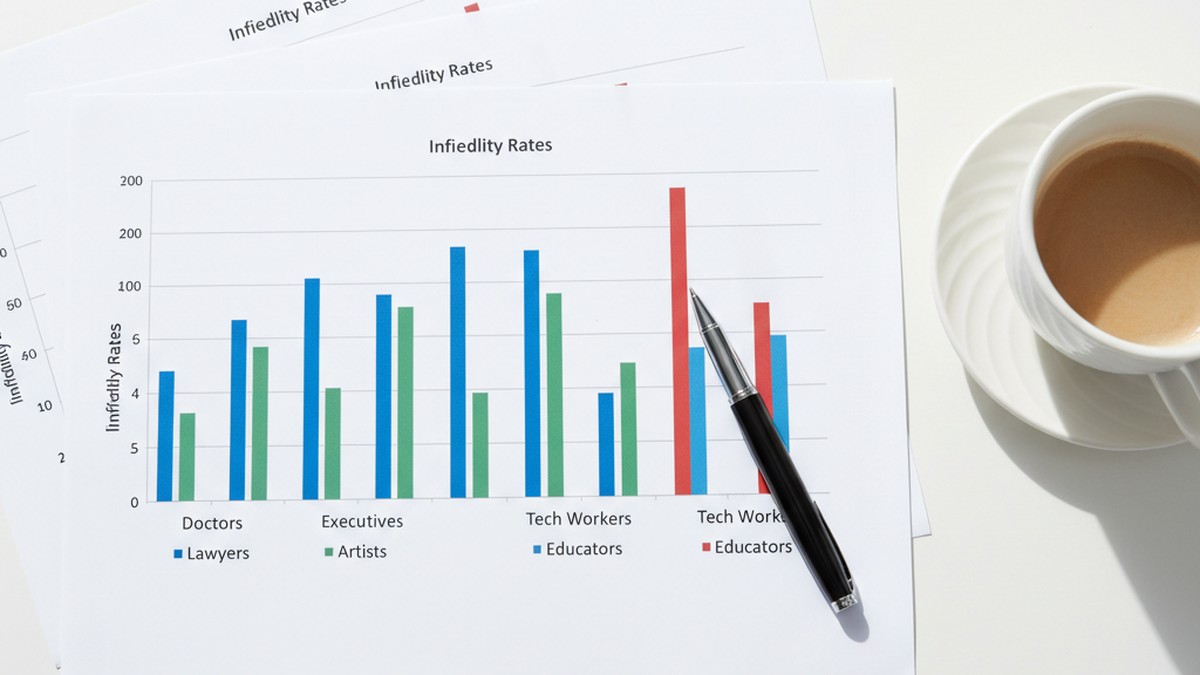
Sales workers report the highest workplace infidelity rate at 14.5%, followed by education at 13.7% and healthcare at 12.5%. Among men specifically, tradespeople account for 29% of male affair-seekers, while 18% of men in high-prestige roles have had extramarital sex according to General Social Survey data.
The table below combines data from four separate sources. The figures are not directly comparable — they measure different things in different populations — but cross-referencing them reveals consistent patterns.
| Profession | Infidelity Rate | Source Type | Primary Risk Driver |
|---|---|---|---|
| Sales | 14.5% workplace affairs | Workplace survey (n=1,644) | Travel + client contact |
| Education | 13.7% workplace affairs | Workplace survey | Close contact, lower oversight |
| Healthcare | 12.5% workplace affairs | Workplace survey | Night shifts, stress bonding |
| Tradespeople (men) | 29% of male affair-seekers | Infidelity site user data | Unsupervised, mobile schedules |
| Medicine (women) | 23% of female affair-seekers | Infidelity site user data | Stress, shift work |
| High-prestige jobs (men) | 18% extramarital sex | General Social Survey | Power, status, opportunity |
| Military (deployed) | 22% reported infidelity | Journal of Traumatic Stress | Separation, extreme stress |
| Upper management | 37% self-reported affairs | Journal of Sex Research | Power, opportunity |
| Non-management workers | 9% self-reported affairs | Journal of Sex Research | Lower exposure overall |
The most striking number in that table isn't any single profession — it's the management gap. The spread between a non-management employee (9%) and an upper manager (37%) is larger than the gap between almost any two job titles. Your partner's level within an organization may matter more than which industry they work in.
Several consistent patterns emerge:
- Sales ranks near the top in both academic and survey-based data
- Healthcare shows elevated risk, driven more by schedule than by job category
- Power and prestige amplify infidelity for men but not for women — the gender split is substantial
- Trades rank high in infidelity site data but are largely absent from academic studies, suggesting platform demographics may inflate that figure
Understanding which patterns hold across multiple data sources — and which appear only in one — is the key to interpreting this data responsibly.
Why Do Certain Jobs Create Higher Infidelity Risk?
Most rankings present profession as a cause of cheating. The research suggests something more specific: jobs don't create cheaters, but certain jobs do create conditions. Four situational factors — travel, opportunity, power, and stress — predict infidelity risk more reliably than occupation category alone.
These four factors form the basis of the TOPS Framework, covered in full later in this article. For now, the core mechanism matters.
Travel and Separation
Geographic distance from a partner removes accountability. The usual social monitoring from shared friends, family, and daily proximity disappears. Military deployment data illustrates this clearly: 22% of deployed service members reported infidelity during deployment, compared to 17% of non-deployed service members (Journal of Traumatic Stress, 2020). That 5-percentage-point gap is attributable almost entirely to separation.
Research on business travel tells a similar story. Multiple surveys find that affairs during work travel are common — pilots, flight attendants, sales executives, and consultants all face the combination of physical distance, hotel stays, and reduced normal social constraint that makes infidelity more psychologically accessible.
Opportunity Density
A tradesperson who spends every day at different locations — alone with clients, unmonitored by colleagues — has high opportunity density. So does a night-shift nurse working in close quarters with colleagues under extreme stress. So does a salesperson entertaining clients at dinners, conferences, and drinks.
Opportunity doesn't cause cheating. But holding all other factors equal, more opportunity means higher probability. The specific day-to-day structure of a job often matters more than the job category label.
Power and Status
Research consistently links organizational power to infidelity, especially for men. The Journal of Sex Research found infidelity rates rise from 9% at the non-management level to 37% at upper management. The Institute for Family Studies found that 18% of men in high-prestige occupations reported extramarital sex — more than double the 7% rate in upper-middle prestige roles.
Two mechanisms explain this. Access: powerful people encounter more people who are interested in them. Entitlement: behavioral psychology research suggests that power reduces sensitivity to social norms, including fidelity.
Stress and Emotional Depletion
High-stress jobs erode the emotional investment a relationship requires. When someone is chronically exhausted, working extreme hours, or carrying intense professional weight, the energy for maintaining intimacy at home often isn't there. Understanding why people cheat usually starts here — it's rarely just about attraction to someone new. Emotional distance at home typically precedes the affair.
If the data here has you concerned about your specific situation, CheatScanX can give you a direct answer — scanning 15+ dating platforms to check for hidden profiles.
The next four sections examine the professions where these factors concentrate most.
Do Medical Professionals Really Cheat More?
Medical professionals show elevated infidelity rates across multiple data sources. An academic study of 360 doctors and nurses found 21% had been unfaithful. Healthcare workers on night emergency schedules were 18 times more likely to report infidelity than part-time workers, suggesting schedule — not profession — is the real driver.
The medical field appears near the top of every infidelity ranking, but the mechanism is frequently misunderstood.
What the Academic Research Shows
A 2021 study published in the International Journal of Environmental Research and Public Health surveyed 360 doctors and nurses using structured questionnaires designed to minimize social desirability bias. Key findings:
- 21% of participants reported being currently in, or having previously been in, an unfaithful relationship
- Over 80% of the unfaithful participants were doctors rather than nurses
- Men were nearly five times more likely to report infidelity than women in the same study
- Workers on night emergency schedules were almost 18 times more likely to be unfaithful than part-time workers
That final finding is the most significant. The single strongest predictor of infidelity in the medical field wasn't gender, specialty, or years of experience — it was whether someone worked the overnight emergency schedule.
This isolates the mechanism. Exhaustion disrupts decision-making. Overnight shifts create close quarters with colleagues who share the same extreme experience. Physical distance from a sleeping partner and heightened emotional intensity at work combine in predictable ways.
What Infidelity Site Data Shows — and Where It Breaks Down
The frequently cited statistic that 23% of female Ashley Madison users work in medicine is real. Since healthcare workers make up roughly 10-12% of the general workforce, that degree of overrepresentation on an infidelity platform does suggest elevated rates.
But healthcare workers are also higher earners with disposable income for subscription services, work shifts that create schedule conflicts with partners, and have high smartphone use that makes digital platforms more accessible. These factors could inflate their platform presence independently of actual infidelity rates.
The academic data — from a structured study rather than a commercial platform — is the more reliable signal. What it shows is that medical infidelity is real, but it's primarily a schedule problem, not a profession-type problem.
A partner in healthcare with regular shifts and predictable hours occupies a meaningfully different risk environment than one working nights in an emergency department. The job title is the same; the conditions are not.
Why Tradespeople Top the Charts for Men
Infidelity site data consistently places male tradespeople — plumbers, electricians, carpenters, construction workers — at the top of male affair-seeking, with one analysis attributing 29% of male users to this occupational category. The explanation has nothing to do with character and everything to do with job structure.
A tradesperson's workday has specific characteristics: early departure, often before a partner is awake. Work at rotating locations across the city or region. No colleague monitoring your calendar or schedule. A vehicle. Access to clients' homes, often when spouses are present during the day. Hours flexible enough that arriving home an hour later than expected rarely triggers questions.
Each of these is an opportunity factor. Combined, they create one of the highest-opportunity work structures of any profession.
The Autonomy-Accountability Gap
This pattern wouldn't be unique to tradespeople if another profession shared the same structure. An independent insurance adjuster driving between client appointments has similar characteristics. A real estate agent showing properties alone does too. What makes trades distinctive is that the combination — solo fieldwork, mobile schedule, physical access to private homes — concentrates all four opportunity factors simultaneously.
Compare this to a desk-based office worker. That person has visible arrivals and departures, colleagues who know their schedule, company systems creating digital trails, and fixed meeting times that structure the day with accountability. A plumber has none of these constraints.
A Common Misconception About This Data
The 29% figure from infidelity site data comes with the same caveat as all infidelity site statistics: it reflects who uses those platforms, not a random sample of tradespeople. Trades workers may use infidelity sites more because they're more aware of them, or because their demographics overlap with the platform's marketing.
Academic research doesn't specifically study tradespeople at the same volume that infidelity platforms report on them. The honest assessment is that the schedule-related opportunity factors are real and well-supported by research — but the specific 29% figure should be understood as a platform observation, not a population-wide cheating rate.
Signs of a workplace affair in any profession show up in behavioral changes rather than job titles: unexplained schedule shifts, increased protectiveness around a phone, or emotional withdrawal at home.
Sales and Education: The Surprising Second and Third
Among workplace-specific infidelity surveys, sales workers lead at 14.5%, with education professionals in second at 13.7% and healthcare workers in third at 12.5%. Sales ranking first is predictable once you understand the risk factors. Education in second place surprises most people — and deserves a closer look.
Why Sales Workers Rank First
Sales jobs stack multiple high-risk factors simultaneously. Regular travel or client entertainment creates distance from a partner. Financial success is tied directly to social performance, which builds unusually high interpersonal fluency and comfort in social settings. Client dinners, conferences, and evening networking events create environments where professional and personal lines blur naturally.
Sales culture also tends to reward persistence, risk tolerance, and comfort with social advance — traits that don't switch off outside work contexts.
Transport and logistics comes in fourth at 9.8% in the same survey, for predictable reasons: constant travel, long time windows away from home, and limited accountability on solo routes.
Hospitality and events management ranks fifth at 7.7%. Long hours, evening and weekend schedules, alcohol environments, and teams that socialize together outside work hours all contribute.
Why Education Ranks Second
The explanation for education's ranking isn't about teachers having less integrity than other professionals. The risk environment is different from sales, but several factors stack up.
University faculty face particularly elevated conditions: conference travel, graduate student relationships involving significant status differentials, tenure protection reducing professional accountability, and a work culture where intellectual connection is prized and often pursued beyond formal office hours. Department events, post-semester gatherings, and professional conferences create social access that other middle-income professions don't.
For K-12 teachers, the risk factor is different. The work requires sustained emotional labor — absorbing the needs and problems of students throughout every day. This creates a pattern where, when a home relationship is also depleted or under stress, the need for reciprocal emotional connection gets sought elsewhere. It's not unique to teachers, but the degree of daily emotional investment the job requires makes it more common.
The broader pattern is that any profession requiring high emotional output — sales, healthcare, education — creates a particular kind of exhaustion that puts home relationships at risk in ways that purely technical or physical jobs don't.
Does Power Lead to Cheating? The Management Factor
Yes, by a significant margin. Research published in the Journal of Sex Research found 9% of non-management employees report infidelity, rising to 24% among middle managers and 37% among upper management. The relationship between organizational power and infidelity holds across industries, not just high-profile sectors.
This is one of the most robust findings in the occupation-and-infidelity research. The pattern holds when controlling for income, age, gender, and industry. It isn't simply that higher-paid executives have more money to fund affairs — the power dynamic itself appears to be the variable.
The Prestige Curve for Men
The Institute for Family Studies analysis of General Social Survey data found an 18% extramarital sex rate among men in high-prestige occupations — roughly double the 7% rate among men in upper-middle prestige jobs. The low-prestige group scored 13%, which is close to the high-prestige rate.
This creates a U-shaped curve: low prestige (13%), upper-middle prestige (7%), high prestige (18%). The safest men appear to be mid-level professionals.
This curve is worth sitting with. It suggests that the mechanism isn't simply "more money and success." Men in comfortable but not exceptional career positions show the lowest rates. Both ends of the prestige distribution show higher rates — lower-prestige for reasons related to financial stress and relationship instability, higher-prestige for reasons related to power and opportunity.
Why the Pattern Reverses for Women
For women, the relationship runs in the opposite direction. The IFS analysis found women in high-prestige occupations report a 9% infidelity rate, while women in low-prestige jobs report 21%.
Several explanations have been proposed. Women in high-prestige careers may have greater relationship satisfaction overall, given more income equality with partners and generally higher partner quality. They may also face stronger professional and social consequences from relationship scandal — a reality that creates stronger inhibition. And high-prestige careers for women tend to correlate with longer-term relationship stability in ways that don't hold symmetrically for men.
The gender split in the data is substantial enough that combining men and women into a single profession ranking obscures the most important information. Why men cheat and why women cheat are meaningfully different questions with different structural drivers.

Which Professions Are the Most Faithful?
Science and pharmaceutical workers, business management professionals, and law enforcement officers report the lowest infidelity rates across survey data. These professions score low on the key risk factors — travel frequency, unsupervised schedules, and irregular hours — that predict infidelity more reliably than job title alone.
The most faithful professions share identifiable characteristics.
Structured, accountable schedules. Scientists and pharmaceutical researchers typically work defined hours in supervised environments alongside colleagues. The autonomous, mobile work style that enables infidelity in trades or sales doesn't exist in a laboratory setting. Work happens in one place, usually during consistent hours, with team members and supervisors present.
Lower travel frequency. Laboratory work, regulated production environments, and compliance-heavy industries require on-site presence. Conference travel happens in pharmaceuticals, but it's periodic rather than routine. The weeks of daily unsupervised mobility that characterize sales roles simply aren't part of the job.
Institutional accountability structures. Law enforcement, despite the stress and shift work, operates within institutions that actively monitor conduct. Officers have documented duty hours, mandatory check-ins, and professional codes of conduct that extend into personal behavior in ways most private-sector jobs don't. This oversight creates a form of accountability that partially offsets the schedule irregularities.
The Law Enforcement Finding Explained
Law enforcement appearing among the most faithful professions surprises many people. Shift work, high stress, and an occupational culture that can normalize bending rules might seem like predictive factors for infidelity. The data doesn't consistently support that expectation.
The most plausible explanation is institutional structure. Police departments maintain oversight of officer schedules and conduct that most employers don't. The professional consequences of behavioral violations can extend beyond the workplace. And law enforcement officers tend to have strong social networks built within their departments — peer accountability is high.
It's worth noting that broader relationship instability among law enforcement is documented in some studies, including elevated divorce rates. Low self-reported infidelity and general relationship health are not the same measure. The faithful-profession ranking applies specifically to affair rates, not overall relationship wellbeing.
The Common Thread
Across all of the most faithful professions, the pattern is structural rather than moral. When jobs create clear accountability, predictable hours, limited solo travel, and constrained access to potential partners, infidelity rates drop. Job title is, again, a proxy for these structural factors.
How Gender Changes the Data
The gender split in cheating statistics by profession is substantial enough that combining men and women into a single ranking hides most of the meaningful variation. Male and female infidelity rates are driven by different factors, and the same profession can carry different risk levels depending on gender.
For men, the General Social Survey data establishes the prestige effect: high-status, high-power roles correlate with higher infidelity. 18% of men in high-prestige occupations report extramarital sex — above the overall male employed-population rate of around 11%.
For women, the pattern reverses. Employed women as a group report a 16% infidelity rate, while homemakers report 8%. But women in high-prestige occupations report only 9% — significantly below the average for employed women. High-status careers appear protective for women in a way they are not for men.
The Ashley Madison Gender Split
Ashley Madison's user demographics offer a specific window into profession-by-gender patterns. Among male users:
- 29% identified as working in trades
- 5% worked in medicine
Among female users:
- 23% worked in medicine
- Trades barely registered as a category
The male and female patterns look almost opposite. This divergence likely reflects different opportunity structures by gender within those professions — male tradespeople have mobile, unsupervised schedules, while female medical workers face night-shift stress and close-colleague exposure — rather than anything inherent to the person's character based on job type.
Age Compounds the Effect
The relationship between profession and infidelity also shifts with age. Younger professionals aged 25 to 35 in high-travel or high-stress jobs show higher rates than older professionals in identical roles. Early career phases involve more job insecurity, longer establishment hours, and less settled domestic life — factors that compound the occupational risk rather than standing apart from it.
A 30-year-old sales associate grinding toward their first management promotion faces a different combination of pressures than a 48-year-old in the same role title. The occupation data captures an average across all ages, which can mask significant variation.
Military and High-Travel Jobs: The Deployment Factor
Military personnel and frequent business travelers show some of the clearest links between job structure and infidelity, because the mechanism — extended separation — is explicit, documented, and measurable.
Military Statistics
Research published in the Journal of Traumatic Stress found that 22% of deployed service members reported infidelity during their deployment, compared to 17% among non-deployed service members. The gap is a direct effect of separation. Service members separated from partners for six months or more are more than four times as likely to report infidelity as those with shorter separation periods.
Rank introduces another layer. Officer-level service members and their spouses show different patterns than enlisted personnel. The institutional stress of deployment affects both the person deployed and the partner remaining at home — military infidelity is a two-way risk that operates on both sides of the separation simultaneously.
Post-deployment is also a risk window. The period immediately after a service member returns home combines reintegration stress, changed relationship dynamics, and the aftermath of extended separation. Research identifies this transition period as elevated-risk for both parties.
Business Travel
The civilian equivalent is business travel. Pilots and flight attendants represent the extreme version: extended layovers in unfamiliar cities, close working relationships with a small crew, professional culture that normalizes crossing time zones and social contexts, and a home life that becomes structurally secondary during work periods.
The mechanism researchers have identified is sometimes called context collapse — the usual social constraints disappear when you're in a different city, known to no one who knows your partner, in a hotel, after a long week. The psychological distance from normal accountability makes behaviors accessible that would feel clearly off-limits at home.
For non-aviation business travelers, the same dynamic operates at lower intensity. Sales executives, management consultants, and professionals in industries that require regular client travel all report elevated affair rates in workplace surveys. The more nights away from home per month, the stronger the association.
The TOPS Framework: A Better Way to Assess Risk
Most profession-based articles rank jobs by infidelity rate and stop there. But those rates are outputs — the result of underlying conditions that vary within professions as much as between them. A doctor working standard day shifts at a small clinic occupies a different risk environment than a doctor on overnight emergency rotations at a major urban hospital. The job title is identical; the conditions are not.
The TOPS Framework is a structured method for assessing infidelity risk based on the four factors that research consistently identifies as predictive.
- T — Travel Exposure: Does the job require regular overnight travel away from home?
- O — Opportunity Density: Does the job create frequent, unsupervised time with potential partners?
- P — Power/Prestige: Does the role carry significant authority, status, or institutional recognition?
- S — Stress Load: Does the job involve chronic high stress, irregular hours, or sustained emotional depletion?
Each factor scores 0 to 3. A total score of 0-4 represents a low-risk environment; 5-7 is moderate; 8-12 is high.
| Profession | Travel | Opportunity | Power | Stress | TOPS Score | Risk Level |
|---|---|---|---|---|---|---|
| Upper management / C-suite | 3 | 3 | 3 | 3 | 12 | High |
| Sales (travel-heavy roles) | 3 | 3 | 2 | 2 | 10 | High |
| Military (active deployment) | 3 | 2 | 2 | 3 | 10 | High |
| Aviation (pilots / flight attendants) | 3 | 3 | 1 | 2 | 9 | High |
| Medicine (night emergency shifts) | 1 | 3 | 2 | 3 | 9 | High |
| University faculty | 2 | 3 | 2 | 2 | 9 | High |
| Hospitality management | 1 | 3 | 2 | 3 | 9 | High |
| Trades (independent contractor) | 1 | 3 | 1 | 2 | 7 | Moderate |
| Law enforcement | 1 | 2 | 2 | 3 | 8 | Moderate-High |
| IT / technology (senior roles) | 1 | 2 | 3 | 3 | 9 | High |
| Science / pharma (lab-based) | 0 | 2 | 2 | 1 | 5 | Moderate |
| Accounting / finance (non-exec) | 0 | 2 | 1 | 2 | 5 | Moderate |
How to Use the Framework
The TOPS score for a specific person depends on their specific role, not just their job title. A senior partner at a law firm scores very differently from a junior associate doing document review. A school teacher with consistent hours scores differently from a university professor with conference obligations and graduate students.
The most useful application isn't "does my partner's profession make them a cheater?" — it's "do the structural factors of my partner's specific role create conditions that strain our relationship?" That reframe moves from accusation to awareness, which is more useful for both people involved.
In practice, what we observe in patterns on the CheatScanX platform is that concern spikes in two conditions: when a partner's job recently changed to involve more travel or irregular hours, and when behavioral changes at home coincide with those schedule shifts. The job creates conditions; relationship behavioral changes are the observable signal.
What TOPS Reveals That Job-Title Rankings Miss
A tradesperson who runs their own business and is reliably home by 4pm most days may score a TOPS 4. A tradesperson doing large commercial contracts across multiple cities might score an 8. The job title is the same; the risk environment is very different.
The research bears this out. In the medical infidelity study, the night emergency schedule predicted infidelity with an odds ratio of 18 — meaning that specific schedule variable was 18 times more predictive than any occupational category alone. Work structure is the variable. Job title is a proxy for it.
This is the finding that most profession-based rankings miss entirely, and it's the most practically useful insight from the full body of research: don't ask what job your partner has. Ask what your partner's job actually looks like day to day, and score those conditions honestly.

What This Data Actually Means for Your Relationship
If you arrived here because you're concerned about a specific partner in a specific profession, here's what the research can and cannot tell you.
What it can tell you: Certain job structures — high travel, irregular hours, unsupervised schedules, significant power, or chronic high stress — are associated with higher infidelity rates at the population level. The management gap alone (9% versus 37%) shows how dramatically structural factors shift baseline probability.
If your partner's role creates several of these conditions simultaneously, that's worth understanding — not as an accusation, but as context for how much pressure their job is putting on your relationship and whether you're actively managing that together.
What it cannot tell you: Whether your specific partner has or will cheat. Population statistics describe group patterns. Individual behavior is shaped by values, relationship quality, prior history, and choices that no occupation statistic can predict. A salesperson with a TOPS score of 10 who is deeply invested in their relationship and transparent about their schedule may be far less likely to cheat than a scientist with a TOPS score of 5 in a neglected, disconnected relationship.
The most reliable indicator of relationship risk isn't occupation — it's whether the relationship itself is healthy, communicated, and mutually prioritized. Partners who feel seen, valued, and connected are less likely to seek that outside the relationship regardless of their profession.
If you've noticed behavioral changes alongside your concern — increased phone protectiveness, unexplained schedule shifts, emotional withdrawal, or inconsistencies in what they tell you — those signals matter more than any occupation data. A structured list of signs your partner is cheating can help you distinguish between anxiety-driven interpretation and patterns that warrant attention.
Keeping perspective on base rates matters: suspicion alone is not evidence, and most concern that brings people to this topic resolves with honest conversation rather than investigation.
Conclusion: Job Title Is a Clue, Not a Verdict
Cheating statistics by profession show real, consistent patterns. Sales workers, educators, and healthcare workers appear repeatedly in high-infidelity categories across multiple data sources. Science and pharmaceutical workers, business management professionals, and law enforcement show reliably lower rates. The management gap — 37% of upper managers versus 9% of non-management employees — is one of the most robust single findings in the research.
But the profession data is best understood as a map of conditions, not a map of character. What correlates with infidelity isn't being a nurse or a salesperson as such — it's the combination of travel, opportunity, power, and stress that certain roles create in larger concentrations than others. Change the structural conditions and you change the risk, regardless of whether the job title changes.
If you're using this data to understand your own relationship, focus less on where your partner's job falls in a ranking and more on what that job does to your relationship over time: the schedule it creates, the energy it leaves them with, the travel it requires, the communication gaps it produces. Those structural effects are what the research is actually measuring.
Your partner's specific role, combined with the health of your relationship and the behavioral changes you're observing, tells you far more than any profession ranking ever could.
If the data in this article has raised specific concerns, CheatScanX provides a direct way to check whether a hidden profile exists across 15+ dating platforms — a concrete answer instead of ongoing uncertainty.
Frequently Asked Questions
Sales workers report the highest workplace infidelity rate at 14.5% in survey data, while male tradespeople account for 29% of male affair-seekers. Upper management shows the most striking pattern across all categories — 37% of executives and senior managers report infidelity, compared to just 9% of entry-level workers.
Medical professionals show elevated infidelity rates, but the driver appears to be schedule rather than job category. An academic study found 21% of doctors and nurses had been unfaithful, and those working night emergency shifts were 18 times more likely to report infidelity. Healthcare workers on standard schedules showed much lower rates.
For men, yes. The Institute for Family Studies found 18% of prime-age men in high-prestige jobs had extramarital sex — more than double the 7% rate in upper-middle prestige roles. For women, the relationship runs in reverse: women in high-prestige careers report lower infidelity rates than women in low-prestige jobs.
Science and pharmaceutical workers, business management professionals, and law enforcement officers consistently show the lowest infidelity rates across studies. These professions tend to score low on the key risk factors — travel frequency, unsupervised schedules, and irregular hours — that predict infidelity more reliably than job title alone.
No. Profession-based statistics describe population-level patterns, not individual behavior. A salesperson may be completely faithful; a scientist may cheat. What the data measures is how certain job conditions — travel, irregular hours, power dynamics, stress — create environments where infidelity becomes more likely, not inevitable.