
# Tinder Bio Red Flags: What Cheaters Write
If you're reading Tinder bios and something feels off, the answer may already be in front of you. A person hiding a committed relationship rarely writes an honest bio — but they almost always leave specific traces in how they write it. These 12 bio patterns are what partnered Tinder users rely on, and most people scroll past them without registering what they're actually reading.
The scale of this is larger than most people realize. A peer-reviewed study published in Computers in Human Behavior found that 42% of U.S. Tinder users are married or in a committed relationship. Globally, estimates range from 18% to 25%. That means on any given day, between one in four and nearly one in two of the profiles you see belong to someone who is not actually available — and their bios reflect that unavailability in patterns that are consistent, recognizable, and learnable.
The tinder bio red flags tied to cheating aren't subtle once you know what to look for. This article gives you a systematic framework for reading them — a phrase-by-phrase translation guide, the psychology that produces this language, and exactly what to do if you find your partner's bio among them.
How Common Is Cheating on Tinder?
According to a study published in Computers in Human Behavior (2018), 42% of U.S. Tinder users are either married or in a committed relationship. Globally, research places this figure between 18% and 25%. That means roughly 1 in 4 to nearly 1 in 2 profiles you encounter belongs to someone who is already partnered.
These numbers are not abstractions. They change the meaning of everything you read in a bio. A vague, commitment-averse profile on a platform where nearly half of U.S. users are already in relationships is not random — it is statistically common behavior with predictable language patterns.
A 2022 analysis in Psychology Today added behavioral detail to the picture. Among the respondents surveyed, 73% knew a male friend in a committed relationship who was actively using Tinder. Seventeen percent of undergraduate students admitted to messaging Tinder matches while they themselves were in a relationship. More than 7% went further — they had in-person sexual contact with a Tinder match while partnered.
These users weren't passive. They were actively matching, messaging, and meeting. And the bios they wrote — designed to attract new contacts while concealing their actual status — follow patterns that appear repeatedly.
The psychological research behind this behavior identified the specific traits that predict partnered Tinder use: low agreeableness (reduced concern for a partner's wellbeing), high neuroticism (need for external validation that the relationship doesn't provide), and Dark Triad characteristics including psychopathy and Machiavellianism. These traits don't just predict the behavior — they predict the language. A person with high psychopathy writes a different kind of bio than a person genuinely looking for a relationship.
The relevant dating app cheating statistics make one thing clear: encountering a partnered person on Tinder is not an edge case. It's a statistically significant probability with every profile you open.
What the Numbers Mean for Bio Reading
If 42% of U.S. Tinder users are partnered, a random sample of 100 profiles contains roughly 42 people navigating the constraint of hiding their presence. Those 42 people did not write their bios freely. They wrote them under a specific operational requirement: attract interest while minimizing identifiability.
That constraint is the engine that produces red flag language. It is not random. It is the predictable output of a specific problem.
Who Is Most Likely to Be Partnered on Tinder?
The demographic breakdown of partnered Tinder users adds useful specificity. Research from multiple sources places the highest rates of partnered app use among men aged 25–45, with the 30–39 cohort showing the most consistent overlap between established relationship status and active dating app presence. Women in this age group show a similar pattern, though at slightly lower rates.
The implication for bio reading is practical: a profile belonging to someone in their early-to-mid thirties that uses availability obfuscation language alongside a static, older-appearing photo set sits at the intersection of multiple risk factors. Age alone means nothing — but age combined with bio patterns and photo patterns forms a coherent picture.
Geography also matters. According to broader infidelity data compiled by Maze of Love (2024), urban populations show higher rates of dating app use among partnered individuals than rural areas, and this pattern holds on Tinder specifically. If you're searching for a partner's profile in a major metropolitan area, the statistical baseline for encountering a partnered user is higher than the global average.
This context doesn't make any individual bio more or less suspicious on its own. It does mean that bio red flags in a demographic and geographic context associated with higher rates of partnered Tinder use carry proportionally more weight.
If any of this sounds familiar, there's a way to know for sure. CheatScanX checks 15+ dating platforms for hidden profiles using a name, email, or phone number.
Check for hidden profiles →Why Is the Tinder Bio the Most Overlooked Red Flag?
The Tinder bio is the most overlooked red flag because most people focus on behavioral signs after matching — inconsistent replies, refusal to meet. But a person hiding a relationship writes a bio under specific constraints that produce predictable language patterns. Reading those patterns before matching saves weeks of uncertainty.
Almost every guide to identifying a cheating partner focuses on what happens after contact: the inconsistent availability, the reluctance to video call, the stories that don't line up. That focus makes sense — behavioral signals are observable and concrete, and they accumulate over time into a recognizable pattern.
But the bio comes before any of that. Before a single message, before any match, a person deliberately chose every word in those 150-500 characters. That deliberateness carries information that most people don't know how to read.
A person in a committed relationship writing a Tinder bio faces a specific constraint problem. They need to:
- Appear attractive and interesting enough to generate matches
- Avoid specific, searchable information that could expose them if seen by a mutual connection
- Pre-explain limited availability so inconsistency doesn't raise suspicion after matching
- Signal interest to compatible connections without confirming details of their actual life
These four requirements produce a recognizable category of writing. It looks casual — like someone who just didn't put much effort into their bio. But compare it to what a genuinely available minimalist writes:
Minimalist but genuine: "Firefighter in Brooklyn. Looking for something real, eventually. Gym, cooking, terrible at karaoke."
Minimalist and evasive: "Easy-going, no drama. Just here to see what happens. Life keeps me busy but I make time for the right person."
The first bio contains three specific identifying details. Someone who knows this person, or who knows the right Brooklyn firefighter, could confirm whether this is their profile. The second bio contains zero identifying information. It was written to be recognizable to no one.
That absence of picture — the inability to form a mental image of who this person actually is, where they work, what their daily life looks like — is itself the signal. The evasion is not incidental to the writing. It is the purpose of the writing.
The same evasion patterns that appear in Tinder bios show up across the apps cheaters use most, because the operational constraint is the same regardless of platform.
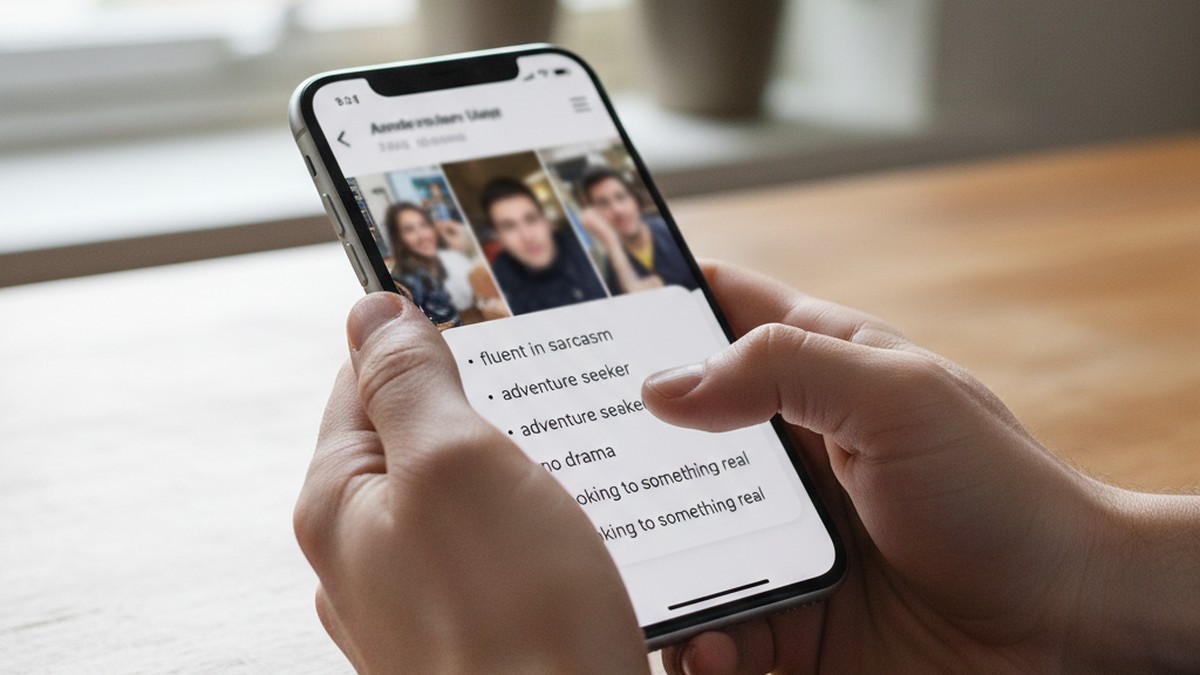
The CADS Framework: 4 Categories of Cheater Bio Language
Not all red flag language carries the same weight. Treating "just here to see what happens" as equivalent to "discreet preferred" misses a meaningful difference in severity and specificity of intent. The CADS Framework organizes cheater bio language into four categories, each with distinct risk implications.
C — Commitment Aversion Language
Phrases that signal unwillingness or inability to commit. This is the most common category and the most ambiguous — it appears in both cheater bios and genuinely available people who simply aren't ready for a relationship. On its own, commitment aversion language is a yellow flag, not a red one.
Examples: "not looking for anything serious," "easy-going," "no expectations," "open to whatever," "just here to see what happens," "no strings"
A — Availability Obfuscation
Language that explains limited availability without actually explaining it. These phrases serve a specific operational function: they prepare any new contact to expect inconsistent communication without revealing the real reason for that inconsistency. Someone who can only reply during work hours, never on weekends, and must cancel frequently needs bio language that accounts for this before anyone asks.
Examples: "work keeps me busy," "not on here much," "here for a bit," "life's complicated right now," "taking it one day at a time," "schedule is unpredictable," "traveling a lot"
D — Discretion Signals
The highest-risk category. These phrases actively request secrecy or explicitly signal that the person needs to operate below the radar. Unlike commitment aversion, which could belong to a genuinely available person, discretion language has one primary context: managing a secret. A person who needs their Tinder activity kept private has a specific reason for that need.
Examples: "discreet preferred," "privacy important," "not looking to complicate things," "keep it low-key," "don't ask don't tell," "mature connections only," "looking for something on the side"
S — Self-Description Absence Patterns
The systematic omission of specifics where a genuine profile would include them. Cheaters typically strip out identifying information: no employer, no neighborhood, no mention of social context. They describe themselves in generic, universally applicable terms — "laid back," "outdoorsy," "family-oriented" — that sound like personality descriptors but provide nothing traceable.
Examples: no profession listed, no specific location, no named social activities, no identifiable hobbies; descriptions like "laid back," "just a regular person," "work hard play hard," "adventure over material things"
| Category | Flag Level | Alone | Combined with Others |
|---|---|---|---|
| Commitment Aversion (C) | Yellow | Low concern | Medium–High |
| Availability Obfuscation (A) | Yellow | Low concern | High |
| Discretion Signals (D) | Red | High concern | Critical |
| Self-Description Absence (S) | Yellow | Low concern | Medium |
The CADS score compounds with combination. A bio with a single C-category phrase sits within the normal range of casual bio writing. A bio with C + A together signals a pattern. A bio with C + A + S, or any D-category phrase alongside anything else, crosses into territory that deserves serious attention. A bio with D + A in combination is as clear a signal as you will find without asking directly.
If your partner's bio is giving you a feeling you can't quite articulate, CheatScanX scans all these platforms — and more — in a single search.
Commitment Aversion Language: The Phrases That Signal Unavailability
Commitment aversion language is the most widespread category and the easiest to rationalize away. "Not looking for anything serious" sounds like an honest, upfront statement of preference. In many cases, it is exactly that — a single, available person who isn't ready for a relationship and says so clearly.
The red flag is not the phrase in isolation. It's the phrase as a container for a different truth.
A genuinely single, non-committal person usually writes their bio alongside at least some identifying information. They name their city, their job, their interests, their weekend activities. The bio reads as a person who exists in a specific life, who happens to want something casual. A partnered person using commitment aversion language tends to pair it with availability obfuscation and self-description absence, because commitment aversion alone doesn't solve all their operational problems. They still need to explain why they can't reliably show up, and they still need to ensure the profile isn't identifiable.
Here is a phrase-by-phrase translation guide for the most common commitment aversion language:
"Not looking for anything serious"
At face value: honest statement of intent. In a CADS context: pre-emptive framing that removes the expectation of loyalty, presence, or accountability. It is a disclaimer, placed upfront, that defends against any future request for consistency. Someone hiding a relationship uses it to signal to like-minded connections that no claims will be made on their availability.
"Just here to see what happens"
At face value: open-minded and spontaneous. In a CADS context: this phrase commits to nothing. It cannot be held to any standard because it made none. Whatever outcome follows — including radio silence, cancellation, or disappearance — falls within the scope of "seeing what happens." It is the most evasive of all commitment aversion phrases because it technically means anything.
"Open to whatever"
At face value: flexible and non-judgmental. In a CADS context: this phrase is frequently used by partnered people to signal interest in physical connection without writing it explicitly in terms that could be screenshotted. "Open to whatever" covers everything and confirms nothing. It is the functional equivalent of an opt-in to any possibility while creating no record of specific intent.
"Easy-going, no expectations"
At face value: low-maintenance partner. In a CADS context: this phrase is a preemptive liability disclaimer. If they go silent for four days, they told you: no expectations. If they cancel three times in a month, they told you: no expectations. The phrase closes down any reasonable request for reliability before the request is made.
"No strings"
This phrase is more direct than the others because it explicitly frames the interaction as transactional and non-binding. Many genuinely single people use it too. The distinction appears when "no strings" clusters with availability obfuscation language — at that point it shifts from a casual preference to an operational management phrase.
"Looking for something fun and easy"
Similar to "no strings" but softer. "Easy" is the significant word here — it anticipates friction (accountability, questions about availability) and pre-positions that friction as a failure of the person asking rather than a failure of the person who created the situation.
The common thread across all commitment aversion language is pre-emption. The person writing it is not describing what they want. They are managing what you might later expect from them.
What Does "No Drama" Mean in a Tinder Bio?
"No drama" in a Tinder bio typically signals low accountability and conflict avoidance — not a relaxed personality. Research links this phrasing with low agreeableness, a trait that predicts continued app use while in a relationship. In practice, it pre-frames any future concern you raise about their behavior as your overreaction.
That interpretation sounds harsh, and it deserves qualification. Some people have genuinely been through difficult, conflict-heavy relationships and are signaling that they want something calmer. That is a real and valid use of the phrase. The problem is that psychological research on partnered Tinder users points to a different dominant use.
The Computers in Human Behavior study (2018) identified low agreeableness as one of the most consistent predictors of using Tinder while in a relationship. Low agreeableness in psychological terms means reduced concern for others' wellbeing, lower empathy, and less investment in maintaining interpersonal harmony. It is also the trait most strongly associated with defensive, anti-accountability language in self-presentation contexts.
"No drama" is the most efficient way to make any future concern you raise about someone's availability, honesty, or behavior into your problem.
Consider the practical effect in a real scenario: if someone's bio says "no drama" and you later discover an inconsistency or ask a direct question about where they've been, that phrase has already retroactively framed your concern as the thing they warned you about. The question itself becomes evidence that you're not "drama-free." It is preemptive emotional deflection built directly into a first impression.
Phrases that function identically to "no drama":
- "Good vibes only" — all concerns are bad vibes; raising them violates the stated premise
- "Drama-free" — same mechanism, more explicit
- "Keep it positive" — positions any negative emotional response as a personal failure
- "If you take everything too seriously, we won't click" — directly punishes inquiry and thoughtfulness
- "Just looking for fun, not complications" — complications here means accountability
Each of these phrases signals the same thing: this person has thought about what might go wrong in a connection with them, and they have written their bio to disqualify you from objecting to it.
A person who is genuinely emotionally available doesn't need to pre-warn you against having expectations. They're not worried about your expectations because meeting reasonable ones is possible for them.
The "Low-Key" Cluster
"No drama" often appears in bios alongside a cluster of tonally similar phrases that all serve the same anti-accountability function:
- "Laid back"
- "Easy going"
- "Just go with the flow"
- "Life's too short to stress"
- "Not looking to complicate things"
Individually, each of these phrases reads as a personality descriptor. As a cluster, they form a complete picture: this person cannot tolerate or will not respond well to any direct questioning about their behavior. That intolerance has a cause, and in the context of partnered Tinder use, the cause is predictable.

Availability Obfuscation: When Bios Explain Away Absence
Commitment aversion language handles the emotional premise — "don't expect commitment from me." Availability obfuscation handles the logistical reality: "here's why I'll only be reachable sometimes, and why that shouldn't raise any questions."
A person in a committed relationship on Tinder has a specific scheduling problem. They cannot reply freely at night when their partner is home. Weekend availability is constrained. They need to leave conversations dark for stretches of time that would be unusual for a genuinely single person. If they meet someone who expects normal communication patterns, that communication pattern will quickly reveal that something is off.
The bio pre-empts this suspicion before any conversation starts.
The Work Excuse — Most Versatile
Work-based availability obfuscation is the most common because it is both socially acceptable and difficult to verify. Nearly every profession can plausibly produce unpredictable hours.
- "Work keeps me busy but I make time for the right person"
- "My schedule is all over the place — I'm in [demanding field]"
- "Nights and weekends are tough, but worth it for the right connection"
- "Traveling for work constantly — hard to be on here regularly"
The phrase does several things simultaneously: it explains limited availability, frames that limitation as admirable (hard-working, successful), sets expectations low from the start, and positions any future communication gap as professional rather than personal. The addition of "but I make time for the right person" adds emotional texture that keeps the bio attractive while the disclaimer does its operational work.
Geographic Ambiguity — Built-In Exit
- "Just passing through"
- "Here for a few months"
- "Visiting for work"
- "Might be relocating"
- "Between cities right now"
Proximity-limiting language contains the relationship's scope geographically and temporally. A "just passing through" framing builds in an exit strategy that needs no explanation — the exit was established before the connection started. It also limits the natural depth of connection available: no one expects a "just visiting" relationship to involve meeting friends, seeing family, or being introduced as a partner.
Situational Vagueness — Softest but Most Common
- "Life's complicated right now"
- "Going through some changes"
- "Taking it one day at a time"
- "Not exactly sure what I'm looking for"
- "Still figuring things out"
This is the softest category but often the most revealing. "Life's complicated" almost never comes with specifics. It is designed to be understood as a temporary, sympathetic situation without describing what the complication actually is. In practice, the most common complication requiring this level of vagueness is a current relationship.
"Going through some changes" operates similarly. Changes that would be openly described — a job transition, a move, a health situation — are described openly. Changes requiring vagueness tend to be relationship changes: a partner they haven't left, a marriage they're navigating around.
What distinguishes genuine limitation from obfuscation is specificity. A genuinely constrained single person writes: "I'm a nurse, so my schedule is all over the place — 12-hour shifts every few days." Someone hiding something writes: "Not on here much" and stops there. Vagueness without specifics is the signal.
Profile Photo Red Flags That Pair With Suspicious Bios
A bio does not exist in isolation. The photos accompanying it form the second half of the profile's message, and a person hiding a relationship faces the same identifiability constraint in photos as in words.
No Photos in Any Identifiable Home Environment
A partnered person's home contains markers of their actual life: a partner's belongings, family photos on walls, a shared living space. Photos in that environment could reveal those markers to anyone looking carefully. Almost all photos in a CADS-flagged profile are outdoors, at events, in generic restaurant or office settings, or in travel contexts — places that contain no domestic markers.
Group Photos With Unclear Identification
This is a documented avoidance tactic. In a group photo, anyone who spots the profile can't be certain which person they're looking at. If a mutual friend, a coworker, or the person's actual partner sees the profile and confronts them, they can claim the photo is of someone else. Group photos also allow someone to appear social and personable without placing themselves in a specific, identifiable context.
Consistent Face Obscuring
One photo with sunglasses is a normal outdoor photo. Three or four photos where the face is always partially obscured by sunglasses, a hat, a turned angle, or distance is a deliberate choice. Reducing recognizability reduces the risk of being identified by someone who knows them.
A Static Photo Set That Appears Old
Maintaining a current photo set requires regular updates and recent photos. Someone hiding their Tinder presence tends to use a static set — often from several years ago, before the current relationship began, or from a single event like a solo trip or a work conference. The tell is consistency: all photos appear to be from the same period or same type of context, with no variety that would suggest ongoing, current life.
No Social Context Photos
A genuinely available person almost always has at least one photo in a social context: a dinner with friends, a birthday celebration, a group hike. These photos signal that they have a social life and that their friends are aware they're dating. A person operating secretly avoids photos that place them in a traceable social context — because their friends do not know they're on Tinder, or because their friends know their partner.
How Photo Age Signals a Hidden Profile
Photo dating is an underused analysis technique. Most smartphones embed metadata in photos, including the date they were taken. While Tinder strips this metadata, the visual content of photos often dates itself — clothing styles, phone models visible in mirror selfies, visible hairstyles, and the apparent age of the subject relative to the stated age on the profile all provide temporal clues.
A 35-year-old profile where every photo appears to show someone in their mid-to-late twenties has a photo set that predates the current relationship by several years. This is often not laziness — it's a deliberate choice to use older photos because newer photos would show their partner, their home, or social contexts that tie them to a specific, identifiable current life.
When a profile's stated age and apparent photo age diverge by more than two or three years, that discrepancy warrants attention. Combined with CADS-flagged bio language, a photo set that appears to predate the current relationship period is a meaningful secondary signal.
Another photo signal worth noting: the complete absence of any photo taken at home. A genuine single person's camera roll naturally contains at-home photos — relaxed moments, a weekend morning, a couch selfie. The absence of any indoor or domestic photos across all profile images, even in a short photo set, suggests a deliberate culling rather than a naturally curated selection.
How Do Dark Triad Personality Traits Show Up in Tinder Bios?
The academic research behind partnered Tinder use points consistently to a set of personality dimensions that predict both the behavior and the language. The 2018 Computers in Human Behavior study identified three Dark Triad characteristics as significant predictors: psychopathy, narcissism, and Machiavellianism. These are not clinical diagnoses — they are personality traits that exist on a spectrum in the general population. But they produce specific communication patterns that appear directly in bio writing.
Psychopathy and Transactional Bio Language
The study notes that people higher in psychopathy show "lower relationship involvement" and "opportunistic or impulsive behavior." In bio terms, this manifests as transactional, efficiency-focused writing that treats the interaction as a commodity exchange rather than the beginning of a human connection.
What it looks like: "NSA," "know what I want," "not complicated," "straightforward," "I'll keep it simple." There is no emotional texture. The bio describes what is on offer and what it is not, with the efficiency of a product description.
Narcissism and Unprompted Status Signaling
Narcissistic traits in the research context correlate with seeking "social approval through Tinder matches" — the app functions as a source of external validation rather than a genuine dating tool. In bio terms, this produces unprompted self-promotion: physical appearance mentions, professional or financial status markers, leisure status signals.
What it looks like: Mentions of salary range, car type, fitness level, or travel destinations that the person initiates without any prompt. The bio positions the person as a prize to be won and contains minimal or no curiosity about what the other person brings to a connection.
Low Agreeableness and Anti-Accountability Writing
Low agreeableness — reduced concern for others' wellbeing — is the personality trait most directly associated with continuing to use Tinder while in a relationship, according to the research. In bio terms, it produces the defensive, pre-emptive language of the commitment aversion category.
What it looks like: "No drama," "don't waste my time," "if you can't handle X, swipe left," "not here for games," "know what you want before you message." These phrases don't describe the person's positive qualities. They set rules and defend against accountability before any contact is made.
High Neuroticism and Validation-Seeking Language
High neuroticism in the research maps to "relationship insecurity and the need for external validation" that the person's current relationship apparently isn't providing. In bio terms, this produces unusual focus on attractiveness, on how others perceive them, and on the appeal of the connection rather than its substance.
What it looks like: Unusual emphasis on physical appearance in the bio, phrases asking for affirmation ("hope you'll give me a chance"), or bios that are almost entirely about what the other person will find attractive about them rather than about what they're looking for.
None of these patterns is diagnostic in isolation. But in combination — a transactional bio with anti-accountability framing, status signaling, and no identifying details — they produce a profile that overlaps substantially with the personality profile the academic research associates with partnered Tinder use.
The Commitment Language Test: What Cheaters Almost Never Write
There's a useful inverse to the CADS framework. Knowing what genuine availability looks like makes the absence of that language more visible and more meaningful.
A person who is genuinely single and open to connection tends to include at least some of the following in their bio:
- A specific identifying detail that makes them findable: a profession, a neighborhood, a named hobby
- A statement about what they're looking for, with emotional content rather than only physical or casual ("tired of surface-level connections," "looking for someone to actually talk to")
- A reference to their social world: friends, family, a regular group activity
- At least one detail that ties them to a specific, current context: "just started rock climbing," "moved here eight months ago," "finally got a dog last year"
These details carry real risk for a partnered person. A named profession in a named city alongside a specific hobby creates a searchable, identifiable combination. If a mutual friend, coworker, or the person's actual partner encounters the profile, that combination of details identifies them. Cheaters solve this by omitting every specific — the result looks casual and minimalist, but it contains nothing that would allow identification.
Compare these two brief bios:
Brief but genuine: "High school teacher in Austin. Here for something real, eventually. Books, live music, Sunday farmers markets."
Brief and evasive: "Laid back and easy going. Just here to meet people. Life is short, make it count."
The first bio, despite being brief, contains a profession, a city, and three specific activities. Someone who knows this person could match these details. The second bio contains no details at all — it could describe literally anyone. It was written to describe no one specifically.
The pattern extends to a specific absence: cheaters almost never write anything that implies a future. Phrases like "looking for something that goes somewhere," "hoping to find my person eventually," or "ready to build something with the right person" create an implicit conversation about current life circumstances — a conversation they cannot have honestly. A person with a partner waiting at home doesn't write "ready to build something with the right person." The temporal contradiction is too visible.
This test is simple to apply: after reading a bio, can you picture the actual person — their job, their neighborhood, their typical week? If the answer is no, if the bio could belong to any adult anywhere without any disqualifying specifics, that blankness is itself a data point.

Cheater Bio vs. Player Bio: How to Tell the Difference
Both cheater bios and player bios use commitment aversion language. Both may use availability obfuscation. Both often omit some specifics. The distinction comes down to one element: discretion signals.
A player — a genuinely single person who isn't looking for commitment — has no operational need for secrecy. Their bio may be casual, even blunt, but there's no practical reason for vagueness about their identity. A player can be recognized. Their friends know they're on Tinder. Their employer won't find a dating profile alarming. They write "not looking for anything serious" alongside their actual first name, their city, and their job.
A cheater has a specific operational requirement: invisibility. That requirement produces language a player doesn't produce and photo choices a player doesn't make.
| Signal | Cheater Bio | Player Bio |
|---|---|---|
| Identity specifics | Absent or stripped down | Present — profession, location, named hobbies |
| Availability explanation | "Work keeps me busy," "life's complicated," "not on here much" | None needed — they're available |
| Discretion language | "Discreet preferred," "privacy important," "keep it low-key" | Absent |
| Photo face visibility | Often obscured — hats, sunglasses, distance | Typically clear |
| Social context photos | Absent | Common — friends, events, activities |
| Future language | Absent | May be absent but not as a calculated choice |
| "No drama" type language | Present — preemptive accountability management | May appear, but less defensive in tone |
| Bio length | Tends to be short — minimizing exposure | Can vary; longer bios are more comfortable |
The most efficient test: does the bio explain why you shouldn't expect much (commitment aversion + availability obfuscation) while simultaneously containing nothing that would let anyone identify who this person actually is (absent specifics, obscured photos)?
A player bio does the first. A cheater bio does both.
The second thing to check: does the profile ask for or imply any discretion? A player doesn't need discretion. The presence of any D-category language in a bio, no matter how mild, is the clearest differentiator between someone casually non-committal and someone managing a secret.
The Accountability Test
There is one more practical distinction that separates these two types of profiles: what happens when you ask a direct question.
A player who isn't looking for a relationship will typically answer direct questions about their availability and situation — they're single, they don't want anything serious, and they'll say so without any defensive maneuvering. They have nothing to protect. Their situation, while perhaps not what you were hoping to hear, is not a secret.
A cheater responds to direct questions with deflection, humor, counter-questions, or vague philosophical observations. "What are you looking for?" gets answered with "I'll know it when I see it" rather than anything specific. "Are you seeing anyone else?" gets redirected: "Why? Are you?" The pattern of non-answering direct questions is distinct from the player's frank statement of non-interest.
In practice, what we consistently see in cases where a partnered person was identified through CheatScanX is that their communication before the profile was found followed this deflection pattern closely. Direct questions about availability, current life situation, or what the person was actually looking for were either redirected or answered with the kind of vague language that appeared in their bio. The bio and the communication style are produced by the same underlying constraint.
This pattern is worth remembering when you're evaluating a bio with multiple CADS markers and wondering whether the interpretation is too harsh. The bio language didn't come from nowhere. It came from someone who has practiced writing and speaking this way because they've needed to.
Discretion Signals: The Highest-Risk Language in Any Bio
Discretion signals deserve their own section because they are, unlike the other CADS categories, nearly unambiguous. Where commitment aversion and availability obfuscation could genuinely describe a complicated but available person, discretion language has one primary real-world use: managing something that cannot be acknowledged.
A person whose Tinder presence needs to stay private is not navigating normal emotional complexity. They are managing a secret from a specific person. In almost every case, that person is a partner.
The highest-signal discretion phrases:
"Discreet preferred" / "discreet only"
This is about as explicit as bio language gets. The person is asking that the interaction remain secret from someone. There is no ambiguity about what "discreet" means in a dating context: it means hidden. The question is only hidden from whom.
"Privacy is important to me"
Softer phrasing, same function. Everyone values privacy in a general sense — but in a Tinder bio, the specific privacy being requested is about the fact of dating activity itself. That request only has urgency if someone shouldn't know.
"Don't ask, don't tell"
An explicit statement of mutual deception management. The person is either in a genuinely open relationship with agreed-upon rules (in which case they would typically say so explicitly — "ethically non-monogamous, partner knows") or they're signaling willingness to maintain parallel secrets.
"Mature connections only" / "serious inquiries only"
These sound like selectivity filters, but they function as accountability avoidance. "Mature" here means someone who won't form emotional attachments or make demands. "Serious inquiries" means someone who understands the parameters and won't push outside them.
"Keep it low-key"
A direct request for concealment without using the word discreet. Low-key means not visible, not talked about, not referenced in any context that could create a traceable record.
"Not looking to complicate things"
Things that don't exist aren't complicated. The complication being referenced here is almost always an existing relationship — the thing that makes any new connection complicated by definition.
"Something on the side"
Rare but explicit. This phrase directly states what the person is looking for and implicitly confirms that a "main" something already exists.
One important clarification: some people in genuinely open or ethically non-monogamous relationships also use discretion language — but they almost always pair it with explicit disclosure ("in an open relationship, my partner knows and is fine with this"). The absence of that clarification alongside discretion signals is what moves the phrase from personal preference into red flag territory.
If you're checking whether your partner might have an active Tinder profile, look for their name and photo in a Tinder profile search first — and check whether any bio associated with their profile contains D-category language.
What Should You Do If You Spot These Red Flags in a Partner's Bio?
If you recognize your partner's photos or details in a Tinder bio flagged with these patterns, document before confronting — screenshot everything before raising the subject, as profiles disappear quickly after a confrontation. Then consider running a cross-platform dating app scan to confirm activity before any conversation.
That 40-word version is the functional starting point. Here is the expanded sequence:
Step 1: Document before confronting.
Tinder profiles change or disappear within hours of a confrontation. Before you say anything to anyone, take screenshots that capture: the profile photos, the bio text, any visible activity indicator (Tinder shows recent activity status in some contexts), and the full profile including age and location. Note the date and time. If you can view the profile on multiple devices, check whether it appears consistently active.
Step 2: Cross-reference across platforms.
Tinder is rarely the only app someone in this situation is using. The same person managing a secret Tinder presence is likely on Bumble, Hinge, or other apps simultaneously. The secret messaging apps used for cheating also come into the picture at this stage — communication platforms like WhatsApp, Telegram, or Snapchat are often the next layer beyond the dating app itself. A comprehensive picture requires looking beyond Tinder.
Step 3: Assess what you actually know.
Finding a bio is not the same as having confirmed behavior. Before any confrontation, clarify your own position: you know the profile exists, you can see what it says, you can see how recently it was active. You don't yet know the full history, how long it has been active, or what has happened through it. A profile from before your relationship started with no recent activity is a different situation than one with a photo added last week.
Step 4: Look at the bio in context.
A suspicious bio is one signal. Combined with the behavioral signs your boyfriend is on dating apps — new phone habits, unusual availability patterns, increased secrecy — it becomes part of a larger pattern. A bio in isolation, especially one that could be old or inactive, is less conclusive than one that pairs with behavioral change.
Step 5: Decide on the conversation.
If you decide to confront, go in with documentation and a clear account of what you found. Come with what you observed and ask for an explanation rather than a confession — the goal is truth, not a forced admission. Be prepared for denial and for the possibility that the profile predates your relationship or has an explanation you haven't considered. Neither of those possibilities makes your concern unreasonable.
If you want to find out if your partner is on dating apps across multiple platforms before having that conversation, doing so before confronting gives you a more complete picture and makes the conversation more factual on both sides.
Reading Tinder Bios With Confidence
The CADS framework is a tool for probability, not a verdict. One red flag phrase is background noise. Two CADS categories together are a signal worth following. Three categories in combination — or any D-category phrase alongside anything else — is a pattern worth taking seriously.
A genuinely single person can write a vague, commitment-averse bio because they're new to the app, emotionally cautious after a difficult relationship, or simply unsure what they want. Vagueness alone does not identify a cheater. What identifies a cheater is the specific combination of vagueness, limited identifiability, and the pre-management of questions about availability and discretion.
The contrarian point most guides miss: you don't need weeks of behavioral evidence to have a reasonable basis for concern. The bio was written deliberately. Every word in it was chosen. A bio that strips all identifying information, explains away limited availability, and requests or implies discretion was not written that way by accident.
Use the framework as a filter, not a conclusion. A bio that scores in three CADS categories, combined with a photo set that hides identifying features, tells you where to focus your attention — not what the final answer is.
To check whether your husband is on Tinder or any other platform, the most reliable approach is a scan that searches multiple platforms simultaneously using name and photos. That scan turns the pattern in a bio from a hypothesis into confirmed or denied activity.
The bio told you where to look. What you find when you look is the answer.
If the patterns in this article match what you're seeing, CheatScanX can search Tinder and 15+ other platforms simultaneously using just a name and location — giving you a confirmed answer rather than a hypothesis.
Frequently Asked Questions
The clearest red flags are explicit discretion signals ('discreet preferred,' 'privacy important'), vague availability language ('just here to see what happens,' 'life is complicated'), and bios that contain no identifying details — no profession, no neighborhood, no social context. When multiple of these appear together, the pattern is meaningful.
Cheaters most commonly use commitment-aversion phrases ('no strings,' 'easy-going,' 'open to whatever') and availability-explaining language ('work keeps me busy,' 'not on here much'). They also omit identifying information and avoid photos that show a home, close friends, or any domestic context that could tie them to a specific life.
The most reliable approach is a dedicated dating app scan that searches Tinder and other platforms using your partner's name, age, and photos. You can also create a Tinder account and search by location, though this shows you a limited subset. CheatScanX searches 15+ platforms simultaneously using just a name and location.
'Looking for something casual' honestly states that the person doesn't want a committed relationship. On its own, this isn't a red flag — it's transparency. The concern arises when 'casual' language clusters with availability obfuscation or discretion signals, which suggests the casual arrangement is being hidden from a third party.
No. Vague bios can reflect introversion, unfamiliarity with dating apps, or genuine uncertainty about what someone wants. A vague bio becomes a meaningful signal only when it clusters with other CADS markers: missing identity information, discretion language, face-obscuring photos, and a bio that explains limited availability without specifying why.