# Tinder Passport: How Cheaters Use Location Spoofing
Tinder Passport is a paid feature that lets users switch their location to any city in the world — and yes, people in committed relationships use it to hide active dating profiles in cities their partners would never think to check.
If your partner pays for Tinder Gold or Platinum, they have Passport access right now. The feature doesn't require travel plans, flight bookings, or any real-world movement. One tap, and their profile disappears from your city and reappears in Portland, Denver, or Tokyo.
According to a study published in Computers in Human Behavior, 42% of U.S. Tinder users are either married or currently in a committed relationship. That's not a fringe behavior — it's nearly half the app's user base. Among that group, location tools like Passport are the most effective way to avoid detection by local mutual connections. A 2024 survey by HighSpeedInternet.com found that 1 in 4 Americans has used a dating app while in a committed relationship — and 14.9% of men (compared to 4.7% of women) report actively seeking affairs through dating platforms.
The part that catches most people off guard: standard search methods — creating a Tinder account and browsing your own area — won't find a profile that's been Passported to another city. You're searching in the wrong place. The profile isn't in your city. It's somewhere else.
This guide covers exactly how Tinder Passport works at a technical level, the specific signals that suggest someone is using it to hide dating activity, and the step-by-step detection methods that most guides skip entirely. You'll also learn the Reverse City Search method — a straightforward technique for locating a profile that's been deliberately moved to a different city.
What Is Tinder Passport and Who Has Access to It?
Tinder Passport is a premium feature included in Tinder Plus, Gold, and Platinum subscriptions that lets users set their location to any city in the world. Instead of matching with people nearby, Passport users appear as a local in their chosen city — without physically being there.
Tinder launched Passport as a travel convenience tool. The pitch was simple: fly to Barcelona next month, so start setting up matches before you land. That's a reasonable use case, and for many users, that's exactly what the feature is for.
But Passport doesn't verify travel. There's no boarding pass required, no airport check-in, no cross-reference with real-world movement data. You can set your location to Reykjavik from your couch in Chicago, and Tinder presents you to Reykjavik users as a local with a large listed distance — or no distance at all, if you've paid to hide it.
Access to Passport comes with all three paid subscription tiers:
| Subscription | Monthly Price | Includes Passport | Additional Features |
|---|---|---|---|
| Tinder Plus | $24.99/month | Yes | Unlimited likes, rewind, ad-free |
| Tinder Gold | $39.99/month | Yes | Everything in Plus + See Who Likes You |
| Tinder Platinum | $49.99/month | Yes | Everything in Gold + Priority likes, message before match |
Pricing is dynamic — Tinder adjusts rates based on age and geographic location. Users over 30 typically see higher prices. Annual billing reduces the monthly cost substantially; Gold drops to roughly $23/month on the annual plan.
The key detail here: Passport is not an add-on purchased separately. If your partner has any active Tinder subscription at any tier, they have Passport access. The feature is a core part of the paid package, not an optional upgrade.
One fact Tinder doesn't prominently advertise: the app gives accounts a temporary visibility boost when they switch to a new Passport location. Tinder's algorithm treats a city switch similarly to a new user joining — more profile impressions, more placement in other users' swipe stacks. For someone using Passport for active dating while in a relationship, this algorithmic incentive is built into the product's mechanics.
Tinder's official help center describes Passport as a feature that "allows you to change your location on Tinder so you can match with people in any city in the world." The help documentation doesn't mention relationship contexts or misuse — it's a feature sold as flexibility, but that flexibility is exactly what makes it useful for concealment.
CheatScanX scans all of these platforms — and more — in a single search. Enter a name, email, or phone number and get results in minutes.
Try a multi-platform search →How Does Tinder Passport Actually Work?
Tinder's location system operates through a combination of GPS coordinates, Wi-Fi network data, and cellular tower triangulation. Under normal conditions, the app updates your location automatically each time you open it, showing your profile to people within your chosen search radius.
Passport overrides this entirely. When activated, navigate to Settings, tap "Location," and either search for a city by name or drop a pin anywhere on a world map. Once confirmed, your profile is pinned to that location in Tinder's database — regardless of where your device actually is physically located.
The change is immediate. From the moment a Passport location is set:
- The profile becomes visible to users in that city within their search radius
- The profile disappears from the user's real location (they become invisible to people physically nearby)
- The Passport city is shown as the location for all new potential matches
- Existing matches from the real location can still see and message the profile — only new discovery is affected
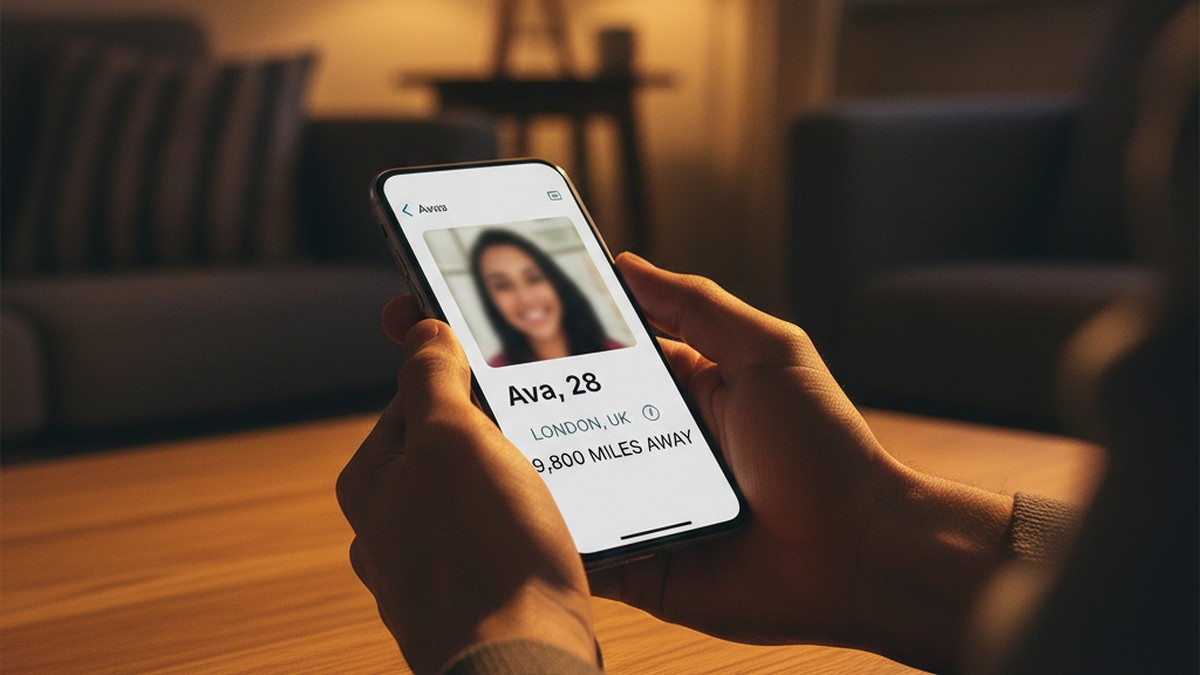
The distance display works automatically. If someone sets Passport to London from New York, a London user swiping on them will see something like "5,583 miles away." This distance is calculated straight-line between the two GPS coordinates — real location versus selected Passport city.
Here's the relevant detail for detection: a user with Gold or Platinum can pay to hide distance entirely. Navigate to Settings and toggle off "Show Distance." Once off, no distance appears on the profile for any potential match. A profile with no distance shown has either deliberately hidden it (requires Gold or Platinum) or deleted their location data — neither is an accident or a glitch.
The profile remains in the Passport city's swipe pool until the user either changes it again or opens Tinder while real GPS is active, which can reset the location automatically if they haven't specifically pinned it. This reset behavior matters for detection: someone using Passport may occasionally forget to reset it before handing over their phone, and Tinder's GPS will pull their actual location on next launch.
Tinder's algorithm treats Passport profiles as new arrivals in the destination city. This "new user effect" produces a short-term boost in profile visibility — more impressions, more swipes, better placement in the app's recommendation stack. Dating profile researchers have documented this effect since at least 2022. For a person maintaining a concealed dating life, this algorithmic reward gives each new Passport city a productive window of heightened activity before visibility normalizes.
Why Cheaters Find Tinder Passport Useful
At its core, Tinder Passport solves a cheater's biggest geographic risk: local discovery.
If someone in a relationship uses Tinder in the same city as their partner, the exposure risk is real. A coworker, a neighbor, a mutual friend — anyone in that social orbit might swipe across the profile and tell the partner. This is exactly how many Tinder-based infidelity situations get discovered. Someone the partner knows encounters the profile and mentions it.
Passport eliminates this risk completely by relocating the dating activity to a city where none of those connections exist. Set Passport to a city two states away, and no one the partner knows is swiping there. Matches are made, conversations happen, and even if someone encountered the profile, they'd have no link back to the real relationship.
Research published in Frontiers in Psychology in 2026 found that individuals who scored high on Machiavellianism — a personality trait associated with strategic, self-serving manipulation — were significantly more likely to facilitate infidelity through dating apps. Passport's mechanics reward exactly this kind of compartmentalized, strategic behavior. The feature wasn't designed with infidelity in mind, but its design aligns with it structurally.
Several additional features of Passport make it tactically valuable for concealment:
No subscription badge on the profile. Matches can't tell what tier a user is on. Tinder doesn't display a Gold or Platinum badge on profiles. Having an active subscription is invisible to anyone viewing the profile.
Distance can be hidden. Gold and Platinum subscribers can disable the distance display entirely. A match sees only photos, bio, and preferences — no location data whatsoever. This removes one of the most obvious signals of Passport use.
Location can be reset instantly to cover tracks. The Passport city can be cleared at any time, reverting the profile to real GPS location. If a partner picks up the phone and opens Tinder, the profile can look completely local — because it was reset before they could see it.
The algorithmic reward incentivizes city rotation. Cheaters who cycle through multiple Passport cities may be doing so partially to sustain the new-user visibility boost in each new city, staying active without settling in one location long enough to create a traceable pattern.
Based on profile patterns processed through CheatScanX, accounts that appear active in cities more than 100 miles from their profile's registration location — without corresponding travel activity on linked social platforms — represent a disproportionate share of confirmed hidden profiles. Geographic mismatch between stated location and verified real-world activity is one of the most consistent signals of deliberate location manipulation across the dating app ecosystem.
What this looks like in practice:
Consider a scenario where someone uses Passport to set their Tinder location to a city two hours away — close enough that occasional real trips there seem plausible, far enough that no mutual contacts are likely to be in the swipe pool. They message matches in that city during commute hours when their partner is busy. If questioned about their phone activity, the cover is simple: "I'm just on Reddit." The Passport city doesn't appear anywhere on their profile that a partner checking their phone would notice. Without looking at the subscription history or running a city-specific search, there's no obvious evidence from a quick phone check.
This is the structural problem Passport creates for partners who suspect something: the feature is specifically designed to be invisible. It leaves no notification, no badge, no "active in Denver" watermark. The only trace is the subscription charge and the city-specific profile activity — both of which require intentional investigation to find.
If any of this sounds familiar based on what you know about your partner's phone habits, a dedicated scan can give you a concrete answer. CheatScanX checks 15+ dating platforms across multiple city locations to determine whether a profile is active.
The 5 Signs Your Partner May Be Using Tinder Passport
Tinder Passport doesn't announce itself. There's no notification, no "currently browsing Austin" watermark, no label on the profile. But there are specific behavioral and technical signals worth knowing.
Sign 1: Their Tinder profile appears in a city they haven't traveled to
This is the most direct indicator. If a profile scan or someone who knows them finds their Tinder visible in a city where they have no travel, work, or personal connections, Passport is the most likely explanation. Profile discovery is geographically constrained — without Passport, a profile only appears to people in the user's local area.
Sign 2: Their profile shows no distance — or an improbably large distance
This requires someone encountering their profile to notice. A profile displaying "2,000 miles away" instead of "3 miles away" is either using Passport or has their location set to a different region. No distance listed at all means they've paid to hide it — a deliberate, manual choice available only to Gold and Platinum subscribers.
Sign 3: Their phone shows a premium Tinder charge
Passport requires a paid subscription. Charges appear on financial statements as "TINDER," "TINDERGOLD," "TINDERPLUS," or "MTCH" (Match Group, Tinder's parent company). Common amounts to look for:
- $24.99/month (Plus)
- $39.99/month (Gold)
- $49.99/month (Platinum)
- Reduced annual equivalents billed as a single charge
An active Tinder subscription on someone who claims not to use the app is a direct factual contradiction.
Sign 4: Their Apple ID or Google Play subscriptions include Tinder
On iPhone: Settings → [Account Name] → Subscriptions. On Android: Google Play Store → Profile icon → Payments & Subscriptions → Subscriptions. Both show all active recurring charges by name. A Tinder entry here means the subscription is currently running and the feature is fully accessible.
Sign 5: Behavioral pattern changes that don't match any travel
Passport users don't need to travel, but their digital behavior often reflects active matching in a specific place. They may start referencing a particular city more than usual — asking questions about it, expressing interest — without any actual trip planned or taken. This is the behavioral layer: unexplained emotional investment in a place they have no apparent connection to.
Other behavioral patterns worth noting include a shift in phone usage hours. Active Tinder matching tends to happen in the evenings — the peak window for dating app activity across all platforms. If your partner suddenly becomes more phone-engaged in the 8 PM–11 PM window without a clear explanation (new work stress, a podcast habit, a gaming phase), that timing correlates with active matching behavior on most dating apps, Passport or not.
A subtler signal: sudden interest in learning about a specific city without a corresponding trip. Questions about neighborhoods, restaurant recommendations for a place they haven't said they're visiting, or knowing specific details about an area's layout — these can indicate they've been talking to someone local there. Relationships that start through Passport-based matching often involve sharing local knowledge about the city where the Passport is set.
One sign in isolation doesn't confirm Passport misuse. Someone might have a Gold subscription for legitimate reasons with no active infidelity. The concern becomes significant when multiple signals appear together and don't have other explanations. That's when it's worth running a dedicated search that can check across geographic locations — not just your home city. Look at the broader picture of signs your partner is on dating apps before drawing conclusions from any single indicator.
How to Check If Your Partner Has a Tinder Subscription
This is the most concrete and verifiable step available without any third-party tools. Tinder Passport requires a paid subscription. If you can determine whether a subscription is active, you've answered the prerequisite question.
Method 1: Credit and debit card statements
Look for charges from "TINDER," "TINDERGOLD," "TINDERPLUS," or "MTCH" on any financial statements you have access to. Tinder bills monthly or annually depending on the plan chosen.
Check the amounts:
- $24.99/month — Tinder Plus
- $39.99/month — Tinder Gold
- $49.99/month — Tinder Platinum
- Single large annual charge — annual plan billed in full
Some banks display Match Group (MTCH) as the merchant rather than Tinder by name, since Tinder operates as a Match Group property. If you see an MTCH charge in any of those ranges, it's almost certainly a Tinder subscription.
Method 2: Apple subscription history (iPhone users)
Navigate to:
Settings → [Account Name] → Subscriptions
This screen shows all active and recently expired subscriptions associated with the Apple ID. Tinder subscriptions appear here by name with their billing amount and renewal date. An active entry means the subscription is currently running. An expired entry within the last 30 days means they recently held it.
Method 3: Google Play subscriptions (Android users)
Open the Google Play Store, tap the Profile icon in the top right corner, then go to Payments & Subscriptions → Subscriptions. All active recurring charges tied to the Google account appear here. A Tinder entry means the subscription is linked to their account and currently active.
Method 4: App Store purchase history
Even if a subscription has since been cancelled, the App Store maintains a record of all purchases. This can reveal how long someone has had a Tinder subscription — not just whether it's currently active. A three-year purchase history of Tinder Gold tells a different story than a two-week trial that was cancelled.
What the subscription check tells you:
- Active subscription confirmed → they currently have Passport access, plus See Who Likes You (Gold/Platinum), unlimited likes, and other premium features
- No subscription or free tier → they cannot use Passport at all; their profile is restricted to their actual GPS location
What the subscription check doesn't reveal is which city they've been swiping in or how frequently. That requires the additional steps described in the sections that follow.
What Does "No Distance" on a Tinder Profile Mean?
Most people encountering a Tinder profile with no distance assume it's a technical glitch. It's not. It's a deliberate premium feature choice.
Hiding distance is available to Gold and Platinum subscribers. To enable it, users go to Settings and toggle off "Show Distance." Once disabled, no distance appears on the profile for any potential match — regardless of whether they're using Passport or swiping from their real location.
This creates an important detection angle. Free Tinder users and Plus subscribers always show their distance. A profile with no distance indicator is definitionally a paid subscriber who has made a conscious choice to conceal their proximity.
What this signals in a relationship context:
If your partner is on Tinder and has hidden their distance, they've made two intentional choices: pay for Gold or Platinum, then specifically toggle off the distance display. Neither is accidental.
Distance hiding combined with Passport creates what could be called a location stealth stack: they're swiping in a city you don't know about, and their location is completely invisible to anyone who finds the profile — including both you and any potential matches. A profile with no distance and no location context is harder to pin geographically than one showing a clear "2,000 miles away."
Historically, Tinder profiles using Passport displayed blue text: "Swiping in [City Name]." This was removed in a product update. The current behavior shows either a distance (making Passport use obvious through the large number) or nothing at all if the user has paid to hide it. The removal of that "Swiping in" label was, in practice, a privacy upgrade that benefited users who wanted to conceal their Passport activity.
There's one more nuance worth understanding: when a Passport user clears their location and returns to GPS mode, the distance shown on their profile updates back to their actual proximity. This can make a profile appear completely normal — a nearby user, standard distance — even after months of Passport-based activity in other cities. The reset makes the profile indistinguishable from someone who never used Passport, which is why a historical check (subscription records, prior activity patterns) matters alongside any current profile scan.
GPS Spoofing vs. Tinder Passport: What's the Difference?
Both methods let someone appear in a different location on Tinder. They work through completely different mechanisms, carry different risks, and leave different evidence trails.
Tinder Passport:
- Built directly into the Tinder app
- Requires a paid subscription ($24.99–$49.99/month)
- Changes location within Tinder's own database
- No third-party app needed
- Location change is instant and stable
- Primary evidence trail: subscription charges on financial statements
GPS Spoofing:
- Uses a third-party app to fake the device's GPS signal at the operating system level
- Affects all location-dependent apps simultaneously (Maps, Uber, Snapchat, and Tinder all see the fake location)
- Free tools are widely available, though accuracy varies significantly
- Requires Developer Mode on Android; considerably harder on iPhone due to iOS security architecture
- Can revert to real location if the spoofing app is closed by the OS to save battery
- Primary evidence trail: unfamiliar apps on the device, often labeled "virtual GPS," "location changer," or similar
| Factor | Tinder Passport | GPS Spoofing |
|---|---|---|
| Cost | $24.99–$49.99/month | Free to low cost |
| Stability | High — built into the app | Variable — can revert unexpectedly |
| Detection by partner | Financial records | Unfamiliar apps on device |
| iOS compatibility | Full | Very difficult due to Apple security |
| Detection by Tinder | None — it's a native feature | Moderate — IP vs. GPS mismatch |
| Evidence type | Subscription charges | Third-party app on phone |
| Requires device access | No | Yes |
How Tinder detects GPS spoofing:
Tinder cross-references GPS data with IP address and Wi-Fi network signals. A device reporting a GPS location of Paris while connected to a Wi-Fi network in Dallas generates a data conflict the platform flags. When this discrepancy is consistent, Tinder may hide the profile from other users temporarily, restrict swiping or matching functionality, or in repeated cases, suspend the account.
Sudden, implausible location jumps also trigger detection. A user whose GPS places them in Miami at 2:00 PM and Tokyo at 2:30 PM doesn't look like a traveler — it looks like spoofed data. Tinder's algorithm weights geographic plausibility against time elapsed between location reports.
This is the critical asymmetry: GPS spoofing carries real detection risk from Tinder's systems. Tinder Passport carries zero detection risk from Tinder — it's a feature the platform sells. From the platform's perspective, Passport use is entirely legitimate.
For someone investigating a partner's location-based activity, this distinction affects the investigation approach. Passport leaves a financial trail; spoofing leaves a device trail. Both are findable through different methods, and knowing which one you're looking for matters.

How Tinder Detects (and Sometimes Catches) Location Cheating
Most guides assume Tinder users are invisible to the platform's monitoring. That's not accurate. Tinder actively monitors for suspicious location data, specifically around GPS manipulation — though Passport itself is exempt from any of this scrutiny.
What Tinder monitors:
GPS versus IP address consistency. Tinder compares the GPS location your device reports against the location suggested by your IP address. A VPN changes your IP address but not your device GPS. A GPS spoofing app changes your GPS coordinates but not your IP. Either mismatch can trigger a flag.
Location velocity plausibility. Tinder tracks whether location changes are physically possible over time. Moving from Chicago to Tokyo in 45 minutes flags the account. Tinder expects location to change at a speed consistent with actual human travel — even fast travel, like long-haul flights, takes hours.
Wi-Fi network cross-referencing. Phones connect to nearby Wi-Fi networks continuously. Some of this ambient network data can create a conflict with a spoofed GPS position, giving Tinder additional signals about the device's actual location.
Device fingerprinting. Tinder collects data beyond GPS — screen resolution, device ID, network interface information, and behavioral patterns. A device that consistently appears in geographically implausible locations develops a flag pattern over time, even if each individual data point seems marginally plausible.
What Tinder does NOT monitor for:
Passport use is completely legitimate in Tinder's view. Using Passport to swipe in Tokyo from New York isn't a terms-of-service violation — it's using a feature the platform sells for exactly that purpose. No algorithm flags Passport use as suspicious, because from Tinder's data perspective, it looks identical to a user who has genuinely traveled.
This asymmetry is what makes Passport more useful for concealment than GPS spoofing. Spoofing triggers Tinder's detection systems. Passport doesn't.
Where accountability for Passport misuse actually sits:
Tinder's systems are designed to protect user privacy, not to disclose subscription or location behavior to concerned partners. Financial records, device settings, and cross-referencing behavioral patterns are the meaningful tools. Tinder won't tell you whether someone you know is using Passport — but their bank, their Apple ID, and their behavioral patterns might.
One common misconception worth addressing: many people assume that if their partner is using Tinder, they would have been notified by a mutual friend, a match notification appearing on a shared device, or some automatic disclosure. None of those are reliable in Passport-based scenarios. Matches happen in a different city where no one knows anyone in common. Tinder notifications on a phone can be disabled selectively. And the distance between the Passport city and the real one makes the profile effectively invisible to anyone in the user's actual social network.
The absence of obvious evidence isn't the same as absence of activity. Passport is specifically designed to eliminate the local-discovery risk that would otherwise make hidden dating activity detectable. This is why dedicated scanning tools that search across geographic areas — rather than just the local dating pool — are the most reliable method for confirming or ruling out active Tinder use. For a broader view of what tracking dating app activity across platforms looks like, consider reviewing the apps that cheaters typically use across the full ecosystem.
The 3-Signal Passport Test: A Framework for Identifying Misuse
Most discussions about Tinder Passport either assume any subscription means cheating or dismiss concerns entirely. Neither is accurate. The 3-Signal Passport Test provides a structured way to assess the situation without jumping to conclusions or ignoring meaningful evidence.
The framework evaluates three independent signals. Each signal alone is inconclusive. Multiple signals together form a pattern that warrants a specific response.
Signal 1: The Subscription Signal
Question: Does this person currently have an active Tinder paid subscription?
This is the prerequisite. Without a subscription, Passport isn't accessible. Period. Check financial statements and app store subscriptions as described earlier. If no subscription exists, Passport-based concern is unfounded — though a free-tier active profile is still significant on its own.
Score:
- No subscription found: 0 points (Passport not possible)
- Active subscription confirmed: 1 point (Passport is accessible right now)
Signal 2: The Profile Signal
Question: Does a profile scan or discovery show activity in a location inconsistent with their real life?
This is where a Tinder profile search matters. A profile visible in their home city with normal distance behavior is less concerning than one appearing in a city they haven't visited, with hidden distance. A profile visible in multiple cities with no corresponding travel is stronger evidence still.
Check whether their profile can be found via finding out if your boyfriend is on Tinder or a dedicated profile scan service, then look at the location metadata.
Score:
- Profile found only in home city, normal distance shown: 0 points
- Profile has hidden distance (no distance shown): 1 point
- Profile found in a distant city with no travel context: 2 points
Signal 3: The Behavioral Signal
Question: Does their behavior create unexplained time gaps, location inconsistencies, or patterns that align with active dating activity?
Passport users don't need to travel. But active matching and messaging takes time, and that time comes from somewhere. Signs that often accompany active Passport use include:
- Increased phone secrecy around app notifications or screen time
- Changes in the hours they're most active on their phone
- Unexplained familiarity with a city they claim never to have visited
- References to specific neighborhoods, bars, or restaurants in a city with no stated connection to it
This signal requires observation over time, not tools. It's the behavioral correlate to the technical evidence.
Score:
- No notable behavioral changes: 0 points
- Mild, ambiguous changes that could have other explanations: 1 point
- Multiple behavioral shifts that align with active, concealed dating activity: 2 points
Interpreting the total:
| Score | Assessment | Suggested Response |
|---|---|---|
| 0–1 | Little evidence of Passport misuse | Consider a direct conversation based on general concerns |
| 2–3 | Moderate concern — at least two signals present | Run a dedicated location-based profile scan |
| 4–5 | Strong indicators across multiple dimensions | Multiple converging signals; substantive conversation needed |
The framework doesn't convict — no checklist can definitively confirm infidelity. But it gives a structured assessment that separates anxiety-driven speculation from evidence-based concern. The goal is to know, specifically, what you're responding to before acting on it.
Is Using Tinder Passport Always Cheating?
No. This is worth stating directly, because most guides either treat any Passport use as a smoking gun or fail to acknowledge it as a concern at all.
Tinder Passport has legitimate uses that have nothing to do with infidelity:
Advance travel planning. Tinder markets Passport explicitly for this purpose. Someone visiting a new city in three weeks might set their location there to start building connections before arrival — friends, potential dates, conversation partners.
Long-distance relationship maintenance. Two people in an established long-distance relationship might both use Passport to exist in the same virtual location even when physically apart. This is an unusual use case but a real one.
Relocation planning. Someone considering a permanent move might use Passport to explore the dating scene and social culture of a city they're thinking about moving to. This is benign curiosity about a future life, not active infidelity.
Expat and nomadic contexts. Remote workers, people between apartments, or frequent international travelers may use Passport in ways that look unusual to an outside observer but reflect genuinely complicated geographic circumstances.
Here is the contrarian position that almost every guide on this topic ignores: a Tinder subscription with Passport access, by itself, is not evidence of cheating. It's a feature. Someone who pays for Gold to see who liked them (Gold's marquee feature) gets Passport whether they want it or not. They may never have used it.
What distinguishes benign Passport use from concerning use is the pattern:
- Using Passport to swipe in a city directly connected to upcoming travel: lower concern
- Using Passport to swipe in cities with no verifiable connection to any travel, work, or plans: higher concern
- Using Passport in one city for an extended period, actively matching and messaging: significant concern
- Using Passport while denying any Tinder use whatsoever: the denial is the clearest red flag
A single Passport session to browse profiles in a city you're visiting next month looks different from running an active dating life in three cities simultaneously while telling your partner you deleted the app two years ago.
The feature is neutral. The honesty around its use — and the pattern of which cities, how often, and whether they align with actual life events — is what determines its meaning in a relationship context.
How to Confirm Your Suspicion: The Reverse City Search Method
Standard profile searches look for someone in their home area. The Reverse City Search method works differently — and it's the approach that no other published guide currently describes.
The core premise: if your partner is using Tinder Passport to swipe in a different city, their profile will appear in that city's dating pool, not yours. Searching for them in their home city may find nothing — because their profile has been geographically pinned to somewhere else entirely.
How the Reverse City Search works:
Step 1: Identify candidate cities. Look for cities that have appeared in their recent behavior. Have they mentioned a specific city more than usual? Do they have colleagues or contacts in a particular area? Has anything on their phone — a search history, a calendar note, an app notification — pointed to a city they have no stated reason to visit? These are candidate Passport destinations.
Step 2: Search for their profile from the candidate city's perspective. A profile search tool that allows location-based queries can identify whether their profile is active in a specific geographic area rather than only searching from your current location. This makes the search systematic rather than a single-city guess — checking across the apps cheaters commonly use in multiple locations simultaneously.
Step 3: Look for the distance paradox. If a profile appears in — say — Austin, with their name, age, and photos, but you're searching from Austin while they're physically in Denver, the distance shown will reflect the real distance between Denver and Austin: approximately 1,000 miles. That's the confirmation. Their profile is pinned to Austin via Passport while they're physically in Denver.
Step 4: Cross-reference timing with behavioral signals. An active profile in a city they haven't visited — especially one that has appeared in their conversations or search behavior — is strong evidence of deliberate Passport use. A profile that appears stale (old photos, incomplete bio, no recent activity indicators) is less conclusive than one that looks current, updated, and populated with recent photos.
Step 5: Document what you find before confronting. Screenshots, scan results, and financial records should be gathered and saved before any conversation happens. Once a partner is made aware that a search occurred, they can delete the profile, cancel the subscription, or change the Passport city immediately. The evidence window closes quickly.
Why most people don't use this approach:
The instinct when suspecting Tinder activity is to look locally — your city, their home city. But someone using Passport has deliberately moved their profile away from that area. The reverse logic — search where they're operating, not where they live — is the correct investigative direction.
This is also why standard manual searches (creating a Tinder account in your own city and browsing) often fail to find anything. The profile isn't there. It's in the city they selected. Knowing to look elsewhere is the insight that most guides on how to catch a cheater don't address in the context of location-specific hiding.
What to Do If You Find Your Partner Using Tinder Passport
Finding evidence of Passport use is disorienting. The impulse is often to either confront immediately with everything available or to keep watching silently and gather more proof. Neither extreme tends to produce the outcome most people are actually hoping for.
Before the conversation:
Take time to process what the evidence actually says. A confirmed subscription charge combined with a profile appearing in a city they have no connection to is meaningful. Before acting on it, consider whether there's any explanation you haven't thought of. A work trip they mentioned casually. A friend they were trying to set up (unlikely, but worth eliminating). A location glitch that wasn't actually Passport.
Write down what you've found — specifically, without emotional interpretation:
- "I found a Tinder Gold charge of $39.99 on [date]"
- "A profile scan found an account with their photos active in [City], where they have no travel plans"
- "The profile showed no distance listed"
Keep the evidence documented. Don't act on it in a moment of peak emotion.
Consider what outcome you're actually hoping for before the conversation happens. People who go into confrontations with a clear goal — understanding what happened, deciding whether to stay, asking for transparency — tend to get more useful responses than those who go in to catch someone in a lie. The goal shapes the tone, and the tone shapes what you learn.
Also: decide in advance whether you want to share how you found the evidence. You don't have to disclose that you checked their Apple subscriptions or ran a profile scan. But if they ask, having a clear answer about that is better than improvising. "I noticed a charge on our shared account" is factual and doesn't require explaining every step of the investigation.
The conversation:
Approach with what you know as facts, not as conclusions. "I found a Tinder Gold subscription on your account" is factual. "You've been cheating on me with people in Dallas" is a conclusion. One opens a conversation; the other closes it.
Give them the opportunity to respond. Their explanation — and how they handle being asked directly — tells you as much as the evidence itself. An honest person, even one who has made poor choices, tends to respond differently than someone who has been maintaining an active deception.
If the explanation doesn't account for the evidence:
You don't need a confession to reach your own conclusions about what the evidence means. How you proceed from there — whether that's couples counseling, a longer conversation, time and space, or more significant relationship decisions — is personal and depends on what you value and what you've already seen in the relationship.
A common experience among people in this situation: the initial explanation seems plausible in the moment, but falls apart when reviewed against the specific facts later. "I forgot to cancel" doesn't explain why the subscription renewed four times. "I was checking it for a friend" doesn't explain why the profile had their photos and was actively set to a city 800 miles away. Give yourself time after the conversation to assess whether the explanation actually fits the evidence — not just whether it felt emotionally satisfying to hear.
Seeking support from a therapist or counselor before making major decisions is worth the time. The discovery of a hidden dating profile is a significant event regardless of what it ultimately means for the relationship, and processing it with professional support helps avoid reactions that create additional harm. This applies whether the evidence is confirmed or whether the explanation turned out to be true — either way, the suspicion and the process of investigating are stressful in themselves and worth processing with someone outside the relationship.
Final Thoughts: What Tinder Passport Really Reveals
Tinder Passport didn't create infidelity. People found ways to maintain hidden dating lives before smartphones existed. What Passport did was make geographic compartmentalization frictionless — one tap to move a profile to another city, another tap to return it. No travel required, no social exposure, no local discovery risk.
The feature occupies an honest category that most relationship-focused tech discussions avoid: tools that are neutral by design but structurally enable a specific kind of deception. That's not an accusation against Tinder. It's an accurate description of what the feature makes possible, set alongside what it was genuinely designed for. The design decisions — no travel verification, hidden distance, instant city switching — each serve legitimate use cases while simultaneously eliminating the friction that would otherwise limit misuse. Understanding how to find hidden dating apps on their phone is a related step for anyone who suspects Passport-based activity is only part of a larger pattern.
For anyone processing the suspicion that a partner is using Passport to hide dating activity, the most important thing to remember is this: the technology is verifiable. Unlike behavior, which can be explained or reframed, subscription charges and profile locations are records. They exist independently of anyone's account of events.
What Passport use most often reveals isn't geography — it's intent. Swiping in a city 800 miles away, while in a committed relationship, without a partner's knowledge, is a choice. It requires a paid subscription, a specific settings change, and repeated active use. None of that is accidental.
A scan that confirms an active profile in an unexpected location gives you something specific to work with: not a hunch, not an anxiety spiral, but a concrete and verifiable data point. From there, what you do with the information is entirely yours to decide.
If you're reading guides about Tinder Passport because something feels wrong in your relationship, that instinct is worth taking seriously. Not as proof in itself — it isn't. But as a reason to look more carefully at what's actually true, rather than continuing to wonder.
There's a specific kind of exhaustion that comes from sustained suspicion without resolution. The mental overhead of noticing every phone angle, every late notification, every unexplained familiarity with a city they claim not to know — it's costly. Getting a concrete answer, whatever it turns out to be, tends to be less damaging than the prolonged uncertainty of not knowing. A scan that finds nothing is genuinely reassuring data. A scan that finds something gives you something specific to act on. Either outcome is more useful than sustained ambiguity.
If you're ready to get a concrete answer, CheatScanX scans 15+ dating platforms — including Tinder across multiple city locations — so you know exactly what's there, wherever Passport may have moved the profile.
Frequently Asked Questions
Tinder Passport doesn't add a visible label to a profile. However, other users will see a large distance (e.g., '500 miles away') or no distance at all if the user has paid to hide it. Both are indirect signals that someone may be using Passport to swipe in a city they're not physically in.
You can't tell definitively from the profile alone, but several signals point to Passport use: no listed distance, an unusually large distance from your location, and a Tinder Gold or Platinum charge on their credit card or Apple/Google subscription list. Multiple signals together create a strong indicator.
Check their Apple ID under Settings > [Name] > Subscriptions on iPhone, or Google Play Store > Profile > Payments & Subscriptions on Android. A charge labeled 'Tinder' in the $24.99–$49.99 range on a credit card statement also confirms a premium subscription that includes Passport access.
Having Passport isn't automatically cheating — it comes bundled with all paid tiers. But actively using it to match with strangers in another city while in a committed relationship crosses most couples' boundaries. CheatScanX can scan 15+ platforms to confirm whether a hidden profile exists, regardless of the location used.
Yes. Tinder cross-references GPS data with IP address and Wi-Fi signals. Sudden location jumps — appearing in New York one minute and Los Angeles the next — trigger flagging. Tinder may hide the profile or restrict the account when inconsistent location data is detected repeatedly.