
# Is My Girlfriend on Bumble? How to Check
The fastest way to find out if your girlfriend is on Bumble is a dating app scan: enter her name, email, or phone number, and it checks Bumble plus six other major apps for matching profiles, usually within minutes. The free alternative — a decoy account swiping in her area — works too, but it's slower and easier to defeat.
If you're asking this question, something specific probably triggered it. A notification you half-saw. A friend who spotted someone who looked like her. A shift in how present she is. You're not paranoid for wanting an answer — you're stuck, and staying stuck is worse than either outcome.
The uncertainty isn't rare. Pew Research Center (2023) found that 46% of U.S. adults who live with a partner have used a dating site or app at some point. This guide covers the fast method, the free method, the Bumble-specific evidence that separates a forgotten profile from an active one, and what to do with whatever you find.
One honest note before the methods: CheatScanX is our scan tool, and it's the first method below because it's the fastest. Everything after it is free and requires nothing but time.
How Can I Find Out if My Girlfriend Is on Bumble?
The fastest way to find out if your girlfriend is on Bumble is a dating app scan. You enter her name, email, or phone number, and the scan checks Bumble plus six other major apps for matching profiles — usually within minutes, without notifying her. The free alternative is a decoy account, which is slower and less reliable.
A scan works from the outside. It searches for profiles linked to the details you provide across Bumble, Tinder, Hinge, Match, OkCupid, Plenty of Fish, and Coffee Meets Bagel. She receives no notification, no profile view alert, nothing. That matters, because the manual method below has a built-in way of exposing you.
The multi-app coverage matters more than it sounds. In a 2023 Stanford Medicine survey of 1,387 Tinder users, nearly two-thirds were married or in a relationship — and people who keep one dating app active while committed rarely stop at one. If she's on Bumble, checking only Bumble answers half the question.
A scan has limits, and you should know them going in. It matches on the identifiers you give it, so a profile built on a secret email with photos you've never seen is harder to connect. No tool can promise a certain result. What a scan does is compress days of manual swiping into minutes and cover seven apps instead of one.
CheatScanX scans all of these platforms — and more — in a single search. Enter a name, email, or phone number and get results in minutes.
Try a multi-platform search →Can I Search Bumble for Her Name?
No. Bumble has no public search bar and no way to look up a specific person by name, username, or phone number. The only ways to find a specific profile are swiping until she appears in your deck or using a third-party scan that checks the app for you.
This surprises most people the first time they try. There's no directory, no URL format like bumble.com/username, and no "find a friend" feature. Bumble built it that way deliberately — the company markets itself on user safety, and a search function would make stalking trivial.
Bumble also hides activity information. Unlike some apps, it shows no online indicator and no last-seen timestamp on any profile, a design choice covered in detail in our guide to Bumble's last-active status. So even if you found her profile, the app itself won't tell you when she last opened it — you have to read the indirect signals, which we'll get to.
If you want the full picture of what is and isn't possible when you try to search Bumble profiles, we've broken down every route separately. The short version: name search doesn't exist, which leaves you with the two methods in this article.
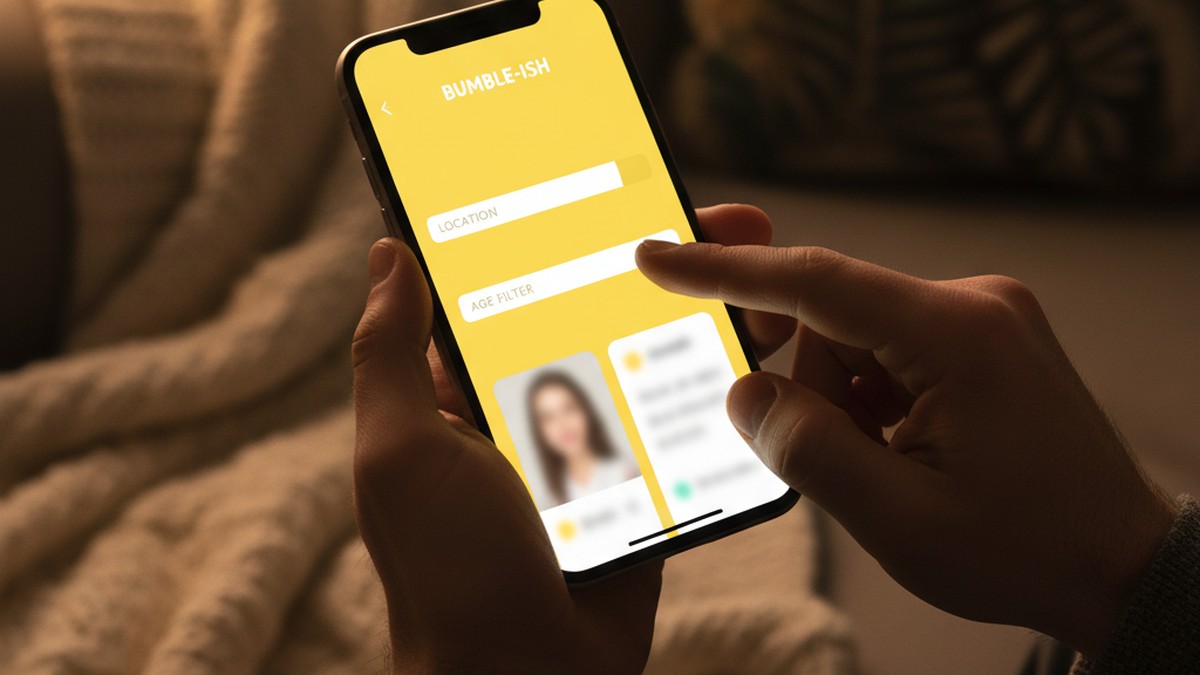
Setting Up a Decoy Account to Find Her: What Actually Works
The free method is a decoy: a male Bumble account built to surface her profile in its swipe deck. It costs nothing, but Bumble's matching mechanics mean most casual attempts fail. Here's what has to be true for it to work.
Her profile only shows to accounts that fit what she's filtering for and where she's swiping. That gives you four settings to get right:
- Gender and orientation. Your decoy must be a male account seeking women — her profile will never appear in a female deck if she's set to match with men.
- Location. Set your location to where she actually opens the app. That's not always home: if she works 20 miles away and swipes on lunch breaks, her profile centers there.
- Age filters — in both directions. Your decoy's age range must include her age, and your decoy's stated age must fall inside whatever range she set. If she filters for 25-33 and your decoy says 41, you'll never see her.
- Patience. Bumble shows you one profile at a time. In a city, you may swipe through hundreds of profiles over several days before she surfaces — if she surfaces.
Then there are the failure modes nobody mentions. Bumble's Incognito Mode, a Premium feature, hides her profile from everyone she hasn't already swiped right on — your decoy will simply never see her. Snooze Mode pauses her visibility entirely, for free. And if she isn't opening the app much, Bumble deprioritizes her card in the deck.
One more risk, and it's the big one: if you swipe right on her profile to confirm it's really her, and she swipes right on your decoy, you match — and now she's looking at your decoy account, asking who made it. A decoy is a one-way mirror only if you never touch the glass.
Why a Woman's Bumble Activity Is Deliberate, Not Passive
Here's the part that makes Bumble different from every other app your girlfriend could be on: the architecture of who speaks first. On Bumble, in opposite-gender matches, a conversation cannot exist unless the woman acted.
For nearly a decade, the rule was absolute — women had to send the first message, and men couldn't say anything until they did. In April 2024, Bumble softened this with a feature called Opening Moves, which lets a woman set a prompt that her matches can respond to first (CNN Business, 2024). That sounds like it weakens the signal. It doesn't. Setting an Opening Move is itself a configuration choice — she wrote a prompt specifically to invite men to start conversations with her.
So the two possible paths to a conversation on your girlfriend's Bumble are: she typed the first message herself, or she deliberately set up a prompt asking men to message her. There is no third path. No man can cold-message her. Nobody can slide into her inbox while she passively ignores the app.
Compare that to Tinder or Hinge, where an account left rotting still collects likes and incoming messages she never asked for. On Bumble, every conversation in her inbox required her hands on the screen. That's why "I don't even use it" carries less weight on this app than any other — and why it's worth testing rather than taking on faith.
And if you're bracing for the "women don't really do this" reassurance: the General Social Survey data says otherwise. Among adults aged 18 to 29 — the core Bumble demographic — women were slightly more likely than men to report having cheated, 11% versus 10% (Institute for Family Studies, 2018).
The Dormant-or-Deliberate Test: Is Her Profile Forgotten or in Use?
Suppose you find her profile. Her likeliest response is the most common one: "That's old — I made it before we met and forgot to delete it." Sometimes that's true. Bumble is unusually good at settling it, because the app's design leaves an activity fingerprint. Run these three markers:
Marker 1: The conversation ledger. Bumble matches expire after 24 hours if no first move is made (Bumble Support). That expiry, combined with the first-move rule, means a genuinely abandoned account accumulates nothing — every match dies within a day, and no conversation can start without her action. If her inbox holds any recent conversation, the account isn't dormant. A forgotten Bumble account is behaviorally inert in a way a forgotten Tinder account never is.
Marker 2: Deck presence. Bumble filters long-inactive profiles out of the active swipe deck. If your decoy account (or a friend's genuine account) sees her card while swiping, she has opened the app recently — inactive accounts stop being served to other users. A profile that surfaces in the live deck is a profile attached to a live user.
Marker 3: Profile freshness. Look at the photos and bio. Are any of the photos from after you two got together — a haircut she got last month, a trip you know the date of, the dog you adopted as a couple? An untouched pre-relationship profile shows only pre-relationship photos. Updated photos mean she opened the app, chose new images, and re-marketed herself.
Score it simply: three dormant markers (no conversations, absent from the deck, stale photos) and the "forgot to delete it" story holds up — the right ask is that she deletes it while you watch, and you're done. Any single deliberate marker means the account is in current use, and the conversation you need to have is a different one.
What Are the Signs Your Girlfriend Is on Bumble?
Common signs include Bumble notifications she swipes away quickly, the app hidden in a folder or missing from her home screen despite battery usage, new selfies that never appear on her social media, guarded phone behavior, and a sudden drop in effort or attention inside your relationship.
None of these is proof on its own. Together, in a cluster, they justify checking:
- The yellow flash. Bumble's notifications are distinctive — the yellow icon, "You have a new match," the "Your match is waiting" nudge tied to the 24-hour timer. Watch for notifications dismissed the instant they land.
- Battery and screen-time receipts. On iPhone, Settings → Battery lists app usage even if the icon is buried in a folder. Bumble appearing there while missing from her home screen is a hard signal — apps don't burn battery without being opened.
- Photos with no destination. Dressed-up selfies that never reach Instagram or her group chats were taken for somewhere. Dating profiles need recent photos.
- The phone turns face-down. A change in phone behavior matters more than the behavior itself. If her phone used to sit unlocked on the counter and now travels to the bathroom with her, note the change, not the habit.
- Effort migrates. Attention is finite. New conversations elsewhere usually show up at home as shorter replies, vaguer plans, and less curiosity about your day. The fuller pattern is covered in our guide to the signs she's talking to another guy.
A caveat that cuts the other way: every item on this list has innocent explanations — a surprise she's planning, a friend's drama she promised to keep private, plain burnout. That's exactly why signs should lower or raise your suspicion, not settle it. Settle it with evidence.

Does Bumble Show When She Was Last Active?
No. Bumble does not display online status or a last-active timestamp for any user. The closest signal is deck freshness: Bumble filters long-inactive profiles out of the swipe deck, so a profile that appears while swiping has been active recently.
This is the piece that frustrates most people who find a profile and want to know if it's current. Tinder-style "Recently Active" badges don't exist here. Bumble made activity invisible on purpose, and no Premium tier reveals it.
That's why the Dormant-or-Deliberate Test above leans on indirect evidence — deck presence, conversation existence, photo freshness — instead of a timestamp the app will never give you. Indirect evidence is still evidence. A profile that surfaces in a live deck with a photo from last month's haircut doesn't need a timestamp.
What Should You Do if You Find Her Profile?
Document what you found with screenshots, including her bio and photos, before saying anything. Then check whether the profile is dormant or active using the Dormant-or-Deliberate Test. Bring it up calmly, ask her to explain, and judge her response — a specific, verifiable explanation is different from deflection.
Take it in order:
- Screenshot everything first. Profile, photos, bio, distance shown. Profiles get deleted fast once a partner starts asking questions, and you don't want the conversation to become your memory against hers.
- Run the three markers. A dormant leftover and an active profile call for completely different conversations. Know which one you're having before you start it.
- Pick a calm moment and be direct. "I found your Bumble profile. I want to understand what's going on" beats an ambush. You're allowed to be hurt; the conversation still goes better if you're the composed one.
- Weigh the response, not just the words. "I made it in March before we were exclusive — look, nothing's on it, I'll delete it right now" is checkable. "Why were you looking? This is a you problem" answers a question you didn't ask. Deflection to your behavior instead of her profile is its own data point.
- Decide what the relationship needs. An active profile in a committed relationship is a boundary violation whatever her intent — browsing, validation, or more. We've written separately about what it means when a girlfriend keeps Bumble during a relationship, including when it's recoverable.
And if you searched and found nothing? Take the win, but take it honestly: one clean check of one app isn't a verdict. If the behavioral signs keep stacking up, the anxiety usually isn't about Bumble specifically — it's about the distance that made you search in the first place. That conversation is worth having either way.
Frequently Asked Questions
Yes. A profile scan searches dating apps from the outside, so she gets no notification and sees no trace. A decoy account is riskier: if you swipe right on her and she swipes right back, you appear in her match list and she knows exactly who was looking.
Yes — create a male Bumble account, set the location and age filters to match her, and swipe until she appears or you exhaust the deck. It costs nothing but can take days, and it fails if she uses Incognito Mode, has Snooze switched on, or set a narrow filter that excludes your decoy.
It happens, and Bumble makes the two cases easy to tell apart. Matches expire after 24 hours unless someone acts, so a forgotten account holds no recent conversations. New photos, an updated bio, or her appearing in the active swipe deck all point to deliberate current use, not a leftover.
Partially. Bumble's Incognito Mode (a Premium feature) hides her profile from everyone she hasn't swiped right on, which defeats decoy accounts. Snooze Mode pauses her visibility for free. Neither removes the account itself — the profile still exists and can still surface in an email- or phone-based scan.
Stop Guessing Tonight
You have two working options. The free one: build a decoy account, match its filters to her age and area, and swipe until you get an answer — accepting that Incognito Mode or a narrow filter can hide her from you indefinitely. The fast one: run a CheatScanX scan with her name, email, or phone number and check Bumble along with Tinder, Hinge, Match, OkCupid, Plenty of Fish, and Coffee Meets Bagel in minutes.
Whichever you choose, follow the evidence and not the dread. A dormant profile deserves a shrug and a deletion. An active one deserves a direct conversation. Both beat another month of checking her notifications out of the corner of your eye.